
The World and Everything in It: October 26, 2026
An election-law expert remembers parents who escaped Nazism and communism, met in a refugee camp, and taught him to cherish the American ballot. Eight days before the midterms, he explains why the rules of American elections are so bitterly contested. On Moneybeat, David Bahnsen has a one-word answer to who trusts consumer-confidence surveys: “Journalists.” Also: tariff retreat, France’s fiscal straitjacket, and California’s wealth tax. Plus: the Statue of Liberty at 140—and the meanings Americans have given her.
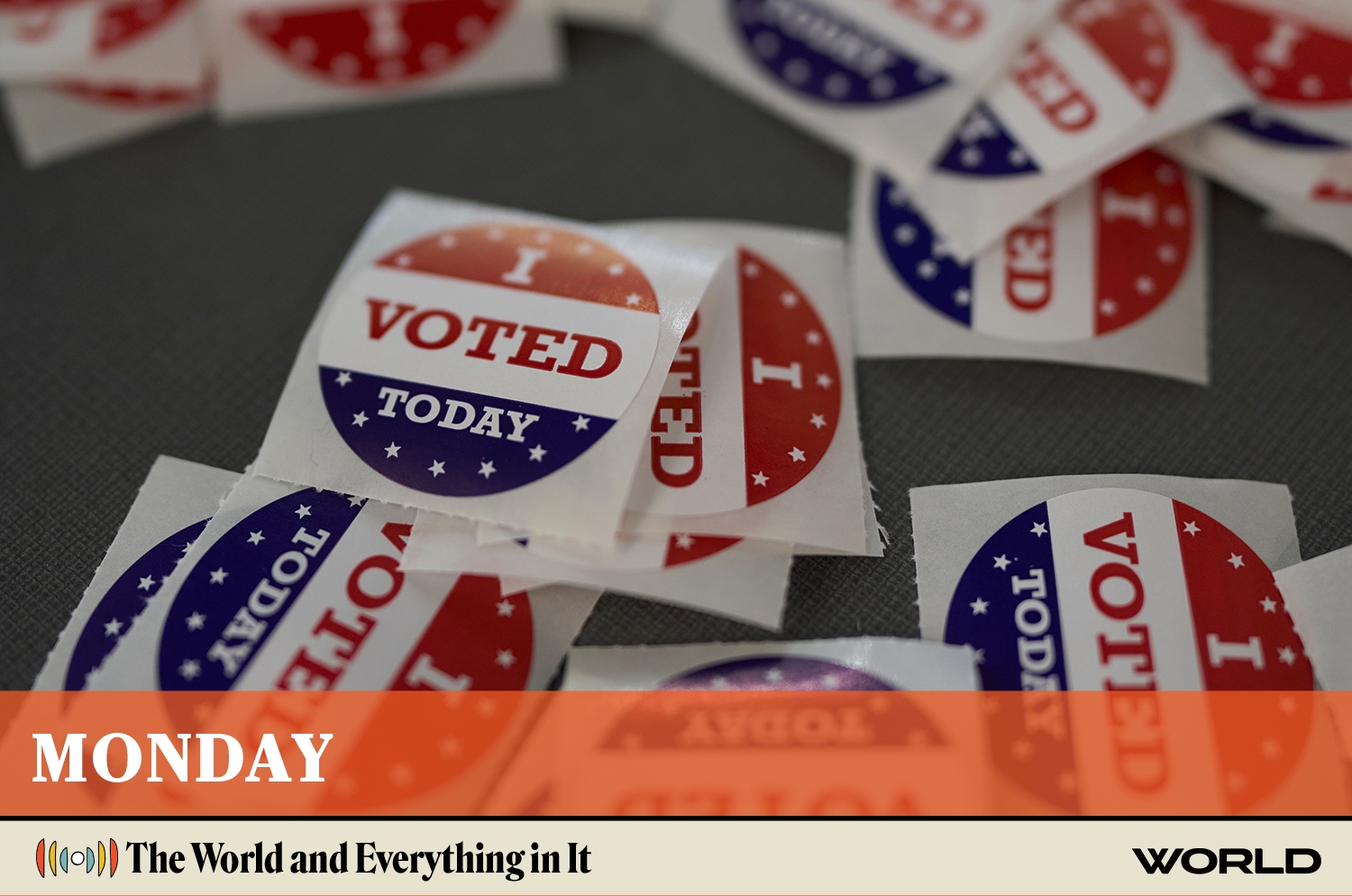
I Voted stickers are seen at an early voting polling place Friday in Nashville, Tenn. Associated Press / Photo by George Walker IV
Editor's note: The following text is a transcript of a podcast story. To listen to the story, click on the arrow beneath the headline above.
MARY REICHARD, HOST: Good morning!
Midterms are days away. And the rules for how those elections are carried out are complex. We’ll talk with an expert on why that is and why our battles over the rules are increasingly contentious.
NICK EICHER, HOST: That’s ahead on Legal Docket,
Also today the Monday Moneybeat, tariffs and taxes, French debts and consumer confidence. David Bahnsen tackles it all.
Later the WORLD History Book:
BERENSON: It was a blank canvas onto which people could project their ideas and their understandings.
The Statue of Liberty, and its evolving meaning.
REICHARD: It’s Monday, October 26th. This is The World and Everything in It from listener-supported WORLD Radio. I’m Mary Reichard.
EICHER: And I’m Nick Eicher. Good morning!
REICHARD: Time for the news now with Kent Covington.
SOUND: [Michigan rallies]
KENT COVINGTON, NEWS ANCHOR: Trump and Obama campaign ahead of midterms » It is the last full week before Election Day, and President Trump is still out stumping for GOP candidates in big races across the country.
Air Force One touched down in Michigan Sunday, where he campaigned for a U.S. Senate candidate.
TRUMP: We're going to elect, I call him apple pie. He's like perfect, this guy. He's like what your state is all about. He's gonna be one of the great United States senators, Mike Rogers. Thank you, Mike
Rogers, a former prominent congressman, is locked in a tight race with Democrat Abdul El-Sayed, who has strong backing from the party’s socialist wing.
And former President Barack Obama campaigned for El-Sayed in Detroit over the weekend.
OBAMA: … Everywhere you go, it feels like change is in the air. And Michigan, that's what I'm feeling right now. That's what you get a chance to do in 10 days!
Recent polls have given El-Sayed a slim lead of about 1 to 2 points among likely voters.
President Trump campaigned for Republicans in Georgia on Saturday. And he’ll visit Mississippi, Texas, and Ohio over the next couple of days.
Former President Obama stumped for Democrats in Ohio over the weekend. And he’ll campaign in Atlanta this week.
Venezuela opposition leader returns » As President Trump was leaving the White House Sunday morning for Michingan, reporters pressed the president on new reports out of Venezuela.
REPORTER: Mr. President, we're seeing reports that Maria Corina Machado is back in Venezuela. What do you know about her return?
TRUMP: I don't know anything about it, but I think she's a very nice woman, and I hope she's safe. But we're doing really well in Venezuela.
Maria Corina Machado is Venezuela’s opposition leader. She’s back home after months in exile and pushing for a new presidential election.
Supporters applauded and hugged her as she entered a church in the town of Barquisimeto.
U.S. forces captured dictator Nicolás Maduro in January. His former vice president, Delcy Rodríguez, still leads the country, with U.S. backing.
U.S. officials say Venezuela cannot rush into an election because it needs trusted election officials and courts first and opposition parties need time to organize.
But many in Venezuela want a concrete sign that democracy is on its way, and say it’s time for the country to schedule an election for next year.
Four Corners region flooding » After severe flooding in Northwestern New Mexico, officials are warning residents:
STARK: These areas, these impacted areas, are a disaster zone.
At a press conference Sunday, San Juan County Manager Mike Stark said authorities are working to determine where it is or is not safe for residents to return.
STARK: Until these evaluations have been made and knowing that there are upcoming storm systems beginning on Thursday that could be as strong as what we've just seen, we are strongly discouraging the com- community from accessing, uh, their property
And it’s not only New Mexico at risk.
Flood alerts stretch across much of the Four Corners region where New Mexico borders Colorado, Utah, and Arizona.
Forecasters warn the San Juan River could reach its highest levels this morning in some parts.
In Colorado, floodwaters already forced people from their homes along several rivers. In Pagosa Springs, the San Juan River rose higher than it had in more than a century.
And in southwestern Utah, flooding swamped dozens of homes and an RV park.
European protests » More protests and looting in France over the weekend, as demonstrators again clashed with police.
SOUND: [Paris protests]
WORLD’s Benjamin Eicher has more.
SOUND: [Paris protests]
BENJAMIN EICHER: Some shot fireworks at law enforcement in Paris and threw objects at them, others set fires and looted shops.
Police in France arrested more than 1,300 people on Saturday.
But many peaceful protesters also took to the streets. Demonstrations started over school conditions and widened to anger over living costs. And protests have spread across Europe, with thousands marching Saturday in Italy, Spain, Portugal and Albania over issues including housing, pensions and corruption.
For WORLD, I’m Benjamin Eicher.
Bus crash in Kenya kills 22 » In Kenya, a bus carrying mourners home from their pastor’s funeral collided with a truck on Sunday, killing at least 22 people.
The passengers were heading to the coastal city of Mombasa when the vehicles crashed on the highway from Nairobi.
Investigators are trying to determine what happened.
Another crash on the same highway killed 17 people three weeks ago.
I'm Kent Covington.
Still ahead: A close look at the fight over election rules in the U.S. Plus, the WORLD History Book.
This is The World and Everything in It.
NICK EICHER, HOST: It’s The World and Everything in It from WORLD Radio, celebrating 15 years. Today is Monday the 26th of October.
Thanks for making us part of your morning routine. Good morning. I’m Nick Eicher.
MARY REICHARD, HOST: And I’m Mary Reichard. Time now for Legal Docket.
Something a bit different today, given that the midterm election is only 8 days away.
The question: Who gets to decide how Americans vote?
The Constitution gives states broad authority to run elections. But Congress makes laws governing federal elections, and federal judges decide whether election rules comply with the Constitution.
EICHER: When those responsibilities overlap, that creates conflict. Legal conflict, and lots of it. Courts decide all kinds of disputes: concerning voter I.D., proof of citizenship, mail-in ballots, congressional districting, to name just a few.
REICHARD: To help understand what the Constitution says about elections, I spoke with Hans von Spakovsky. He’s a senior legal fellow at Advancing American Freedom, a former commissioner on the Federal Election Commission, and a former counsel to the Assistant Attorney General for Civil Rights at the Justice Department. He has spent decades working with election law.
VON SPAKOVSKY: Well, when it comes to federal elections, Congress and the state share responsibility. Congress, for example, can set the time, place, and manner of congressional elections. They can set the date for presidential elections. The qualifications of voters, who's eligible to vote in those federal elections, that is actually given to the states.
EICHER: Dividing responsibility like that means election laws tend to differ from state to state, and differ quite a lot.
For example, one state has weeks of early voting. Another state may have a very short window in which to vote.
Von Spakovsky says the Constitution permits this, so long as states comply with constitutional protections as well as federal law.
VON SPAKOVSKY: Some states are very good at the kind of security measures they put in. Other states like California, New York, are very bad at it. What the Constitution says is that through the legislation that Congress has passed to uphold various amendments like the Thirteenth, Fourteenth, and Fifteenth Amendment, states have a great deal of leeway. They, however, cannot discriminate on the basis of race when they are putting in election rules.
REICHARD: When those rules are challenged, the courts must decide whether a state has crossed a constitutional line.
Those decisions are especially consequential.
But how did election rules become such a political flashpoint? I put that question directly to von Spakovsky:
Hans, It seems like every election cycle we have all this contentious talk about people voting who shouldn't have been voting. Why has the division of power become so contentious, do you think?
VON SPAKOVSKY: Well that bipartisan split really has only occurred in the last twenty years. In 2005, for example, Jimmy Carter and James Baker formed a bipartisan commission, election reform. And for example, back then they both recommended you should require an ID to vote. That was a bipartisan recommendation. They also recommended minimizing mail-in voting only for those who really need to do it. And it's really since then we've had the split. Biggest fight, Mary, recently is about aliens registering and voting. We've had an honor system for a long time. You're simply asked, are you a citizen or not? And if you say yes, you're registered to vote. The problem with that is there are many, many examples of aliens who are not U.S. citizens getting registered to vote. So the biggest fight has been over requiring states to actually verify and check and make sure you are a U.S. citizen when you registered and vote.
REICHARD: You know I often read in certain media outlets there are just one or two examples of illegal aliens registering to vote or actually voting. They’ll say, you know, “This is much ado about nothing.” What does reliable evidence tell us about the extent of this problem?
VON SPAKOVSKY: Well, the problem isn't illegal aliens, it's aliens in general, whether they're here legally or illegally. And if you want just one example recently that puts that one or two claim to shame is, as you know, just about what, two months ago, the New Jersey governor had to admit that because of some supposed glitch at their DMV, they had registered 6,600 aliens to vote. She didn't say how long this had been going on, but clearly it was a problem. Not so many years ago the Pennsylvania Secretary of State was forced to resign after he admitted similarly that due to some kind of glitch, as he termed it, in Pennsylvania's DMV driver's licensing system, that at least 10,000 aliens had gotten registered to vote. And apparently this had been going on for years.
REICHARD: And do we know whether those excess registrations in New Jersey and Pennsylvania went in primarily one party's direction, or is that unknown?
VON SPAKOVSKY: No, that's unknown because the New Jersey governor refused to identify who the aliens were and refused to give that information, for example, to the Department of Justice, which is supposed to investigate and prosecute aliens who register and vote in this country
REICHARD: Now it seems every election year there's some election-related case that reaches the Supreme Court. What legal principles guide justices when an election dispute reaches the High Court?
VON SPAKOVSKY: Well, there's two things. I mean, one, they look at the Constitution and the division of responsibility between the federal government and the states. What can states do? What can the federal government do? But the other big principle they've developed in recent years is a principle saying that courts should not get involved in making changes in the election process shortly before the election. That causes confusion and chaos for election officials and also for voters.If there is a dispute, we'll settle it after the election, but you can't do it in the middle of the election process.
EICHER: The Supreme Court also confronts questions that go beyond the mechanics of voting. One is how states draw congressional districts and whether that violates protections against discrimination based on race.
In one recent case, Louisiana versus Callais, the court considered how race may be used in drawing those district lines.
Von Spakovsky sees that decision as an important statement about equal protection:
VON SPAKOVSKY: That was a decision about the Voting Rights Act which says you know you can’t discriminate on the basis of race in the voting process. A lot of folks were abusing that law. They were trying to claim politics was the same thing as racial discrimination. And what the Supreme Court said in that decision was and quite properly, you cannot use race when you are redistricting, when you are drawing boundary lines for political districts, whether it's at the local or congressional level. And I think that's a very important upholding of equal protection, the Voting Rights Act, and our amendments to the Constitution that say racial discrimination and race should play no part in the political process.
That case illustrates a difficult distinction in election law: the difference between racial discrimination and political advantage. The Court’s duty is to apply constitutional and statutory protections even when the consequences are politically significant.
REICHARD: I asked von Spakovsky what he thinks Americans misunderstand about the Supreme Court’s role in protecting voting rights.
VAN SPAKOVSKY: Well, I think too many people think that they engage in decisions trying to get certain political policy outcomes. They don't. They've been very good at saying whatever the rule is that a state, for example, has put in place and it's up before the court, can they do this constitutionally?
The judicial role, he says, is not to decide which election rules are preferable, but whether those rules are lawful.
EICHER: For von Spakovsky, election law is more than a professional interest.
His admiration for the American system started a long time before he became a federal election commissioner or even a lawyer. His parents were immigrants who’d experienced political oppression firsthand.
VON SPAKOVSKY: Oh yeah, I'm first generation. I was born and raised here, but my mother was German, grew up in Nazi Germany. My father was Russian, escaped communism. They met in a refugee camp in 1946 in the American occupied sector of Germany, immigrated to the U.S., became citizens. And I've always understood from them how important our elections are and how vigilant you, as a member of the public, have to be to maintain our democratic republic.
REICHARD: His parents made sure that lesson was practical and not just theoretical.
VON SPAKOVSKY: You know, they thought it was a way of teaching me good civics, how to be a citizen, when I was not old enough to vote, to take me with them when they went into the polling booth.
I asked him whether he still prefers to vote on Election Day.
VAN SPAKOVSKY: I try to go on Election Day because that's the way my parents brought me up….My schedule doesn't always allow me to do it, but I prefer voting on Election Day.
That lesson came from parents who knew what it meant to live without the freedoms Americans enjoy. And that perhaps explains why he still remains so invested in the process.
Behind the legal battles is a foundational idea: the right of citizens to choose their representatives, and the responsibility to preserve that right.
And that’s this week’s Legal Docket!
MARY REICHARD, HOST: Coming up next on The World and Everything in It: The Monday Moneybeat.
NICK EICHER, HOST: Time now to talk business, markets, and the economy with financial analyst and advisor David Bahnsen. David heads up the wealth management firm, the Bahnsen Group, and he is here now. Good morning, David.
DAVID BAHNSEN: Well, good morning, Nick. Good to be with you.
EICHER: Well, David, the White House lifting its 50% tariffs on Canadian products that are important to businesses in, of all places, the state of Maine, apparently this is to help out Republican Senator Susan Collins of Maine ahead of the election. Now, at the same time, it’s imposing tariffs on different Canadian products, and you’ve long said that exemptions like this acknowledge that tariffs impose real costs.
So, is this actually shifting the burden here, or do you see this as a genuine tariff cut at the end of the day? I guess what does this accomplish economically?
BAHNSEN: Well, I would start wondering what it accomplishes politically. A week before the election, it seems a little too little, too late. But the net net of this is a full 50% tariff cut. They said that they’re replacing certain things, but when you look under the hood, the actual dollar impact is almost negligible, and they’re just capitulating on these 50% tariffs.
Now, of course, I’m all for it. I think it’s better for Americans to not have that higher tax burden, and I do believe that it is—I guess it’s implicit—but I think it’s a pretty loud, implicit admission that the administration sees these tariffs coming at a cost. And when we can remove that cost to help Americans, I think that’s a good thing, and they should be commended for doing that.
EICHER: Well, David, The Wall Street Journal reporting foreign investors, including buyers in Japan, are becoming less willing to finance the government debt of France, and French bond yields have gone up. And at the same time, France, very deep in debt, and now dealing with continued unrest in the streets. Do you think there’s a signal here that there may be a risk of default, or is the economic problem something else?
BAHNSEN: Well, let’s be very clear to tell the whole story here. France’s yield has gone much higher than it had been. You know what France’s 10-year cost is right now? It’s 5%. You know the United States’s 10-year cost is right now 5%. So this is by no means a dire straits situation. It’s just much more expensive than it had been, and yet there has not been a total freeze-up, a total cutoff from foreign investment, and in fact, there’s actually a lot within the European Union.
But it is higher, and probably will go higher, and should go higher to the extent that it represents a unsustainable fiscal reality in France. But much like the U.S., are we actually talking about default risk? Of course not.
So we basically have an unsustainable situation in France that has crowded out their private sector, that has left them without real economic growth, that has deprived their younger generation of economic opportunity. But then some are looking at it like, “Oh no, they may default on debt,” and I think that’s the wrong way to look at it. The other stuff I said is the real consequences, and to me, that’s far worse.
There is a lot going on with their riots. They’re trying to crack down now. But I do believe the fiscal social safety net of France is unsustainable, and it was what the French people wanted that they voted for, and it just so happens to be a percentage of GDP that is nothing like we’ve ever seen. And so I don’t want to conflate it all with the riots, but there is an awful economic situation there. The bond markets responded, but I think we need to point out that their bond yield and our bond yield are the exact same.
EICHER: Well, we’re about a week away from Election Day. Lots going on, but also an interesting question in California: a proposed billionaire wealth tax is on the ballot. And David, the Journal is reporting that Mark Zuckerberg, a prominent Californian, has considered leaving the state over this. And Meta has arranged some non-voting shares of the company that would allow him to raise the cash that he might need for a possible tax bill without losing control of the company. Do you think this is a genuine business response to this particular negative incentive, the tax?
BAHNSEN: Yeah, Nick, I think it was a PR stunt. And Mark already had super-voting shares, but it was a really effective way. Facebook, Meta, are no dummies when it comes to PR to get out publicly how against this thing they are and how threatened they are by it, and how difficult it could be for Facebook employees, without having to sound overtly political.
But at the general level of incentives and how people respond, the very reason that 15 out of 17 European countries that did a wealth tax and got rid of it is why Gavin Newsom and Larry Summers and most liberal Democrats are opposed to this, because it not only is horrifically wrong on so many levels, but it fails on its own measure. It doesn’t generate revenue, and that’s why you have different unions within California fighting with each other about it. Because some even say to the ones that support it, “Hey, this is going to hurt us in the grand scheme of things.” And so certainly the Zuckerberg Facebook posturing here is indicative of that wider and broader message.
EICHER: All right, David, I think you’re going to like this one. The University of Michigan has its Consumer Sentiment Index saying now that the consumer sentiment is at its second lowest reading in more than 70 years. I think the interesting thing is to look at the partisan breakdown here. Democrats have a consumer sentiment of 37. Republicans have it at 83. So, same economy, but very different numbers now.
Everybody may be sincere in the rating; they may come by it honestly. But it sure sounds to me like politics dressed up as economic data. Who actually relies on this index?
BAHNSEN: Journalists (laughs).
EICHER: Touché (laughs). Touché.
BAHNSEN: So this is not a new phenomena. First of all, everybody does politicize any economic data metric they can, so that part is well baked in. But as far as consumer sentiment and consumer confidence, I long ago realized that they are terrible leading indicators.
That the only thing that tells you what the consumer is doing is what they do, and that what they do is itself not an unpredictable measure, because they do spend all the time, no matter what, unless they run out of access to credit and money. And that’s why credit conditions and financial conditions are the leading indicator I’ve followed for 20-plus years, and not what people say.
The Republicans are not being honest when they say it’s the best economy ever, and the Democrats are not being honest when they say it’s the worst economy ever. But they both are doing what they love to do, and I would just argue that there’s better economic data than the University of Michigan’s consumer confidence.
EICHER: Well, that’s what I get for reading the paper. David Bahnsen, founder, managing partner, and chief investment officer of the Bahnsen Group. David writes weekly at dividendcafe.com, and for WORLD Opinions, we’ve got links to David’s latest Dividend Cafe. Just tap the episode headline in your podcast player. That opens up episode notes. You’ll find those links right there. If you’d like to dig a little deeper—and by dig, I mean just tap—pretty easy. David, thank you. We’ll talk to you next time.
BAHNSEN: Thanks so much, Nick.
NICK EICHER, HOST: Good morning! This is The World and Everything in It from listener-supported WORLD Radio. I’m Nick Eicher.
MARY REICHARD, HOST: And I’m Mary Reichard. Up next, the meaning of one of America’s most historic landmarks.
America has been a republic for 250 years, and Lady Liberty has been part of that story for more than half that time.
The statue was dedicated 140 years ago. But what she symbolizes is up for debate.
WORLD’s Emma Eicher has this week’s WORLD History Book.
EMMA EICHER: Over her 140 years, the Statue of Liberty has stood for two causes. First, it was abolition. Now, it’s an icon for immigration.
But how did it change?
ED BERENSON: There's an art historian named Albert Boime who called the Statue of Liberty a hollow icon,
Ed Berenson is professor of history and chair of the history department at New York University.
BERENSON: What he meant by that was that because it was this kind of classical Greco-Roman goddess of liberty, it it didn't really stand in particular for for anything. It was a blank canvas onto which people could project their ideas and their understandings.
Berenson says the statue started as a project for the people, or rather, two peoples: the French and the Americans.
BERENSON: The original deal was the French would pay for the statue, and the Americans would pay for the pedestal.
Two Frenchmen dreamt up plans to build the giant statue: law professor Edouard de Laboulaye and sculptor Frederic Bartholdi. Bartholdi wanted it to signify freedom:
BERENSON: He put the goddesses of liberty together with the colossi from the ancient world to come up with the idea of building a gigantic statue.
In the 1870s and 80s, France and the U.S. were improving their already friendly relationship. De Laboulaye and Bartholdi were abolitionists and idealized the American Republic.
BERENSON: They were really hoping that the, that France could return to a regime that looked much more like the American one. That is, that had the freedoms that were associated with the Declaration of Independence and and American liberty.
1876 was the centennial of the U.S. Declaration of Independence, the perfect time for a gift. And a political statement.
BERENSON: By creating a monument that praised the United States and, by implication, criticized their own lack of liberty, they thought they could achieve a number of political objectives.
The French people generally supported the idea, and crowdfunded the materials for the statue, which was completed in 1886. Her official name: Liberty Enlightening the World.
From base to torch, Lady Liberty stands a little over 151 feet tall, around 14 stories. At her feet are broken shackles and chains—symbolizing the end of oppression. The torch represents enlightenment. Her left hand holds a tablet referencing the Declaration of Independence. And her form is draped with thin sheets of copper.
BERENSON: Hammered to just two pennies in thickness.
At the time, builders didn’t realize that copper would eventually oxidize and turn green.
BERENSON: Bartholdi died in 1904, and that transformation was, hadn't all the way taken place, and so he actually didn't live to see its final color.
But the color became iconic, especially to New Yorkers:
BERENSON: The Statue of Liberty was massively restored in the 1980s because it was actually falling apart, and there was never any thought to, to changing the color.
In 1883, Americans held a fundraiser for construction of the pedestal. Emma Lazarus, a poet and author, wrote the poem “A New Colossus” as part of the fundraising efforts.
Twenty years later, it appeared alongside Lady Liberty:
BERENSON: Her poem was engraved on a plaque, and that a plaque was attached to the Statue of Liberty.
People began to connect the themes of Lazarus’s poem with the statue:
BERENSON: That's what most Americans think when they think of the Statue of Liberty. They think, okay, give me your tired, your poor, your huddled masses yearning to be free … and it's really not until well into the 20th century that the Statue of Liberty comes to stand for a welcome to immigration.
The shift away from the statue’s association with abolition coincided with an influx of immigrants through Ellis Island.
BERENSON: That's when there's just a gigantic wave of immigrants who start to come from Europe to the United States, and because so many people came in a space of a really short period of time, 20-25 years or so, immigration was incredibly controversial.
Not all Americans welcomed the change:
BERENSON: There's one really famous political cartoon where the Statue of Liberty is holding her nose and hiking up her skirts as the garbage from Europe is being dumped at her feet.
Berenson says immigration has always been a controversial topic in America, and even though the Statue is now recognized as a symbol of immigration, it wasn’t always that way.
Still, that could be the magic of it.
BERENSON: It was the generic neoclassical form that allowed this abstract symbol to be open to all kinds of different interpretations.
Berenson says many New Yorkers who can trace their European ancestry back through immigration admire what the Statue stands for. Their families yearned to breathe free, and made their home in the land of liberty.
That’s this week’s WORLD History Book. I’m Emma Eicher.
NICK EICHER, HOST: Tomorrow: High-school female athletes are taking a stand—and asking voters in Washington state to stand with them. And champion marathoner Sara Hall on running the race with endurance. That and more tomorrow. I’m Nick Eicher.
MARY REICHARD, HOST: And I’m Mary Reichard.
This is episode 35-16 of The World and Everything in It, from WORLD Radio. WORLD’s mission is biblically objective journalism that informs, educates, and inspires.
The Bible says, “Let them thank the Lord for his steadfast love, for his wondrous works to the children of man! For he satisfies the longing soul, and the hungry soul he fills with good things.” —Psalm 107:8-9
Go now in grace and peace.
WORLD Radio transcripts are created on a rush deadline. This text may not be in its final form and may be updated or revised in the future. Accuracy and availability may vary. The authoritative record of WORLD Radio programming is the audio record.
Please wait while we load the latest comments...
Comments
Please register, subscribe, or log in to comment on this article.