
The World and Everything in It: October 22, 2026
Carmen Agra Deedy tells schoolchildren what she remembers from communist Cuba: first food disappeared, then people. Six in ten young Americans say they’d give socialism a shot. In Idaho, a pastor finds his Kansas abortion fight waiting for him back home. Plus: Christian metal meets the Juggalos, and a runaway tortoise fights the law (spoiler: the law wins).
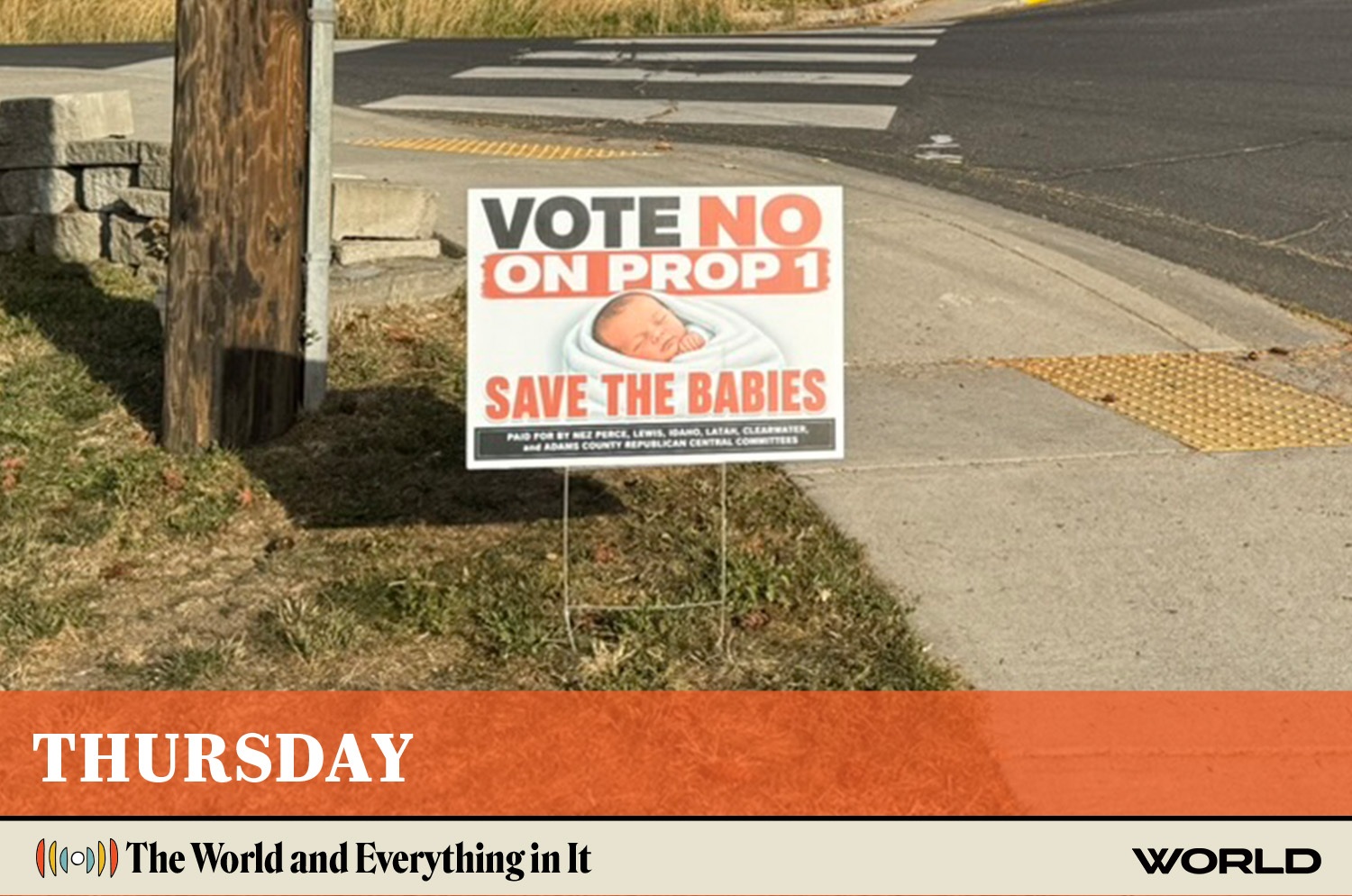
Pro-life sign in Moscow, Idaho Photo by Emma Eicher
Editor's note: The following text is a transcript of a podcast story. To listen to the story, click on the arrow beneath the headline above.
MYRNA BROWN, HOST: Good morning!
Abortion on the ballot in Idaho…and pro-lifers encourage Christians to help defeat it.
NEILSON: In any state where this is something on the ballot, it is your job as a Christian to protect innocent children.
MARY REICHARD, HOST: Also, a former ambassador on the religious liberty implications of being debanked. And, socialism’s appeal has taken root with many young Americans. An expert explains why.
Also, an alt-metal band returns after 7 years… and proves it hasn’t gone soft.
LASSITER: We love doing the crazy stuff.
And commentary from Daniel Darling on discerning when and how to engage with politics.
BROWN: It’s Thursday, October 22nd. This is The World and Everything in It from listener-supported WORLD Radio. I’m Myrna Brown.
REICHARD: And I’m Mary Reichard. Good morning!
BROWN: Time for news now with Kent Covington.
KENT COVINGTON, NEWS ANCHOR: U.S. teacher released from Russia » A retired American English teacher is free today … after four years behind bars in Russia.
74-year-old Stephen Hubbard says Russian forces took him from his home in Ukraine in 2022 … eight years after he’d moved there … and accused him of fighting as a mercenary for Ukraine.
President Trump told reporters at the White House …
TRUMP: I set the, uh, the stage earlier, but the other day I was talking to Vladimir Putin about settling his war with Ukraine, which I think we're getting closer to, by the way. But, uh, I mentioned, "Could you let Steven Hubbard out, please?"
He said Putin agreed … and that the US did not give up anything in return.
He also suggested a link between Hubbard’s freedom … and Trump’s decision to delay new sanctions against Russia.
TRUMP: I was in the midst of getting Steven out of Russia, and if we did what these foolish people wanted me to do, uh, he wouldn't be coming out right now. He'd be in there for another 20 years.
But he also again pointed to ongoing peace talks with Russia.
TRUMP: The last thing I want to do is upset an apple cart where we’re getting close to setting a war.
And he said he appreciated the fact that Moscow had largely refrained from interfering in the U.S. conflict with Iran.
Zelenskyy remarks » U.S. Special Envoy Steve Witkoff greeted Stephen Hubbard in St. Petersburg Wednesday … but he also spoke with Vladimir Putin … in a meeting he characterized as productive.
And one day earlier in Norway Witkoff met with Ukrainian President Volodymyr Zelenksyy … who described that meeting the same way.
ZELENSKYY: Our talks with Steve yesterday was very productive meeting. We shared our ideas, steps forward to the peace.
Zelenskyy said he wants to freeze territorial lines right where they are for the moment, cease fire, and begin serious trilateral talks with the White House and the Kremlin
ZELENSKYY: I think this is the best way President Trump, with his leadership, and me and Russian leader trilaterally, better with Europeans, but minimum trilaterally.
A Kremlin official said Wednesday that Vladimir Putin, after meeting with Witkoff … has agreed for Russia to resume three-way negotiations next month with Washington and Kyiv.
But diplomats will steer those talks. This is not the sit-down Zelenskyy is calling for with Trump and Putin.
Rep. Omar emerges » Minnesota Congresswoman Ilhan Omar is speaking out in a new campaign video ... asking supporters for donations after federal agents raided her Washington home.
The Democrat posted the message Tuesday night, speaking from the back seat of a vehicle.
She thanked donors and suggested that the criminal investigation is all political ahead of the midterm elections. She also promised to return to the campaign trail … after laying lower for more than a week.
OMAR: We're not gonna be intimidated, we're not gonna be silenced, we're not gonna be scared. I'll be out there campaigning alongside all of you and making sure that we beat back all of this and that we win in the midterms.
Investigators are examining, among other things, whether Omar or her father supplied false information on immigration paperwork that helped her become a citizen.
Agents searched her home last week and seized her phone. Omar has not been charged with a crime. Her lawyers call the investigation baseless.
Her video did not directly address the allegations. She asked supporters to donate, saying she faces an expensive fight.
Macron slams Trump for blaming immigration for riots » French President Emmanuel Macron is criticizing remarks by President Trump and others … about riots and looting in France. WORLD’s Kristen Flavin reports.
KRISTEN FLAVIN: Macron on Wednesday called comments by foreign leaders “unacceptable” and “stupid.” He singled out leaders campaigning for elections “on the other side of the Atlantic.”
Asked whether he meant Trump, Macron replied, “Among others.”
President Trump had pointed to French immigration policy for the unrest. He said “They let people into their country that don't love their country, they don't love their buildings, they don't love their art.”
France’s justice minister says both foreigners and French citizens were among those arrested. French authorities have not released figures establishing how many rioters were Muslim immigrants.
The protests began over school conditions and spread to anger over living costs.
For WORLD, I’m Kristen Flavin.
Africa CDC calls an Ebola crisis summit » Africa’s Ebola outbreak has reached Nigeria … prompting African health officials to call an emergency meeting for next week.
Health ministers will meet online next Wednesday to coordinate their response.
Nigeria’s patient recently traveled from Uganda, but investigators are still determining where she contracted the virus. Health workers are checking dozens of people who had contact with her for symptoms.
The outbreak has infected nearly 10,000 people in Congo and killed nearly half of them. Kenya has reported nine cases.
I’m Kent Covington.
Still ahead … Why are many young Americans drawn to socialism? And later … Daniel Darling will be along with his thoughts on when and how to engage with politics.
This is The World and Everything in It.
MYRNA BROWN, HOST: It’s The World and Everything in It from WORLD Radio, celebrating 15 years. Today is Thursday, October 22nd.
Thanks for making us part of your morning routine. Good morning. I’m Myrna Brown.
MARY REICHARD, HOST: And I’m Mary Reichard.
First up: A proposed ballot measure in Idaho could overturn the state’s pro-life laws in the midterm election.
BROWN: Now, local religious leaders, pro-life advocates and pastors are speaking out against the measure … even from the pulpit.
WORLD’s Lauren Canterberry has the story.
NEILSON: Father in heaven, thank you so much for this day.
LAUREN CANTERBERRY: In early 2025, Pastor Brian Neilson moved back home to Idaho to lead Pine Ridge Baptist Church. At the time, he was grateful to return to a pro-life state.
Before then, he had pastored in southern Kansas. In 2022, voters there rejected a constitutional amendment clarifying the state does not recognize a right to abortion.
NEILSON: Then abortion became rampant in Kansas.
Kansas has since become a regional abortion destination for women in surrounding states. Now pro-abortion activists are targeting other conservative states … including Idaho.
NEILSON: Coming here, you never think you’re going to have to do it all over again. But then I guess we should realize that because Satan is everywhere, he has the same tricks.
Idaho has one of the strictest pro-life laws in the nation. Under the Defense of Life Act, abortion is banned at every stage of pregnancy with narrow exceptions.
Next month, Idaho voters will decide whether to approve a proposition intended to repeal those protections. Locals call it simply: Prop 1. Supporters are knocking on doors and speaking at public events, while pro-life advocates are doing the same and more. Pastors are taking the issue to pulpits, urging Christians to vote against the measure.
Emily Naugle is President of Right to Life Idaho. She says pro-life voters should not ignore the very real threat the ballot item poses.
NAUGLE: It’s not enough that we’re a Christian state. It’s not enough that we are overwhelmingly conservative or Republican. That’s what people in Ohio thought. That’s what people in Montana thought. People did not take it seriously.
Ohio, Montana, Missouri, Arizona, and Nevada have all passed pro-abortion constitutional amendments since 2022, after the Supreme Court’s decision in Dobbs v. Jackson Women’s Health Organization.
Idaho’s Prop 1 would remove protections for unborn babies before they could likely survive outside the womb. Advocates argue it’s necessary to protect women’s health. But pro-lifers say it could allow abortion into the third trimester.
NAUGLE: Any definition of fetal viability would allow abortion at 24 weeks. The way this redefines fetal viability is letting the doctor determine the number of weeks.
Current state statutes consider an unborn baby “viable” when he or she can potentially survive outside the mother’s womb with medical support. But the new proposal would only recognize a baby’s viability if he or she could survive without that medical help.
NAUGLE: This is late-term abortion.
Midterm years typically draw less voter engagement. But Naugle has been surprised to find many people are already aware of what’s on the ballot.
NAUGLE: At the fair booths and stuff over the summer I was very gratified that a lot of people knew about Prop 1 and had heard it preached about in church. And I’m not just talking about one church or one denomination. All over, people were familiar with it, they had heard about it from church, and they were voting no.
Pastor Neilson is one of those pressing the issue in his Sunday sermons.
NEILSON: Speaking out against abortion is no surprise to our congregation.
More than 200 Idaho pastors and ministry leaders have signed an open letter opposing the proposition. And the movement is not limited to Protestant leaders.
In July, Idaho’s Bishop urged Roman Catholics to oppose the ballot measure. Latter-day Saints leaders issued their own guidance encouraging Mormons to vote against the statute.
NEILSON: I don’t agree with Catholic or Mormon theology at all. But in this particular case, I’m not going to be mad that they’re joining us.
According to the Pew Research Center, about 61% of Idaho’s residents identify as Protestant, Mormon, or Catholic.
Both the LDS organization and the Roman Catholic Diocese of Boise made large donations to one of the political action committees fighting the proposition.
Naugle and Neilson say it’s important for churches to join the fight against pro-abortion initiatives.
NEILSON: The worst thing Christians are guilty of is sitting on their hands and not going to vote. In any state where this is something on the ballot, or anything like it, it is your job as a Christian to protect innocent children.
Early polls showed just over half of voters would vote against Prop 1 on election day, taking place November 3rd. Both Neison and Naugle say it will take Christians voting against it to ensure its defeat.
Reporting for WORLD, I’m Lauren Canterberry.
MYRNA BROWN, HOST: Coming up next on The World and Everything in It: Debanking.
A report released last week by the Office of the Comptroller of the Currency lays out subjective policies of banks that contributed to unfair denials of their financial services.
MARY REICHARD, HOST: Two guests join us now to talk about it: Former U.S. Ambassador at Large for International Religious Freedom Sam Brownback. He is founder and chairman of the National Committee for Religious Freedom. His organization was debanked.
And Caleb Dalton is senior counsel with Alliance Defending Freedom, which represents clients who have experienced debanking.
REICHARD: Ambassador Brownback, for listeners who haven't heard the term before, what is debanking and what makes that different from a bank just closing an account for legitimate reasons?
SAM BROWNBACK: Debanking is where you become, you're a customer of a bank and they say we don't want you anymore, and they just cut you out for whatever reason they may cite. what was cited often in this case was reputational risk. I think it was a lot of just social engineering being done by various institutions to comply and go along with an administration that was pushing everything to the hard left, particularly culturally.
REICHARD: Well, let's get concrete about that. Ambassador, one case I see involved a conservative Christian nonprofit whose account was closed. Based on what if you know, and what does that example tell us about the vulnerability of religious organizations?
BROWNBACK: They took in the report and they took out the names and so they just were saying some examples of different things. But in our case, what it was is we were the National Committee for Religious Freedom. We were going to stand for religious freedom for everybody everywhere in the United States. We were gonna fight for it. But it was interpreted that these religious groups have a a orthodox view of cultural norms, I guess you would put it. These are people that go to Sunday school and they kind of try to live by this set of values. And they decided we don't like that because the culture is moving left, it's moving away from that, and therefore we want to kick them out. And when we went public with our case in 2022, I had over a dozen other groups pretty similar to us in a sense that they were culturally conservative groups. They say this had happened to them as well, but they had just gone silently 'cause they were afraid it would hurt their organization too much if they were public about it.
REICHARD: Now Caleb, you say this mostly affected right leaning organizations–why
CALEB DALTON: So the report documents I would say mostly what you would qualify as right leaning organizations. And one of the reasons why, if you dig into the details of the report, you see some banks were using the Southern Poverty Law Center as a as a proxy to decide who to debank. And as I think many of of your listeners may be aware, the Southern Poverty Law Center is a discredited left-wing organization that just smears their political opponents. But banks were using that as a proxy to decide who to kick out of their programs and who to discriminate against.
REICHARD: Ambassador, why should people across the political spectrum be concerned about this?
BROWNBACK: A bank should be about a being a financial institution and particularly these large too big to fail banks that get all this federal backing implicitly and sometimes explicitly, they should not be in the business of picking a societal favorite from a cultural standpoint, left or right.
REICHARD: Well, what about Islamists who want to have a bank account to fund terrorism on our own soil? Can you distinguish between what you're talking about in this report and that kind of thing?
BROWNBACK: Well, I sure could, because as governor I had two cases of militant Islamist who wanted to blow up buildings in the state of Kansas, and we prosecuted them to the full extent of the law and they're in jail now. And they're gonna be in jail for a long period of time. But as a governor, I stand and I celebrate faith of everybody's, peaceful faith. But you cannot use that in a terroristic fashion. But we have freedom of religion in Kansas and the state of Kansas will protect that for everybody, but we're not gonna protect anybody that goes to blow up buildings.
REICHARD: So Caleb, what recourse would someone have today if a bank did close an account without a meaningful explanation?
DALTON: The OCC actually set up a website you can go to called helpwithmybank.gov. And if you've experienced some this you should go there and and let the OCC know and let the government know so they can investigate.
REICHARD: I’m curious if there is there anything else authorities can do to make this right?
BROWNBACK: Push for the statutory change in your state. those are doable. Federal legislation is really hard to come by anymore, but it should happen. But a number of states could really push these fair access bills like what Tennessee pioneered and several other states have done. And I, I hope a number of states really pick those bills up and move and make into law.
REICHARD: Excellent. Ambassador Brownback and Caleb Dalton with ADF, thank you so much for your time. Appreciate it.
BROWNBACK: Thank you.
DALTON: Thanks for having us.
MARY REICHARD, HOST: Coming next on The WORLD And Everything in It: Correcting the record!
Six out of ten people in this country under the age of 30 say they’re willing to give socialism a shot.
MYRNA BROWN, HOST: A survey conducted last year, also shows a third of Americans under 30 say they like communism, too.
What’s the story behind this worldview and what do we do about it?
AUDIO: And you see in the paintings we have here…
Eric Patterson stands in the Victims of Communism Museum, pointing to a collection of paintings of emaciated prisoners. They’d been forced to mine uranium in a Siberian work camp in the 1950s.
ERIC PATTERSON: And just two days ago we had eighth graders here…90 eighth graders and one of the girls asked me. Isn’t uranium toxic? She’s only twelve or something. Will they die from this? So it had caught her attention.
As the head of the Victims of Communism Memorial Foundation, he knows a lot about men, women and children murdered by communism.
PATTERSON: One question I often get is simply, Well, isn’t socialism a good set of ideas and it’s kind of warped by communism? That is really not what it is. Socialism is the first step. It is state control of everything financial and economic. And then the second step is control of everything, including what you think. That’s what communism is.
Congress unanimously created the foundation in 1993–not long after the end of the Cold War. But Patterson says many have still forgotten the lessons from that time.
PATTERSON: So, as a nation of immigrants we haven’t done a very good job of transmitting to the next generation or two generations ahead just what so many of these grandparents went through in a place like Hungary and fleeing to the west or Czechoslovakia fleeing the Prague Spring in 1968 or Vietnam.
That leaves many surprised at how the majority of young people have become attracted to communism. But Patterson says we’ve raised a generation of what he calls practical socialists. Many today don’t have to pay for their phone, car, education or healthcare.
PATTERSON: And that is a very different coming of age than previous comings of age where we expected someone to get a part time job in high school, buy their first bike, help pay for their first car. And so it’s not a surprise when they’re 22, 24 or 26 for them to say, whoa, whoa, whoa…. these things have been provided in the past. You’re the one breaking the social contract.
Patterson also points to shifts in public education over the last two decades.
PATTERSON: Younger people have been taught, America is a story of imperialism. But they don’t really tell against who. America is a story of domination. Look at that big military. But they don’t tell that we liberated Europe, World War I, World War II, or the Cold War. So a real effort for us is to correct the record.
Author Carmen Agra Deedy doing her part to set the record straight.
AUDIO: When I show you the page, kekekeke……..
She’s written multiple children’s books and is telling a room full of fourth and fifth graders about coming to America from communist Cuba as a refugee.
CARMEN AGRA DEEDY: And if you never see the sun again, snarled the mayor. And he ran for a blanket to cover the rooster’s cage.
I may sing a darker song, the brave Gauito called after him, but I. Will. Sing. And he did…kekekekeke
STUDENT: What was the reason you wrote the Rooster Who Would Not Be Quiet?
AGRA DEEDY: When I was a little girl there was a revolution. And it became a communist country and when that happened things changed very quickly and within days food began to disappear. People began to disappear and that’s when it got scary for my mom and dad. Because if you did not agree, you weren’t just left alone. You didn’t just lose your job. You might disappear all together.
Patterson says the rooster is an analogy of the communism that has decimated Cuba. He says the same ideas now threaten Gen Z and the generations to come.
PATTERSON: We’ll do them a disservice if we don’t cultivate from a young age a sense of compassion and responsibility for the neglected and the vulnerable. And there’s no one more vulnerable than those who are in the clutches of a totalitarian regime.
Or those flirting with one.
AUDIO: No loud singing at home…no loud singing…no singing. Wow..until finally the noisy village of LaPas was as silent as a tomb.
MARY REICHARD, HOST: Police in New Jersey got a call about a suspicious character wandering down a neighborhood street.
Officers arrived to find a fugitive on the move. But this was a low-speed chase.
The suspect was a large tortoise.
Monroe Township police set out in pursuit—on foot. And according to their official report, quoting here, “We won—the suspect was safely taken into custody.” Police even posed for pictures with their catch. Eventually, the owners came forward and took him home.
Reminding us all of the old fable about the tortoise and the hare … Except, this time the tortoise lost. Apparently, the police didn’t stop for a nap.
It’s The World and Everything in It.
MYRNA BROWN, HOST: Today is Thursday, October 22nd. Thank you for turning to WORLD Radio to help start your day.
Good morning. I’m Myrna Brown
MARY REICHARD, HOST: And I’m Mary Reichard.
Coming next on The World and Everything in It: The return of a Christian band known for mashing genres—and making noise.
BROWN: The music group Set for the Fall’s latest album I Said What I Said takes listeners on a journey from anger to redemption.
And WORLD’s Arsenio Orteza says the North Carolina band delivers its message with enough volume and musical muscle to reach audiences beyond the Christian music scene.
ARSENIO ORTEZA: If you’re looking for a reason to call our current decade the Roaring Twenties, try the band Set for the Fall. It’s a quartet known for its high-volume alternative metal. It debuted with an EP in 2013, but listeners are most familiar with this track from its 2017 album 3 Nails.
MUSIC: [“Let Go” by Set for the Fall]
This is “Let Go.” It exemplifies Set for the Fall’s combination of raw emotion and faith-based intensity. The group takes its name from Simeon’s words to Mary in Luke 2:34. But the band’s lead singer Joey Lassiter says the expression “set for the fall” has other meanings as well.
LASSITER: It was to capture that whole—you know, when you fall down, when you fail at life, are you going to get back up? Pretty much what we've been about is second chances and, you know, tenacity to just get back up and keep stumbling through this thing we call life.
The group has just released its third album, I Said What I Said. It was seven years in the making, and it’s the band’s loudest and heaviest yet.
MUSIC: [“Product of Pressure” by Set for the Fall]
This is “Product of Pressure,” a track remixed by the group’s drummer Dylan McLain. I recently spoke with Harrison Muffley, one of Set for the Fall’s two guitarists. He explained what the band wasn’t hearing in the initial mix that McLain was able to bring out.
MUFFLEY: You can't really explain it. It’s not easy to just be like “Ah, add a little bit more punch. Add a little bit more low end.” But when Dylan sent that first mix for “Product of Pressure,” I was like “That's it!” It reminds me of us live. And I think that's what we've been searching for.
Not every song on I Said What I Said slams as hard. Like many metal bands, Set for the Fall includes at least one more radio-friendly track.
MUSIC: [“Black Box Heart” by Set for the Fall]
This is “Black Box Heart,” a song that Muffley says likens a relationship to a plane crash. It’s rather mellow, so it’s no surprise that the band didn’t include it in its most notorious show to date: a performance at the Insane Clown Posse’s 2025 Gathering of the Juggalos.
Insane Clown Posse is a duo best-known for purveying “horrorcore,” a hip-hop sub-genre focused on the dark and the transgressive. The Posse’s fans are self-defined outsiders known as Juggalos. They revel in the group’s atmosphere and do so most visibly at their annual “Gatherings.” According to Donovan Roybal, Set for the Fall’s other guitarist, the Posse’s Violent J was somewhat surprised that a Christian band wanted to perform there.
ROYBAL: He’s like “Just so you know, the Juggalos are different kind of people. Like, you know what you're getting into?” He didn't say those words exactly, but that's what he was saying.
The group’s set went well; you can watch it on YouTube. And according to Lassiter, crashing an Insane Clown Posse party exemplifies what Set for the Fall is all about.
LASSITER: We love doing the crazy stuff. I mean, we wanna play places that you would not normally see—anybody who considers himself a Christian would not be caught dead. We're like “Yeah, we'll go there. That's where we wanna go.”
And by going there, Set for the Fall is following in some very powerful footsteps.
MUSIC: [“Changed” by Set for the Fall]
I’m Arsenio Orteza.
MARY REICHARD, HOST: Good morning! This is The World and Everything in It from listener-supported WORLD Radio. I’m Mary Reichard.
MYRNA BROWN, HOST: And I’m Myrna Brown.
You heard earlier in the show about pastors urging other Christians to vote on a ballot initiative. Christians often wonder about what their level of political engagement should be: when, how, even if they should be involved. WORLD Commentator Daniel Darling has some points to consider.
DANIEL DARLING: In a question-and-answer session with college students in 1949, theologian Carl F. H. Henry was asked, “I don’t think the Christian ought to have anything at all to do with politics, do you?”
Henry had a quick response: “Why not found a monastery? I know a chap who wants to sell some real estate out near the desert.”
Henry’s point was that faithful Christians cannot escape politics. We don’t live in a monastery.
Two years earlier, Henry had published The Uneasy Conscience of Modern Fundamentalism.
Fundamentalists had rightly rejected the liberal social gospel that divided mainline Protestantism. But Henry feared they were overcorrecting. They were withdrawing from the world rather than applying the truth of Scripture to its pressing problems.
Henry would spend the next half-century urging Christians to take seriously their responsibilities in the world. He helped found Christianity Today and became a leading voice for modern evangelicalism.
But he wasn't content with Christians simply lobbing complaints at the culture.
In 1991, just after the Gulf War, Henry reached for a military analogy. Iraq had fired notoriously inaccurate Scud missiles. Henry thought Christians could be just as haphazard in their cultural engagement.
AUDIO: [CARL F. H. HENRY]
“We need to stop just firing sporadic Scud missiles into the culture, trying to intimidate it at this point or that point. We need Desert Storm logistics and strategy.” (possible aside: “Are you speaking as the ‘mother of all theologians?” to laughter. This may go over listeners’ heads.)
And Henry was specific about where Christians ought to engage.
AUDIO: [CARL F. H. HENRY]
“What has happened to public education? What has happened to the mass media, literature, and the arts? And what has happened to the political arena? And if God has given you gifts and a calling—that’s the area into which ... to address yourself.”
Henry knew something about Christians practicing politics. His son Paul served for years as a Republican congressman from Michigan.
But Henry distinguished between the responsibility of Christians as citizens and the particular calling of pastors. He urged pastors to address moral issues with Scriptural clarity, while cautioning against getting too deep into legislation or political endorsements.
That distinction still matters.
What should church members expect from their pastor when it comes to politics?
Pastors should not hesitate to apply the Word of God to issues of grave moral concern. They should do this with courage and conviction. We should not be silent where Scripture is not silent. And we should urge the people of God to steward their citizenship in a way that honors the Lord.
Yet church members should not expect on Sunday what they get throughout the week on social media, podcasts, and cable news.
Pastors are not pundits.
They have a mandate to “feed the flock of God,” as Peter writes in his first epistle, and to preach the Word “in season and out of season,” as Paul instructs Timothy.
It is the Word of God alone that is “living and active” in the hearts of men and women.
In any age, Christianity has something to offer the world—both a message of salvation by faith in the risen Christ, and a worldview superior to the ideologies and narratives that capture the hearts of men.
For WORLD, I’m Daniel Darling.
MARY REICHARD, HOST: Tomorrow: It’s Culture Friday with John Stonestreet. And, finding a glimpse of the gospel in a film about alien encounters. We’ll revisit the 2002 sci-fi thriller Signs. That and more tomorrow.
I’m Mary Reichard.
MYRNA BROWN, HOST: And I’m Myrna Brown.
This is episode 3514 of The World and Everything in It, from WORLD Radio. WORLD’s mission is biblically objective journalism that informs, educates, and inspires.
The Bible says, “But even if you should suffer for righteousness’ sake, you will be blessed. Have no fear of them, nor be troubled, but in your hearts honor Christ the Lord as holy, always being prepared to make a defense to anyone who asks you for a reason for the hope that is in you; yet do it with gentleness and respect, having a good conscience, so that, when you are slandered, those who revile your good behavior in Christ may be put to shame.” —1 Peter 3:14-16
Go now in grace and peace.
WORLD Radio transcripts are created on a rush deadline. This text may not be in its final form and may be updated or revised in the future. Accuracy and availability may vary. The authoritative record of WORLD Radio programming is the audio record.
Please wait while we load the latest comments...
Comments
Please register, subscribe, or log in to comment on this article.