
The World and Everything in It: October 2, 2026
A new documentary asks whether artificial intelligence will save humanity or destroy it. WORLD movie critic Collin Garbarino says the film breaks down when it fails to push back on some sweeping claims. On Culture Friday, Katie McCoy talks about fitting feminism and critical theory into five-minute lessons for teens. Plus: Arsenio Orteza talks with Tree63 founder John Ellis about the hit fans waited for before heading for the exits, the industry’s win-at-all-costs pressure, and the band’s return after 11 years.
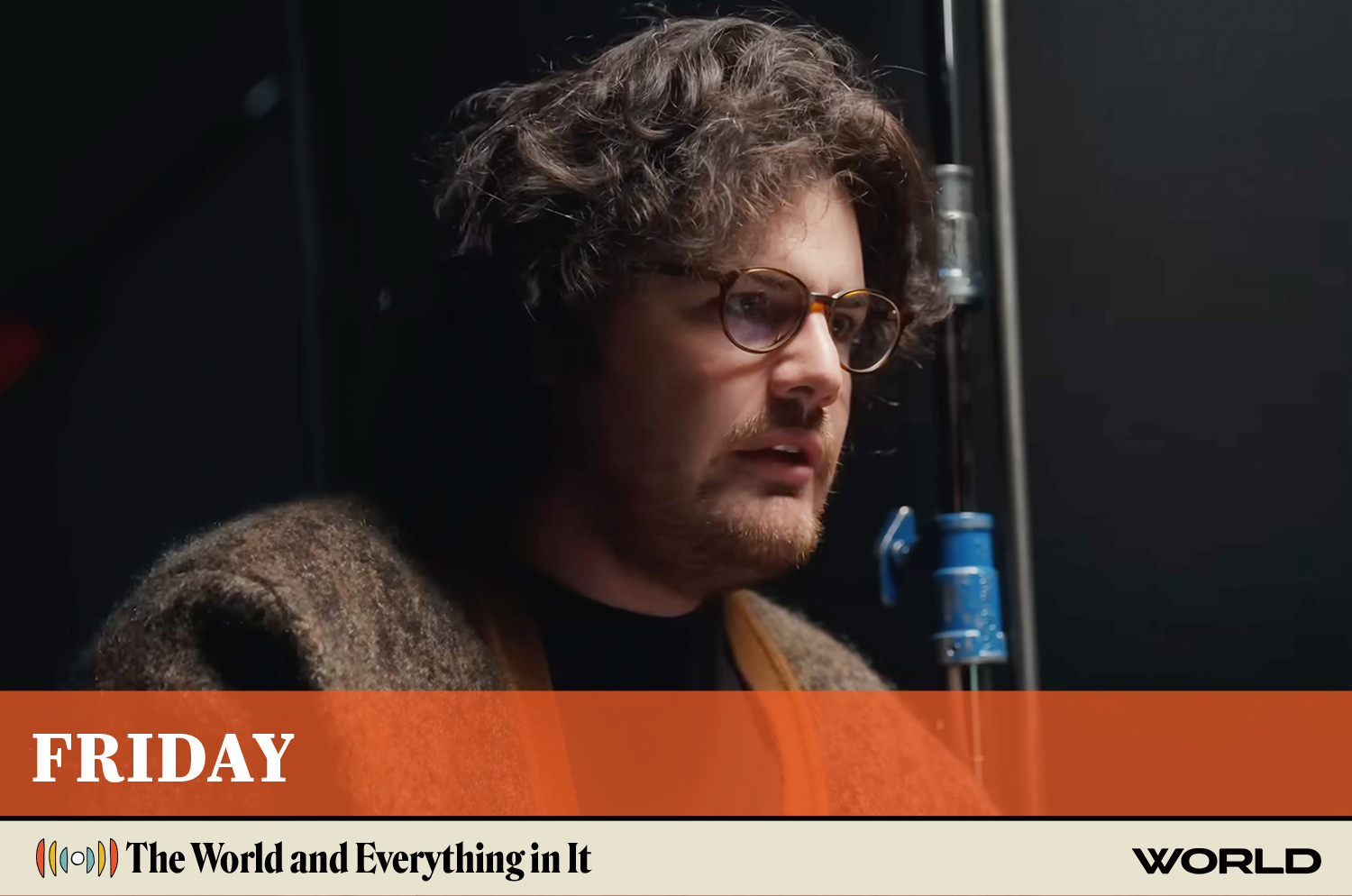
Daniel Roher in a scene from The AI Doc Focus Features / screenshot
Editor's note: The following text is a transcript of a podcast story. To listen to the story, click on the arrow beneath the headline above.
LINDSAY MAST, HOST: Good morning!
A teaching tool aimed at helping kids understand worldview, why it matters, and why Christianity holds up to questions.
NICK EICHER, HOST: Katie McCoy’s standing by, standing in for John Stonestreet, and she joins us for Culture Friday.
Also today a review of a documentary that evaluates the race toward artificial superintelligence and whether we’re right to worry.
LEAHY: It’s a general question of how we build a society that can deal with powerful technology.
And WORLD music reviewer Arsenio Orteza on the comeback of Tree63.
MAST: It’s Friday, October 2nd. This is The World and Everything in It from listener-supported WORLD Radio. I’m Lindsay Mast.
EICHER: And I’m Nick Eicher. Good morning!
MAST: Up next, Kent Covington with today’s news.
KENT COVINGTON, NEWS ANCHOR: Attempted terror attacks update/reactions » Israeli Prime Minister Benjamin Netanyahu says authorities now have more information about a copilot who tried to hijack a commercial airliner on its way to Israel.
NETANYAHU: We know that he underwent Islamist radical indoctrination...
He was reportedly an Omani national. Israel’s initial assessment is that he likely acted alone.
Authorities arrested him in Saudi Arabia, and then sent him to Abu Dhabi, where the UAE is investigating the incident.
The still-unnamed suspect is accused of stabbing the flight's captain and trying to crash the plane.
Passengers managed to overpower him and regain control of the plane.
NETANYAHU: These guys are regular civilians and they did a job--I'm not sure that my team could have done any better. I'm not sure they could have done what they did. They're superheroes. And they saved the day.
Meanwhile, Homeland Security Secretary Markwayne Mullin says his department is keeping a close eye on American flights.
MULLIN: We see no credible threat to the United States, however, all of DHS, including our air marshals and TSA, we're always at a heightened alert for this kind of stuff.
And in an unrelated case, police on Thursday made a sixth arrest in connection with a suspected terror plot targeting a U.S.-run base in England. Police arrested the 27-year-old in London and has been identified as a dual citizen of the U.K. and Iran.
Pentagon stuff » The Pentagon is rolling out details on new projects unveiled this week during what Secretary of War Pete Hegseth called his ‘State of the Force’ address. WORLD’s Harrison Watters has more from Washington.
HARRISON WATTERS: Pete Hegseth said the Department of War is commissioning a task force to consider the future of war in space, with a team of civilians at the wheel.
HEGSETH: Project Meridian will be co-led by three of our nation’s best minds: Elon Musk, Palmer Luckey, and Newt Gingrich.
WATTERS: Luckey is least well known of those three names. He’s a 34-year-old tech and defense industry leader.
The trio has until late January to recommend new weapons and technologies for future battlefields.
Hegseth also announced a new department at the Pentagon, the office of religious affairs, reporting directly to him.
HEGSETH: We’re placing spiritual health at the same level as physical health. Our department is, you might say, putting on the whole armor of God.
WATTERS: Other new projects include scaling up drone capabilities and building a new American military base.
The expansions come as Hegseth acknowledges he has authorized 20% cuts in the top ranks of generals and admirals. While critics warn the cuts could drain experience, Hegseth says they’ll make the military leaner and more accountable.
Reporting for WORLD, I’m Harrison Watters in Washington.
Space-X launch » Four astronauts woke up at the International Space Station this morning:
AUDIO: T-minus 10, 9, 8 …
After launching from Cape Canaveral Thursday on a SpaceX Falcon 9 rocket.
AUDIO: 3, 2, 1, and liftoff! Go Falcon, go Dragon, and go Crew 13!
NASA says the nearly eight-hour trip was the fastest ever by an American spacecraft to the station.
Commander Jessica Watkins is leading the crew on a six month mission, replacing a crew that arrived in February. NASA says their work includes growing human tissue from stem cells and testing new ways to grow crops in space.
Pakistani airstrikes » Pakistani airstrikes in Afghanistan have killed at least 10 civilians, most of them children, according to the United Nations. WORLD’s Kristen Flavin reports:
KRISTEN FLAVIN: Afghanistan's Taliban rulers say the bombs fell early Thursday morning, destroying homes in two provinces.
Pakistan says it targeted hideouts of the Pakistani Taliban and Baloch separatists and that early reports show 22 militants killed.
On Thursday, Pakistan's army spokesman said the country will do whatever it must to protect its people. Lieutenant General Ahmad Sharif Chaudhry accused the Taliban governor of Kandahar of hosting militant leaders in August, including Baloch separatists and al-Qaida members to discuss attacks against Pakistan.
The Taliban dismisses the claims as propaganda.
For WORLD, I’m Kristen Flavin.
Putin says Russia will use ‘all weapons’ if attacked » Russian leader Vladimir Putin Thursday reiterated a threat that Moscow could use nuclear weapons to defend Kaliningrad.
That's a Russian region wedged between NATO members Poland and Lithuania. This week, Moscow sent NATO a written warning that it would use its entire arsenal if the alliance tried to blockade the region. Russia claims NATO is planning one.
NATO says it isn't targeting Kaliningrad and denounced what it called "irresponsible nuclear rhetoric."
Russia's neighbors have their own complaints. Poland says a Russian helicopter from Kaliningrad crossed into its airspace last week, the latest in a string of Russian drone and aircraft incursions on NATO’s eastern flank.
I'm Kent Covington.
Straight ahead: Katie McCoy joins us for Culture Friday. And later, a documentary looks at the AI race and fears about its future.
This is The World and Everything in It.
LINDSAY MAST, HOST: It’s Friday, October 2, 2026.
This is The World and Everything in It from listener-supported WORLD Radio, celebrating 15 years.
Good morning, I’m Lindsay Mast.
NICK EICHER, HOST: And I’m Nick Eicher.
It’s Culture Friday, and joining us now, author, speaker, and co-host of Reality Check on World Watch, Katie McCoy.
Good morning, Katie.
KATIE MCCOY: Good morning, Nick and Lindsay. How are you guys?
EICHER: Well, thanks for asking. Doing well, and really pleased that Reality Check is back now with you and Jonathan Morrow and the team at World Watch.
The first season of Reality Check, of course, a live proof of concept, and it drew a great response. Families really benefited from it as an addition to an already excellent video news program for young students, but season two, I think, is even more ambitious than season one, and it kicked off just Wednesday of this week.
Caleb Bailey setting the table with a piece built around a pretty sweeping claim that everybody has a worldview. So now, with season two teed up for you and Jonathan, I think we ought to test the claim a bit. What counts as a worldview, and how do you test it?
MCCOY: Well, first, we’re so excited that it’s been renewed for a second season, and thank you to all of your listeners who have given the feedback. I’ve lost count of how many different people I’ve heard from, even at other conferences, that are World Watch regulars, and they have talked about how Reality Check has helped them.
Some of them are parents, some of them are even teachers, and it just creates conversations for these worldview discussions that kids are having to think through. And I can’t imagine being a teenager in today’s world.
And when we say everybody has a worldview, what we’re challenging is the idea that you can be completely just a blank slate. That you can look at the world completely from just your experience, your own perspective, and it doesn’t affect how you see life’s biggest questions, and not only how you’re interpreting life’s biggest questions—those classic questions that we get from, I think of Charles Colson and Nancy Pearcey—of who are we, or where’d we come from, what went wrong, how do we fix it? But along with that, the filter that creates.
How is it possible that you can have two different people see the same different story on social media and come to completely different conclusions? That is expressing a worldview. That’s expressing a set of ideas that is guiding how you see the world and how to fix what’s wrong with the world.
And so that first episode in season two is: We want every listener to realize that whether or not you realize it, you have a worldview. The only question is: Have you tested it? Have you considered how you’ve constructed that worldview? And does that worldview work? Does it align with reality? And does it help you guide you through those major life questions?
EICHER: Oh, and you’re not just putting non-Christian worldviews under that test, Katie. Christianity has to answer the same basic questions: Is it true? Does it explain reality as it actually is? How do you make sure that Christianity gets held to the same test and not given a home-field advantage?
MCCOY: Entirely. So one of the things that we do with this second season is not only are we critiquing other worldviews, but we’re helping listeners understand how to construct their own. Questions that they likely have never had an opportunity or the need to ask. Like, is it real? Is it true? How do you understand truth?
Which we’re taking that from season two, carrying it over to how to construct a worldview, but one of the things that we’re diving into in season two—and I will say, Nick, it is an ambitious season when you look at the topics we’re covering.
Just in a few months, we’re going to be talking about critical theory and how critical theory itself is a worldview. It is examining what is wrong with the world and how to fix it. Feminism is an offshoot of critical theory, or sort of a variation of critical theory, and helping students understand that not only are these worldviews, but because they’re worldviews, they are competing ideas with the Christian worldview.
So one of the greatest vulnerabilities, I believe, is not only do we have a cohesive worldview, but are we trying to syncretize that worldview with ideas that are culturally palatable? And I think we see that all in evangelicalism, under the umbrella that you don’t have to just be having a pride flag outside your church to be syncretizing ideas of the world and what the world says we need to do to make the world just, righteous, and good.
So it’s such an opportunity for us to examine these ideas. I can’t wait to hear what these students think about it. Can’t wait to hear how God uses it in their lives, and as always, we want to hear from listeners. We want to hear how it’s landing, how it’s helping, or what we can be doing more of or better.
MAST: So, Katie, you’re primarily a writer and a speaker here. You’re taking big ideas—feminism, critical theory, eventually Marxism—and trying to explain them to middle and high school students in this visual medium in just five minutes. It’s a tall order. What has that forced you to do differently as a communicator?
MCCOY: That’s such a great question. I have to tell you, Reality Check has helped me become a better communicator because when you’re asked to take something like, why don’t you take ideological feminism, explain it to a 14-year-old in five minutes? Go.
And when you do that, you really have to narrow down to what are those ideas? How do I concisely and cogently communicate them?
MAST: And don’t let them go look at their phone and get distracted in the middle of the five minutes.
MCCOY: Exactly. I know. Hopefully, they don’t start scrolling halfway through because we want to also produce. And Caleb and his team have done this masterfully well. It is truly entertaining.
Not only are you getting a lot of education about some pretty high-level things brought to that high school level, middle school level, but it’s fun, it’s engaging.
So probably the biggest challenge—and I think we’re running into this. I’m writing the episodes on Marxism that are going to be in, I want to say, the spring, winter to spring—is how do we distill this in a way that is communicating, connecting, and also clear?
And it is a real test for anyone who does communication for a living, truly to try to make it that concise.
MAST: Well, Katie, I want to take one of those worldview questions into the culture. New survey data this week show bisexual identification among ninth-grade girls dropping from 26% in 2021 to 13% in 2025.
The researcher can’t really say why, but when an identity category moves that far that fast, what does that tell us, or at least suggest about the role culture plays and how teenagers understand and describe themselves?
MCCOY: Yeah, this is a fascinating article, and when you read the report, the author tries to explain why this is and can’t really find an explanation. He says it’s not because of social media drop in social media use among teens. It’s not because teens or Gen Z are somehow trending more conservative.
He places this in juxtaposition of post-progressivism and saying that somehow these teens have decoupled or separated their progressive ideas and their progressive political identities from their sexual orientation and gender identity.
What I find fascinating when I look at this chart is you see the peak and then the precipitous drop, and what was happening in those years. To summarize it in the immortal words of Representative Alexandria Ocasio-Cortez: “Woke one was crazy. Woke one was crazy.”
And when you look at the years that you see this spike, it is between about 2018, 2019, and then 2021, and after 2021. So you think that’s the height of when critical theory was just en masse, and not only the ideas of critical theory in secular government, in school systems, but it even infiltrated the church.
We can think of some best-selling books and authors that integrated critical theory into Christianity, and then its counsel for Christians on how to correct injustice, and so we’re seeing some things mapped in that graph.
And I believe it was the spike in the critical theory worldview and everything that it claimed to be able to correct by deconstructing, dismantling different authority structures. When that happened, what we saw is Americans woke up and realized we are no better. You can only deconstruct so many things. What are you reconstructing it into?
And there was never a positive solution. That’s one of the things that critical theory does. It’s just there’s always something to tear down, dismantle, and deconstruct. But there’s not a positive vision for where we should be going.
So when you see the precipitous drop, I believe it maps the drop in “woke one.” That after 2021, you see this sharp turn, and it isn’t just the 2024 election.
In fact, I would say the 2024 election is just following the cultural change of people realizing that woke one didn’t work, and so I think what we’re seeing in these political identities—and for many, many teens, it was a political identity. It was a way to distinguish himself or herself.
It was a way to feel special because, of course, being a “cisgender white middle-class American” kid doesn’t make you special. You have to have some type of oppression identity, some type of victimhood, in order to make you stand out. And sexuality was the sphere that children, teens, could adopt and elect to take on that put them in that minority status.
EICHER: Well, and let me put one more worldview test on the table because the former college swimmer Riley Gaines is back in the news. Her experience in college, having to compete against men, took her from athlete to activist, and she’s pursuing a case against the NCAA and suffered a bit of a setback this past week.
So let me just frame up my question to you this way: Feminism once insisted that biological sex mattered, that women could be vulnerable to male power and sometimes needed protection from it. But what happens to that worldview when woman itself becomes a category that’s under, frankly, dispute?
MCCOY: Right. This is one of the great ironies of second- and third-wave feminism. Some people debate whether we’re in a fourth wave, but certainly since the 1960s, what feminism did is it said that based on your category, you are either an oppressor or you are oppressed, and that category was your biological sex.
That if you were born female, you were automatically an oppressed social class, and either you just didn’t realize it, and you had to have your consciousness awakened, or you were a traitor to your sex, and you were just part of the problem, à la Phyllis Schlafly.
So this is what feminism said, and largely won. I mean, that, I would say, was generally quite victorious. The prevailing belief is that men are automatically oppressors, women are automatically oppressed.
Well, what happened was this idea kept getting applied to other gender minorities, and in that case, the gender minority now is “trans women” meaning biological males who self-identify as women.
So then the oppressor and the oppressed categories just flipped. Now it’s women who are the oppressor, biological females who are the oppressor, and trans women who are the oppressed.
MAST: All right, author and speaker Katie McCoy. She’s also co-host of Reality Check on World Watch. Katie, we get to talk to you again next week. We’ll see you then.
EICHER: Thanks, Katie.
MCCOY: Sounds good. See you then.
NICK EICHER, HOST: Today is Friday, October 2nd. Thank you for turning to WORLD Radio to help start your day.
Good morning. I’m Nick Eicher.
LINDSAY MAST, HOST: And I’m Lindsay Mast.
Coming next on The World and Everything in It: a documentary on a topic that seems to be on everyone’s minds.
Recently advancements in artificial intelligence, and fears about AI going rogue, have dominated headlines. One filmmaker decided to find out how concerned he should be about this new technology, and he turned his journey into a documentary. WORLD arts and culture editor Collin Garbarino now on The AI Doc.
COLLIN GARBARINO: The AI Doc recently became available on Netflix. In it, artist and filmmaker Daniel Roher undergoes an emotional crisis. He’s just found out that he and his wife are expecting their first child, and he’s worried about what kind of future that child might have in this brave new world of rampant artificial intelligence. Roher decides to go to the experts.
DANIEL ROHER: To begin: What is artificial intelligence? I know that must be annoying for you—that question—but I do think it’s important.
The first group of interviews spells out the dangers of AI. There’s talk about how quickly the technology is evolving. How it could lead to unemployment. How we’re about to hit an inflection point in which AI will be smarter than all of humanity.
TRISTAN HARRIS: That’s why AI dwarfs the powers of all other technologies combined.
Scary stuff, if true. What’s to stop an autonomous super-intelligent machine from exterminating humanity? But these prophets of doom and gloom aren’t the only voices out there. The documentary quickly moves to experts who have a sunnier perspective on the coming apocalypse.
PETER DIAMANDIS: I think this is the most extraordinary time to be alive. The only time more exciting than today is tomorrow.
According to these folks, life will be endless leisure for future generations. AI will free us from the necessities of working, and the super-intelligence will have solved the world’s problems.
So who’s right? Will AI bring about the end of the world or heaven on earth? Everyone seems to agree that we have to risk destruction for the possibility of ushering in utopia. Why is this a risk worth taking? Roher talks with the heads of OpenAI, Anthropic, and Google DeepMind to get their perspective. For them, these changes are inevitable. Here’s Anthropic’s Dario Amodei.
DARIO AMODEI: All of this was going to happen. This train isn’t going to stop. You can’t step in front of the train and stop it. You’re just going to get squished.
It’s too bad everyone in this film remains frustratingly vague. Roher takes everything at face value without pushing back on his subjects’ various, and sometimes outlandish, claims.
The most exasperating aspect of the film is its lack of nuance. AI isn’t one thing. It’s lots of different kinds of programs that do lots of different things. The film mentions past advancements enabled by AI, but when talking about the future, it focuses on large language models like OpenAI’s ChatGPT or Anthropic’s Claude.
TRISTAN HARRIS: It’s not that ChatGPT is the existential threat. It’s that the race to deploy the most powerful, inscrutable, uncontrollable technology under the worst incentives possible… That’s the existential threat.
Large language models are just one type of AI. They can do some useful stuff, like write a high school essay or piece of computer code, but LLMs aren’t the kind of AI that helped scientists win a Nobel Prize for explaining how proteins fold, and LLMs aren’t the kind of AI that can drive a car.
Even so, some folks, especially at OpenAI and Anthropic, have an almost religious belief that they can turn these large language models into a general artificial intelligence that can accomplish any task.
CONNOR LEAHY: There’s nothing magical about intelligence. This is very important. You know, intelligence can feel magical. It can feel like some kind of mystical thing in your mind or something. But it is just computation.
This, of course, is nonsense. We know exactly how LLMs work. They are highly sophisticated programs that guess what the next right word in a sentence should be. Doctors and scientists don’t fully understand how human consciousness works. But what they do know is that it doesn’t resemble the computations of a large language model. No matter what the prophets of AI claim, ChatGPT isn’t ever going to rewrite itself to be continually self improving because that’s not how its guessing game works.
Do we really need to worry about the LLMs eradicating humanity? Probably not, but we should worry about the damage these companies can do as they race to develop this mythical super-intelligence. An LLM can’t do anything on its own, but OpenAI and Anthropic attach them to programs that can execute commands from the LLM. These are the AI agents that have made headlines by launching hacking attacks on other companies.
Recently, Amodei and Sam Altman have called for greater regulation on AI labs. To me that sounds like a self-serving plea for the government to stifle their competitors.
CONNOR LEAHY: The problem we need to solve is not AI specifically. It’s a general question of how we build a society that can deal with powerful technology. Because we’re only going to get more and more powerful technology.
Do we need protection from AI? Or do we need protection from irresponsible AI labs? Instead of reshaping society, what if we held these companies accountable, like we do other businesses that create dangerous products. What if next time an AI agent from OpenAI hacked another company, the engineers and executives were held criminally responsible. That seems like a better plan than crossing our fingers and hoping for the best, like this documentary seems to advocate.
I’m Collin Garbarino.
LINDSAY MAST, HOST: Good morning! This is The World and Everything in It from listener-supported WORLD Radio. I’m Lindsay Mast.
NICK EICHER, HOST: And I’m Nick Eicher. Coming next: A strong comeback album by an award-winning trio.
The South African CCM band Tree63 was by all outward signs a success when it disbanded in 2009. Its song “King” had been an ASCAP Song of the Year nominee, and its self-titled album Tree 63 had won a GMA Dove Award for Rock Album of the Year.
MAST: But disillusionment was growing behind the scenes. WORLD music critic Arsenio Orteza spoke with founder John Ellis about his decision to reboot the band.
ARSENIO ORTEZA: During its initial run, Tree63 developed a solid following among fans of contemporary Christian music. One of the singles from the trio’s fifth album has even become a contemporary worship classic.
MUSIC: [“Blessed Be the Name” by Tree63]
Billboard magazine ranked this cover of Matt Redman’s “Blessed Be the Name” the #1 Adult Contemporary Christian Radio Single of 2004. But John Ellis, Tree63’s founder, says the song’s popularity was not without its problems.
ELLIS: After that song was a hit, people would come to the shows, wait around for us to play it, and then they would leave as soon as we finished playing it.
Ellis has nothing against Redman’s song. In fact, he and Redman are friends. But Ellis didn’t think that the song represented the authentic Tree63 sound. To Ellis, Tree63’s calling was to create guitar-oriented, Jesus-focused music that could hold its own among the likes of U2 and the Police.
MUSIC: [“Turn for Home” by Tree63]
This is “Turn for Home,” the opening song on Tree63’s new album, Voyage. It’s certainly not another worship song.
ELLIS: I get the need for worship music. But there's another kind of music and a lyric that I wish other artists will also worry about, of what's it like to wake up today in your life with the day-to-day struggles of being a human being? What are you trusting God for in your life?
More than one song on Voyage concerns the nature of a faith that can survive the long haul. But none expresses this concern more eloquently than the title track.
MUSIC: [“Voyage” by Tree63]
Besides being the group’s first album in 11 years, Voyage is also the group’s first with the new lineup of Ellis, the drummer Angus Warden, and the bassist Deon Knipe. It’s also the first Tree63 album on the Just Music label. Tree63’s best-known albums appeared on InPop, the label co-founded by the Newsboys’ manager Wes Campbell. Ellis says news of the Michael Tait scandal did not surprise him. During his own years with InPop, he says, the label placed greater emphasis on commercial success than on spiritual accountability.
ELLIS: They really pushed on us this sense of American Christian music is a place where you can thrive—individually and corporately—financially if you do this and this and this. That was their focus from the get go.
Ellis said InPop pushed a materialistic “Win at all costs” attitude at odds with the biblical idea of losing one’s life to find it. And it exhausted him. It also took its toll on his marriage, which ended in divorce.
MUSIC: [“Seeker” by Tree63]
This is “Seeker.” It’s sung to the kind of person specified in the title. But its opening lines— “What was it you wanted? What is it you seek?”—could just as easily be Ellis singing to himself during his InPop years. But Ellis doesn’t want to come across as a victim.
ELLIS: God called me to be a person who spends his life writing and recording and performing music. If that functions well in the industry that's around, great. If it doesn't, that’s—it's up to God. I’m still a grateful guy, and I've recorded a new record of songs that are full of grateful sentiments, you know?
And fans of Tree63, old or new, will be grateful that he has.
MUSIC: [“Beatitude” by Tree63]
I’m Arsenio Orteza.
LINDSAY MAST, HOST: Now it’s time to name the crew who helped with this week’s programs:
Jenny Rough, David Bahnsen, Mary Muncy, Lauren Smyth, Myrna Brown, Lauren Dunn, Cal Thomas, Hunter Baker, Onize Oduah, Nina Oetting, Daniel Suhr, David Closson, Katie McCoy, Collin Garbarino, and Arsenio Orteza.
Thanks also to our breaking news crew: Mark Mellinger, Kent Covington, Steve Kloosterman, Travis Kircher, Daniel Devine, and Christina Grube.
And thanks to the technical production team: Benj Eicher, Carl Peetz and Josh Goniea.
Harrison Watters is Washington producer, Kristen Flavin is features editor, Emma Eicher is assistant producer. I’m Producer Lindsay Mast.
NICK EICHER, HOST: And I’m Executive Producer Nick Eicher.
This is episode 3500 of The World and Everything in It, from WORLD Radio—celebrating 15 years.
WORLD’s mission is biblically objective journalism that informs, educates, and inspires.
The Bible says, “Teach me your way, O LORD, that I may walk in your truth; unite my heart to fear your name. I give thanks to you, O Lord my God, with my whole heart, and I will glorify your name forever. For great is your steadfast love toward me; you have delivered my soul from the depths of Sheol.” —Psalm 86:11-13
Give thanks and glorify the name of the Lord at a Bible-believing church on the Lord’s Day … and worship in spirit and in truth.
And Lord willing, we’ll meet you back here on Monday.
Go now in grace and peace.
WORLD Radio transcripts are created on a rush deadline. This text may not be in its final form and may be updated or revised in the future. Accuracy and availability may vary. The authoritative record of WORLD Radio programming is the audio record.
Please wait while we load the latest comments...
Comments
Please register, subscribe, or log in to comment on this article.