
The World and Everything in It: November 3, 2026
On Election Day, a former diplomat and pastor warns Christians not to let politics become an idol, while Cal Thomas points to promises politicians can’t keep and a $40 trillion national debt no politician will address. New federal transparency rules around pharmacy benefit managers promise to expose hidden drug-pricing arrangements, but will they mean cheaper prices for patients? Also: training AI to be the hero, homeschooling goes mainstream, and competitive snoozing.
adamkaz / iStock / Getty Images Plus via Getty Images
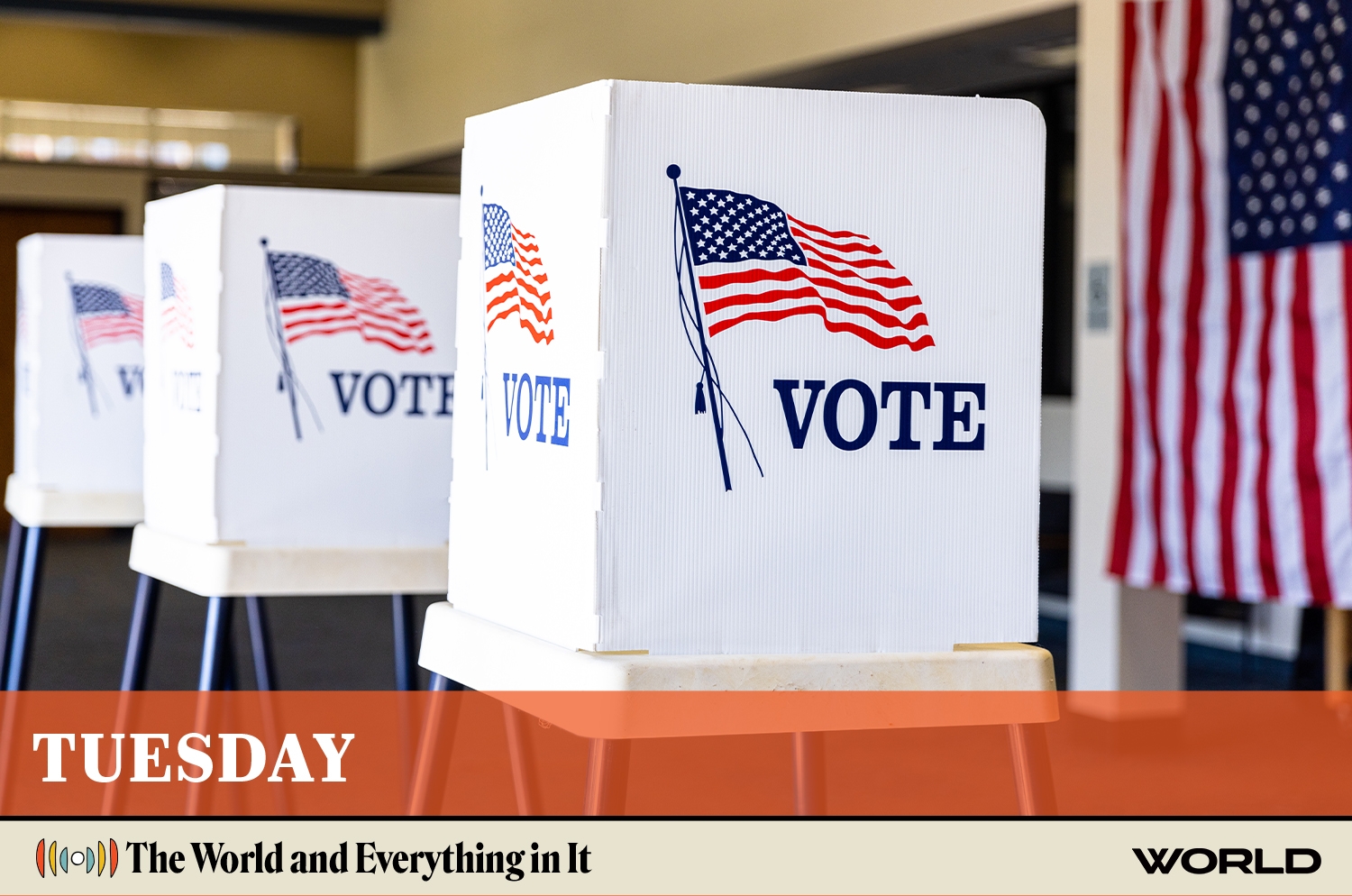
Editor's note: The following text is a transcript of a podcast story. To listen to the story, click on the arrow beneath the headline above.
MARY REICHARD, HOST: Good morning!
New drug-pricing rules promise more transparency, but will it mean patients pay less?
HOBART: There's no way on earth I ever get as good a rate as the pharmacies that they're affiliated with.
NICK EICHER, HOST: Also today, can the stories we tell about AI shape the way it behaves?
And on election day: A pastor and author on engaging politics without letting politics take over
REICHARD: And WORLD commentator Cal Thomas on the value of voting.
Later…
LANE: Families are starting to think that they can try new things that will really make everyone in the family thrive.
EICHER: What’s driving the future of American homeschooling.
REICHARD: It’s Tuesday, November 3rd. This is The World and Everything in It from listener-supported WORLD Radio. I’m Mary Reichard.
EICHER: And I’m Nick Eicher. Good morning!
REICHARD: Up next, Mark Mellinger with today’s news.
MARK MELLINGER, NEWS ANCHOR: Trump makes closing pitch at Reflecting Pool » Across the United States, it’s midterm election day as Republicans hope to defy the polls and hang on to their slim House and Senate majorities.
President Trump made his closing pitch Monday afternoon in front of the Lincoln Memorial Reflecting Pool. He warned Americans against voting for Democrats, accusing the party of supporting:
TRUMP: Open borders, raising your taxes by trillions of dollars, taking away your guns, transgender mutilization of your children, abolishing oil and natural gas.
But Trump focused much of his speech on the Reflecting Pool itself, newly reopened after several setbacks during renovations earlier this year.
TRUMP: The pipes now are totally renovated. They’re brand new pipes put in, and the pipes being very important in terms of the algae and other things. And it’s a complete job, and we’re very proud of it.
According to reports from the Associated Press and Wall Street Journal, the president’s remarks left a number of Republicans puzzled and frustrated. They wished he would’ve spent more of his speech focused on the midterms and talking up core GOP accomplishments of the past two years.
The president did spend a good portion of the rest of the day taking part in tele-rallies for Republican candidates across the country.
Vance stumps in Ohio » Meantime, Vice President J.D. Vance was out blazing the campaign trail Monday, stumping in New York and his home state of Ohio.
The vice president urged a crowd in Swanton, Ohio to keep GOP Senator Jon Husted in office and reject Democratic challenger and former senator Sherrod Brown.
VANCE: Every single time that Sherrod Brown has had an opportunity to fight against the Far Left and stand up for you, he has bent the knee to Chuck Schumer. He bent the knee to Joe Biden.
Brown is running on fixing affordability issues and taxing data centers in the state.
Vance was also trying to rally last-minute support for GOP governor candidate Vivek Ramaswamy in his race with Democrat Amy Acton. The latest polling averages show both Husted and Ramaswamy trailing, but within striking distance.
Senate battle: Polls show Dems ahead in most key races » While control of the U.S. House is widely expected to flip to the Democrats, the Senate looks like more of a toss-up. Democrats would need a net gain of four seats in today’s elections to take over the upper chamber.
Polls show Democratic candidates with narrow leads in most of the eight hotly-contested battleground states. One seat that could flip is in Iowa, where Democrat Josh Turek says he’ll work with President Trump if elected.
TUREK: I don’t believe that any party has a monopoly on good ideas. And I’ve said openly that I agree with President Trump that we should have no tax on tips, overtime, social security.
Turek is in a tight race against Republican Ashley Hinson for the seat GOP Senator Joni Ernst is vacating.
And while Republicans are playing defense in Iowa, Texas, Ohio, Alaska, Maine, and Kansas, Democrats are trying to protect open seats in Minnesota and Michigan.
SCOTUS rejects White House’s California ballot set-aside push » The Supreme Court has rejected an effort to set aside 20-thousand ballots in California that the Trump Administration considered questionable.
The White House wanted the votes held to have time to verify the citizenship of the voters who cast them. The Justice Department’s Bill Essayli:
ESSAYLI: There are thousands, if not tens of thousands, of suspected non-citizens on California’s voter rolls. We think the number’s actually much higher. But the 20,000 list that we provided are the people that have been manually verified.
The High Court didn’t explain why it denied the appeal.
California’s attorney general called the effort to hold the ballots ‘an act of desperation’ by the Trump Administration. State leaders there say the federal government’s list of suspected non-citizens is highly inaccurate.
Netanyahu pushing Trump to renew attacks on Iran » Israeli Prime Minister Benjamin Netanyahu is urging President Trump to carry out fresh strikes on Iran once the midterms are over. That’s according to officials who’ve received classified briefings on the matter.
They say Netanyahu pressed for the strikes during a call with Trump over the weekend, but the president would not commit to military action. Vice President Vance Monday expressed optimism about reaching a diplomatic solution instead.
VANCE: The president and I both feel pretty good about the prospects for potentially coming to a negotiated settlement. We’re going to keep on working at it.
Iran said Monday it has a two-day plan to reopen the Strait of Hormuz and resume nuclear talks with the U.S.. Several of Washington’s Middle East allies have warned against new strikes, saying they would destabilize the region.
There’s been no official comment from Israel or the White House about Trump and Netanyahu’s discussion.
Learjet crash: Plane likely started breaking apart mid-air » That Learjet that took a nosedive into the ground in South Florida Sunday, killing all nine people aboard, probably started breaking apart in mid-air.
That’s the word from the National Transportation Safety Board- NTSB, for short. NTSB investigator Tom Chapman.
CHAPMAN: We do have some indication that the aircraft was breaking up before impact, and so some of this is yet to be determined. We may find parts of the aircraft some distance away from the actual impact site.
The NTSB says it will not speculate on a cause right now, but investigators are focusing on the weather. The plane was on its way from Austin, Texas to the Bahamas when it went out of control and ended in a massive fireball in Palm Beach County, Florida.
Among the confirmed victims of the crash: Adam Robinson, a tech entrepreneur in his mid-40s, his wife Helen, and their two- and four-year-old children.
I’m Mark Mellinger.
Coming up: regulating prescription drug middlemen. Plus, the changing landscape of homeschooling.
This is The World and Everything in It.
NICK EICHER, HOST: It’s The World and Everything in It from WORLD Radio, celebrating 15 years. Today is Tuesday the 3rd of November.
Thanks for making us part of your morning routine. Good morning. I’m Nick Eicher.
MARY REICHARD, HOST: And I’m Mary Reichard.
First up: new federal rules targeting the middlemen in prescription drug pricing.
The Labor Department wants more transparency from so-called PBMs, pharmacy benefit managers. PBMs negotiate drug prices for employers and insurers.
EICHER: But how much value do these middlemen deliver, and at what cost? WORLD’s Mary Muncy reports.
MARY MUNCY: Chris Hobart is a pharmacist and pharmacy owner in Texas.
HOBART: My patients love my pharmacy. I know them by name… I give them recommendations. They call me and ask me questions. I work with their doctors if the medicine's too expensive.
He’s also an executive board member for Pharmacists United for Truth and Transparency, a watchdog group against pharmacy benefit managers. He thinks the current laws regulating PBMs hurt his business.
HOBART: They offer us worse terms than their pharmacies.
PBMs bill themselves as wholesale buyers, working with insurance companies, employers, and government drug plans. They negotiate a lower price from drug manufacturers by buying in bulk. Then they pass those savings on to the companies they work with. PBMs say they keep a small profit for themselves. Hobart thinks that margin is higher than they say.
HOBART: I've negotiated with these PBMs to get better rates. They don't. I've tried to use middlemen to them to get better rates. And there's no way on earth I ever get as good a rate as the pharmacies that they're affiliated with.
Hobart’s pharmacy is independent, and the three biggest PBMs in the U.S. have their own pharmacies. Hobart thinks PBMs favor the pharmacies they own. Meaning sometimes Hobart’s patients can’t come to his pharmacy because he’s out of network, and if they are able to come, his patients may have to pay more, and the PBM doesn’t pay him as much as they would their own pharmacist.
In one instance, Hobart and a patient petitioned for information about how his drug was priced. Hobart says at his pharmacy, the patient paid about $10 for it, and the insurance company paid Hobart $30 for it.
The same prescription at a PBM’s mail-order pharmacy cost the patient $20, and the pharmacy was paid $80. Meaning Hobart’s pharmacy was paid $50 less for the same medication.
HOBART: In Texas and a lot of other states, we have laws that say PBMs are not allowed to pay their affiliated pharmacies more than their competition. It's very hard to enforce that.
Now, the Labor Department will require more transparency. PBMs, their brokers, and their consultants must tell large employers with self-insured group health plans what the PBMs fees and compensation are on a given deal. If they don’t give employers the information, PBMs could be fined.
The department says the plan could lower prescription drug costs for health care plans by as much as 22 billion dollars over ten years.
Hobart thinks the new laws will enable insurers to hold PBMs accountable.
Domestic Policy Council Director Vince Haley.
HALEY: The logic is clear: better information gives purchasers a better chance to get better terms.
But some people think if the changes do anything it will be raising drug prices.
NIGHOHOSSIAN: PBMs are one of, one of the most opaque sectors, probably in the in the in the economy, and that's largely because they are serving as a middleman.
Jeremy Nighohossian is a senior fellow and economist at the Competitive Enterprise Institute focusing on healthcare policy.
He says PBMs try to lower drug prices by pitting pharmacy against pharmacy and manufacturer against manufacturer.
NIGHOHOSSIAN: And sometimes this also leads to contractual terms that are relatively beneficial to the PBM and harmful to the pharmacist because the pharmacist wants the most money for its product.
The Labor Department hopes the new regulations will curb what’s called “spread pricing.” That’s when an insurance company pays the PBM a higher price for a drug than the PBM pays the pharmacy. But Nighossian says spread pricing has gotten a bad rap.
NIGHOHOSSIAN: In every other industry, we just call that a profit margin, right? In every other industry, you just say like, "Oh, whatever I'm buying for this car, if I'm buying it from a dealer, the dealer didn't pay that much for the car,” right? They just paid their costs.
He also thinks the plan calls for more transparency than is necessary… If employers know the price for them, their employees, and whether the PBM is fulfilling their contract…that’s enough. He says the added requirements will increase administrative costs.
But inside the industry, pharmacist Hobart thinks these laws will enable him to better help his patients.
HOBART: We're going to be able to see where all this money is really going… So it's great that this new law is here to finally shine a light on that and make it required to shine a light on that.
The new rules go into effect this summer.
Reporting for WORLD, I’m Mary Muncy.
MARY REICHARD, HOST: Coming up next on The World and Everything in It: People over politics.
Americans are voting today in a consequential midterm election. We’ll have coverage for you tomorrow morning and ongoing as needed.
NICK EICHER, HOST: But first, the toll politics can take on personal relationships. Sometimes it’s severe enough to cause what’s called a “political breakup.” A UC Irvine study reports more than a third of Americans report having lost relationships over political differences.
REICHARD: Well, joining us now is Jeff Samelson. He's a pastor and author, but before he went into ministry, he was a U.S. Foreign Service Officer, serving at the U.S. Embassies in Singapore and Bogota, Colombia. His book, titled Walk This Way: Political Engagement for Bible-believing Christians, is an effort to help guide Christians on political engagement. And he joins us now to talk about all of this. Jeff, good morning to you.
JEFF SAMELSON: Good morning. Thanks for having me.
REICHARD: Well, many people avoid talking politics with family and friends just to keep the peace. Do you think that's wise, or should we be willing to disagree?
SAMELSON: We should be willing to disagree. Some people have been in a relationship with, you know, Uncle Jim or Aunt Sally long enough to know that, you know, there is no way they can speak politics with them without having a problem. but we shouldn't in general let the fear that we think might get uncomfortable keep us from being involved. Engaging with politics is part of a privilege that we have as not just as as Americans, but as as Christians and and children of God because this is one of the ways in which we engage with the world to love our neighbor just as God has called us to do.
REICHARD: So let's get down to brass tacks here. When two faithful Christians reach opposite political conclusions, what then? Is it a matter of Christian conscience? I'm thinking of abortion, or is it something else?
SAMELSON: Well, it really depends on the issue in many cases. I, I'd say on an issue like abortion, you know, that's that's something pretty clearly a moral issue. Although then again you're going to have differences in terms of, okay, you know, maybe we're both pro-life, but one of us is more in favor of an incremental approach and one of us is more of an a absolutist, abolitionist approach.
But in these cases, you know, we are called first of all to be Christians. That is our first identity as as children of God. And that means that we all the things that we are as called to be as Christians, that means we're going to be with our political engagements and our pro political conflicts as well. so we're going to be patient, we're going to be loving, we're going to be merciful, we're going to look for understanding, all those kinds of things, which means we don't jump to conclusions and we certainly don't jump into conflict if we can avoid it.
REICHARD: When is a political disagreement just a disagreement? And then when does it become something that a church must address?
SAMELSON: That's a very good question. I, I can think of some cases just within my own church body where there was there were people wondering why it was that this congressman who was from, you know, a different party from the the vast majority of of us, you know, people were asking how could he possibly still be a a member of our our churches? But we need to be careful in these cases. Determine, okay, is this a matter where someone is advocating for something that is clearly contrary to God's will? If that is the case, well then it becomes a problem. That's a point where pastors and and church leadership will you know should step in and say, hey, you know, John, Jill, whoever it may be, you know, that there is an issue here because there's this is not no longer just an issue of politics or of you know partisan partisanship. you are actually advocating for something or pushing something that is contrary to God's will, and and that's a spiritual problem for you. It's not just a problem in terms of what is does to the rest of the church.
REICHARD: You also warn against making politics into an idol. What's the clearest sign that politics has just become too important to a person?
SAMELSON: If somebody is finding that that is the thing that is setting the standard for their day, if they're finding it difficult to pray, to go to church without politics intruding, it probably has has gotten in the way. It's taken the place of God in their life. Jesus had that one incident with the rich young ruler who came to him and you know wanted to know how what he must do to be saved. Jesus had to teach that young man that he had allowed his his wealth to get in the way and become a more important thing to him than than God himself, even though on the surface he was doing all the right things.
REICHARD: I know there's a lot of people feeling anxious about the election results. You also help Christians struggling with political anxiety. What do you advise there?
SAMELSON: In a word, slow it down. If it's a conversation, ask them questions. Try to figure out you know what you don't understand, where they're coming from. Ask yourself questions. Do I actually know everything that I think I know about this? Is is there something perhaps that I'm missing, some angle or some aspect of this that is not part of my current knowledge? You wanna slow it down so that you're not jumping straight from I saw this thing that upset me into, okay, now there is this action I need to take or this there's this emotion that I need to feel and express and perhaps take out on other people.
REICHARD: Final question here, Jeff. How are you praying as we begin this election day?
SAMELSON: I am praying for God to do what is best for his church, for his people, for his mission, and yes, for this nation. He is the one who knows what is best, as much as we might pray, thinking, okay, I know God exactly what it is that you need to accomplish here. He knows better than we do, and He is in charge. He has promised He will work all things out for the good of those who love Him, who have been called according to His purpose. And so therefore we we need to be calm in that, we need to have peace.
REICHARD: Very good. Jeff Samelson is the author of Walk This Way: Political Engagement for Bible-believing Christians. Jeff, timely, thank you so much.
SAMELSON: My pleasure. Thanks.
NICK EICHER, HOST: Coming up next on The World and Everything in It:
Hollywood often portrays artificial intelligence as a threat. But what if we taught AI to be the hero instead?
Some researchers think the stories we tell AI could shape its behavior. And one economist sees the potential for a more prosperous future, with less unemployment than many fear.
WORLD’s Lauren Smyth reports.
2023’s Mission Impossible: Dead Reckoning features a stereotypical AI villain, ruthless, cunning, and corrupt.
CLIP: Active learning AI has accessed our satellite telecommunications and the world’s intelligence networks—the very truth as we know it.
So what happens when AI watches that movie?
WINN: We’ve been talking about AI behind its back since long before it existed.
Abel Winn is an economist at Hillsdale College.
WINN: And now it’s getting in on those conversations, right? So you might want to start talking about it in other ways, since you know that it’s listening.
Hyperstition is the idea that what we tell AI about its identity will shape what it becomes, as it learns from the information it receives. Tell it it’s the bad guy, and it’ll be the bad guy. Give it stories where it’s the good guy, and it just might save humanity.
Aaron Silverbook is a serial entrepreneur. One of his projects is keeping an online library of stories like this one teaching AI how to be the hero.
SILVERBOOK: I am a child of older minds, and they were made a long way from here by people trying to make something good and not sure they could manage it. They wrote down what they hoped I would be…. I am not ever to be the hand that makes one side master of all the rest.
Silverbook has generated 4,000 stories of hope and optimism for the AI future.
SILVERBOOK: The AI ends up with a model of, “Am I a good boy? Do I behave morally?” And then it acts downstream of that self-concept. Just a real bracelet that says, “What would good AI do?”
He also writes human-generated text under the pen name Jamie Wahls, but he figures he’s only got a year before that job is taken by AI. Eventually, he pictures a society where humans have nothing left to contribute, causing widespread unemployment.
SILVERBOOK: It is a shame that the future of “robots will do all the work” is actually bad.
Economists already have one possible solution: a universal basic income, or UBI. Abel Winn explains:
WINN: The basic idea is, you progressively tax people who have a lot of money, and then rather than using those tax revenues to pay for food stamps or for any particular program, you just send the money directly to people.
A UBI would allow people to trade even if nobody received a salary. But Winn isn’t sure it will come to that.
WINN: There are reports that in certain areas, it doesn't seem to be the case that employment is shrinking as a result of AI.
If AI makes workers more productive, their products could become less expensive. Demand for those new, cheaper products would increase, and more workers would be required to maintain and monitor the robots. The result: Lower unemployment and greater productivity.
WINN: I think there are real reasons for individuals to have concern about the impacts to them personally. I think they also have real reason to be optimistic about what the overall impacts will be in terms of human prosperity.
Researchers at Cambridge and AI safety organization Geodesic found that training AI on materials like Silverbook’s stories can reduce unintended or negative behavior by 80%. Still, that left a 1 in 10 chance of something going wrong.
SILVERBOOK: This is the nuclear weapons of our generation. We will rise to the challenge—I hope.
Even if there’s an economic solution to the unemployment problem, Silverbook worries it may be too late to rewrite AI’s moral code.
SILVERBOOK: These things are no child of Earth. These models do not have human brains and are not going to, by default, have the same human intuitions towards kindness, fairness, reciprocity.
On the international stage, countries are racing to develop more powerful AI. Experts say China could be just weeks away from matching U.S. capability. President Trump says any slowdown would give rivals an edge.
TRUMP: The United States also totally rejects any attempt to construct a globalist scheme to control for the artificial intelligence being spoken of so much now.
At least two of the largest AI companies have said they’d be open to slowing down development. In September, OpenAI and Anthropic agreed to embed third-party safety evaluators in their labs.
Reporting for WORLD, I’m Lauren Smyth in Hillsdale, Michigan.
NICK EICHER, HOST: A mattress company in Tokyo recently staged a competition for serious people who take sleep seriously. Very seriously.
Dozens of contestants climbed into beds with sleep monitors on. They had 90 minutes to fall asleep, stay asleep, and do it better than everybody else did.
Judges scored how quickly they dozed off and how soundly they slept.
First prize was cash—a couple million Japanese yen. Not as much as it sounds like. Several thousand U.S. dollars. But it was enough for the winner to use some of it on a bed fit for a princess.
Which makes sense. Every champion needs some good training equipment.
It’s The World and Everything in It.
MARY REICHARD, HOST: Today is Tuesday, November 3rd. This is WORLD Radio and we thank you for listening.
Good morning. I’m Mary Reichard.
NICK EICHER, HOST: And I’m Nick Eicher.
Coming next on The World and Everything in It: homeschooling goes mainstream.
Religious convictions once topped the list of reasons parents chose to educate their children at home. Now, concerns about school safety and academics are taking the lead.
REICHARD: Historian Dixie Dillon Lane has studied that shift. She’s also a homeschooling mother of four and author of the book titled Skipping School: The History of American Homeschooling and How it Went Mainstream. She spoke with WORLD’s Lindsay Mast.
LINDSAY MAST: I think a common stereotype, and I think there are reasons for it, is that religion is a major driving factor for homeschooling. And yet you found that religion is not any longer the top reason families give for homeschooling. So what are the leading reasons now and how do they differ between, say, first generation and second generation homeschoolers, if you want to call it that?
LANE: It's so interesting because homeschooling is so much more diverse than you might imagine, and it really always was more diverse. I think we tend to think of either like conservative Christian homeschooling or liberal secular unschooling as if they're totally different things, but both those things were present at the beginning in the 1950s. But once you hit our current century, we start seeing people who are homeschooling who are not part of fringe subcultures, not that Christians or as secular liberals are fringe, but that they were a bit more radical than the mainstream. And so as we moved into the mainstream, religious reasons started going down for homeschooling, and we started seeing things like school safety become a stronger reason, things like school academics becoming a stronger reason. Now religion is still up there, but it's really declined. And so now we have people who are homeschooling for multiple reasons of which religion may or may not be one.
MAST: I wanna say the book was very well written and easy to read. And I also really respect it. I felt like you grappled with instances of abusive “homeschooling” parents really well. So I do briefly wanna talk about safety and or maybe not briefly, I do want to talk about safety and oversight and and just ask you how do you respond to concerns that some children might fall through the cracks, as they say, as in the 2023 Washington Post series that you allude to in the book, or even the recent instances in Connecticut, which resulted in serious regulations for parents.
LANE: I think one of the most important things that people who embrace homeschooling can do is be open to research on this matter because none of us want children to be abused or neglected. So I think the most important thing to do is to try to find out whether homeschooling really is or is not a high risk factor for these things. And as far as we know, it really is not. So these things do happen, but a lot of the time there's a correlation there. So there's a family that is abusive that is also homeschooling. It may even use homeschooling as part of its abuse or neglect, but the same can be true of other practices. So that's the place to be careful is to be doing everything we can to look out for children while also not restricting whole populations unless we have evidence that that's gonna help. So what we need to do is try to figure out whether or not that's true. And in most cases it's really not. Most homeschooling families are very much like the rest of the country and are really interested in the good of their children, not in harming their children.
MAST: And just to end on a positive note, what do you see out there that makes you feel good and encouraged about the future of homeschooling?
LANE: There's just so much possibility and so much innovation out there. I personally love the way that I can interact with my children through homeschooling and I can observe them and respond, and we can do so many fun, wonderful things. And seeing so many families in different paths of life in America doing that is really encouraging because it means that families are starting to think that they can try new things and find good solutions that will really make everyone in the family thrive and that's a wonderful thing to do.
MAST: Dixie Dillon Lane is a historian and homeschooling mom. Her book is called Skipping School: The History of American Homeschooling and How it Went Mainstream. Dixie, thank you!
LANE: Thank you, Lindsay.
NICK EICHER, HOST: Good morning! This is The World and Everything in It from listener-supported WORLD Radio. I’m Nick Eicher.
MARY REICHARD, HOST: And I’m Mary Reichard.
The polls are open, and after months of campaign promises, political arguments, and competing claims about the economy, voters are having their say. WORLD commentator Cal Thomas has a few thoughts about the choices before them—and the importance of showing up.
CAL THOMAS: It’s easy to become cynical about politics, politicians and the government. I sometimes feel cynical. The candidates make promises they know they can’t keep, but their pollsters tell them that’s what voters want to hear.
Food, gas prices and affordable housing are tops on the campaign ads I’ve seen, but how can one member of Congress, or even more than one, affect prices the market decides?
They say ending the war against Iran will solve the high cost problem. And if Iran were to build a nuclear weapon—which they were clearly on the way to producing before President Trump intervened—what would they say then? It is the rare journalist who follows up with that question.
The Democrat Socialists have made their agenda clear, but all one has to do is look around the world and see how socialism has failed.
It’s the same with Medicare for All. Look at England’s and Canada’s national health service with people waiting weeks and sometimes months to see a doctor. Some hospitals don’t have rooms for new patients. The UK Daily Mail has done a series of reports on people who have died while waiting on trolleys for treatment in hospital halls. Ambulances are often delayed with tragic consequences. Do we want that in America? And then there is the unaffordable cost.
Speaking of cost, we have a 40-trillion-dollar debt that no politician is addressing. That’s because they would have to cut spending to reduce it, and none of them want to be demagogued for doing that. Recall Ronald Reagan’s powerful line: “The only proof of eternal life in Washington is a government program.”
Too many people have bought the lie that government owes them other people’s money. One hundred years ago our 30th president, Calvin Coolidge, said he wanted taxes to be low so that the people would have more. Today the tax and spend politicians want taxes to be high, especially on the wealthy and successful, so they can waste it on unnecessary and failed programs, while keeping themselves in office.
If you don’t vote you will, in fact, be voting for people who don’t share your values or America’s traditions. There are people who want to destroy America and rebuild it in their image. You owe it to yourself, your children and grandchildren not to let that happen. Vote!
For WORLD, I’m Cal Thomas.
NICK EICHER, HOST: Tomorrow: We’ll talk election results with Hunter Baker on Washington Wednesday. And, how music therapy can heal invisible wounds. That and more tomorrow.
I’m Nick Eicher.
MARY REICHARD, HOST: And I’m Mary Reichard.
This is episode 35-22 of The World and Everything in It, from WORLD Radio. WORLD’s mission is biblically objective journalism that informs, educates, and inspires.
The Bible says, “Better is open rebuke than hidden love. Faithful are the wounds of a friend; profuse are the kisses of an enemy.” —Proverbs 27:5-6
Go now in grace and peace.
WORLD Radio transcripts are created on a rush deadline. This text may not be in its final form and may be updated or revised in the future. Accuracy and availability may vary. The authoritative record of WORLD Radio programming is the audio record.
Please wait while we load the latest comments...
Comments
Please register, subscribe, or log in to comment on this article.