
The World and Everything in It: November 2, 2026
Dirty tricks that helped sink Supreme Court nominee Robert Bork also produced a privacy law nearly four decades ago. On Legal Docket, the question for today’s Supreme Court: Does that law apply in the digital era? Moneybeat: David Bahnsen gives Fed Chairman Kevin Warsh credit for understanding a growing economy is not the same as an inflationary one. Also, the WORLD History Book: a flash flood, a tomb hidden for thousands of years, and Howard Carter’s first glimpse of “wonderful things.”
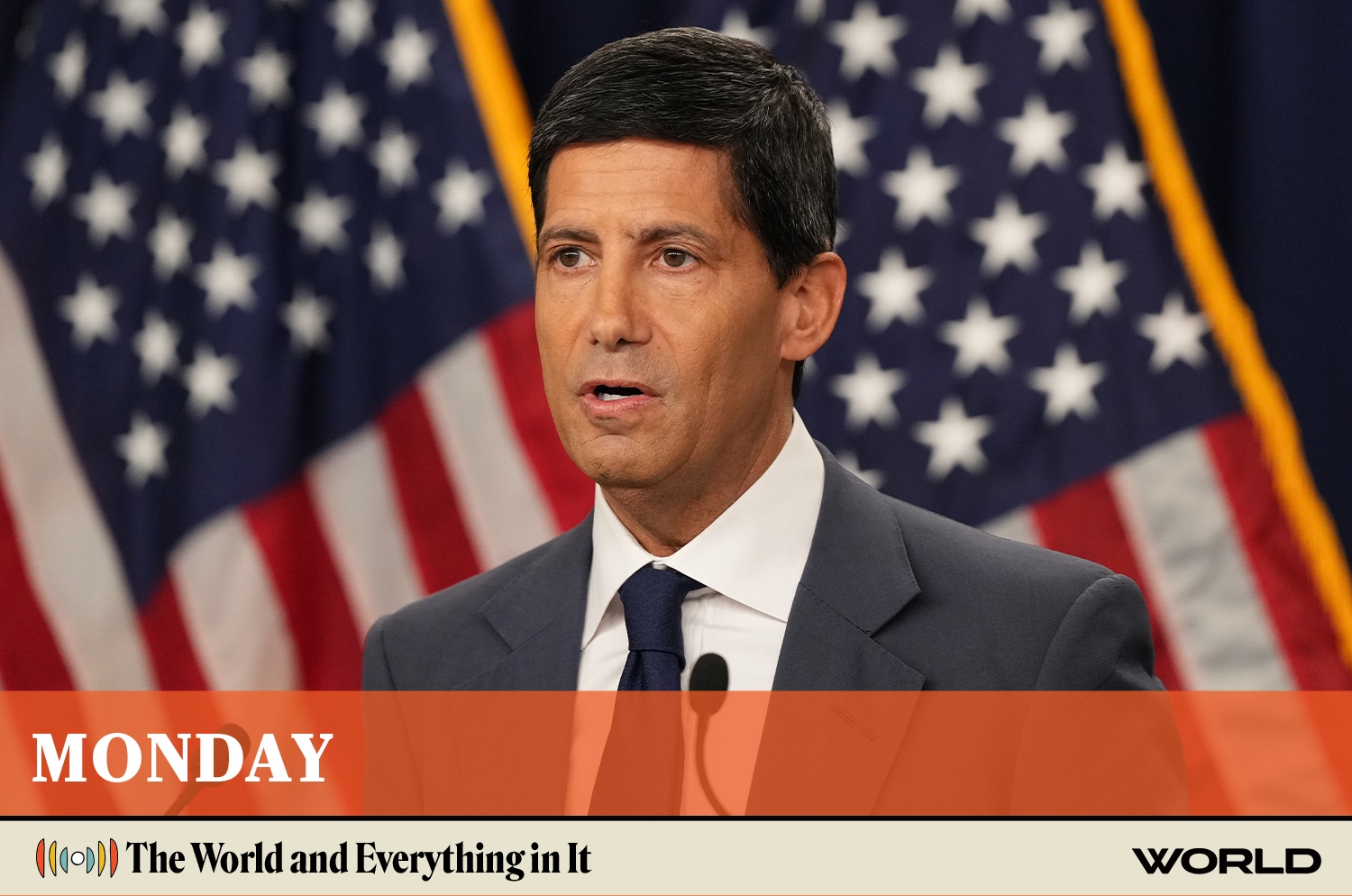
Federal Reserve Board Chairman Kevin Warsh speaks during a news conference at the Federal Reserve, Wednesday. Associated Press / Photo by Julia Demaree Nikhinson
Editor's note: The following text is a transcript of a podcast story. To listen to the story, click on the arrow beneath the headline above.
MARY REICHARD, HOST: Good morning!
Websites track you all over the internet. But can they share that information without your permission? The Supreme Court takes up a piece of that question.
AUDIO: You have two very simple solutions. One is to get consent. … And the other is to stop selling people’s private information. …
NICK EICHER, HOST: That’s ahead today on Legal Docket.
Also today the Monday Moneybeat. Lots of grumbling about the economy with Election Day so near … but we’ll look at the numbers.
And the WORLD History Book:
DODSON: The tomb and its treasures are a way for people to access ancient Egypt.
The story of the boy king.
REICHARD: It’s Monday, November 2nd. This is The World and Everything in It from listener-supported WORLD Radio. I’m Mary Reichard.
EICHER: And I’m Nick Eicher. Good morning!
REICHARD: Up next, Mark Mellinger with today’s news.
MARK MELLINGER, NEWS ANCHOR: Trump on midterms » Candidates across the country are making one final campaign push on election eve. Vice President JD Vance is in his home state of Ohio today, hoping to give Republican candidates a late boost.
On Sunday, President Trump campaigned in Iowa for Republican Ashley Hinson.
TRUMP: Just two days from now, the people of Iowa are going to elect Ashley Hinson -she’s phenomenal, by the way- to the United States Senate.
Hinson leads Democrat Josh Turek in the most recent polls, but it’s tight. Her lead is only about two points.
And hours later, the president stumped for Republican Senator Roger Marshall in Kansas, where the latest polls give Marshall’s challenger, Democrat Adam Hamilton, a two-point lead.
Democrat endorses Rogers in Michigan Senate race » Those are a couple of just a handful of races expected to decide control of the U.S. Senate. Another is in Michigan, where Republican Mike Rogers just picked up a big last-minute endorsement.
Haley Stevens, the Democrat Abdul El-Sayed defeated in the Senate primary race, announced Sunday:
STEVENS: 90% of the votes I'm gonna cast are gonna be for Democrats. My vote for Senate, I am just one vote, as is every Michigander. My vote for Senate is gonna be with Mike Rogers.
Stevens’s comments came on the same day she attended a Sunday morning church service with Rogers.
There’s been tension between El-Sayed and Stevens ever since their primary ended. Stevens is a strong supporter of Israel, while El-Sayed has been a frequent critic of the Israeli government.
Senate Minority Leader Chuck Schumer called Stevens’ endorsement of Rogers “a despicable betrayal.” President Trump called the move “very brave” and said he'd like to see Stevens switch parties. El-Sayed insists the endorsement won’t matter.
Other Senate races latest: Texas, Arkansas » Democrats in Texas are hoping this year’s elections will yield that state’s first Democratic senator in more than 30 years. Polls show Democrat Sam Talarico with less than a two-point edge over Republican Ken Paxton.
Both men were on the campaign trail this weekend, with Talarico proclaiming…
TALARICO: We are going to shock the nation, shock the world when we beat the billionaires and take back Texas.
Meantime, Paxton warned:
PAXTON: [If] we lose Texas, we lose America.
And in Alaska’s closely-watched Senate race, polls show Democratic challenger Mary Peltola with a two-point lead over Republican Senator Dan Sullivan.
Sunday, a federal judge dismissed a Justice Department lawsuit seeking to block certification if Sullivan loses. The DOJ cited the presence of another candidate on the ballot who shares Sullivan’s name, a candidate the New York Times says Peltola’s campaign helped recruit to serve as a decoy, something Peltola denies.
GOP Senator Tim Scott on NBC’s Meet the Press:
SCOTT: You can’t trust Mary Peltola’s campaign and the collusion between her campaign and the DSCC.
DSCC is short for Democratic Senatorial Campaign Committee. Democrats say there are plenty of races across America featuring candidates of the same name. The Justice Department is appealing the judge’s ruling.
Right now, Republicans hold a 53-to-49 edge in the Senate, and have the vice president in their corner to break any ties. That means Democrats need a net gain of four seats in Tuesday’s elections to take control.
Florida plane crash » Nine people are dead after a jet nosedived into a neighborhood in Palm Beach County, Florida Sunday afternoon, erupting into a giant fireball.
Florida Governor Ron DeSantis:
DESANTIS: Obviously this was a cataclysmic plane crash. It looked like missile going down. It left a big crater on the side of the road.
The Learjet had taken off from Austin, Texas and was on its way to the Bahamas. Everyone on board died. There were no reports of injuries to anyone on the ground, though hundreds of people had to scramble to find shelter, because the crash scene blocked the entrance to their mobile home park.
The National Transportation Safety Board says this is the U.S.’s second-deadliest plane crash this year. Minutes before the crash, the pilot reported ice accumulation on the plane and moderate turbulence. Soon after, the jet descended 27,000 feet over the course of one minute.
Iran attacks could resume soon » Fighting in the U.S. war with Iran could ramp back up after Tuesday’s midterms. The Guardian reports countries in the Middle East are braced for the worst.
Negotiators in Qatar spent the weekend trying to mediate a deal in which Iran would reopen the Strait of Hormuz and restart nuclear talks... in exchange for the release of billions of dollars in Iranian assets.
Iran’s top leader, Ayatollah Khomeini, has warned the U.S. against resuming attacks. But last week, President Trump hinted escalation could be coming.
TRUMP: It’s a question [of] when do I want to end it? Simply a question of when do I want to end it?
The U.S. has reportedly warned allies in the Middle East of a possible short but intense renewal of attacks on Iran.
However, the White House is also signaling openness to another path. Secretary of State Marco Rubio said over the weekend -quote- “If there is a diplomatic solution, we would be open to it.”
Congo Ebola deaths top 5,000 » More than 5,000 people have now died in the Democratic Republic of Congo’s Ebola outbreak, the second-deadliest on record. WORLD’s Benjamin Eicher reports:
BENJAMIN EICHER: The country’s health ministry has reported more than 10,000 cases since declaring the outbreak in May. About half have died.
And health workers are struggling to reach people in time. The World Health Organization says about a third of the deaths happened outside treatment centers.
Fighting and attacks on health workers are slowing efforts to contain the virus. Some workers have also walked off the job after months without pay.
The outbreak has spread beyond Congo, with cases reported in Kenya and Nigeria.
There is not yet any approved vaccine for the strain of Ebola driving outbreak. But early medical care can help patients survive.
For WORLD, I’m Benjamin Eicher.
And I’m Mark Mellinger.
Coming up, the Supreme Court weighs how an old law that could affect privacy in the internet age. Plus, the discovery of King Tut’s tomb.
This is The World and Everything in It.
NICK EICHER, HOST: It’s The World and Everything in It from WORLD Radio, celebrating 15 years. Today is Monday the 2nd of November.
Thanks for making us part of your morning routine. Good morning. I’m Nick Eicher.
MARY REICHARD, HOST: And I’m Mary Reichard. It’s time for Legal Docket.
REAGAN ARCHIVE: President Reagan announces Robert Bork’s nomination to the Supreme Court.
This was 1987. President Reagan choosing a nominee for the Supreme Court.
Opposition came almost immediately.
KENNEDY ARCHIVE: “Robert Bork’s America…” [Excerpt from July 1 floor speech.]
EICHER: Outside groups got involved, enlisting celebrities like movie star Gregory Peck.
PECK COMMERCIAL
REICHARD: The opposition threw everything it had at Bork. But in the middle of the confirmation fight, someone crossed a line.
EICHER: A reporter for a Washington newspaper got hold of Bork’s video-rental records. A list of 146 movies he and his family had rented.
REICHARD: Nothing scandalous in the list. But the fact that someone could obtain those records without permission caused an uproar in Congress.
EICHER: Even senators who opposed Bork’s nomination condemned the invasion of privacy.
BIDEN ANNOUNCES NEGATIVE COMMITTEE VOTE
Bork’s nomination ultimately did fail. But the privacy controversy produced something lasting.
REICHARD: That’s right, one year later in 1988, Congress passed the Video Privacy Protection Act. V-P-P-A.
It prohibited video-rental businesses from disclosing customers’ viewing records without consent, subject to limited exceptions.
EICHER: Now, fast-forward almost four decades.
Michael Salazar signed up for a free email newsletter from 24-7-Sports. That’s a website owned by Paramount Global. He also watched videos on the site while he was logged into Facebook.
He says the site secretly shared his identity and his viewing history with Facebook even though he’d not given consent. So he sued Paramount, alleging violation of the V-P-P-A.
REICHARD: But there’s a catch: Salazar subscribed to a newsletter, not a video service.
Lower courts said that mattered and dismissed the case. That law didn’t fit these facts.
And at the Supreme Court, Paramount’s lawyer Paul Clement argued that Congress meant exactly what it wrote: to protect video customers, not every person who just happens to watch a video online.
Clement said Salazar’s lawyers are trying to make an old law solve a new problem.
CLEMENT: For years, the statute worked as designed. Personal protection of…information of video consumers was protected, and there was virtually no litigation under this statute. Then, however, the plaintiffs' class action bar discovered the VPPA and its statutory and punitive damages.
EICHER: For the other side opposed to disclosure of personal info, Salazar’s lawyer, Joshua Hammack.
HAMMACK: And that shift did not occur because plaintiffs suddenly woke up one day and discovered the Video Privacy Protection Act. It occurred because of the advent of pixel technology.
Tracking pixels. These are tiny bits of code embedded in websites. They tell marketers the pages you visit and the videos you watch. If that information gets linked to your identity, it allows whoever has it to build a detailed picture of your online activity …
HAMMACK: … including the personally identifiable information specifically defined in this statute.
REICHARD: A kind of legal jiu-jitsu followed, with the justices coming up with some unlikely hypotheticals.
Justice Samuel Alito envisioned this one:
ALITO: Let’s say I got gas at a Costco or a Sam’s Club. And then I’m having a conversation with my neighbor who’s complaining about the high cost of gas and he says, I had to pay X per gallon. And I said: Well, I paid X minus 20 cents. And he says: Wow. Where did you get your gas? And I say: I got it from a provider of optical services because Sam's Club and Costco have optical services as well. Now…I would just be playing games if I said that, wouldn't I?
Not necessarily, Hammack countered. A business can sell several kinds of products. And he came up with an even weirder purchase:
HAMMACK: Maybe I was feeling really brave at the gas station and I got sushi. That's a good or service from -(Laughter.) --a gas station, but it's not a fuel good or service, and it's certainly not the fuel that you would normally buy at a gas station.
EICHER: Making the point that businesses sell all kinds of things. So which consumer does the law actually protect?
REICHARD: Clement warned that Salazar’s interpretation would sweep in almost any business that puts videos on its website.
Chief Justice John Roberts wasn’t buying into the easy examples.
ROBERTS: You've picked some hypotheticals that are particularly helpful for you. Chick-fil-A, you don't think of that as anything other than chicken. But there are a lot of stores that sell a lot of different things, including the type of videos that we're talking about. And so I don't know why we should focus just on the easy hypotheticals.
CLEMENT: Well, it's sort of my job to focus on the easy hypotheticals. (Laughter.) But I think, if you—
ROBERTS: I would think your job is to focus on the hard ones - (Laughter) --at least from our point of view.
Justice Elena Kagan came at it from another angle. Suppose a judge watched some questionable sports videos online…
KAGAN: And then it turns out that the judge watches some pretty funky sports videos, you know, like a lot of women wrestling or something. (Laughter.) And that’s embarrassing.
Clement tried to reassure her:
CLEMENT: I mean, I think it's hard to watch a lot of embarrassing videos on 247Sports based on my perusal of it. But, like, you know…maybe, like, watching, you know, Chicago Bears films is embarrassing in certain parts of the country….The point is, though, it shouldn't turn on whether you also subscribed to a free online newsletter, a free email newsletter.
EICHER: Levity aside, the serious question is whether a law written for video rental stores applies to the way websites share personal information now.
Justice Brett Kavanaugh wondered if that would turn an old privacy law into something never anticipated at the time: internet ads.
Justice Kagan offered a solution:
KAGAN: Well, this statutory language, you know, it is relatively clear ... .You have two very simple solutions. One is to get consent. Easy enough. People do it every day. And the other is to stop selling people's private information. Take your pick.
REICHARD: Clement was skeptical it works quite that way.
CLEMENT: I'm just not sure the consent is going to be easy as you imagine.
And therein’s the tension. Internet companies depend upon targeted ads for all that “free” service we get. And we consumers might never know who is watching what we are watching.
So the justices have to decide how far a privacy law from the age of video rental stores goes in this digital age. Or, Congress could just write better, updated laws.
EICHER: Alright this last case today turns on two rounds of ammunition.
A man named Kendrick Jarrett Beaird pleaded guilty to possessing a firearm as a convicted felon. His criminal history was long; here, police found him with a Glock pistol and a magazine that could hold 17 rounds.
REICHARD: And that number is important, because a tougher penalty attaches when a semiautomatic firearm can accept a large-capacity magazine.
EICHER: Here’s the trouble, though. The federal guidelines don’t say how large “large capacity” is.
Accompanying commentary says more than 15 rounds is large capacity.
The judge relied on that explanation and sentenced Beaird to six years in prison.
REICHARD: But Beaird argues that the explanation ought not carry the same authority as the guideline itself.
You can think of it like this: Who gets the final word on what the rules mean? The people who write them, or the judges who apply them?
EICHER: Justice Ketanji Brown Jackson once served on the Sentencing Commission. She said the guidelines and the explainers go together.
JACKSON: And I think we sort of have a fundamental misunderstanding of how the manual works because the guidelines and commentary are actually inextricably linked. And what I mean by that is that sentencing judges use the Guidelines Manual to do what is essentially a calculation. It's kind of like math…
But if the Supreme Court changes how judges use those explanations, then what happens to sentences that are already imposed? Justice Alito brought up a 1993 decision that said the commentary is binding unless it meets certain exceptions:
ALITO: Mr. Feigin, what would be the practical consequences of overruling Stinson? I'm told that there were 66,000 defendants sentenced in federal courts, federal district courts, in 2025. Do you have an estimate of how many of those sentences relied on commentary and would have to be done over?
The government’s lawyer didn’t have a number, but he said many sentences would remain valid.
Justice Sonia Sotomayor worried that without commentary, judges would reach different conclusions and thereby undermine consistency in sentencing.
REICHARD: The Court also appointed a lawyer to defend the way things are done now. Here’s Anthony Dick to make that case:
DICK: It is emphatically the province of the judiciary to say what the law is, but the advisory sentencing guidelines are not the law. They are advisory.
He argues the sentencing guidelines are useful for judges to consider, but they are responsible to interpret legal texts independently, not forced to impose a certain sentence.
For Beaird, the dispute revolves around a magazine holding 17 rounds instead of 15, a difference that contributed to a longer sentence. For the federal courts, a decision here could change how judges calculate the recommended prison sentences for thousands of criminal defendants.
And that’s this week’s Legal Docket.
MARY REICHARD, HOST: Coming next on The World and Everything in It: The Monday Moneybeat.
NICK EICHER, HOST: Time now to talk business, markets, and the economy with financial analyst and advisor David Bahnsen. David heads up the wealth management firm, the Bahnsen Group, and he is here now. Good morning, David.
DAVID BAHNSEN: Good morning, Nick. Good to be with you.
EICHER: Well, David, the Nasdaq fell nearly 3% on Friday, finishing up October down more than 5%. That’s the worst month since March of last year. Technology stocks took a lot of the beating, which of course leads to your latest Dividend Cafe, in which you raise a concern I don’t think we’ve really explored all that much: the borrowing that is financing all of the AI spending.
And you point to rising costs for something called credit default swaps, essentially insurance or protection against borrowers failing to repay debts. But you say that doesn’t necessarily mean that investors expect these companies to go into default. So help us understand the danger specifically that you’re talking about and how it connects to what’s going on in the markets.
BAHNSEN: Yes, well, one thing I will say, just because we often are here to talk about money and markets, and even though I like to avoid talking our own book, I think it’s relevant at a higher level that while October ended up being a really difficult month for Nasdaq, tech, AI, it was not a terrible month for all of the stock market. In fact, it was one of the biggest months in history for dividend growth equities.
And I say that to point out that there are sometimes where everything is dropping, and there are other times where everything is going up, but there are other times—what we refer to as a rotation—where people are moving from some of the frothier, riskier aspects of the market and into things that might be a little more sensible and reasonable. And October was not just one of those months, but it was one of those months in spades.
Now look, it could reverse in a heartbeat, but I want people to understand that the underlying dynamic in the market right now is much more rotational than risk-on or risk-off. And when you talk about the rotation out of tech and the risks you mentioned in AI, a credit default swap is essentially a derivative that functions as insurance against a bond, a credit instrument, defaulting. And the costs have gone way up, and yet they’ve gone up more or less proportionate to the amount of new issuance. There’s a ton of new bonds, a ton of new debt, and therefore there’s a lot more insurance that has come out.
But when you look at the cost going up of Microsoft or Meta or double A, triple A—you know, rock-solid companies that have virtually no chance of defaulting without Armageddon—that speaks to the fact that people want to buy more of this debt, and to do so they have to take some of the risk off their books by buying more insurance against it. So it’s a liquidity issue. There’s a limit to liquidity, and then that pushes the price up.
And I could make this even more complicated. Believe it or not, that’s me trying to make it simple, but it is very multi-party and interconnected, and it’s opaque, and that is a basic, surefire recipe for more risk in the system. I am not talking about 2008 risk. I’m not talking about something that bleeds into your local bank, but I am talking about investor risk. And unfortunately, it’s an investor risk I don’t think enough investors are paying attention to.
EICHER: Well, moving from the market specifically into the economy more broadly, David, we’ve come to the end of a month, as we mentioned, but also September was the end of a quarter, and it took a couple of weeks for the government to generate its first estimate on economic growth. We got that last week. GDP coming in at a 3.4% annual rate in quarter three. That’s good growth. It’s strong growth.
But the same day, we got another major report showing the Federal Reserve’s preferred gauge of inflation running at 3.6% over the past year. Now, the day before those reports, the Fed had gotten together, voting to keep its benchmark interest rate where it was. Fed Chairman Kevin Warsh saying that most of his colleagues don’t believe the economy is running too hot. He’s argued that improvements in productivity actually can support faster growth without necessarily being inflationary. So, how do we distinguish healthy economic growth from an overheating economy?
BAHNSEN: Right now, we know these two things about the economy: prices have continued moving higher, and real growth has been positive, but not fantastic. This 3.4% annualized for Q3 means that we are going to end up being at about 2% on the year, because you’ve got to remember, we had some lower quarters earlier in the year.
Now, real GDP means you’re taking nominal GDP and deflating it by the amount of inflation. So that 3.6% PCE, that 3.4% CPI, these things that indicate prices going up, that’s hurting the real GDP growth. You’re deflating it by a higher inflation number.
So here’s the issue we face: the real GDP growth is not great, other than the one thing making it great, which is a lot of investment and capex in AI, data center construction, etc. If those things all play out, that’s the most disinflationary force of my lifetime.
I don’t think anybody can speak to what that will be in 10 and 20 years. Chairman Warsh is confident, as am I, that we should get enhanced productivity in the next several years, but in the meantime, as they make decisions month by month and quarter by quarter, I think that it remains precarious. It remains a jump ball. You get a good jobs number one month, and you get a bad inflation number one month.
But what you’re not getting from this chairman—and I can’t say this enough, that I think is so good and so important—is him conflating an overheating economy with growth. Overheating could mean a reckless bubble mania, and it could also mean high inflation, prices moving higher. But I think that growth speaks to productivity and production of goods and services, and we should all embrace growth without falling for the error of believing it is always inflationary, because it is most certainly not always inflationary.
EICHER: All right, David. Another economic milestone, and you know how we journalists love our economic milestones. This is not a happy one. The Wall Street Journal published a piece reporting that the federal debt held by the public—this is a different number—the federal debt held by the public stood at about 100% of GDP at the end of the fiscal year. That is roughly $32 trillion, or equal to an entire year’s economic output.
Now, we talk about these debt milestones frequently enough, and the Journal’s weekend piece also poses a question: Where have all the fiscal hawks disappeared to? So, we’ve talked often about the debt problem, but why do you think the political incentive to do anything about it seemingly has just gone away?
BAHNSEN: Well, first of all, for those listening that are worried that they’re suffering from déjà vu, the Journal ran a bizarre story because we did not just reach 100% debt to GDP. We did it six months ago, and then GDP grew a little, but the debt grew a little. So they’re just re-headlining the same story as both of these numbers move a little bit. And I guess it helped get some new clicks to repeat the headline.
EICHER: Yeah. I clicked right on it.
BAHNSEN: Well, we’re at 100% debt to GDP, public debt to GDP. We have been, we will be, and it will go higher. And the real story, because they buried the lede, is where are the fiscal hawks?
And here’s your answer: the fiscal hawks are Democrats when Republicans are in power, and they are Republicans when Democrats are in power. That’s the fiscal hawks. There are no fiscal hawks that are Republicans when Republicans are in power, or vice versa.
So you recall the Biden administration wanted to do Build Back Better, a huge spending bill, when President Biden was in office. Now they say they’re fiscal hawks, and they want to see big tax increases when President Trump’s in power. Likewise, Republicans have been guilty of this for most of my adult lifetime.
There is no fiscal hawk other than a limited group of people—I’m proud to consider myself one of them—that believe whoever is in power is irrelevant. The time is now to address the spending issues and to generate pro-growth policies that will address that ratio of our public debt relative to our GDP.
EICHER: All right, David Bahnsen, founder, managing partner, and chief investment officer of the Bahnsen Group. David writes each week at dividendcafe.com. We’ve got links to David’s latest Dividend Cafe in the episode notes. So as you’re looking at your podcast player, just tap the episode headline, and you will find those links right there. David, thank you. We’ll talk to you next time.
BAHNSEN: Thanks so much, Nick.
NICK EICHER, HOST: Good morning! This is The World and Everything in It from listener-supported WORLD Radio. I’m Nick Eicher.
MARY REICHARD, HOST: And I’m Mary Reichard. Up next, the World History Book.
This week marks the anniversary of one of the most remarkable archaeological discoveries of the 20th century.
WORLD’s Emma Eicher has the story.
EMMA EICHER: It was November 4th, 1922, when archaeologist Howard Carter made the discovery of a lifetime. He was digging in Egypt’s Valley of the Kings—where ancient pharaohs were buried.
Carter recalled his initial feelings in this 1936 interview with BBC Radio:
HOWARD CARTER: I suppose most excavators would confess to a feeling of awe, almost embarrassment, when they break into a tomb closed and sealed by pious hands so many centuries ago.
Carter hadn’t found just any grave—it was the intact tomb of the boy king, Tutankhamun.
AIDAN DODSON: Tutankhamun was a king of Egypt who ruled during the 14th century B.C. …
That’s Aidan Dodson, professor of Egyptology at the University of Bristol. He says Tutankhamun became pharaoh at only 9 years old, and died at 18 or 19. When Carter found the grave—a little more than three thousand years later—it was the only one belonging to a pharaoh that hadn’t been robbed.
Dodson says that was because of a fortunate accident.
DODSON: They had cut the tomb very very deep in the valley, and flooding, which took place not long after the burial, had completely obliterated the tomb, so it was buried under meters of debris, most of which was solidified like concrete.
Carter and his sponsor, Lord Carnarvon, had been excavating in the Valley of the Kings for years without much success. Working from a list of pharaohs buried here, they knew Tutankhamun had never been found. So they decided to dig in an untouched area of the Valley.
DODSON: They found a step cut in the rock, and it was fairly clear, given all the layers which had been above it, that it hadn't been touched since at least about 1100 BC.
But it would be weeks before Carter would see what was underneath the layers. Carnarvon was in the U.K. at the time and Carter had to send for him. He finally arrived with his daughter and they started exploring.
They found that the outermost door had been broken and resealed. Dodson says modern experts theorize that robbers had gotten into the first room, then were caught in the act.
DODSON: The resealing shows that the police clearly had caught them at it. And it looks like probably within a fairly short time of that being done is when one of these flash floods happens.
Carter made a small hole in the second doorway to the rest of the crypt. He put a candle through it to see the other side:
DODSON: His eyes get accustomed to the light … he starts seeing glitters of gold …
Behind him, Carnarvon asked, “Can you see anything?”
DODSON: … He says, ‘Wonderful things.’
Carter’s team set to work. They carefully numbered, catalogued, and photographed each of the 5000 artifacts.
In 1924, Carter finally approached Tutankhamun’s sarcophagus.
CARTER: In a dead silence the huge lid, weighing over a ton and a quarter, was raised from its bed. Light shot into the sarcophagus …
He was disappointed to see only linen shrouds. But after the team had unwrapped them.
CARTER: A gospel wonderment escaped our lips! So gorgeous was the sight that met our eyes. A golden effigy of the young king of magnificent workmanship filled the whole of the interior. This was but the lid of a series of three coffins, nested one within the other, enclosing the mortal remains of the young King Tutankhamun.
The discovery shook the world—because at that point, no one had ever found such a well-preserved tomb of a pharaoh. A time of so-called Eygptomania fell over the West.
DODSON: Egypt was probably more in people's faces than it's ever been before or since, and it influences art. It influences literature, it influences fashion to some degree …
And it launched theories of the pharaoh’s curse … a legend that disturbing a tomb or mummy would bring bad luck, disease, and even death.
Lord Carnarvon’s untimely passing early into excavations kicked off that superstition.
DODSON: He had been bitten on the face by a mosquito. You just don't shave for a couple of days and wait for it to heal. Unfortunately, being an earl, you know earls don't wander around unshaven. So he shaved, took the top off it, it got infected, and he died.
A journalist at the British newspaper The Daily Mail also started spreading unfounded rumors of people dying because of the curse. And it stuck.
DODSON: Here we are, you know, over over 100 years later, still talking about the curse, which you know never existed, but it's taken its own existence.
It took a decade for Carter and his team to fully excavate the tomb. Many of the artifacts were first displayed at the Egyptian Museum in Cairo. International tours later traveled the globe with some of the treasures.
Last year, the Grand Egyptian Museum in Giza brought the entire collection of artifacts together for the first time in roughly a century.
Dodson says the discovery was celebrated in both academia and culture, and that helped its popularity to endure.
DODSON: There's sort of the academic side about what it actually has revealed. Beyond that, though, the tomb and its treasures are a way for people to access ancient Egypt. I don't think anybody has sort of captured the international imagination, the way that Tutankhamun and his tomb have done.
About half of the royal tombs in the Valley of the Kings remain undiscovered, while archaeologists continue their efforts to find them.
That’s this week’s WORLD History Book. I’m Emma Eicher.
NICK EICHER, HOST: Tomorrow … a former U.S. foreign-service officer on getting through a tense political season.
And how homeschooling went from the fringes to the mainstream. That and more tomorrow.
I’m Nick Eicher.
MARY REICHARD, HOST: And I’m Mary Reichard.
This is episode 3521 of The World and Everything in It, from WORLD Radio. WORLD’s mission is biblically objective journalism that informs, educates, and inspires.
The Bible says: “In this is love, not that we have loved God, but that He loved us and sent His Son to be the propitiation for our sins. Beloved, if God so loved us, we also ought to love one another. No one has ever seen God; if we love one another, God abides in us and His love is perfected in us.” —1 John 4:10-12
Go now in grace and peace.
WORLD Radio transcripts are created on a rush deadline. This text may not be in its final form and may be updated or revised in the future. Accuracy and availability may vary. The authoritative record of WORLD Radio programming is the audio record.
Please wait while we load the latest comments...
Comments
Please register, subscribe, or log in to comment on this article.