
The World and Everything in It: August 26, 2026
A familiar name wins a divided Senate primary, and Hunter Baker weighs what carried Darline Graham across the finish line before turning to presidential power over voting and welfare reform at 30. In Afghanistan, women find one narrow economic opening under Taliban rule. Plus: an old railway comes back to life, a baby arrives riding shotgun, and Janie B. Cheaney makes room for silence.
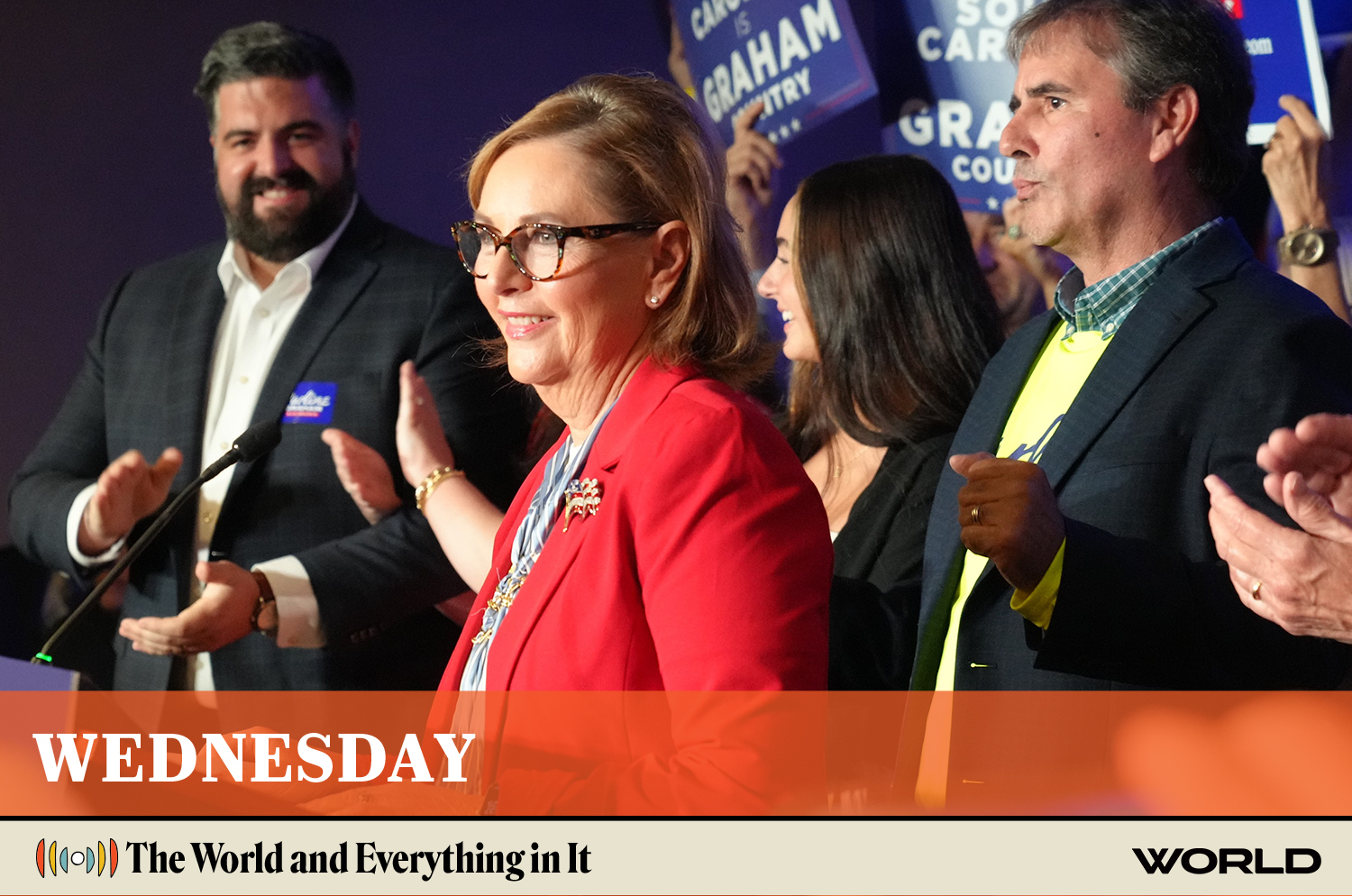
Sen. Darline Graham, R-S.C., gives a speech to supporters after winning a special Republican primary runoff in Columbia, S.C., Tuesday Associated Press / Photo by Meg Kinnard
Editor's note: The following text is a transcript of a podcast story. To listen to the story, click on the arrow beneath the headline above.
LINDSAY MAST, HOST: Good morning!
Darline Graham wins the GOP nomination for her late brother’s Senate seat in South Carolina. Was it the family name, was it the president’s endorsement, or was it her own appeal.
NICK EICHER, HOST: Washington Wednesday is coming up with Hunter Baker.
Also, today World Tour: Life for women five years after the Taliban took Afghanistan.
Later: how an abandoned railway tunnel became a center of community life.
ANNAND: I don't think anybody had the idea that 8,000 people would turn up, but they did.
And WORLD Commentator Janie B. Cheaney on a digital detox.
MAST: It’s Wednesday, August 26th. This is The World and Everything in It from listener-supported WORLD Radio. I’m Lindsay Mast.
EICHER: And I’m Nick Eicher. Good morning!
MAST: Up next, Kent Covington with today’s news.
SOUND: [Graham watch party]
KENT COVINGTON, NEWS ANCHOR: Elections » Voters pulled the proverbial lever in three states on Tuesday. And South Carolina was one of them, where the sister of the late Sen. Lindsey Graham won the nomination to succeed him.
GRAHAM: So, South Carolina Republicans, I humbly accept your nomination to serve as the Republican nominee for the United States Senate…
Graham, who enjoyed President Trump’s endorsement, defeated GOP Congressman Ralph Norman by roughly 5 percentage points.
She’s already serving in the Senate, appointed by Gov. Henry McMaster last month to serve out the rest of her late brother’s term.
In Oklahoma, Mike Mazzei won a GOP primary runoff for governor. Also in Oklahoma, another socialist won a Democratic primary. N’Kiyla Jasmine Thomas won her party’s nomination for US Senate.
And another hard left Democratic candidate also won in Georgia, as Everton Blair won a special House runoff for a US House seat.
Iran latest » Iran remains defiant in the face of heavy new sanctions. WORLD’s Kristen Flavin has that story.
KRISTEN FLAVIN: A projectile knocked out an oil tanker's engine room in the Strait of Hormuz. The crew is safe, and no one has claimed responsibility. But it came hours after Treasury Secretary Scott Bessent unveiled what he calls the greatest financial offensive ever. The new sanctions hit roughly 60 people, companies and ships tied to Iran's covert oil trade.
President Trump then declared the strait clear of mines, saying every one in international waters has been detonated or removed, and any boat laying new ones will be destroyed.
No outside authority has yet confirmed that.
Iran's economy minister says Tehran has a two-year plan to ride out the sanctions.
Tankers are still crossing, but at about a quarter the volume before the war.
For WORLD, I’m Kristen Flavin.
Canada trade war » Canada is firing back in the trade war with the US, announcing new tariffs in retaliation for duties President Trump tacked onto Canadian goods over the weekend.
Starting September 8th, Canada will tax about 20 billion dollars' worth of American goods. Tariffs range as high as 50 percent, targeting products including steel, aluminum, dairy and appliances.
Canadian Finance Minister Francois-Philippe Champagne says the prime minister did all he could:
CHAMPAGNE: But ultimately, the terms proposed by the US administration were uneconomic, unfair, and unacceptable.
Canada says American negotiators wanted a say over Canada's trade deals with other countries, among other things. Saturday, the U.S. put 50 percent duties on roughly $20 billion in Canadian goods. Trump says tariffs on Canadian cars, trucks, and auto parts double to 50 percent in January.
Doug Ford, Premier of Ontario called the US tariffs an “unprovoked attack by President Trump.”
FORD: We love the American people, we love the U.S., uh, and it's unfortunate that, uh, President Trump has taken this avenue.
But Lisa McClain, Chair of the House Republican Conference, says it's Canada that is being unfair. For one thing, she says … Canada is telling other countries they can dodge U.S. tariffs by shipping products through Canada … to pretend their goods are actually Canadian.
MCCLAIN: Sell your products and ship your products through Canada, and we'll, we'll make sure that you don't have to pay your tariffs. Well, that doesn't sound like a really good partner to me.
She says the U.S. tariffs are just, adding that since the 1990s:
MCCLAIN: The Canadians have tariffed our farmers and dairy products at 250%, since the 1990s.
Mexican beef » While tariffs climb up north, President Trump is temporarily lowering them down south in a bid to ease beef prices. But some Senate Republicans don’t like it.
WORLD’s Harrison Watters has more from the nation’s capital.
HARRISON WATTERS: Mexican beef cattle started crossing into Arizona this week as part of the President’s effort to lower beef prices. The Agriculture department closed the border to Mexican beef last summer to combat cases of a pest known as the new world screwworm. But that led to a supply shortage.
Agriculture Secretary Brooke Rollins broke down the numbers:
ROLLINS: In that 14, 15 months, that equals about a million point four head of cattle that would have come into our country that did not, and those are all lean cattle. That's all ground beef cattle, basically.
WATTERS: President Trump said the U.S. will temporarily allow 300,000 metric tons of ground beef into the country without import taxes.
Critics warn the move could hurt domestic ranchers by making them compete with cheap alternatives. And several GOP senators warned the move would not fix underlying problems for the nation’s shrinking cattle herds.
A farm bill, with provisions to help cattle ranchers, is stuck in committee until the Senate returns next month.
Reporting for WORLD, I’m Harrison Watters in Washington.
Dolly Parton obit » America has lost a country music icon.
MUSIC: [Jolene]
Dolly Parton died on Tuesday. The singer-songwriter was known for hits like Jolene, I Will Always Love You, Coat of Many Colors and many more.
Already a regular atop the country music charts, in 1980, she hit the big screen co-starring in the comedy 9-to-5.
MUSIC: [ 9-to-5]
She wrote and performed the hit theme song of the same name, which earned her two Grammy Awards and an Oscar nomination.
She went on to open a critically acclaimed theme park, Dollywood, in Tennessee, and was known also for her charity work.
She remarked in an interview last year:
PARTON: Well, I don't think about my, my life in terms of superstar. I'm just a working girl. I always say, and it's the truth, that I am a workhorse that looks like a show horse
Tributes have poured in from the entertainment industry and beyond, including from Tennessee Gov. Bill Lee:
LEE: There's always someone criticizing someone for something, but not with Dolly. And it, it speaks to this unique, uh, ability she had to love people, uh, and to genuinely love them
President Trump called her “one of the greatest Country singers, and far beyond, EVER.” He ordered flags lowered to half staff for one week in her honor.
Parton's representatives said she died after a brief battle with cancer. Dolly Parton was 80 years old.
I'm Kent Covington.
Coming up, women in Afghanistan navigate the oppressive rule of the Taliban. Plus, an old railroad tunnel gets it’s second wind.
This is The World and Everything in It.
LINDSAY MAST, HOST: It’s Wednesday, the 26th of August. Glad to have you along for today’s edition of The World and Everything in It.
Good morning. I’m Lindsay Mast.
NICK EICHER, HOST: And I’m Nick Eicher. Time now for Washington Wednesday, and joining us is Hunter Baker.
He’s a senior fellow for Civic Renewal and Religious Liberty at First Liberty Center for Religion, Culture, and Democracy. He’s also a regular contributor here to WORLD Opinions. Hunter, good morning.
HUNTER BAKER: Good morning.
EICHER: Well, issue one: a Senate seat, a family name, and a party at war.
We begin, of course, in South Carolina, where Republicans have chosen Darline Graham to succeed her late brother, Senator Lindsey Graham.
MAST: Governor Henry McMaster appointed Graham after her brother’s sudden death last month. She had never held elected office. Her opponent, Congressman Ralph Norman, brought nearly two decades of legislative experience.
President Trump went all in for Graham, encouraging her to run, campaigning for her, and telling voters to “pretend I’m on the ballot.”
EICHER: So this became a stark choice: an inexperienced outsider carrying the Graham name and Trump’s endorsement, going against a political veteran who supports the president but doesn’t always defer to him. And so, in the end, South Carolina Republicans went with Graham.
So, Hunter, you told us the South Carolina Republican Party is at war over this. What exactly is the war about?
BAKER: Well, I think that what happened is that there were many Republicans in the state who really disagreed with what one person called the idea of birthright senatorship—that we don’t choose our senators based on the fact that they are a close relative of the person who held the office, especially when they don’t really have experience.
None of that really goes to say that Darline Graham will not be a good senator. She has won this primary. In all likelihood, she will go on to win the general.
But a lot of people are angry because Trump and people who were on Darline Graham’s side went all in on defeating Ralph Norman, and he’s a respected person, as you pointed out.
He had 20 years of legislative experience, about half of that federal, and so the idea that this guy who is a stalwart South Carolina Republican all of a sudden is an enemy to be defeated and destroyed didn’t sit well with a lot of people, and that’s going to linger as a bad taste for quite a while.
MAST: Well, Hunter, President Trump asked voters to treat this as though he himself were on the ballot, and South Carolina Republicans responded by choosing his candidate. How do you see this? Did voters ratify the president’s leadership, the Graham family legacy, or Darline Graham herself?
BAKER: Probably some of all the above. Now, when we say ratify, you’re talking about a very close race, so it was almost a 50–50 race, which goes back to that division that I’m talking about.
But I think that there was tremendous sympathy for her. It was always a part of Lindsey Graham’s campaigns to point out that he had had to raise her after their parents died, and so voters were certainly familiar with hearing about her.
And certainly it’s true that Donald Trump has a lot of power. We’ve seen him get a lot of people elected with his endorsement, and so he put his full weight behind her.
EICHER: So let me try something out here, Hunter. Darline, as you said, was appointed during an extraordinary period of grief. The president endorsed her before she entered the race. Here’s the idea: There’s probably no one in America who has the foreign policy chops that Lindsey Graham had.
There certainly was no one on the ballot last night who could just pick up the phone and talk to Bibi Netanyahu or Volodymyr Zelensky, or any number of American allies. He was simply irreplaceable on foreign policy—not by his sister, not by Ralph Norman.
So, honestly, how much should the difference between the two of them on foreign policy knowledge have mattered? If she inherits the constituent service team that her brother built, she’ll probably work out to be just a completely fine senator. Argue with that point, Hunter.
BAKER: I think that she will do well from the constituent service end of things. I think that will be her strength.
But we only have 100 senators, and so we’re talking about the elite. The American public policy elite sits in the U.S. Senate. And yeah, it’s true that Ralph Norman would not have been the foreign policy whiz that Lindsey Graham was, but he has a lot of expertise with regard to budget and is a strong fiscal conservative.
And so I think that there would have been real value in having somebody there pushing for balancing the budget, pushing for controlling spending. He was one of the people pushing pretty hard for the SAVE Act, so I think that he brought something to the table, and as yet we’re not sure what she’s bringing.
MAST: All right, issue two: the Supreme Court, the president, and voting by mail.
In June, the court ruled states may count ballots received after Election Day if they were cast by Election Day.
EICHER: And then Monday, the court let parts of President Trump’s mail voting order move forward, lifting a lower court injunction because the states had sued too early. The justices did not rule the order lawful, and another injunction remains in place. So, voting procedures have not yet changed, but the administration now has a bit more room to act.
MAST: So, Hunter, here’s the question: Has the court created something of a too-early, too-late trap? States cannot sue now because the policy is unfinished, but may be unable to obtain relief later because the election is too close.
BAKER: Yeah, it’s a good question. There’s an old bit that Groucho Marx used to do where you have a committee taking up new business, and somebody tries to bring it up, and he says, “Well, we’re on the old business right now.”
And after he’s done with the old business, he says, “Now it’s time for the new business.” And the person wants to bring up their new business, and he says, “Well, that’s old business now.”
So the timing just doesn’t work out. My friend Dan McLaughlin at National Review pointed that out, but this is one of those deals where the issue is not judicially what we would call ripe, and I think that is existing in a quasi state.
But rather than go more deeply into that, I think that it’s not a great look for the president to be pushing this from an executive order point of view. Everybody knows that he feels that he was cheated in 2020. So it looks like it’s kind of his vendetta.
He believes he was cheated. He’s trying to change the electoral process sort of through his own fiat, and I really believe that when it comes to how the electoral process works, how our elections work, how campaigns work, we need bipartisan legislation.
We need some patriotic senators and congressmen to work together to help Americans have confidence in how elections are run in the United States today. We’re not going to get there through executive orders because then we’ll just have presidents coming in and reversing themselves every time they’re elected, just like we’ve done with the Mexico City policy on abortion funding. We need to do something more lasting that we can count on.
EICHER: All right. So, in the absence of that, Hunter, the statesmen are just not there. So, what do you see happening next?
BAKER: My prediction is that this is not going to get resolved in time for the midterms. We know that the federal government can regulate federal elections. They can, right?
It’s kind of in the states’ hands, but the federal government can do it. What we don’t know is if the president can do it through executive order. That’s the question that remains.
EICHER: All right. Well, issue three, Hunter: welfare reform at 30.
Saturday marked 30 years since President Clinton signed welfare reform into law. The law ended an open-ended federal entitlement. It added work requirements and time limits. It gave states a bit more control.
MAST: Former House Speaker Paul Ryan argued in The Wall Street Journal that the safety net has since grown into a patchwork of overlapping programs, often creating benefit cliffs as families earn more, but there’s a larger question: whether government should be the principal administrator of compassion in the first place.
EICHER: And that’s the question, Hunter. What did the 1996 welfare reform get right, and where do you think it stopped short?
BAKER: So that legislation was tremendously important. We could also look at it as politically important.
Bill Clinton, I think, had to sign that legislation in order to get his second term, because you had Newt Gingrich and the Republicans after that massive 1994 win. So that was the price that he had to pay.
EICHER: Yeah, and Clinton had to go against his own party.
BAKER: That’s right, and it turned out to be a tremendously important piece of legislation. I don’t think people remember this, but what it did was it introduced a limit to welfare benefits, and it introduced work requirements.
So what happened is that you had lots of people. The welfare rolls. I can remember at the time. This is not excessive to say: people said this was the most successful piece of legislation since the GI Bill. So it was extremely effective in getting people off of welfare.
Now, since that time, it has been less successful. It turned into a block program, and I think that states began to use the money to do a lot of different things, a patchwork of this or that, and it didn’t work as well as it had once been designed, and we have forgotten about it.
And in the meantime, I think that we have vastly increased things like Medicaid and food stamps.
MAST: So, Hunter, how do we put this history in the context of the broader crisis of the national debt?
BAKER: Well, people may not recall this, but at the end of the ’90s and the beginning of the 2000s, we actually had balanced budgets and surpluses for, I think, about three years.
So, as we sit here, people at that time were talking about, “Wow, we could actually get on a path to pay off the national debt.” Can you imagine?
We were talking about that not that long ago, and now we seem to be on this crazy, unsustainable path to 40 trillion, in which we regularly have years—individual years—with deficits of more than a trillion, and sometimes even 2 trillion in a single year.
So it looked like we really had things under control. I think, through a combination of war and various national crises like the financial meltdown and then COVID, plus the demographics moving against us, we have a serious budget crisis.
MAST: Hunter Baker is senior fellow for Civic Renewal and Religious Liberty at First Liberty’s Center for Religion, Culture, and Democracy. Hunter, thank you.
BAKER: Thank you.
NICK EICHER, HOST: Coming up next on The World and Everything in It: WORLD Tour.
Today, five years after the United States left Afghanistan and the Taliban retook power, women are shut out of most of public life. But a narrow opening remains: starting a business. WORLD’s Mary Muncy reports.
MARY MUNCY: Before the U.S. pulled out, Marina LeGree’s organization took girls hiking in Afghanistan.
LEGREE: After puberty, girls play a very restricted role as mothers in training, and then mothers, and they shouldn't be seen. They shouldn't be playing.
In 2014, LeGree started a mountaineering school for women called Ascend. She wanted to give girls an activity outside, out of the public eye.
The first parents were a tough sell, but:
LEGREE: If they can trust that we'll take good care of them… then they say ‘yes,’ because Afghan parents again are like any parents; they want the best for their kids.
Things were going well, and the program was growing. There was relative freedom in the country as the U.S. government propped up the Afghan government.
Then in 2020, President Trump signed a peace agreement with the Taliban that required U.S. troops to withdraw by the following spring.
THOMAS BARFIELD: There's a reason that neither Obama, Bush, or even Trump one pulled out of Afghanistan.
Thomas Barfield is a professor of anthropology at Boston University specializing in Afghanistan. He says over time many politicians came to see the war as either a 4-billion-dollars-a-year stalemate or an insurance policy against a terrorist government.
BARFIELD: In terms of American politics, no Americans were dying. Afghans were dying, but Americans weren't… The cost was relatively low politically for America, and if it goes bad, it's really bad.
He says former President Joe Biden could have overturned the agreement. Instead, Biden ignored the advice of top generals to leave a limited residual force behind … and ordered all American troops to leave Afghanistan by August 31. The country fell in ten days.
BBC: An American military transport plane on the runway this morning, mobbed by Afghans trying to flee their country.
ABC NEWS: Taliban fighters are now patrolling the streets of the capital and in the presidential palace after–
The president of Afghanistan fled the country.
Ascend helped more than 130 people leave the country. Most could not take their families.
Barfield says this is the third time an internationally propped-up Afghan army has collapsed in the last 50 years.
BARFIELD: Afghanistan people are very sensitive about where power is going. Once the United States pulled out, people decided this government will not stand.
The current iteration of the Taliban is organized. It took over the previous government structures and is using them to maintain control.
They’re oppressive, but he says many Afghans are hesitant to start more fighting.
BARFIELD: Somebody says, ‘They should really get rid of the Taliban.’ On the other hand, if you've seen five governments come and go in your lifetime, maybe you think, I should just be patient.
“Patience” has been Marina LeGree’s strategy.
LEGREE: What I hear from our staff and our participants: It's safer. It's not a war zone anymore. It's cleaner. The streets are more organized.
But those indicators mask the Taliban’s radical repression of women. Afghan women cannot go to school past the sixth grade, and they face severe limits on speaking in public. They must have a male escort at all times and this summer, the Taliban removed a minimum age for child marriage. Professor Barfield says women are more restricted there than in any other Muslim country.
LEGREE: It is gender apartheid. Anything else is it's closing your eyes or lying about it.
Surprisingly, the Taliban government does allow women to start businesses. So in 2024, Ascend reopened as an entrepreneurship school in Kabul.
LEGREE: Early marriage is about economics most of the time. It's not because anybody really loves that solution, but it's a way to, you know, take a mouth to feed and put it in another household and get something in return.
But a woman has more power if she has a way to make money. One woman opened a chicken farm and started hiring her female relatives.
LEGREE: They have impossible choices. You know, they don't want to get married when they're 16 and start having babies, but they don't have free choice.
LeGree can't give them choices. What Ascend can offer is a paycheck, a business, and a reason a family might not marry off their daughter as a child.
Reporting for WORLD, I’m Mary Muncy.
NICK EICHER, HOST: Regena Felix was in labor when she and her husband Frankie arrived at a hospital near Phoenix.
She was monitored several hours, but was just not far enough along.
So the couple was discharged and told to wait at home—an hour’s drive south.
About halfway home, contractions got serious, and Regena told Frankie he’d better turn around.
They got as far as a casino parking lot—still 15 minutes from the hospital.
Baby girl Noa was born in the passenger seat.
Good thing, by the way, that car’s a new Honda CR-V.
REGENA: We said that she’s going to drive that car to high school.
Fair enough. Noa’s been riding shotgun since day one.
It’s The World and Everything in It.
NICK EICHER, HOST: Today is Wednesday, August 26th.
Thank you for turning to WORLD Radio to help start your day.
Good morning. I’m Nick Eicher.
LINDSAY MAST, HOST: And I’m Lindsay Mast.
Coming next on The World and Everything in It: an old railway gets a second life.
For decades, two tunnels beneath the English city of Bath sat blocked and forgotten. They now carry cyclists and runners—but the train whistles still echo.
WORLD’s Lauren Smyth takes us underground.
LAUREN SMYTH: Mark Annand grew up with the sound of trains. Now, that sound lives inside a crank-operated audio player he helped place along this trail.
MARK ANNAND: This will take about a minute… I’m surprised it works, it wasn’t for a long time. [CRANKING]
RECORDING: … Express, recorded in 1956. You will hear the crews sound the whistle as the locos first leave Devonshire Tunnel and later enter Coombe Down. [TRAIN WHISTLE]
Right around the corner from that audio player is the opening of the old railway tunnel.
SOUND: [CYCLING AND VOICES]
But instead of trains whistling, you’ll now hear cyclists and runners, chatting, breathing heavily, out for fun or commuting to work.
ANNAND: So here we go around the corner, and it's flat because we've reached the summit of the line, but this lovely tunnel has a bend at each end and a straight bit in the middle, and also changes in levels because it'll start going downhill in a minute.
This is Annand’s project: the Two Tunnels Greenway, a paved, thirteen-mile trail that connects the Combe Down and Devonshire tunnels. The tunnels themselves stretch for roughly 1.5 miles, making this Britain’s longest underground bike path. Inside, the walls are still sooty from old locomotives.
ANNAND: It was railway ballast underfoot and old rocks. You can see the sort of collars of brickwork and then unlined bits and collars of brickwork. It does tend to drop the occasional small chunk of this rather soft, crumbly rock from the roof.
The line was built in 1874 by the Somerset and Dorset Joint Railway, just after the height of the English locomotive boom. It was a popular route, carrying holidaymakers to the South Coast. On weekends:
ANNAND: You would have had a train through here every 10 minutes serving all the big cities in the north of England.
Accidents were rare but could be serious because of the steep hills. One day, two trains got on a collision course. Thinking quickly, one of the crews put their engine in reverse and jumped off the train to save themselves.
ANNAND: That loco and one truck crawled up through Combe Down Tunnel on its own, got to the top of the slope here, thought, “Whoopee!”, ran away down here, and was probably going at trans-light speeds when it started the big semi-circular turn into Bath.
The engine ran into a bridge and stopped just before it would have hit the station. No deaths—but it was a close call. Other freak accidents had less happy endings.
The railway company was haunted by lives lost on the route and overwhelmed by rising costs of maintenance and upgrades. In the 60s, it went bankrupt and the line was shut down. For years, local authorities largely ignored the tunnels. Over time, the entrances were blocked or lost.
But Annand didn’t forget.
ANNAND: I'd been exploring it since I was about that—no, that tall. I visited as a teenager, came through from the other side before it was covered up, and came out of this portal quaking, cause I thought I was going to be in terrible trouble from British Rail, who couldn't care less, basically.
In 2004, Annand and his sister revisited their childhood home. The area surrounding the railway had been turned into a park, but the siblings couldn’t get into the tunnels. Then they got an idea to make the tunnels part of the park.
ANNAND: I took it to an organization called the Bath Cycling Campaign. And they said, “Yeah, that's a really good idea, but it's far too ambitious. It'll never happen.”
Annand set out to prove them wrong.
ANNAND: With, has to be said, fairly few resources, we managed to get 5,000 copies of a rather lovely leaflet printed that we made. We slotted ourselves into this exhibition in Green Park with our untidy little stand, and got quite a great deal of interest about it.
Annand started a petition for the tunnels to be reopened and got 750 signatures in the first week. That got the attention of local authorities, but it was six years before work on the tunnels began in earnest, and a decade before the public was allowed inside.
Opening day was bright, sunny April 6, 2013. It was slated to be a big party—but nobody realized just how big.
ANNAND: I don't think anybody had the idea that 8,000 people would turn up, but they did, with a drumming band, among other things. It’s the cheerfulest, most cheerful queue I’ve ever seen. And that was it, the launch of the route.
Word of the Two Tunnels route spread rapidly across travel blogs, cycling magazines, local guidebooks, and the Internet. Nowadays, they’re rarely empty. Parents let their children bike through the tunnels to keep them off the busy roads.
ANNAND: The tunnels aren’t scary. They may be dark, but they're lit, and they're a safe space, and that's really been maintained ever since.
Each year, a local group called Relish Running organizes races through the tunnels, ranging in length from a 500-meter sprint to a 50 kilometer ultramarathon. Part of each entry fee goes toward upkeep on the tunnels.
ANNAND: They'll tend to attract a thousand runners from all over the place who come and run this route because it's pretty distinctive. So it might not be a route on which you do a two-hour marathon, but it will be a route which very much gets people involved in running, which is lovely.
The next official race through the tunnels will be a half-marathon held in February. But runners, walkers and bikers going any distance can enjoy the open tunnels 24/7, 365.
Reporting for WORLD, I’m Lauren Smyth in Bath, England.
LINDSAY MAST, HOST: Good morning! This is The World and Everything in It from listener-supported WORLD Radio. I’m Lindsay Mast.
NICK EICHER, HOST: And I’m Nick Eicher. Not all screen time is frivolous. Phones put sermons and theology podcasts within easy reach—some even have great news podcasts, but I digress.
MAST: Because even good content can crowd out deep thought—and our attention to the people right in front of us. Here is WORLD commentator Janie B. Cheaney
JANIE B. CHEANEY: What does it mean to “be holy”? It’s not an easy concept in a secular age, but the root meaning is to be set apart. Not isolated—just the opposite. To be holy is to be present: first to the Lord, then to family and friends, and finally even to strangers in the checkout line or waiting room.
In his sermon on I Peter 1:15, here’s where our pastor came down from the theoretical. How present are we, to anyone, if we’re staring at our phones half the time?
In the privacy of his own home he caught himself scrolling instead of paying attention. Screens were “sucking the life out of relationships.” The internet is a useful pastoral tool for looking up a quote or a helpful exposition. But once captured, his mind easily wandered into trivialities that nibbled away time, minute by minute.
Even godly content had its limits. What if Christians are beginning to let their phones do their thinking for them? Rather than wrestling with a difficult passage for themselves or with each other, it might be getting too easy to plug in to a theology podcast. Holiness takes work. “Prepare your minds for action,” says the Apostle Peter; action, not passive reception.
Sermon applications are often where the rubber meets the road, but the application of this sermon mashed our congregation into the asphalt. After expositing on Peter’s view of holy living, Pastor challenged us to give up screens for a whole month.
Whoa.
Social media – not a problem for me. Streaming movies and shows? I could probably live with that. Web-surfing might be more of a problem. Podcasting? Well . . .
Podcasts were my brain candy. Walking, shopping, driving, cooking, I needed a voice in my ear, even if subject matter wasn’t especially compelling. I was beginning to wonder why I couldn’t just be quiet. And was this the best use of my mind?
Motivated by such questions, I took the pledge and persevered through the month-long fast, though not perfectly. So did about 70% of the congregation, if not perfectly. The young adults seemed willing, even eager. Some of them formed accountability partnerships to lock down each others’ phones. Many admitted it was hard at first, but after it was over they said things like, “I didn’t realize how much time I was wasting.” “We took more walks with the kids or called friends to meet us at the park.” “We started inviting people over.” “I read three books in a month.”
Surprisingly, most of those with misgivings were older members. Some didn’t think their screen use was a problem; others felt they needed social media to keep up with family and friends. Perhaps they felt isolated without that window on the world. We know too well the negative effect of unlimited screen time on young brains but there may be an unexamined effect on older brains, too.
Thirty days later, how have we changed?
Personally, I’m more selective about podcasts and I’m practicing phone-free weekends. Others say they’re sleeping better, or reading more, or walking unplugged. Maybe we’re paying more attention to the beauties and the duties that surround us. And maybe we’ll learn to listen to the silence, because that’s where the Lord’s still small voice is heard.
LINDSAY MAST, HOST: Tomorrow: The chairman of the House Education and Workforce Committee talks to us about downsizing the Department of Education. And, U.S. veterans feel the effects of healthcare cuts. That and more tomorrow.
I’m Lindsay Mast.
NICK EICHER, HOST: And I’m Nick Eicher.
The World and Everything in It comes to you from WORLD Radio. WORLD’s mission is biblically objective journalism that informs, educates, and inspires.
The Bible says, “Now concerning brotherly love you have no need for anyone to write to you, for you yourselves have been taught by God to love one another, for that indeed is what you are doing to all the brothers throughout Macedonia. But we urge you, brothers, to do this more and more, and to aspire to live quietly, and to mind your own affairs, and to work with your hands, as we instructed you, so that you may walk properly before outsiders and be dependent on no one. —1 Thessalonians 4:9–12
Go now in grace and peace.
WORLD Radio transcripts are created on a rush deadline. This text may not be in its final form and may be updated or revised in the future. Accuracy and availability may vary. The authoritative record of WORLD Radio programming is the audio record.
Please wait while we load the latest comments...
Comments
Please register, subscribe, or log in to comment on this article.