
The World and Everything in It: August 25, 2026
Canada’s prime minister finds political upside in a trade war that may cost Canadians. License-plate cameras solve crimes while recording ordinary travel, and ranchers watch for a flesh-eating parasite America thought it had eradicated. Plus, Washington trades motorcades for IndyCars, and Disney borrows unlikely First Amendment precedents. In Oklahoma, freshmen pay a kiss toll before class to honor Mom and Dad.
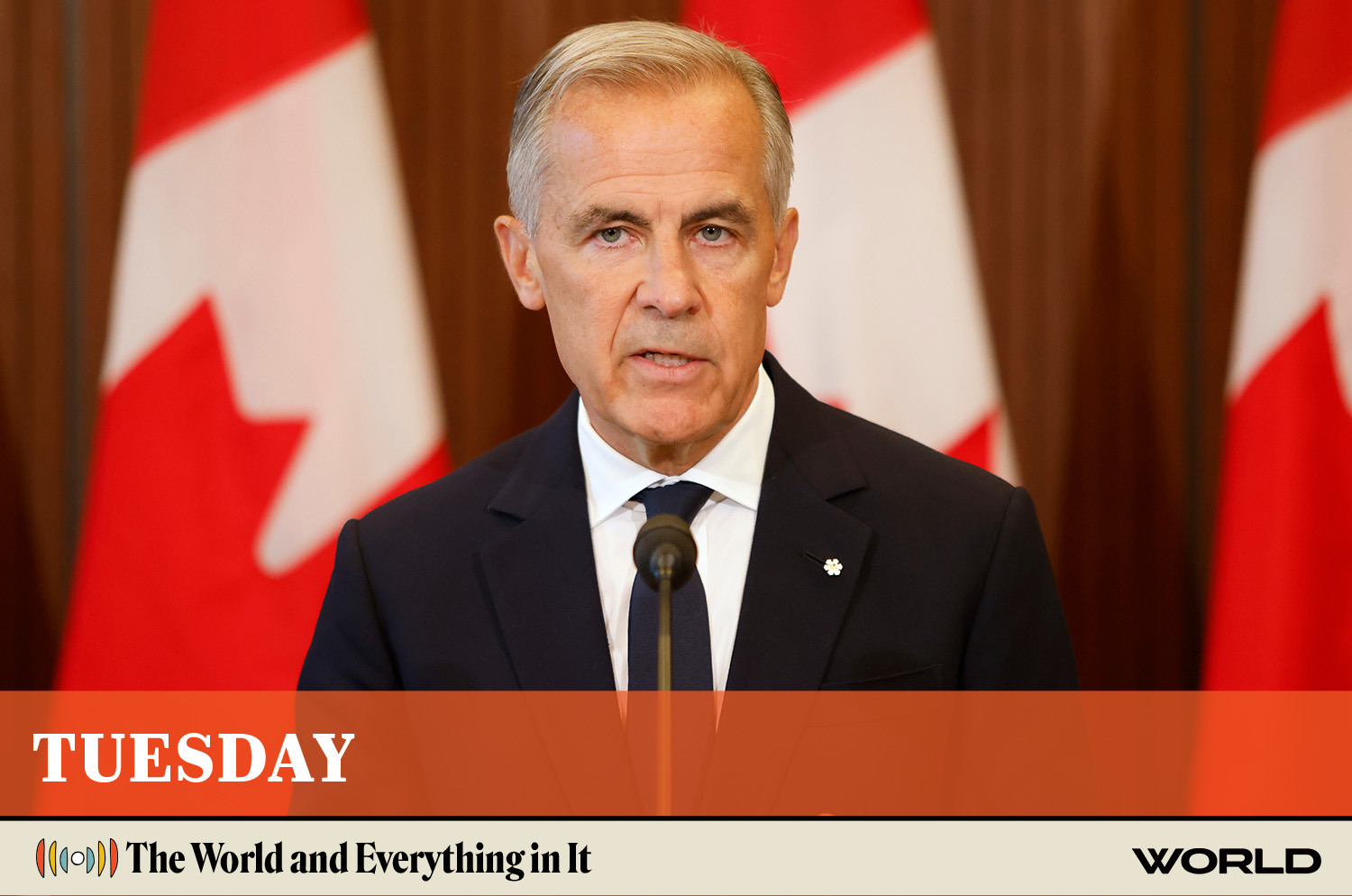
Prime Minister Mark Carney speaks about Canada's response to new U.S. tariffs during a news conference in Ottawa on Saturday. Associated Press / Patrick Doyle / The Canadian Press
Editor's note: The following text is a transcript of a podcast story. To listen to the story, click on the arrow beneath the headline above.
MARY REICHARD, HOST: Good morning!
License plate readers help solve crimes, but at what cost to privacy?
ZAWACKI: Those cameras are all communicating with each other in a way that allows law enforcement and the government to track where people are coming and going.
NICK EICHER, HOST: Also today, the U.S.-Canada trade war. We’ll talk to a former member of the Canadian parliament.
Later, a deadly parasite is keeping cattle ranchers on alert.
HURT: The maggots will continue to repopulate, and eventually they will eat the animal alive.
And Disney’s unlikely First Amendment defense. Commentary from WORLD’s Daniel Suhr.
REICHARD: It’s Tuesday, August 25th. This is The World and Everything in It from listener-supported WORLD Radio. I’m Mary Reichard.
EICHER: And I’m Nick Eicher. Good morning!
REICHARD: Up next, Kent Covington with today’s news.
KENT COVINGTON, NEWS ANCHOR: SCOTUS Mail-in voting » The Supreme Court is allowing the Trump administration to move ahead with part of the president's executive order aimed at tightening election rules.
The 6-to-3 ruling allows Homeland Security to compile state-by-state lists of U.S. citizens eligible to vote and provide those lists to states.
But the justices did not rule on whether the president's order is legal. Instead, they found that the states challenging it don't currently have legal standing to do so.
Trump signed the order in March and remarked:
TRUMP: The cheating on mail-in voting is, is legendary. It's horrible what's gone on. And, uh, it's very clearly covered, uh, very, very clearly. So I think this will, uh, help a lot with elections.
Twenty-three states and Washington, D.C., sued, arguing the president overstepped his authority.
Another part of Trump's order would require states to provide the Postal Service with lists of voters receiving mail ballots. But that provision remains blocked nationwide under a separate court ruling.
And the Supreme Court cautioned that Monday's decision does not mean the administration's efforts to implement the order will necessarily be lawful … leaving the door open to more challenges.
With some states beginning to mail ballots within weeks, it's unclear how much practical effect the ruling will have before November.
Iran sanctions » The U.S. government has a message for any global shipping or technology company still doing business with Iran: Cut ties, or be barred from using the U.S. dollar.
Treasury Secretary Scott Bessent:
BESSENT: Our objective is to sever every economic lifeline that sustains this tyrannical regime until Tehran stands alone.
The Treasury Department warned companies dealing in aviation, gold, and shipping about possible future sanctions.
The U.S. has placed restrictions on doing business with Iran since the 1979 hostage crisis, but is upping the pressure with secondary sanctions on those who deal with Iran.
The new sanctions target nearly 60 individuals and businesses.
When asked if Chinese banks are on the new target list, Bessent said no one should test American resolve.
BESSENT: Every country, every entity should know that they should be prepared to face U.S. sanctions, and the no, no one is is above this.
The United Arab Emirates last week said it would cut financial ties with Iran following a missile attack, and Bessent said he expects to see more nations follow suit.
Canada trade war » With a trade war between the United States and Canada ramping up, President Trump on Monday threatened 50 percent tariffs on Canadian cars, trucks and steel starting January 1st.
The U.S. put 50 percent duties on $20 billion in Canadian goods Saturday. Canada plans to answer two weeks from today, with higher tariffs on US goods.
Both sides say the blame belongs on the other side of the bargaining table after trade talks broke down last week.
Vice President JD Vance told a crowd in Maine:
VANCE: What we've said to Canada is, Stop it. Apply a basic principle of fairness to the trade that you're doing between North Dakota and Canada, between Maine and Canada. And what happened at the very end is they came in with a bunch of unreasonable last-minute demands.
The Trump administration says among those demands, lower tariffs on heavy trucks and changes to some steel and aluminum rules.
But Canadian Prime Minister Mark Carney insists that his team was reasonable and pragmatic throughout the talks.
CARNEY: We made progress, and we did make some progress in recent weeks. In the end, that momentum reversed, and we could not accept what the U.S. had offered, nor could we give what they asked.
He says U.S. negotiators wanted limits on Canada's trade deals with other countries, among other things.
Carney says his focus is on manufacturing more at home and building stronger trade ties with other countries.
Nearly three-quarters of all Canadian exports go to the United States.
Ukraine latest » In Ukraine:
SOUND: [Ukrainian Independence Day]
A somber ceremony in the capital Monday as Ukrainian President Volodymyr Zelenskyy marked the nation's Independence Day by remembering fallen troops, laying flowers at the Wall of Remembrance.
Many European leaders were on-hand including new UK Prime Minister Andy Burnham, who told the crowd he saw before him an unbroken country:
BURNHAM: It is my first overseas visit and I chose to do this, and I hope it tells you something about the importance that I attach to your cause. [APPLAUSE]
At a news conference afterward…
Zelenskyy again made an urgent plea for more resources to step up military pressure on Moscow.
ZELENSKYY: We need to be competitive with the number of deep strikes...we have huge drones, we have capacities, as I said. We need more money, much more money.
Meanwhile, Russian officials claimed Monday that a Ukrainian drone damaged a private children’s center in the southern Russian city of Krasnodar, killing three teenagers.
Congo Ebola » More than 300 people died of Ebola in a single week in eastern Congo. WORLD’s Kristen Flavin reports:
KRISTEN FLAVIN: It's one of the deadliest weeks yet, in the fastest-growing Ebola outbreak on record.
And since May more than 26-hundred have died. That’s nearly half of everyone known to be infected.
Health workers can't keep up. Most of the dead never reach a treatment center, and responders face rebel attacks and unpaid wages.
The virus has reached Uganda, and two Americans caught it in Congo and were flown to Germany.
16-thousand doses of an Ebola vaccine reached Congo Friday. But this outbreak comes from a rare strain the vaccine was never designed for, and no one knows if it will work.
Officials haven't said when it will go to frontline workers. More than 40 of those workers have died.
For WORLD, I’m Kristen Flavin.
Reno fire » Flames have pushed to the edge of Reno, Nevada.
The Hawk Fire has burned more than 15-thousand acres and driven 40-thousand people from their homes. Some had minutes to pack.
AUDIO: I literally wanna cry and go back for all my stuff, but, you know, I just pretty much got what I thought I needed, and now I'm just trying to go.
The flames consumed homes over the weekend and was still uncontained Monday night. Crews are trying to keep it from jumping a highway into packed neighborhoods.
Investigators say people started it, the third human-caused fire near Reno this month.
I'm Kent Covington.
Coming up: the growing debate over license plate readers. Plus, ranchers work to protect their livestock from a parasite outbreak that has upset the U.S. beef supply.
This is The World and Everything in It.
NICK EICHER, HOST: It’s Tuesday the 25th of August.
Glad to have you along for today’s edition of The World and Everything in It. Good morning, I’m Nick Eicher.
MARY REICHARD, HOST: And I’m Mary Reichard.
First up: the trade war with Canada.
President Trump is threatening 50 percent tariffs on Canadian cars, trucks, and auto parts. Canada plans to answer with tariffs of its own next month. Both governments say the other side walked away from a nearly finished deal.
U.S. Trade Representative Jamieson Greer:
JAMIESON GREER: We had found a way to a deal, and then we set about to finalize it, and then in the last hours, I think there were things that the Canadians just, you know, they wanted more.
EICHER: Joining us now, Stockwell Day, a former leader of Canada’s opposition and former minister of international trade. He’s now a political consultant and commentator.
REICHARD: Stockwell, good morning.
STOCKWELL DAY: Good morning, good to be with you.
REICHARD: Well, last we spoke after Prime Minister Justin Trudeau resigned and Mark Carney took the reins. You said Carney was enjoying positive polling because he campaigned on countering President Trump. Now we are one year later. How's that working out for him?
DAY: For him, it's really working out well, that's a great question, and it's probably stronger or higher than ever. And just to assure my American friends, this sometimes resentment, feeling resentment against Americans, this goes way back in Canadian history, way, way back before we even a country. It always has to do with economic interests. And of course, there was a concern at one time way back in the mid 1800s that the soon to be U.S. was going to annex what was soon to be Canada. So these are historic frictions. And I would say they are at record high right now because there's a lot of personal feeling against President Trump in a personal way. Add to that the sort of historic opposition to U.S. trade that's built into our DNA, those add up now to the fact that gives Prime Minister Carney high approval ratings. As a former minister of international trade, I don't think he's dealing with this 100% correctly, but certainly he's got the broad support of Canadians.
REICHARD: Well given all that, Canada says the latest U.S. demands are just unfair. Washington says Canada just moved the goalposts. So from what you can tell, who walked away from a workable agreement?
DAY: Well, sifting through those tea leaves is really difficult. And, you know, I think on both sides, there are accusations that could fairly land. The concern when Prime Minister Carney did the press interviews right following the, you know, the final walk away, he broadly said this is because the U.S. wanted to restrict trade between Canada and other countries.
And what's emerging now, and it's what I thought and what I was talking about over a week ago, the fact that Canada has, in my view, unfortunately, overly pursued a closer relationship with China, that has not helped. And as a backdrop, as an underlay, does not help negotiations with the U.S. When you look at the fact that China is, you know, sponsoring and helping Russia kill Ukrainians, China has always been soft on and allied to a degree with Iran.
And then you have the prime minister trying to get Canada to snuggle up closer to China. That's not good ground on which to try and plant the seeds of a good trade relationship. So that's specifically what the U.S. was referring to, was what they call trans shipments, where goods could come in other ways than directly say from China into the U.S. They suspect Canada could be involved in that. I think Canada frankly has a bit of a weak spot there in terms of pursuing China so closely. And if it's with other nations, then Prime Minister would be right to say there's no blanket prohibition, there shouldn't be a blanket prohibition on Canada with other nations, but the accusation related to China probably has some merit.
REICHARD: Mm-hmm. So is there some path that you can see back to the negotiating table before September eighth, given all that?
DAY: Well, I think there is. What you have to do, and what I found out as a minister of international trade using the WTO, the World Trade Organization, with any country you can find some specific areas that you can minimize the harm. And I think Canada's got to be doing that aggressively. And I think Prime Minister Carney will be thinking that might look like a sign of weakness on his part, but it's not. He has said that by September 8th, retaliatory tariffs are going to be in place, which is just another reason why I and most economic students of economies, we are opposed to tariffs generally. Tariffs do not make for good economic policy, but we're stuck with them. But we should be aggressively pursuing on a case-by-case basis some better carve-outs for Canada. I think we've got a case to make with some of the governors along the Northern border. I have found that at different times in negotiations with the U.S. There are governors whose states are going to be hurt more and maybe say some of the southern states. So we should be pursuing that. And this has to do with the U.S., but I am joining our leader of the Canadian opposition saying we've got to call Parliament back into session so that the people of Canada can really see specifically what were the major irritants, where can we carve out some things that will help Canadians. I'm concerned about on September the 8th Canada coming back, which is blanket reciprocal tariffs. It's just going to mean more Canadians getting hurt.
REICHARD: Stockwell Day is a former member of the Canadian Parliament and now a political commentator. Stockwell, thank you so much.
DAY: Thanks for your interest. Appreciate it.
NICK EICHER, HOST: Coming up next on The World and Everything in It: eyes on the road.
Automated license plate readers arrived in the U.S. in the late ’90s. Since then, technology has advanced far beyond simply identifying numbers and letters. The readers now include AI-powered image-recognition that does far more than read plates, the software can track vehicles across the country.
MARY REICHARD, HOST: Supporters say the technology helps catch criminals. But others worry it’s just another way for the government to track innocent people.
WORLD’s Lauren Smyth has the story.
LAUREN SMYTH: The camera pointed at this parking lot by a home improvement store captures detailed information about every car that passes by—its license plate, color, any dents or scratches, bumper stickers, and even what’s stored in truck beds.
ADAM HICKS: People with liberty and people with freedom should not live this way. And I believe that we are living similar to animals at a zoo.
Adam Hicks doesn’t want his picture taken.
Authorities near his home in Birmingham, Alabama approved a $10 million package last year to install more automated license plate readers, or ALPRs. Their contract is with a company called Flock. This new generation of ALPRs uses AI-powered software to flag vehicles that might be of interest to police.
HICKS: Even if it's been used for good things, it sets up a system to where it's slowly encroaching on our liberties.
There’s no readily available information about how many ALPRs are aimed at roadways around the country, but user-generated databases suggest there could be more than 100,000. The majority are Flock cameras, which don’t record video but log rapid photo sequences.
KYLE ZAWACKI: When people hear that, it sounds very direct, as if it's just license plate reading, and it's just taking images of license plates.
Kyle Zawacki is the legislative director of the ACLU of Michigan. He says photos from Flock cameras around the country are fed into a single database that can be accessed by authorized users anywhere.
ZAWACKI: Those cameras are all communicating with each other in a way that allows law enforcement and the government to track where people are coming and going from.
Law enforcement say the images serve as extra eyes on the street. Jackson, Michigan Undersheriff Anthony Stewart says Flock cameras have helped bring more criminals to justice in the relatively high-crime city, including in a quadruple murder case.
ANTHONY STEWART: Had we not had that resource, it's likely that that crime would have been unsolved.
Flock says its cameras helped find 10,000 missing persons and solve a million crimes last year. Stewart adds that many victims say they’re thankful for that closure. But the cameras still have a bad reputation.
STEWART: I can't make sense of it because we're in a society of cameras.
ALPRs don’t always get things right. In Arkansas, police held a driver at gunpoint after a Flock camera misread the license plate. There was an infant in the backseat. Zawacki again:
ZAWACKI: I’ve seen error rates as high as 2, 3, 4%, and if you’re collecting millions of images and you have a 4% error rate, that’s a significant amount.
Another objection: potential misuse of information. At least 50 police officers have been accused of accessing Flock cameras to stalk personal contacts. Undersheriff Stewart says officers are supposed to document a reason when they search the ALPR database.
STEWART: If you try to circumvent the system, there's a failsafe in the Flock system to detect that, and you're immediately disabled.
But elsewhere in Michigan, Zawacki says public records obtained by the ACLU showed cases of nonspecific or incomplete documentation.
ZAWACKI: We also know that law enforcement have used license plate reader systems to search for people and vehicles for just the word protest, or immigration.
That’s been enough for some private citizens to take matters into their own hands, disabling or stealing ALPRs and staging protests.
Others, like Adam Hicks, are just looking for ways to stay out of the cameras’ line of sight. But he says he thinks the surveillance is applied unevenly and feels powerless to get the attention of local authorities.
HICKS: I feel like a coward, because the only thing I feel to do is simply just talk about it. I don’t know what we should do.
Fewer than half of U.S. states have passed laws on how ALPR data can be collected, used, and kept. Michigan, where Kyle Zawacki lives, is one of those states.
ZAWACKI: There could be—and are—dozens, if not hundreds, of different contract languages, that can determine or be different for how long data is collected, who has access to it, what is required in order to get access to it, who it’s shared with.
Flock recommends that agencies only hold onto the data for seven days.
For now, it’s still up to law enforcement and state officials to decide how long they’ll keep those images. Meanwhile, lawsuits in multiple states are challenging whether the cameras are legal at all.
For WORLD, I’m Lauren Smyth in Jackson, Michigan.
NICK EICHER, HOST: Coming up next on The World and Everything in It: the need for speed hits Washington, D.C.
Over the weekend, Freedom 250 Grand Prix racecar drivers made laps around the National Mall at speeds approaching 200 miles per hour.
SOUND: Cars zooming around the circuit.
Kyle Kirkwood, an American IndyCar driver, won Sunday’s race after leading most of the way in his No. 27 Honda.
KYLE KIRKWOOD: I get out of the car, I see President Trump sitting there, cheering me on. As a proud American, that’s a pretty big deal to have the President cheering you on.
REICHARD: The race came about after President Trump signed an executive order granting IndyCar the opportunity as part of the celebration of America’s 250th anniversary.
The race marked the end of festivities that have dominated downtown D.C. this summer. But the finale did not go quietly.
SOUND: [Audience reaction]
EICHER: It did not. 150,000 people watched from the grandstands lining the course or on big screens dotting the national mall.
Carole Lieber, a D.C. resident, attended the practice and qualifying rounds Saturday.
LIEBER: I was really concerned about what was it going to do to the streets. Was it going to damage the streets? And it doesn't seem to be bothering the streets. And the drivers are going by and waving, so that's pretty fun. So they seem to be enjoying themselves also…
The IndyCar circuit set seven sharp turns around iconic D.C. landmarks like the National Archives and Smithsonian Air and Space… with longer stretches on avenues that typically limit drivers to slower speeds.
Volunteers helped visitors navigate the various bridges and gates constructed for the event.
HOUSE: It's long days for all the staff and volunteers. starting early morning before the gates open, and then until the gates close…
E.J. House, came from Maryland to be close to the action.
HOUSE: A couple of the drivers were walking through this morning. We got to chat with a couple of times… that access is really nice.”
REICHARD: FOX, the official Freedom 250 Grand Prix broadcaster, marketed the race as a once-in-a-lifetime event, though there have been hints of a potential repeat.
D.C. resident Maria Martinez said she knew nothing about street races before attending Saturday’s festivities but would come back.
MARTINEZ: There’s a lot of union here. Everyone’s very happy.
EICHER: Others from the area say they’re looking forward to getting back to normal on the National Mall. Again, Carole Lieber:
LIEBER: I'll be glad to get our city back because it's been a long summer of not being able to go here…
There have been three major Freedom 250 events along the mall since early June. But those disruptions to normalcy have also meant unique opportunities:
LIEBER: But it's my first. It's my first car race, other than maybe seeing a car race in a movie, like a 50s movie or whatever, Monte Carlo, what have you. Yeah, I've never seen a race. It was a lot of fun. I really enjoyed it.
REICHARD: The future for a D.C. Grand Prix part two may be uncertain, but at least one partnership is set.
IndyCar and Fox announced last week that they would donate $2 million dollars to First Lady Melania Trump’s program to fund scholarships at Indiana University and Purdue. IndyCar drivers marked the announcement by presenting the first lady with a custom racing helmet.
NICK EICHER, HOST: Students across the country are returning to classrooms.
At one Oklahoma high school, freshmen face their first assignment before their parents even drop them off.
For 26 years, seniors at Bishop Kelley Catholic High School in Tulsa have surrounded arriving cars to promote a practical Bible lesson.
They hold the doors shut until each freshman kisses a parent goodbye. Usually mom.
For the students, a little embarrassment.
For the parents, something else. School president Sister Mary Hannah, the audio from CBS.
HANNAH: This is a big moment for them, especially if it’s their first child or their last child.
A rite of passage and an early lesson in honoring your father and your mother.
At Bishop Kelley. the seniors enforce the fifth commandment with a promise.
It’s The World and Everything in It.
MARY REICHARD, HOST: Today is Tuesday, August 25th.
Thank you for turning to WORLD Radio to help start your day.
Good morning. I’m Mary Reichard.
NICK EICHER, HOST: And I’m Nick Eicher.
Coming next on The World and Everything in It: a parasite American ranchers thought they’d left behind.
New World screwworm was eradicated from the United States decades ago. But now it’s been moving north again through Central America and Mexico.
REICHARD: Their return has disrupted cattle shipments from Mexico and put U.S. ranchers back on alert.
WORLD’s Mary Muncy reports.
MARY MUNCY: Lawrence Hurt is standing beside a pen full of cattle in southern New Mexico.
HURT: I'm old enough I can remember the screwworms from when I was a teenager.
He saw a couple of outbreaks in the late 1970s.
HURT: Had a horse that got cut on the fence up on the shoulder, and was looking at the wound, you know, dressing, treating the wound, and found the maggots in there. And then we pulled them out and sent them off and that was positive.
The only way to remove them is to pick them out one by one. Hurt says ranching is not for the “squeamish.”
HURT: If you’ve worked around them, you’ll get a smell. You'll know that smell immediately. You know it's just dead, dead flesh, combination of you know the dead flesh and the worms.
Screwworms look like white maggots, but instead of feeding on dead flesh, they burrow into open wounds and eat live flesh—both of animals and humans.
The cycle starts when a female fly lays up to 300 eggs in a wound; the larvae eat the flesh in the wound until they're mature enough to drop onto the ground. Then they burrow into the soil and reemerge as a fly.
HURT: If it goes untreated, the maggots will continue to repopulate, and eventually they will eat the animal alive.
But there are ways to stop them. In 1957, ranchers began pushing them out of Florida by introducing sterile flies into affected areas. It worked so well that other states wanted to try it.
Around this time, the USDA started publishing pamphlets and videos to educate the public and get their help in finding infestations.
USDA: Examine your animals at every opportunity. Look for cuts, scratches, or other wounds. If you find a wound that contains insect eggs or larvae, take about a dozen worms and all eggs from the wound.
Ranchers put that in a jar and sent it to a lab to be tested. If it was screwworm, that information went to the Eradication Headquarters in Mission, Texas.
VIDEO: Here, millions of screwworm flies are being reared each day and made sexually sterile by exposure to gamma rays from radioactive cobalt.
The USDA dropped boxes of the sterile flies in strategic locations and by 1966, officials declared they had eradicated New World Screwworm from the U.S.
But flies don’t respect national borders.
In the 70s there were more outbreaks, so the U.S. partnered with Mexico and Central American countries to push screwworms further south. By the 90s, they pushed them all the way to the Darién Gap in Panama.
That border mostly held until 2023—when Panama declared a state of emergency due to a screwworm outbreak. The flies kept moving north and last summer, a Texas rancher found an infestation in a calf.
Experts cite several reasons why screwworm could have broken the barrier at the Darién Gap. The CDC blames increased movement through the Gap and new areas of farming.
It’s all left ranchers on high alert.
Last month, Hurt and his team branded and castrated his new calves. Then:
HURT: We treated them with Catron spray on the brands, the earmarks, and the castration cuts, and then we gave them a shot of Dectomax, and then we also added a fly tag to them, insecticide fly tag.
All extra protocols to try to keep screwworms out of the wounds. They also do a lot of extra visual checks. If Hurt finds even one, he won’t be able to move cattle for weeks—a financial hit.
One study says that in 1975, screwworm cost the U.S. cattle industry over $600 million adjusted for inflation and ranchers today are already fighting a western drought that started in earnest in 2020.
It’s forced Hurt to cut his herd number in half.
HURT: Calves were worth about $1,000 a head before the jump in price. They're like $2,000, $2,200 a head now, so you're basically to break even. Half as many cattle, twice as much money.
That’s part of the reason beef prices have almost doubled since 2020.
HURT: It's been an impact on the feed-feedlots and the packing plants. They've had a couple more packing plants close in the last year. I'm sure there was some other issues going on, but partly due to the reduced numbers of cattle available for slaughter.
It’s going to take time for those plants to come back online and even longer for beef prices to drop.
The USDA plans to allow cattle across the Mexican border in stages so they don’t flood the market. In New Mexico, there haven’t been any new outbreaks in months.
HURT: It's just like everything else that we do to produce healthy animals. It's forefront for us to make sure that if the screwworm gets here, that we are prepared to deal with it.
So for now, Hurt waits and watches.
Reporting for WORLD, I’m Mary Muncy in Luna County, New Mexico.
NICK EICHER, HOST: Good morning! This is The World and Everything in It from listener-supported WORLD Radio. I’m Nick Eicher.
MARY REICHARD, HOST: And I’m Mary Reichard.
Disney is fighting an FCC investigation into whether its diversity, equity, and inclusion hiring practices ran afoul of federal anti-discrimination rules.
But the company is drawing its First Amendment defense from some unexpected places. Here’s WORLD commentator Daniel Suhr.
DANIEL SUHR: The Walt Disney Company has found a curious new use for the First Amendment.
Disney is under federal investigation into whether its DEI practices produced race- and sex-based employment discrimination.
Disney’s defense amounts to this: The Constitution protects its right to discriminate.
That’s a surprising position for two reasons.
First, the Supreme Court has rejected versions of it before.
In three cases during the 1980s, the Court held that freedom of association did not allow business organizations like Rotary clubs to exclude women.
More recently, Harvard argued that its First Amendment right to academic freedom protected race-based affirmative action.
Harvard lost.
Second, Disney is relying on two cases it would hardly be expected to celebrate: 303 Creative versus Elenis and Boy Scouts of America versus Dale.
One protected a Christian wedding website designer from being compelled to create messages for same-sex weddings. The other allowed the Boy Scouts to exclude homosexual males from leadership.
Disney is perhaps the most pro-LGBT company in the Fortune 500, and it now finds itself citing those cases to defend race- and sex-based employment practices.
The irony is hard to miss.
The Foundation for Individual Rights and Expression takes the analogy even further. It compares Disney’s claim to the constitutional freedom of a church to choose ministers who share its faith.
That is quite a leap—from a church choosing its ministers to Disney sorting employees by race and sex.
Disney is reaching for these arguments because the Federal Communications Commission has considerable leverage.
Disney holds licenses for eight local ABC stations. The Commission requires its licensees to comply with federal equal-employment rules.
As I argued in a legal brief filed in this proceeding, FCC Chairman Brendan Carr now has the entertainment leviathan over a regulatory barrel.
Here’s Carr explaining why the agency opened its investigation:
CARR: Starting all the way back in March of 2025, I wrote a letter […] protected characteristics.
Faced with that investigation, Disney has doubled down.
It says its casting decisions are constitutionally protected “expressive content.”
It says its race- and sex-specific professional networks are protected “expressive association.”
And it relies on the precedents protecting the Boy Scouts and the Christian website designer.
Now Disney has sued Carr, arguing that the entire DEI investigation is really a pretext for punishing the company because President Trump dislikes Jimmy Kimmel and the hosts of The View.
But that retaliation claim does not answer the underlying question:
Did Disney violate the rules against race- and sex-based employment discrimination?
Discriminating based on race and sex was a bad bet for Disney. Defending it with proven loser arguments is no better.
Disney should’ve taken a cue from Frozen and let it go.
Instead, it greenlit a sequel.
For WORLD, I’m Daniel Suhr.
MARY REICHARD, HOST: Tomorrow: Hunter Baker is back for Washington Wednesday. And, how an abandoned railway tunnel became a center of community life. That and more tomorrow.
I’m Mary Reichard.
NICK EICHER, HOST: And I’m Nick Eicher.
The World and Everything in It comes to you from WORLD Radio. WORLD’s mission is biblically objective journalism that informs, educates, and inspires.
The Bible says, “Hide your face from my sins, and blot out all my iniquities. Create in me a clean heart, O God, and renew a right spirit within me. Cast me not away from your presence, and take not your Holy Spirit from me. Restore to me the joy of your salvation, and uphold me with a willing spirit.” —Psalm 51:9-12
Go now in grace and peace.
WORLD Radio transcripts are created on a rush deadline. This text may not be in its final form and may be updated or revised in the future. Accuracy and availability may vary. The authoritative record of WORLD Radio programming is the audio record.
Please wait while we load the latest comments...
Comments
Please register, subscribe, or log in to comment on this article.