
The open seams of free nations
On Washington Wednesday, Hunter Baker looks at the places where a free society can leave itself exposed. Also: Trump accounts and executive power, climate suits and federalism, and a lightning round on double-haters, permitting reform, and what happens when ideologues actually have to govern.
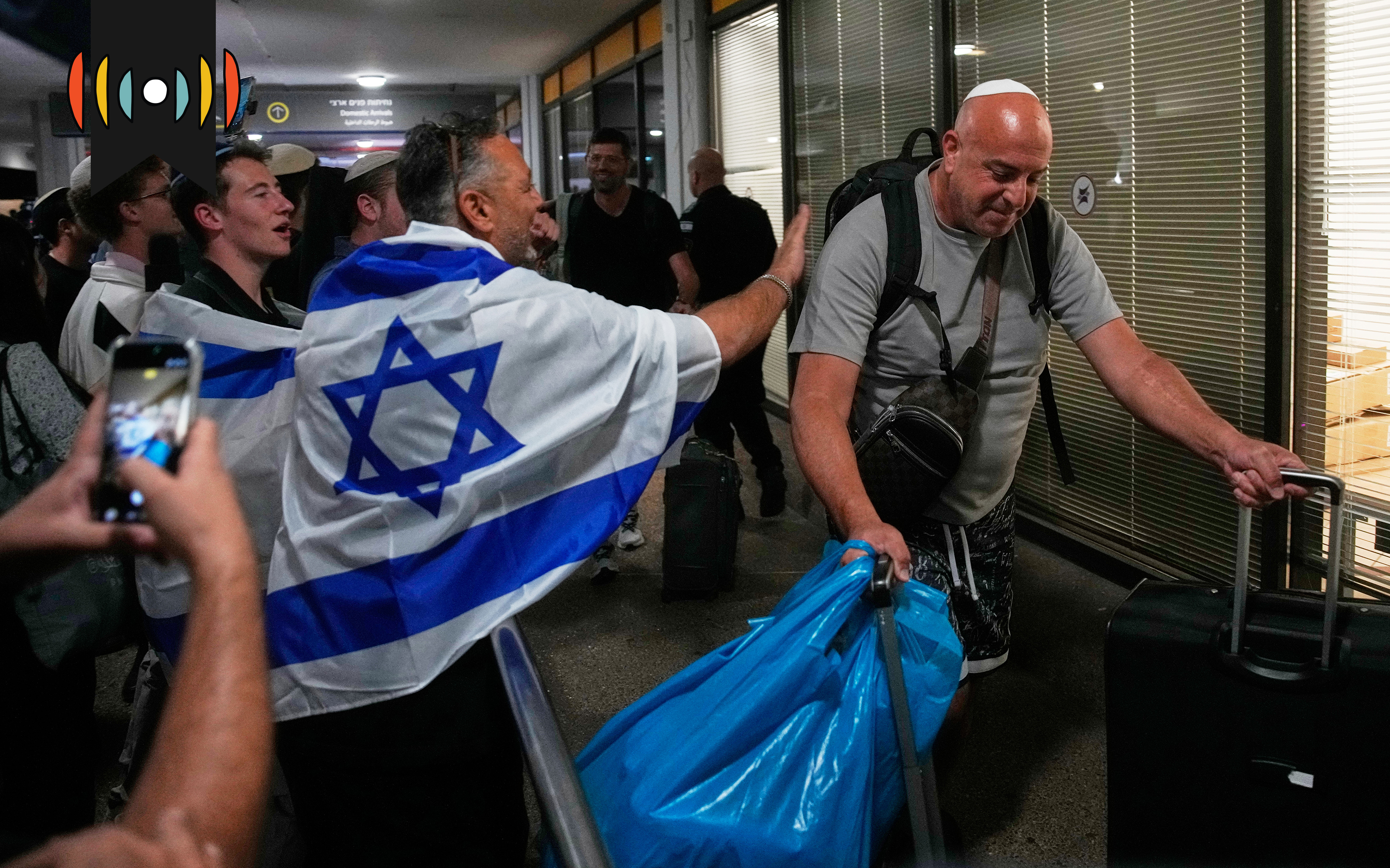
Israeli passengers from FlyDubai are welcomed at Ben Gurion International Airport near Tel Aviv, Israel, Sept. 30. Associated Press / Photo by Ohad Zwigenberg
Editor's note: The following text is a transcript of a podcast story. To listen to the story, click on the arrow beneath the headline above.
NICK EICHER, HOST: It’s Wednesday, October 7.
This is The World and Everything in It from WORLD Radio, celebrating 15 years.
Good morning. I’m Nick Eicher.
LINDSAY MAST, HOST: And I’m Lindsay Mast.
Time now for Washington Wednesday.
Back with us is political scientist and senior fellow at the First Liberty Institute, Hunter Baker. Hunter, good morning.
HUNTER BAKER: Good morning.
MAST: Issue one today: Security at the seams. Hunter, three stories caught our attention this week. First, an update on an old story: President Trump approved execution by firing squad for Nidal Hasan. Hasan is the former Army psychiatrist convicted in the 2009 massacre at Fort Hood, Texas, that killed 13 people.
EICHER: The second case, investigators say, a FlyDubai co-pilot had previously been barred from flying in Oman before he would attack the pilot on a flight to Israel. The plan, it seems plain enough, but still just alleged, was to fly that plane straight into the ground and kill a planeload of Jews.
Authorities in Oman, as well as FlyDubai, the airline, and Israel each reportedly had pieces of information that never came together in time. Thankfully, the passengers were able to save the day.
MAST: In the third case, in Britain, the U.S. moved its B-1 bombers out of RAF Fairford a week after five men were arrested near the base. U.K. authorities are investigating an alleged Iran-linked plot.
EICHER: Now, three different stories, but in every case, the threat got a long way inside the perimeter, Hunter. So here’s the question: As we start, are our biggest security vulnerabilities increasingly at the seams? That is to say, places where several institutions each own part of the problem, but nobody owns the whole thing.
BAKER: I remember when 9/11 happened. My immediate reaction to that occurrence was that life on planet Earth, and certainly in the United States, was going to be extremely different after that event, but actually that wasn’t the case. We made some changes at airports, and security procedures became a little bit more burdensome. But actually, the changes weren’t as severe as I thought they might be.
With the things that we’re observing, these sort of occurrences where people get inside of systems and threats get a lot further than you would hope they could. What occurs to me is that you have a choice to make about a free society. If you’re going to have a very free society, then these threats are generally going to be able to get pretty far, unless you’re willing to make some significant sacrifices regarding privacy.
From my perspective, I remember people were very concerned about the Patriot Act. I think that if you want to have a free society and prevent a lot of these sort of things, you have to have more room for probably incursions on privacy as a way to get the jump on these sort of things.
MAST: Hunter. These aren’t all intelligence failures in the classic sense. Sometimes somebody already had the information, and the problem was getting it to the person who could act on it. So, is modern government too compartmentalized for threats that deliberately cross the lines between military and civilian, foreign and domestic, or public and private?
BAKER: It might have been worse in the government of the past. I think that at least now we have information technology and probably a greater ability to detect patterns and things like that. But it’s clear that it’s not enough.
Or it may simply be the case that our values are such that we are trying to make sure that we don’t abridge anyone’s rights by casting them under suspicion or being excessively suspicious of them because of their ethnic background or something like this. These are all the kind of calculations that a free society has to make, and it’s very difficult.
EICHER: Issue two: Trump accounts. Let’s turn to a new federal program for children. Congress created what are now called Trump accounts. These are investment accounts intended to build assets for children, and the Treasury Department has since added automatic enrollment. It now allows approved charities to contribute individual company stocks, families can’t refuse those shares, and they can’t sell them for five years.
Now we’ve spoken positively of this program for the most part, but this is more of a process thing. I think these specifics were not provided for by Congress, so the question is: At what point does executive implementation stop being merely that implementation and start becoming a rewrite of what Congress actually created?
BAKER: There’s always this threat of abuse. You may remember that when the Affordable Care Act, also known as Obamacare, was passed, that Congressman Bart Stupak went to great lengths to try to gain certain pro-life protections, which eventually dragged the legislation over the line. And then, promptly after doing that, the Health and Human Services Agency issued the extraordinarily burdensome mandate regarding abortion and abortifacient drugs and birth control that hit companies like Hobby Lobby and various Christian organizations and universities, and that was not the legislation itself, but an executive interpretation.
So that’s always something you have to guard against. It seems like something similar to that may be happening with the Trump accounts. Now that having been said, I really thought about this. I’m having a tough time seeing the harm, or the way that it might be abused, and I think this is going to be the kind of thing where we have to watch what happens, and we may have to develop further rules in response to the way these exceptions are employed.
MAST: All right. Issue three: climate suits and federalism. And here we’ll stay on separation of powers. The Supreme Court opened its new term with a federalism fight over climate change. Oil companies want the court to shut down state and local lawsuits seeking damages for climate-related harms. But on Monday, the justices appeared skeptical of doing that outright, although guessing what the court will do is probably not a great idea.
But bottom line, this dispute is bigger than environmental policy. If states and cities can use tort law to impose potentially enormous costs over a national and global issue, aren’t the courts effectively making policy Congress has chosen not to make, or would you say that this is simply federalism at work?
BAKER: There’s a certain amount of policy that preemptively belongs to the federal government. It’s very hard for me to understand how climate harms of this type, letting carbon dioxide into the air, resulting in increased heat, or something like that, would be something that is localized. I’m confused by the theory of these suits in that sense, and I can understand why federal agencies would say this really belongs to us.
This is different from one of these stories like we’d have in Cleveland or somewhere like that, where a company’s been dumping pollutants into the river, and then the river catches fire or something like that. This is a different thing, and that may be an apocryphal story. This idea that climate change, to the extent that it occurs, occurs state by state to me seems ridiculous, and so I can understand why the court would take a hard look at this.
EICHER: Time for the lightning round now. 30 seconds for real, or at least we’ll try it. A Wall Street Journal poll, Hunter says that 21% of registered voters dislike both major parties, and that’s quite a big jump from 13% just a few short years ago back to the 2022 midterms. So these are double haters. So is this just noise, or would you call it the defining voter of 2026, the double hater?
BAKER: It may take us to a different place in our politics. When I was younger, I can remember that we were totally focused on the idea of the centrist voter, and that politics was really aimed at winning over that centrist voter, and that would lead the two parties to converge in terms of their policy.
And you’d have people like George Wallace claiming there’s not a dime’s worth of difference between them, but I think that there’s a group of voters who want less ideology and more competence in government, and I think they’re going to be more inclined to become independents as we’re seeing.
EICHER: Okay, so yes, no, are they going to be the defining voter of ’26, or is that whole thing just overblown?
BAKER: They could be. ’26 may be a little soon, but eventually,
MAST: Do the double haters vote?
BAKER: Oh, I do think that they vote. I think that people who have the tendency to say that I hate both parties are people who pay attention to politics.
MAST: All right. Next up, a piece of bipartisan Senate draft legislation would put deadlines on federal reviews, shorten litigation windows, and make other changes aimed at getting infrastructure built faster. Hunter, is this a real bipartisan breakthrough?
BAKER: I am thrilled. I am so excited by this legislation potentially happening. I come from the South. You think about the way the American South was transformed by the Tennessee Valley Authority and some of those major infrastructure projects, and I just think that the potential is incredible.
We have been through a period where these kind of large projects get tied up for 15, 20 years and don’t do anybody any good. I think these things are a far better way to spend government money than our constant flow of entitlements and transfer payments and things like that, because you actually get something, you get something that’s productive and does a lot of good for the economy, and that you can build from.
So I’m hoping that this bipartisan compromise lasts and it goes all the way to the president.
EICHER: Finally, Seattle’s socialist mayor has had to scale back parts of her agenda amid a budget deficit and public safety pressure, meantime in Huntington Beach, California, there is a MAGA governing bloc, and it has run into courts and spending fights and voter resistance and internal divisions. So finish this sentence: Ideologues discover governing when—fill in the blank.
BAKER: —they have no other choice. You get into these crises like New York did in the 1970s, and some of us remember that famous headline: “Ford to New York City Drop Dead,” because they wanted the federal government to bail them out.
And you’re going to get into these kind of situations, but it’s hard to get there because left-wing ideologues actually like the impact. If they govern badly, and if their policies are too far left, people in the center and the right move out. And if people in the center and the right move out, you’re guaranteed to win the next election. And so it’s a self-fulfilling cycle that people on the left may find desirable.
MAST: All right, Hunter Baker, political scientist and senior fellow at the First Liberty Institute. Hunter, thank you so much.
BAKER: Thank you.
WORLD Radio transcripts are created on a rush deadline. This text may not be in its final form and may be updated or revised in the future. Accuracy and availability may vary. The authoritative record of WORLD Radio programming is the audio record.
Please wait while we load the latest comments...
Comments
Please register, subscribe, or log in to comment on this article.