
The midterm rule
Washington Wednesday: The president’s party usually cedes ground in the midterms. But why do some elections bring political earthquakes while others barely register? Political scientist Hunter Baker looks to history for clues and offers a 2026 balance-of-power prediction. Plus: party loyalty versus candidate character, and the local political revolt against AI data centers.
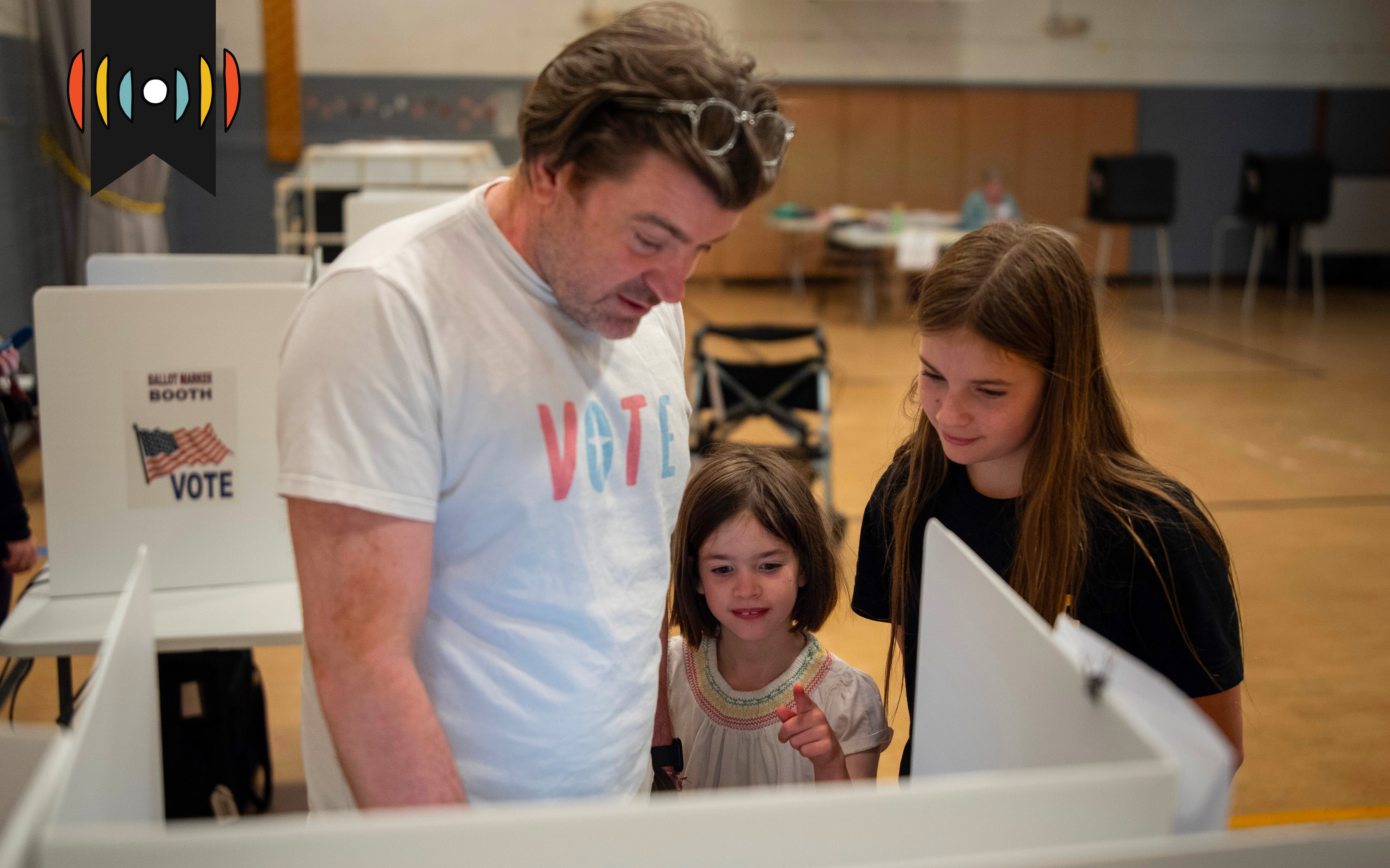
A father votes with his children at their polling place in Columbus, Ohio, during the primary election. Associated Press / Photo by Carolyn Kaster
Editor's note: The following text is a transcript of a podcast story. To listen to the story, click on the arrow beneath the headline above.
LINDSAY MAST, HOST: It’s The World and Everything in It from WORLD Radio, celebrating 15 years. Today is Wednesday, the 28th of October. Thanks for making us part of your morning routine. Good morning. I’m Lindsay Mast.
NICK EICHER, HOST: And I’m Nick Eicher. It’s Washington Wednesday, our last one before Election Day. I am especially excited about this one. We will be putting our expert on the hot seat for a lightning round of election day predictions. So hang on.
And joining us now is that expert Hunter Baker, political scientist and senior fellow at the First Liberty Institute. Good morning to you, Hunter.
HUNTER BAKER: Good morning.
MAST: All right, Hunter. Issue one: What kind of midterm is this? Let’s begin with some history. The president’s party. We’ve been hearing this over and over all summer long. The party in the White House usually loses ground in the midterms, but the losses are considerably uneven. So you can think of 1994, 2010, and 2018 on the one hand, and the much smaller Republican gains in 2022. Hunter, looking back at those elections, what separates an ordinary midterm correction from a major backlash against the party in the White House?
BAKER: First of all, I think that the polling situation is far more difficult than it was in the past. In the past, people had landlines. They would answer the phone, and they would participate in these polls. Now, most of us we think about we receive a call from an unfamiliar number, we don’t pick it up. So the question is, who is actually participating in these polls? We don’t know. So I think it’s. I think first of all, it’s just difficult to get a randomized poll in the way it was in the past. Second, then you have to ask, what is the mood of the country? What is driving things?
In 1998, Republicans thought they would win because of the Monica Lewinsky scandal that had kind of gathered up Bill Clinton’s presidency. But actually, they were surprised they didn’t do all that well, and people seemed to be kind of sick of it, whereas you look at the 2022 midterm. Biden was facing a lot of uphill stuff in terms of terrible withdrawal from Afghanistan, the Russia-Ukraine business, oil prices through the roof, and he dealt with it in a very transactional way.
He drew down the strategic oil reserve in a big way to lower the prices, and was promising everybody with student loan debt, which is a whole lot of people, that he was ready to spend a half a trillion dollars without even getting Congress’s approval to improve their situation. So all of that was designed to diminish the losses in the midterms, and it worked. The Republicans, I think, have not been able to come up with a similar sort of a pitch, and I think that’s why a lot of people on the Republican side are worried about what’s going to happen.
EICHER: Okay, so let’s apply that to what’s about to happen. The history that you just gave us, apply it to 2026. We’ve got high gasoline prices. We’ve got an unpopular war with Iran. We’ve got the growing prominence of the Democratic Socialists energizing that side. Take your pick of issues. Now, some of these factors, of course, work against Republicans. Others work against Democrats. Do you think that this election is more about dissatisfaction with the party in power or doubts about the alternative?
BAKER: I think it’s both. I think that the war and the oil prices are going to work strongly against Trump. In addition, just general inability to get prices down. I think that Trump underestimated the degree to which tariffs would probably prevent inflation from coming down. So all of those things go against the Republicans. On the other side are the Democratic Socialists, and if you survey voters, we always talked about the doubts about that. But I think that one of the words that people would increasingly associate with the Democratic Party is socialist, and I think that word is still not a great word in American retail politics, and so that may help the Republicans a little bit in this midterm.
EICHER: Well, another word that kind of is a double-edged sword there too is President Trump and all of the campaigning that he’s doing. The Wall Street Journal followed him around for seven rallies in seven states just last week. Republicans are counting on him to energize the base, turn out the MAGA voters. But as we say, he is an equal opportunity motivator. He turns out his supporters, but he also turns out his opponents. So how does how does that fit in the midterm equation.
BAKER: His popularity is not very high right now, and so some Republicans have kind of run away from him or held him at arm’s length, and so that would suggest that at least in some places they don’t want the big Trump push. I was just in a meeting with a fairly significant. Center left type of political observer, and he was very optimistic about their chances because he noted that some of the places that Trump is speaking are very red places, indicating that Republicans could be worried that even in some of their strongest sort of battlegrounds, that there may be trouble. So that’s the question: Is are these places being chosen strategically? Are they being chosen because Trump likes an enthusiastic audience? What’s going on?
MAST: All right, Hunter. Moving on to issue two: party loyalty and political character. Wall Street Journal columnist Gerard Baker argues this week that some Republican candidates could actually help their party by losing. You may remember the other baker, no relation, saying a few weeks ago, "Help me! I feel a bad case of TDS coming on." TDS being Trump derangement syndrome, as it’s known. He’s now openly suggesting it would be better for Republicans if Paxton loses in Texas, and not just Paxton, Ken Paxton in the Texas Senate race, but Vivek Ramaswamy in the Ohio Governor’s race.
Baker argues that character ought to matter even when a candidate’s policy positions are more appealing to party voters. And in Ohio, we’ve seen that extraordinary campaign ad featuring Democratic candidate Amy Acton’s strange mother attacking her own daughter, and we’ve spoken quite a bit about the character issues around Paxton. So, Hunter, where does party loyalty end and accountability for a nominee’s character and conduct begin? It’s a question at least as old as the initial Trump candidacy.
BAKER: I think that the Republican Party may end up learning a lesson on this, I think it was a big mistake for Trump to go with Paxton over Cornyn, who would have walked to re-election. I believe the big question, though, when you talk about this character issue, at least in parliamentary positions, right? We’re talking about representatives and senators. I think that is different than electing executives who are really guiding and running things. When it comes to people in legislative positions, you could just imagine them as wearing an R or a D on their jersey.
Generally speaking, they’re going to vote with the party and they’re going to be part of a block, and if you vote for somebody of the party with which you disagree, what’s going to happen is we’re going to go forward two years. That party may elect the next president, and then you have made that president stronger, and you may receive a public policy with which you very strenuously disagree, but that’s a leftover from the decision you made two years ago. So I just I think that in terms of just practical impact, it may be expensive to make this choice based on character.
EICHER: All right, issue three: the data center revolt. Here’s an election issue, Hunter, that doesn’t follow the usual partisan divide. Washington wants the U.S. to lead the world in AI, artificial intelligence, but the facilities needed to power that ambition, they are running into opposition from local voters. Concerns about electricity prices, the use of water, tax incentives, development. Wall Street Journal reporting these disputes are becoming campaign issues in Texas, in Ohio, Michigan, and Georgia. The city of Nashville has already imposed a moratorium on new projects. So, Hunter, what happens to a national priority like American leadership and AI when the political resistance comes from the local communities being asked to host all of this infrastructure.
BAKER: Let me just say that the United States currently has about 1/3 of all the data centers in the world. So we need to not act like we haven’t had data centers. We have a whole lot of data centers in the United States, and I think that it is clear to me that this kind of technology is where the world is going, and we don’t want to be left behind. Now, with regard to sort of the local consequences, I’ve done some reading about it. I suspect that the resistance may be more emotional than rational.
It seems to me that the problems regarding water and cooling and the energy grid are being solved, but when it comes to a big emotional political issue like this, the politicians tend to know that they can’t try to attack it with a rational case, and so you’re seeing them just respond. The polls are telling them that people are worried about data centers, and they’re acting accordingly.
MAST: All right, Hunter. This is the moment we’ve all been waiting for. You’ve given—
BAKER: Painful!
MAST: Well—
BAKER: Difficult!
MAST: Sure, but you’ve given us the historical framework, and we’ve talked about the forces at work in this election.
EICHER: Okay, so here comes the pain, the cumulonimbus clouds they have gathered. It is. Time for the lightning round. This is our last Wednesday in October, election prediction lightning round special. I think we should trademark it. Three questions. No penalty for being wrong. No prize for being right. But we do want some home run cuts here, Hunter.
MAST: All right. So first up, the Senate. The 270 to win consensus map has Democrats and their independent allies at 49, Republicans at 46 with five toss ups. Hunter, your prediction: Who controls the Senate in January?
BAKER: Just remember that only 1/3 of the Senate is up at any one time, and the playing field differs. This is sort of a Republican playing field, so even though I think that there will be a Democratic wave, I suspect that we will be left with a 50-50 tie with the Vice President breaking the vote. Because I just think that we’re going to get one or two surprises, maybe in Michigan, something like that, that helps the Republicans to hold on.
EICHER: All right, here is where it plays out: the House, the consensus map that Lindsey just mentioned, that has Democrats at 220. They already win. Okay, so the consensus has them at 220 before assigning any of the 19 toss-ups. So it could be really big. The consensus view, as I say, it’s got the gavel in Hakeem Jeffries' hand. Your prediction. Does anything change?
BAKER: 2024 was a great year for the Republicans, and they only ended up with bare control of the House. This is not going to be a good year for the Republicans. They are absolutely going to lose control of the House. I hope you don’t end up replaying that, and I’m in shame. But they’re going to lose control of the house, and the speaker is going to change.
MAST: All right, then, Hunter. Let’s assume the congressional makeup that you’ve just predicted for the final two years of President Trump’s term. What governing coalition will he have to rely on?
BAKER: It’s going to be an interesting opportunity for the Democrats to make a choice. They can either vent their spleen and investigate Donald Trump and try to impeach Pete Hegseth and do all these different sort of things, or what they can do is they can use the House to pass bills out of the House that they think would be constructive and that they can then say if you elect a Democrat as the next president, we’ll be able to turn into policy and law, so that’s the question they’re going to face. My suspicion is they’re going to do a lot of spleen venting.
EICHER: Well, you remember, of course, 1994 turned out to be great for Bill Clinton. It turned him around, right?
BAKER: It certainly did. That’s right.
EICHER: Could something like that happen with Trump? Yes or no?
BAKER: Would losing help him? It might. I mean, I think that sympathy for him increased significantly while he was in the wilderness as people watched all the lawfare, and if the Democrats do a lot of impeaching of him and constantly trying to take him down, the sympathy for him may go up again.
EICHER: All right. Well, we’ve got your predictions on tape now, Hunter. No turning back. We will revisit next week once the voters have had a chance to weigh in. Hunter Baker, political scientist and senior fellow at the First Liberty Institute. Hunter, thank you as always.
MAST: Thanks, Hunter.
BAKER: Thank you.
WORLD Radio transcripts are created on a rush deadline. This text may not be in its final form and may be updated or revised in the future. Accuracy and availability may vary. The authoritative record of WORLD Radio programming is the audio record.
Please wait while we load the latest comments...
Comments
Please register, subscribe, or log in to comment on this article.