
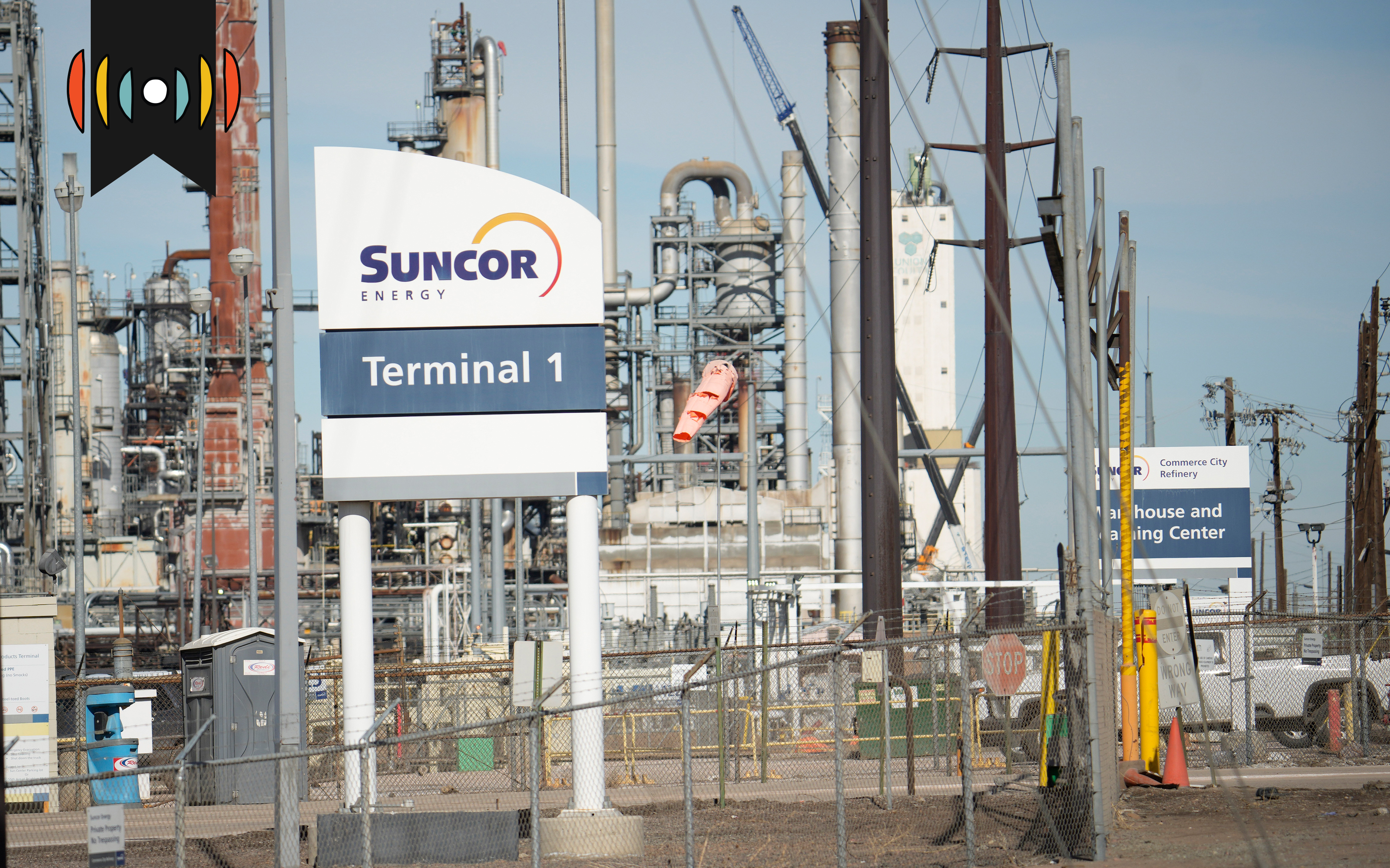
The Suncor refinery in Commerce City, Colo. Associated Press / Photo by David Zalubowski
Editor's note: The following text is a transcript of a podcast story. To listen to the story, click on the arrow beneath the headline above.
NICK EICHER, HOST: It’s The World and Everything in It from WORLD Radio, celebrating 15 years. Today is October 12th, thanks for making us part of your morning routine. Good morning! I’m Nick Eicher.
MARY REICHARD, HOST: And I’m Mary Reichard. Time now for Legal Docket. Today, a Colorado county wants oil companies to pay for climate damage. But could one local lawsuit wind up setting energy policy for the entire country?
ROBERTS: We’ll hear argument first this term in case 25-170, Suncor Energy v Boulder County Commissioners of Boulder County.
Chief Justice John Roberts opening the Supreme Court term last Monday.
⚖️ Go deeper | The Suncor case file
Want to follow the arguments yourself? We’ve gathered a few useful starting points.
- Supreme Court argument · Listen or read
The competing briefs · Read both sides
- Energy companies
- Boulder
- Federal preemption · Understand the law
Emissions data · Explore the numbers
Suncor v. Boulder began in Boulder, Colorado, where city and county officials want oil companies to pay for damage they link to climate change.
EICHER: The question is not over disputed climate change models. It’s whether federal law bars a Colorado lawsuit seeking damages tied to emissions far beyond the state. Specifically: Is this compensation for damage at home—or regulation of conduct elsewhere?
In 2018, Boulder sued ExxonMobil and Suncor Energy. Boulder alleges the companies misled the public about fossil-fuel risks and contributed to damage from floods and wildfires.
Now the city and county want the companies to help pay those costs.
REICHARD: The companies say the case goes well beyond Colorado. In their view, local courts cannot set worldwide emissions rules.
Kannon Shanmugam is the attorney for the companies.
SHANMUGAM: This case involves an unprecedented effort to use state law to regulate global conduct. Boulder is suing Petitioners under Colorado law on the theory that their global conduct increased the global use of fossil fuels, which led to an increase in global greenhouse-gas emissions, which contributed to global climate change, which resulted in global harms. Our constitutional system does not permit state law to be used in that manner.
His position: pollution that crosses state lines calls for federal rules. One state should not decide energy policy for everyone.
SHANMUGAM: Because of the ambient nature of air and water and the conflicting rights of states, this Court has held for over a century that federal law governs interstate pollution claims. That principle applies with even greater force to claims involving global climate change.
The Trump administration agrees with the companies. It acknowledges that states sometimes do allow lawsuits for injuries caused elsewhere. But a line has to be drawn between a claim for local harm and one that could change production nationwide. Principal Deputy Solicitor General Sarah Harris:
HARRIS: …the state that is imposing the liability rule is saying: Hey, if you bring your cars in my state, if you bring your opioids in my state, you're liable for conduct within my state. What it's not doing is saying what Colorado is doing here: You're banned from making that product anywhere nationwide.
EICHER: That brings us to a legal doctrine known as preemption—when federal law takes precedence over state law. The energy companies argue that the Constitution and the Clean Air Act bar these Colorado claims.
Boulder answers that states have long provided compensation for injuries within their borders.
One more thing: Before the Supreme Court can settle this dispute, it first has to answer a threshold question: whether it can even hear the appeal at this point.
REICHARD: Greenhouse gases do not respect state boundary lines.
That makes it hard to trace one flood or one wildfire to the actions of particular companies. Boulder would have to prove that connection if its claims reach trial.
EICHER: But proving those allegations is different from deciding whether the lawsuit is allowed in the first place. The Court’s earlier pollution cases help explain the difficulty.
REICHARD: In one ruling, the justices said the Clean Air Act replaced federal judge–made rules for limiting greenhouse-gas emissions. In another, the Court allowed certain state-law pollution suits… but placed limits on which state’s law could apply. So those rulings do not squarely answer whether Colorado may use its own law to recover damages linked to emissions from elsewhere.
Both sides claim support from the precedents. Justice Elena Kagan saw a parallel with earlier lawsuits against tobacco and opioid manufacturers. Those cases also involved lawful products and allegations that manufacturers had misled the public.
KAGAN: I suppose the opioid litigation more recently follows the same model. This is chapter 3. So, if this is chapter 3, were chapters 1 and 2 also preempted?
SHANMUGAM: I don't think so. I would submit that this is, in fact, a very different book, and that is for the simple reason –
KAGAN: A very different?
SHANMUGAM: Book, not the same -- not a chapter in the same book…and that is because in the tobacco litigation as your question illustrates, that feels a lot more like a traditional misrepresentation claim where you have representations that are being made about a product. You have consumers relying on those representations.
EICHER: …relying on representations that in turn caused relatively direct injuries.
The companies say climate change involves a much longer chain of cause and effect. But Justice Kagan distinguished the difficulty of proof from the legal right to make a case:
KAGAN: So they might have a bad claim on the merits, a more attenuated claim on the merits. But this is the same kind of lawsuit against the same kind of actors for the same kind of harm. And I guess I'm not understanding how it is that the one would be preempted and the other is not.
REICHARD: Her point: a case can be hard to win without being barred from court altogether.
Kevin Russell, the attorney representing Boulder, defended the states’ traditional power to provide remedies for injuries within their borders—even when the conduct began elsewhere.
RUSSEL: Since the Founding, states have had the power to provide tort remedies for injuries occurring within their borders even when the conduct causing those injuries occurred elsewhere. When somebody in New York defames a citizen of Boulder on national television or somebody in California releases a computer virus on the Internet or a biological virus into the world and it causes mass damage in Colorado, it has never been thought that only federal law can provide a remedy…
Boulder says Congress can restrict those state-law claims. But federal courts should not assume Congress has done so without a sound legal basis.
Chief Justice Roberts seemed to like that idea:
ROBERTS: There are a lot of familiar situations where conduct outside of the state has broad effects among other states and all that, and yet we allow the state courts in a particular state to bring litigation that affects that whether it's a mass tort sort of thing or maybe complaints about the operation of the Internet. I guess I'm not quite sure what makes this situation different from those…
So Boulder has a pretty good federalism argument. States —unless federal law says something else—do usually control their own tort laws. Tort, those are civil wrongs.
EICHER: But lurking in that argument is a weakness: if Boulder can recover damages for global emissions, why can’t every county in the United States sue for the same reason?
Justice Clarence Thomas pressed the county on that:
THOMAS: If you prevail, is there a limiting principle …as to whom you can sue?
Boulder’s lawyer cited existing limits on lawsuits, including the need for a connection to the state.
But Justice Thomas didn’t let it go.
THOMAS: So you could just as easily sue large retailers of…these products?
RUSSELL: I think nothing in the Constitution would prevent that. I think that we would have --
THOMAS: But nothing in your theory prevents that either, right?
RUSSELL: Nothing in our theory prevents that.
REICHARD: That’s a big concession. That answer leaves the door open to lawsuits against retailers as well as producers. It does not mean those claims would succeed. But it does raise the question of where a court could draw a line.
EICHER: Justice Amy Coney Barrett pressed Boulder’s attorney on a central distinction: If Colorado cannot directly regulate emissions beyond its borders, could it seek damages instead?
BARRETT: So, even if Colorado says…these emissions are harming the residents of Colorado… that would not be okay?
RUSSELL: I don't think so. And, again –
BARRETT: So the same thing can happen through the tort suit, though?
RUSSELL: It isn't the same thing.
Boulder’s answer is yes. A court ordering a company to stop and a court making it pay for proven harm are not the same thing.
Justice Brett Kavanaugh asked whether large damages awards could have much the same practical effect as regulation:
KAVANAUGH: It's going to bankrupt -- you know, if there are enough of these, bankrupt… these various defendants and certainly other defendants out there. I mean, anyone is a potential defendant for a suit like this, any -- any manufacturer, any business. So why is the state tort suit different than the state law? I’m just not understanding that.
Boulder hasn’t put a dollar figure on its own claim.
But here’s a possible comparable: Another climate lawsuit in Oregon seeks tens of billions of dollars. And dozens of state and local governments have filed similar lawsuits.
The companies warn that enough damages awards could reshape national energy policy.
Boulder disagrees, saying that merely making companies pay up for proven harm isn’t the same as setting rules for emissions.
REICHARD: But the justices may never reach the question. First, they must decide whether the Supreme Court can hear this appeal before the underlying lawsuit is finished.
Justice Samuel Alito is recused in this case, leaving eight justices to decide, meaning the Court could split four to four. That would leave the Colorado Supreme Court’s ruling in place without setting a nationwide, binding precedent.
Either way, the justices are not deciding whether Boulder proved its claims. If the lawsuit proceeds, Boulder still must connect the companies’ conduct to the alleged harms and establish damages.
The outcome could affect dozens of lawsuits like it across the country.
And that’s this week’s Legal Docket!
WORLD Radio transcripts are created on a rush deadline. This text may not be in its final form and may be updated or revised in the future. Accuracy and availability may vary. The authoritative record of WORLD Radio programming is the audio record.
Please wait while we load the latest comments...
Comments
Please register, subscribe, or log in to comment on this article.