
Reality Check video WORLD Watch video
Editor's note: The following text is a transcript of a podcast story. To listen to the story, click on the arrow beneath the headline above.
LINDSAY MAST, HOST: It’s Friday, October 2, 2026.
This is The World and Everything in It from listener-supported WORLD Radio, celebrating 15 years.
Good morning, I’m Lindsay Mast.
NICK EICHER, HOST: And I’m Nick Eicher.
It’s Culture Friday, and joining us now, author, speaker, and co-host of Reality Check on World Watch, Katie McCoy.
Good morning, Katie.
KATIE MCCOY: Good morning, Nick and Lindsay. How are you guys?
EICHER: Well, thanks for asking. Doing well, and really pleased that Reality Check is back now with you and Jonathan Morrow and the team at World Watch.
The first season of Reality Check, of course, a live proof of concept, and it drew a great response. Families really benefited from it as an addition to an already excellent video news program for young students, but season two, I think, is even more ambitious than season one, and it kicked off just Wednesday of this week.
Caleb Bailey setting the table with a piece built around a pretty sweeping claim that everybody has a worldview. So now, with season two teed up for you and Jonathan, I think we ought to test the claim a bit. What counts as a worldview, and how do you test it?
MCCOY: Well, first, we’re so excited that it’s been renewed for a second season, and thank you to all of your listeners who have given the feedback. I’ve lost count of how many different people I’ve heard from, even at other conferences, that are World Watch regulars, and they have talked about how Reality Check has helped them.
Some of them are parents, some of them are even teachers, and it just creates conversations for these worldview discussions that kids are having to think through. And I can’t imagine being a teenager in today’s world.
And when we say everybody has a worldview, what we’re challenging is the idea that you can be completely just a blank slate. That you can look at the world completely from just your experience, your own perspective, and it doesn’t affect how you see life’s biggest questions, and not only how you’re interpreting life’s biggest questions—those classic questions that we get from, I think of Charles Colson and Nancy Pearcey—of who are we, or where’d we come from, what went wrong, how do we fix it? But along with that, the filter that creates.
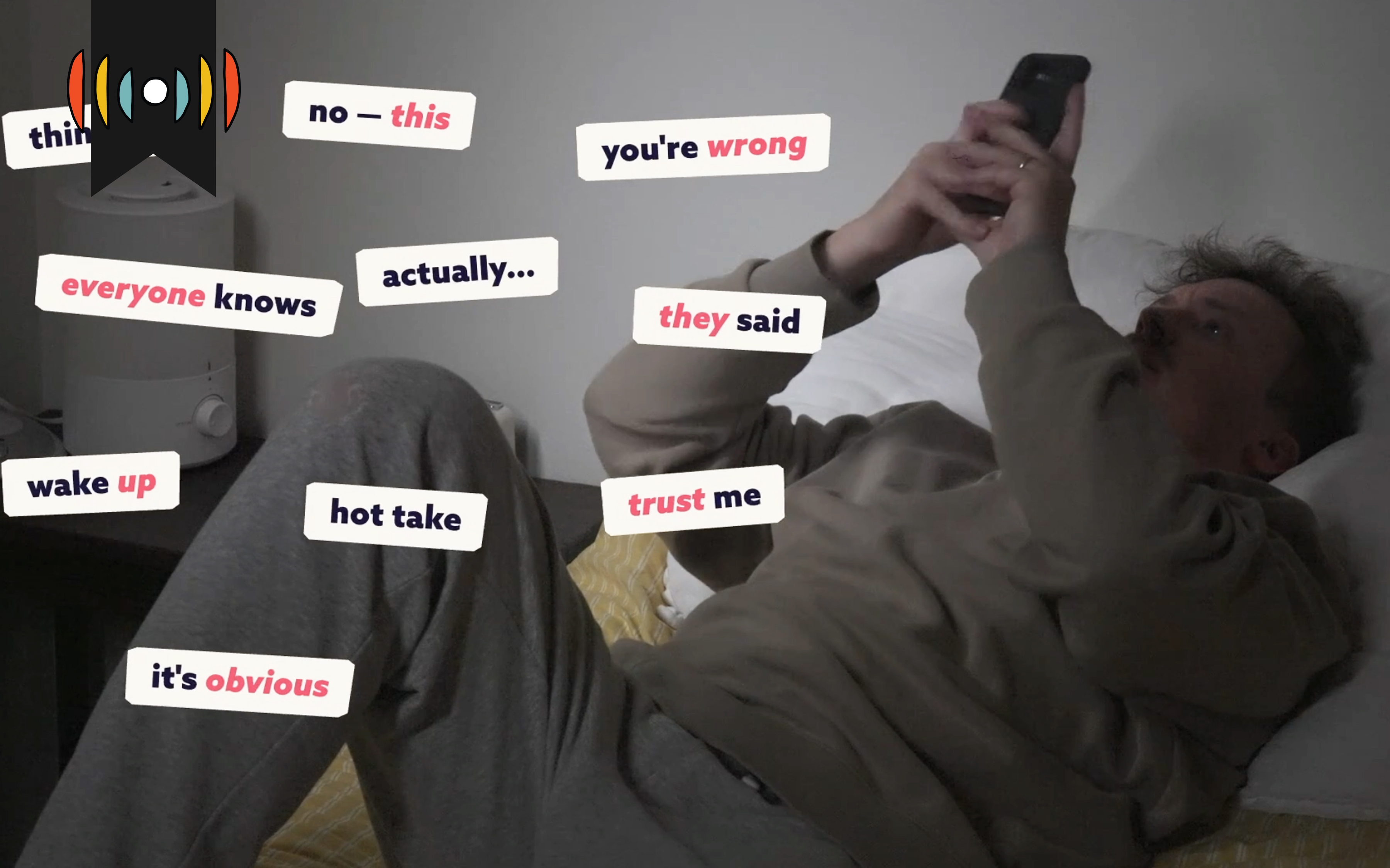
How is it possible that you can have two different people see the same different story on social media and come to completely different conclusions? That is expressing a worldview. That’s expressing a set of ideas that is guiding how you see the world and how to fix what’s wrong with the world.
And so that first episode in season two is: We want every listener to realize that whether or not you realize it, you have a worldview. The only question is: Have you tested it? Have you considered how you’ve constructed that worldview? And does that worldview work? Does it align with reality? And does it help you guide you through those major life questions?
EICHER: Oh, and you’re not just putting non-Christian worldviews under that test, Katie. Christianity has to answer the same basic questions: Is it true? Does it explain reality as it actually is? How do you make sure that Christianity gets held to the same test and not given a home-field advantage?
MCCOY: Entirely. So one of the things that we do with this second season is not only are we critiquing other worldviews, but we’re helping listeners understand how to construct their own. Questions that they likely have never had an opportunity or the need to ask. Like, is it real? Is it true? How do you understand truth?
Which we’re taking that from season two, carrying it over to how to construct a worldview, but one of the things that we’re diving into in season two—and I will say, Nick, it is an ambitious season when you look at the topics we’re covering.
Just in a few months, we’re going to be talking about critical theory and how critical theory itself is a worldview. It is examining what is wrong with the world and how to fix it. Feminism is an offshoot of critical theory, or sort of a variation of critical theory, and helping students understand that not only are these worldviews, but because they’re worldviews, they are competing ideas with the Christian worldview.
So one of the greatest vulnerabilities, I believe, is not only do we have a cohesive worldview, but are we trying to syncretize that worldview with ideas that are culturally palatable? And I think we see that all in evangelicalism, under the umbrella that you don’t have to just be having a pride flag outside your church to be syncretizing ideas of the world and what the world says we need to do to make the world just, righteous, and good.
So it’s such an opportunity for us to examine these ideas. I can’t wait to hear what these students think about it. Can’t wait to hear how God uses it in their lives, and as always, we want to hear from listeners. We want to hear how it’s landing, how it’s helping, or what we can be doing more of or better.
MAST: So, Katie, you’re primarily a writer and a speaker here. You’re taking big ideas—feminism, critical theory, eventually Marxism—and trying to explain them to middle and high school students in this visual medium in just five minutes. It’s a tall order. What has that forced you to do differently as a communicator?
MCCOY: That’s such a great question. I have to tell you, Reality Check has helped me become a better communicator because when you’re asked to take something like, why don’t you take ideological feminism, explain it to a 14-year-old in five minutes? Go.
And when you do that, you really have to narrow down to what are those ideas? How do I concisely and cogently communicate them?
MAST: And don’t let them go look at their phone and get distracted in the middle of the five minutes.
MCCOY: Exactly. I know. Hopefully, they don’t start scrolling halfway through because we want to also produce. And Caleb and his team have done this masterfully well. It is truly entertaining.
Not only are you getting a lot of education about some pretty high-level things brought to that high school level, middle school level, but it’s fun, it’s engaging.
So probably the biggest challenge—and I think we’re running into this. I’m writing the episodes on Marxism that are going to be in, I want to say, the spring, winter to spring—is how do we distill this in a way that is communicating, connecting, and also clear?
And it is a real test for anyone who does communication for a living, truly to try to make it that concise.
MAST: Well, Katie, I want to take one of those worldview questions into the culture. New survey data this week show bisexual identification among ninth-grade girls dropping from 26% in 2021 to 13% in 2025.
The researcher can’t really say why, but when an identity category moves that far that fast, what does that tell us, or at least suggest about the role culture plays and how teenagers understand and describe themselves?
MCCOY: Yeah, this is a fascinating article, and when you read the report, the author tries to explain why this is and can’t really find an explanation. He says it’s not because of social media drop in social media use among teens. It’s not because teens or Gen Z are somehow trending more conservative.
He places this in juxtaposition of post-progressivism and saying that somehow these teens have decoupled or separated their progressive ideas and their progressive political identities from their sexual orientation and gender identity.
What I find fascinating when I look at this chart is you see the peak and then the precipitous drop, and what was happening in those years. To summarize it in the immortal words of Representative Alexandria Ocasio-Cortez: “Woke one was crazy. Woke one was crazy.”
And when you look at the years that you see this spike, it is between about 2018, 2019, and then 2021, and after 2021. So you think that’s the height of when critical theory was just en masse, and not only the ideas of critical theory in secular government, in school systems, but it even infiltrated the church.
We can think of some best-selling books and authors that integrated critical theory into Christianity, and then its counsel for Christians on how to correct injustice, and so we’re seeing some things mapped in that graph.
And I believe it was the spike in the critical theory worldview and everything that it claimed to be able to correct by deconstructing, dismantling different authority structures. When that happened, what we saw is Americans woke up and realized we are no better. You can only deconstruct so many things. What are you reconstructing it into?
And there was never a positive solution. That’s one of the things that critical theory does. It’s just there’s always something to tear down, dismantle, and deconstruct. But there’s not a positive vision for where we should be going.
So when you see the precipitous drop, I believe it maps the drop in “woke one.” That after 2021, you see this sharp turn, and it isn’t just the 2024 election.
In fact, I would say the 2024 election is just following the cultural change of people realizing that woke one didn’t work, and so I think what we’re seeing in these political identities—and for many, many teens, it was a political identity. It was a way to distinguish himself or herself.
It was a way to feel special because, of course, being a “cisgender white middle-class American” kid doesn’t make you special. You have to have some type of oppression identity, some type of victimhood, in order to make you stand out. And sexuality was the sphere that children, teens, could adopt and elect to take on that put them in that minority status.
EICHER: Well, and let me put one more worldview test on the table because the former college swimmer Riley Gaines is back in the news. Her experience in college, having to compete against men, took her from athlete to activist, and she’s pursuing a case against the NCAA and suffered a bit of a setback this past week.
So let me just frame up my question to you this way: Feminism once insisted that biological sex mattered, that women could be vulnerable to male power and sometimes needed protection from it. But what happens to that worldview when woman itself becomes a category that’s under, frankly, dispute?
MCCOY: Right. This is one of the great ironies of second- and third-wave feminism. Some people debate whether we’re in a fourth wave, but certainly since the 1960s, what feminism did is it said that based on your category, you are either an oppressor or you are oppressed, and that category was your biological sex.
That if you were born female, you were automatically an oppressed social class, and either you just didn’t realize it, and you had to have your consciousness awakened, or you were a traitor to your sex, and you were just part of the problem, à la Phyllis Schlafly.
So this is what feminism said, and largely won. I mean, that, I would say, was generally quite victorious. The prevailing belief is that men are automatically oppressors, women are automatically oppressed.
Well, what happened was this idea kept getting applied to other gender minorities, and in that case, the gender minority now is “trans women” meaning biological males who self-identify as women.
So then the oppressor and the oppressed categories just flipped. Now it’s women who are the oppressor, biological females who are the oppressor, and trans women who are the oppressed.
MAST: All right, author and speaker Katie McCoy. She’s also co-host of Reality Check on World Watch. Katie, we get to talk to you again next week. We’ll see you then.
EICHER: Thanks, Katie.
MCCOY: Sounds good. See you then.
WORLD Radio transcripts are created on a rush deadline. This text may not be in its final form and may be updated or revised in the future. Accuracy and availability may vary. The authoritative record of WORLD Radio programming is the audio record.
Please wait while we load the latest comments...
Comments
Please register, subscribe, or log in to comment on this article.