
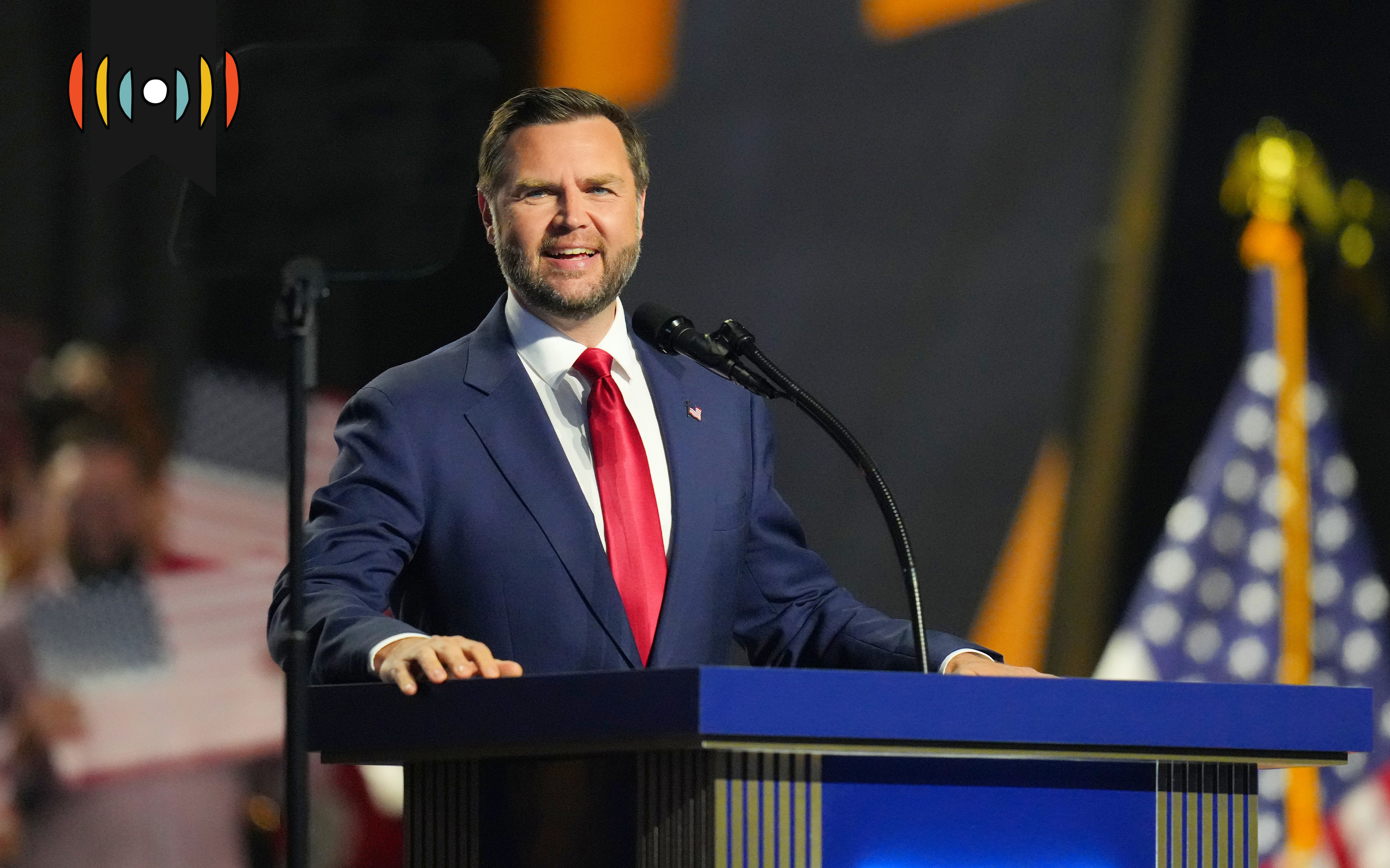
Vice President JD Vance speaks at the Republican convention in Dallas, Thursday. Associated Press / Photo by Julio Cortez
Editor's note: The following text is a transcript of a podcast story. To listen to the story, click on the arrow beneath the headline above.
MARY REICHARD, HOST: Coming up next on The World and Everything in It: The Monday Moneybeat.
NICK EICHER, HOST: Time now to talk business, markets, and the economy with financial analyst and advisor David Bahnsen. David heads up the wealth management firm, the Bahnsen Group, and he is here now. Good morning, David.
DAVID BAHNSEN: Well, good morning, Nick. Good to be with you.
EICHER: Well, David, you’ve spent much of your career in and around Wall Street, and I thought your Dividend Cafe reflection on 9/11 deserves a mention today, making a point I’d like the WORLD listener to hear. And it’s not just a reflection on the resilience of the human spirit or the durability of American free enterprise.
What we remembered last week was an attack on America’s power centers, our government, our ability to wage war, but also on a symbol of our financial strength. And that’s where I’d like for you to go. What does the human response to a catastrophe like the 9/11 attacks say to an investor about why economies and markets come back?
BAHNSEN: Well, the focus in terms of investors was on the human spirit, and the point I wanted to make is that I think there are some people who accept the premise that the human spirit is indomitable, that it was made by God to do great things, but they accept that premise in periods of normalcy.
If you look at this rather unsettling new millennium that we began over 26 years ago, the 9/11 event, the financial crisis, the COVID pandemic are the three big ones. Those are three doozies to fit into 25 years.
The stock market is now at all-time highs, and company profits are now at all-time highs, not by magic through these three major events. Humans don’t want to give up; they want to do things. They want to do things, by the way, that are profitable because it advances self-interest. It promotes objectives that they care about. It drives progress.
There’s all these embedded motivations that exist, and they do exist on days like September 12th. And I expect the response to those events to be much like it was after 9/11, after financial crisis, after COVID pandemic, and that is humans doing what God made them to do, which is to restore profitable endeavors, and those things create investable opportunities in any economy.
EICHER: Well, David, let’s turn briefly to the Fed. There’s a big rate policy meeting coming up this week. The CME FedWatch tool about a week ago had the odds of a quarter-point rate increase at about 60 percent. It’s now at about 90. Big jump.
And in between, the Consumer Price Index, the CPI, came in roughly as it was expected to come in. So why did the likelihood increase so much?
BAHNSEN: What happened was the CPI report came, and it isn’t that the CPI report pushed it up to 90; it’s that the lack of a CPI report was holding it down to 60. Then the CPI report came; it was in line with expectations. Actually, the core rate was 0.1 higher, so the Fed could very well decide, no, we’re still not going to do it, and here’s our reason why.
But the CPI didn’t give them any cover. And I will say this: If markets expect a quarter-point rate hike in September, they have to expect another one at either the late October or December meeting.
But if you really believe you have to raise rates to bring down the activity and velocity of money that is putting upward pressure on prices, then you can’t possibly believe one quarter-point hike is going to do that. It’s an interesting week we have ahead here.
EICHER: All right, David. Just one more market story. The Wall Street Journal reporting that Anthropic is preparing its IPO, its initial public offering, in a way that could value the company at around $2 trillion, and investors still haven’t seen the financials.
In principle, what would you say would have to be true about future earnings and cash flow to justify that kind of valuation?
BAHNSEN: Well, I can’t justify it because I believe that valuations are a byproduct of future expected earnings and cash flows, and nobody in their right mind thinks that Anthropic or SpaceX are being valued off of that.
Now, in fairness to Anthropic—which is not words you’re gonna really ever hear come out of my mouth again, and I’m upset you made me say it this time—but I think their annualized revenues are 60, 65 billion, and SpaceX’s were 18 billion, and they IPO’d at about a one-and-a-half-trillion valuation.
So relative to SpaceX on a revenue basis, the Anthropic IPO is cheap, but it’s all speculation. Anthropic has what is effectively a couple trillion dollars of liabilities, of commitments out there, and the assumptions you have about what their future revenues will be do not right now help explain how they’re going to pay their bills, let alone be worth a couple trillion dollars.
And no one’s buying it for $2 trillion now, thinking let’s hope it’s worth $2 trillion in seven years. They want it to be worth $5 trillion in seven years. If you’re trying to go get a 10, 15, 20 percent a year return based on the level of risk you’re taking, the whole thing is madness. It’s speculative. It’s not new. It’s been going on a very long time.
But there are—I have to say, I was a child of the excesses of the ’90s, and I thought that they were radical then. But I will say, for my young Gen X counterparts, we had many less zeros and commas in our excess than they seem to have now.
EICHER: Well, David, speaking of excesses, before we go, I think you know where we’re headed. A couple of policy announcements from the administration this week.
Vice President Vance’s proposal: It involves roughly $9,000 for married families with one spouse at home, and then there is President Trump’s call for a $5,000 dividend for every American. Now, you object to both of these, but not for the same reason. Tell us the distinction.
BAHNSEN: Look, two major policy things were announced in administration this week. One is more serious than the other.
I think that the vice president’s announcement is serious. They intend to not go to Congress and by executive branch try to offer a reshuffling from funds in place, of $9,000 to married families where the one spouse stays home.
And, by the way, that’s within a program that’s total funding is about $10 billion and right now has hundreds of thousands of poor single women taking from it, so they have to expand that program if they are to do something like this.
Then the other announcement was what President Trump said, not with Congress, not with any particular executive order or authority, but just as a quasi-campaign speech at this rally that the Republicans held in the middle of last week, announcing that they were going to give $5,000 to every American as a dividend, something that would cost in the range of $1.3 trillion.
Okay, well, that one is far more reckless because of the zeros and commas, but it’s never ever going to happen. It’s very upsetting that the administration could say it, because then one day another administration might say something that can get done and use this to rationalize it. Well, why not go throw something huge out there and say you guys wanted to give rich people $5,000 with money that doesn’t exist?
And I will add, it’s very disappointing to see people that should know better. I’m not referring here to the White House, but I’m saying defenders saying, “Oh, well, they’re just doing it from profits from the tariffs,” which, soaking wet, are a couple hundred billion and aren’t profits at all. We are running $2 trillion deficits after the tariff revenue is considered. So that to me is appalling.
The other one, I freely acknowledge, has some people—and I would put Vice President Vance in this list—that are well-intentioned in believing, hey, we’re just reshuffling monies that already exist to something that we don’t like, which is single women that are poor getting support, to married women who are less poor getting support.
First of all, it’s as naive as anything I’ve ever heard in my adult life to believe that that’s what we’re going to do. That we’re going to have the political ability to pull from poor people to give to less poor people just because we socially like the outcome better. It will not happen.
And it is flat-out welfare with money that doesn’t exist to give to married families of under, let’s call it, $76,000 of income because it’s a little complicated how it works.
But the other lie going on—and, by the way, in a lot of cases is not a lie; people just don’t know—and then they’re coming to me saying, “Okay, now I didn’t understand that.”
A lot of people are saying this money is already apportioned; it has to be spent. We may as well try to channel it to families rather than where it’s going now. But it is not apportioned. Thirty percent is out of the Social Security Act. Seventy-one percent of this expired in 2020 and has not been extended.
And Congress is just having to year by year re-apportion it without legislation, and that’s totally at a discretionary basis. So this is a huge expansion of the welfare state. It is totally contrary to my view of family values, which is not that we believe in having children because the government will pay us to do it. And I’ve never heard that argument from any Christian in my life.
EICHER: Well, David Bahnsen is founder, managing partner, and chief investment officer of the Bahnsen Group. He writes regularly at dividendcafe.com and at WORLD Opinions. David, have a terrific week.
BAHNSEN: Thanks so much, Nick.
WORLD Radio transcripts are created on a rush deadline. This text may not be in its final form and may be updated or revised in the future. Accuracy and availability may vary. The authoritative record of WORLD Radio programming is the audio record.
Please wait while we load the latest comments...
Comments
Please register, subscribe, or log in to comment on this article.