
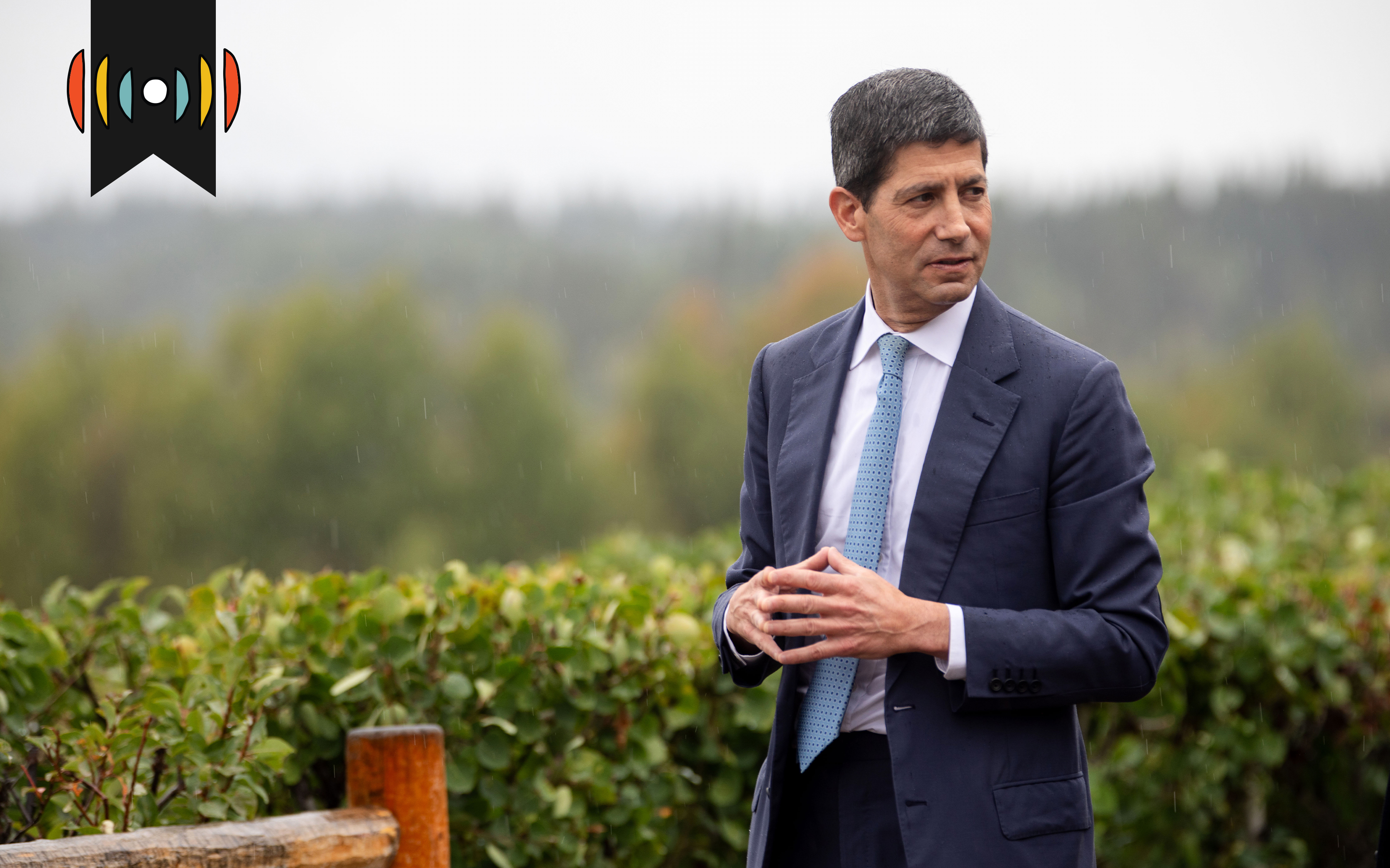
Fed Chair Kevin Warsh arrives at the annual Jackson Hole Economic Policy Symposium in Moran, Wyo., Friday. Associated Press / Photo by Amber Baesler
Editor's note: The following text is a transcript of a podcast story. To listen to the story, click on the arrow beneath the headline above.
MARY REICHARD, HOST: Coming up next on The World and Everything in It: The Monday Moneybeat.
NICK EICHER, HOST: Time now to talk business, markets, and the economy with financial analyst and adviser David Bahnsen. David heads up the wealth-management firm The Bahnsen Group. He is here now.
Good morning, David.
BAHNSEN: Good morning, Nick. Good to be with you.
EICHER: We talked last week about the anticipation around a speech at the Jackson Hole Economic Symposium. A speech with interesting timing ... new Fed Chairman Kevin Warsh hit his 100th day on the job. But I know you were looking forward to what he would have to say ... and now he’s said it.
So David, what did you hear as the central message?
BAHNSEN: I think that the major takeaway I had was that he reiterated something that he’s been criticized for since becoming Fed chair, which is that trying to do policy by hinting at future policy, what we refer to as forward guidance, that he’s not going to do it.
The issue, Nick, is that in the here and now, he has task forces that have been appointed that are in the middle of their work, and I, for one, am very curious as to the gravity, punch, and potency of what’s going to come back when they talk about how they collect data, what they’re going to do with the Fed balance sheet.
Is it going to be like most governmental task forces, which are really cosmetic and not usually very potent, or is there something big coming out of it?
What he’s done with the task forces is all at once create the opportunity for some real reform, but also leave us hanging because they are TBD.
EICHER:One of the reasons Chairman Warsh gave for rejecting forward guidance is what he calls the “hall-of-mirrors problem.” Listen.
WARSH: If markets rely materially on the Fed’s guidance, and the Fed relies on market prices, we’re more likely to be blinded to new developments, more likely to be caught unprepared, and more likely to commit errors in policymaking.
EICHER: David, is that what he means by a hall of mirrors—and how does that circularity affect actual investment and economic productivity?
BAHNSEN: It is what he meant, but it’s also what critics of forward guidance have said for a long time. But what is profound is the Fed chair himself saying it.
The way I put it with clients is people begin investing money not off of what their outlook is, but how they predict others are going to be investing money in response to that activity.
It’s distortive activity. It is people responding to things that are interventions, and so it is necessarily less productive because unless you don’t believe that the most productive economic activity are human beings acting in self-interest, building businesses, doing things, making investments, taking risks, and that’s the optimal framework for economic growth.
And then anything that waters that down by trying to factor in Fed guidance or how the Fed responds or this, that, and the other, we can debate how marginal that dilution is. But I don’t think there’s a debate, not a credible academic or intellectual argument, that suggests that this isn’t marginalizing economic productivity to some degree.
The ideal framework would be that the Fed has a much more limited scope and jurisdiction, and at some directional level, Kevin Warsh agrees with that.
EICHER: Warsh also made an unusually direct statement about the Fed’s responsibility for inflation. Listen to this part—
WARSH: Now, there is one signal nobody can miss. The responsibility for 65 months of sustained, elevated inflation sits squarely with the central bank. And that’s where it belongs.
EICHER: David, do you take it literally—that the Fed caused the inflation? Or is Warsh making a broader “buck stops here” statement?
BAHNSEN: I don’t agree, nor do I even think he really believes it—that all of the inflation is because of the Fed. But he may be saying the inflation could have been caused from this, this, and this, but it’s the Fed’s responsibility to go deal with it.
So there is a “buck stops with us” sense that is legitimate, but economically it’s a little too binary for my liking. But I also take the context in which he’s saying it differently.
Now, no, I have not heard it from inside the Fed before, and you’re not gonna hear it from someone who was there. He can say it because he wasn’t there over those 65 months.
But I want to point something out, Nick.
Chairman Powell was, and then Chairman Powell is now a sitting Fed governor, as are plenty of the other members of FOMC. So there’s a dog whistle in this.
What he is basically trying to say is: Why do we want a majority of FOMC members now that were responsible for some policy mistakes then?
And I do believe that there is some cordiality, but nevertheless contentious policy disagreements right now behind the scenes. But Warsh is the one with the microphone, so he can get little jabs like that in there to help from the bully pulpit.
EICHER: Last bit of the address, Warsh’s reading of the economy.
WARSH: In my view, credit and loan markets are showing few signs of policy restraint. Now, certain sectors like housing and agriculture are showing strains. But on balance, I would be hard-pressed to describe broad financial conditions as restrictive.
EICHER: Warsh also described the labor market as stable and consistent with full employment. But is “stable” the same thing as strong enough to absorb a rate increase?
BAHNSEN: I think that for him to have leaned more into price worries and less into job-growth worries is a way to say, “I’m feeling more hawkish than dovish.”
You notice, by the way, when he spoke that short-term rates came up a little bit, but the 30-year actually came down a basis point. The 10-year barely went up, so there was a little bit of curve flattening, and that, I think, is speaking to him trying to reestablish a little bit of Fed credibility.
But the issue is the vulnerability in the job market is an argument against raising rates, and so you either have to really believe the job market’s solid, which there’s some anecdotal evidence it’s done pretty well. I always point to the initial jobless claims. We had another benign report there on Thursday.
If he were to hike rates, people are going to lose jobs. There’s just too many variables connected to that across companies that borrow money, floating-rate, mortgage-related, commercial-real-estate-related, that on the margin, higher rates right now would be difficult for jobs.
And the job market, although not terrible, isn’t great, and it’s that no-hiring, no-firing component. Be optimistic that there’s not a lot of firing, but be pessimistic that there’s not a lot of hiring.
But I do believe that he does not want to get in a position where he has to start cutting rates because the unemployment rate is screaming higher, and that’s why I think him talking about it this way gives him the ability to do what I think he actually wants to do.
He does not want to cut rates and sacrifice Fed credibility and be perceived as capitulating to the president, but I don’t think he really wants to hike rates either.
And it may just be the best way for him to navigate this is to leave things status quo, which is somewhat faithful to the dual mandate regarding both the employment side and the price-stability side.
EICHER: Before we go, just real fast, I want to get your take on the treasury secretary’s big announcement on Iran. Secretary Scott Bessent announced what he calls “Operation Economic Outcast.”
The Wall Street Journal editorial page says the strategy threatens secondary sanctions against foreign refiners, shippers, exchange houses, and banks that help Iran turn oil into spendable money.
David, is this genuinely a new escalation? Do you think economic pressure to change the behavior of a regime that has to date shown itself willing to impose enormous hardship on its own people?
BAHNSEN: It’s interesting. Secretary Bessent was one of the people I was most excited for the new Trump administration at cabinet level. He’s one I had a relationship with going in, have met with since he has become Treasury Secretary, and therefore it’s hard for me because it’s now two weeks in a row of criticism.
But it isn’t so much I’m critical of what they’ve done. It’s just a little odd the way it was melodramatically positioned.
Am I supposed to believe that we have not been doing economic sanctions against Iran the last six months?
I am not convinced at this time that the Iranian regime is impacted by self-preservation.
I believe that they are willing to do extraordinary damage to their own people, and I don’t know if part of that is the jihadi culture or just a kind of resilience of these Iranian extremists.
But them moving to significant unemployment or inability to have capital mobility, I’m not sure that they care.
But I am happy that we are using economic weapons where we can against a genuine enemy, but I’m not totally sure that we weren’t already doing it.
EICHER: David Bahnsen is founder, managing partner, and chief investment officer of The Bahnsen Group.
You can read his regular market writing at dividendcafe.com. David also writes regularly for WORLD Opinions.
David, thank you so much. We’ll catch you next week.
BAHNSEN: Thanks so much, Nick.
WORLD Radio transcripts are created on a rush deadline. This text may not be in its final form and may be updated or revised in the future. Accuracy and availability may vary. The authoritative record of WORLD Radio programming is the audio record.
Please wait while we load the latest comments...
Comments
Please register, subscribe, or log in to comment on this article.