
Growth is not the enemy
Moneybeat: Fed Chairman Kevin Warsh gets something important right, says David Bahnsen: A growing economy isn’t the same as an overheating one. Also: the tangled web of borrowing behind the AI boom and fiscal hawks who seem to flock only when the other party is in power.
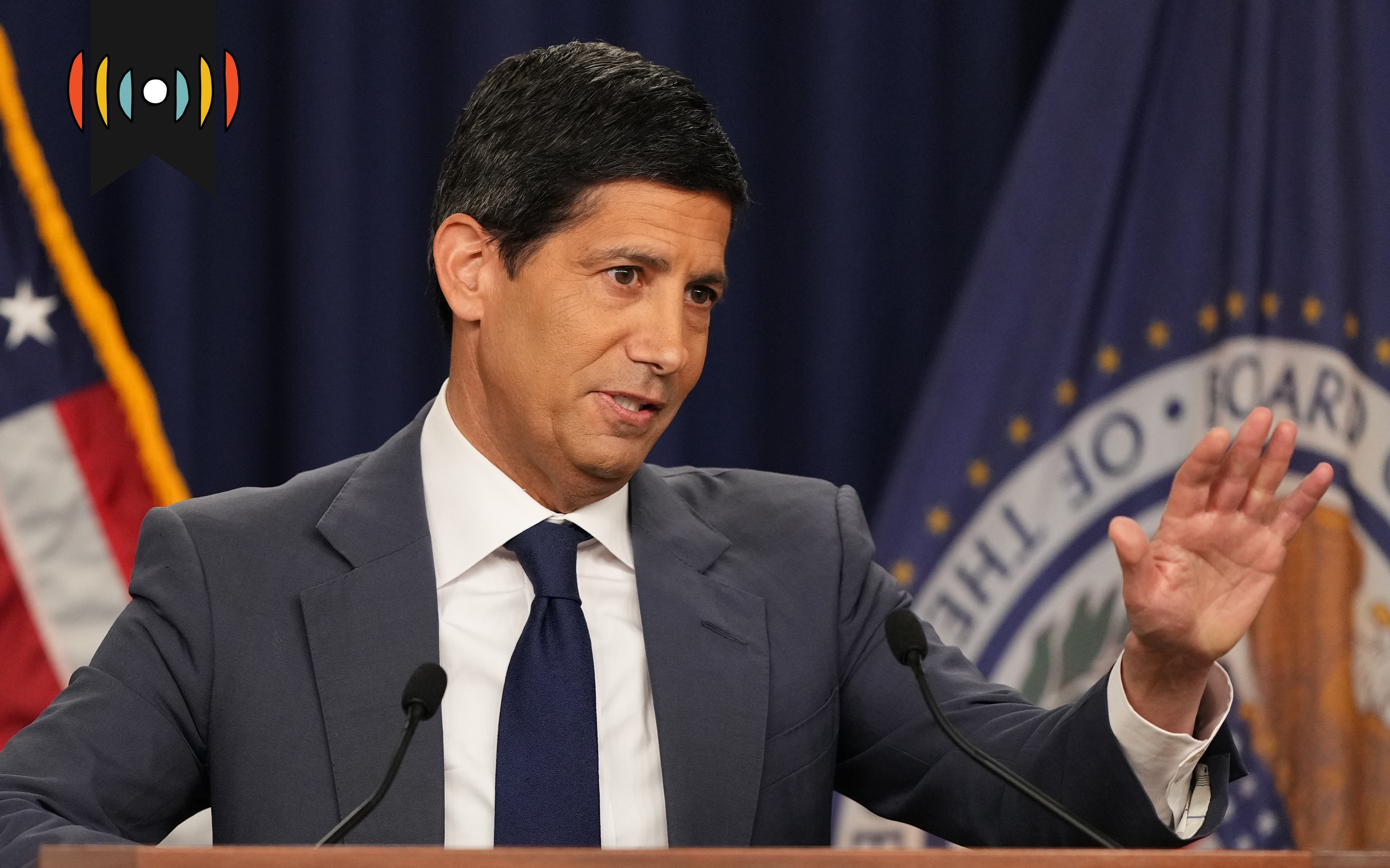
Federal Reserve Board Chairman Kevin Warsh speaks during a news conference at the Federal Reserve, Wednesday. Associated Press / Photo by Julia Demaree Nikhinson
Editor's note: The following text is a transcript of a podcast story. To listen to the story, click on the arrow beneath the headline above.
MARY REICHARD, HOST: Coming next on The World and Everything in It: The Monday Moneybeat.
NICK EICHER, HOST: Time now to talk business, markets, and the economy with financial analyst and advisor David Bahnsen. David heads up the wealth management firm, the Bahnsen Group, and he is here now. Good morning, David.
DAVID BAHNSEN: Good morning, Nick. Good to be with you.
EICHER: Well, David, the Nasdaq fell nearly 3% on Friday, finishing up October down more than 5%. That’s the worst month since March of last year. Technology stocks took a lot of the beating, which of course leads to your latest Dividend Cafe, in which you raise a concern I don’t think we’ve really explored all that much: the borrowing that is financing all of the AI spending.
And you point to rising costs for something called credit default swaps, essentially insurance or protection against borrowers failing to repay debts. But you say that doesn’t necessarily mean that investors expect these companies to go into default. So help us understand the danger specifically that you’re talking about and how it connects to what’s going on in the markets.
BAHNSEN: Yes, well, one thing I will say, just because we often are here to talk about money and markets, and even though I like to avoid talking our own book, I think it’s relevant at a higher level that while October ended up being a really difficult month for Nasdaq, tech, AI, it was not a terrible month for all of the stock market. In fact, it was one of the biggest months in history for dividend growth equities.
And I say that to point out that there are sometimes where everything is dropping, and there are other times where everything is going up, but there are other times—what we refer to as a rotation—where people are moving from some of the frothier, riskier aspects of the market and into things that might be a little more sensible and reasonable. And October was not just one of those months, but it was one of those months in spades.
Now look, it could reverse in a heartbeat, but I want people to understand that the underlying dynamic in the market right now is much more rotational than risk-on or risk-off. And when you talk about the rotation out of tech and the risks you mentioned in AI, a credit default swap is essentially a derivative that functions as insurance against a bond, a credit instrument, defaulting. And the costs have gone way up, and yet they’ve gone up more or less proportionate to the amount of new issuance. There’s a ton of new bonds, a ton of new debt, and therefore there’s a lot more insurance that has come out.
But when you look at the cost going up of Microsoft or Meta or double A, triple A—you know, rock-solid companies that have virtually no chance of defaulting without Armageddon—that speaks to the fact that people want to buy more of this debt, and to do so they have to take some of the risk off their books by buying more insurance against it. So it’s a liquidity issue. There’s a limit to liquidity, and then that pushes the price up.
And I could make this even more complicated. Believe it or not, that’s me trying to make it simple, but it is very multi-party and interconnected, and it’s opaque, and that is a basic, surefire recipe for more risk in the system. I am not talking about 2008 risk. I’m not talking about something that bleeds into your local bank, but I am talking about investor risk. And unfortunately, it’s an investor risk I don’t think enough investors are paying attention to.
EICHER: Well, moving from the market specifically into the economy more broadly, David, we’ve come to the end of a month, as we mentioned, but also September was the end of a quarter, and it took a couple of weeks for the government to generate its first estimate on economic growth. We got that last week. GDP coming in at a 3.4% annual rate in quarter three. That’s good growth. It’s strong growth.
But the same day, we got another major report showing the Federal Reserve’s preferred gauge of inflation running at 3.6% over the past year. Now, the day before those reports, the Fed had gotten together, voting to keep its benchmark interest rate where it was. Fed Chairman Kevin Warsh saying that most of his colleagues don’t believe the economy is running too hot. He’s argued that improvements in productivity actually can support faster growth without necessarily being inflationary. So, how do we distinguish healthy economic growth from an overheating economy?
BAHNSEN: Right now, we know these two things about the economy: prices have continued moving higher, and real growth has been positive, but not fantastic. This 3.4% annualized for Q3 means that we are going to end up being at about 2% on the year, because you’ve got to remember, we had some lower quarters earlier in the year.
Now, real GDP means you’re taking nominal GDP and deflating it by the amount of inflation. So that 3.6% PCE, that 3.4% CPI, these things that indicate prices going up, that’s hurting the real GDP growth. You’re deflating it by a higher inflation number.
So here’s the issue we face: the real GDP growth is not great, other than the one thing making it great, which is a lot of investment and capex in AI, data center construction, etc. If those things all play out, that’s the most disinflationary force of my lifetime.
I don’t think anybody can speak to what that will be in 10 and 20 years. Chairman Warsh is confident, as am I, that we should get enhanced productivity in the next several years, but in the meantime, as they make decisions month by month and quarter by quarter, I think that it remains precarious. It remains a jump ball. You get a good jobs number one month, and you get a bad inflation number one month.
But what you’re not getting from this chairman—and I can’t say this enough, that I think is so good and so important—is him conflating an overheating economy with growth. Overheating could mean a reckless bubble mania, and it could also mean high inflation, prices moving higher. But I think that growth speaks to productivity and production of goods and services, and we should all embrace growth without falling for the error of believing it is always inflationary, because it is most certainly not always inflationary.
EICHER: All right, David. Another economic milestone, and you know how we journalists love our economic milestones. This is not a happy one. The Wall Street Journal published a piece reporting that the federal debt held by the public—this is a different number—the federal debt held by the public stood at about 100% of GDP at the end of the fiscal year. That is roughly $32 trillion, or equal to an entire year’s economic output.
Now, we talk about these debt milestones frequently enough, and the Journal’s weekend piece also poses a question: Where have all the fiscal hawks disappeared to? So, we’ve talked often about the debt problem, but why do you think the political incentive to do anything about it seemingly has just gone away?
BAHNSEN: Well, first of all, for those listening that are worried that they’re suffering from déjà vu, the Journal ran a bizarre story because we did not just reach 100% debt to GDP. We did it six months ago, and then GDP grew a little, but the debt grew a little. So they’re just re-headlining the same story as both of these numbers move a little bit. And I guess it helped get some new clicks to repeat the headline.
EICHER: Yeah. I clicked right on it.
BAHNSEN: Well, we’re at 100% debt to GDP, public debt to GDP. We have been, we will be, and it will go higher. And the real story, because they buried the lede, is where are the fiscal hawks?
And here’s your answer: the fiscal hawks are Democrats when Republicans are in power, and they are Republicans when Democrats are in power. That’s the fiscal hawks. There are no fiscal hawks that are Republicans when Republicans are in power, or vice versa.
So you recall the Biden administration wanted to do Build Back Better, a huge spending bill, when President Biden was in office. Now they say they’re fiscal hawks, and they want to see big tax increases when President Trump’s in power. Likewise, Republicans have been guilty of this for most of my adult lifetime.
There is no fiscal hawk other than a limited group of people—I’m proud to consider myself one of them—that believe whoever is in power is irrelevant. The time is now to address the spending issues and to generate pro-growth policies that will address that ratio of our public debt relative to our GDP.
EICHER: All right, David Bahnsen, founder, managing partner, and chief investment officer of the Bahnsen Group. David writes each week at dividendcafe.com. We’ve got links to David’s latest Dividend Cafe in the episode notes. So as you’re looking at your podcast player, just tap the episode headline, and you will find those links right there. David, thank you. We’ll talk to you next time.
BAHNSEN: Thanks so much, Nick.
WORLD Radio transcripts are created on a rush deadline. This text may not be in its final form and may be updated or revised in the future. Accuracy and availability may vary. The authoritative record of WORLD Radio programming is the audio record.
Please wait while we load the latest comments...
Comments
Please register, subscribe, or log in to comment on this article.