
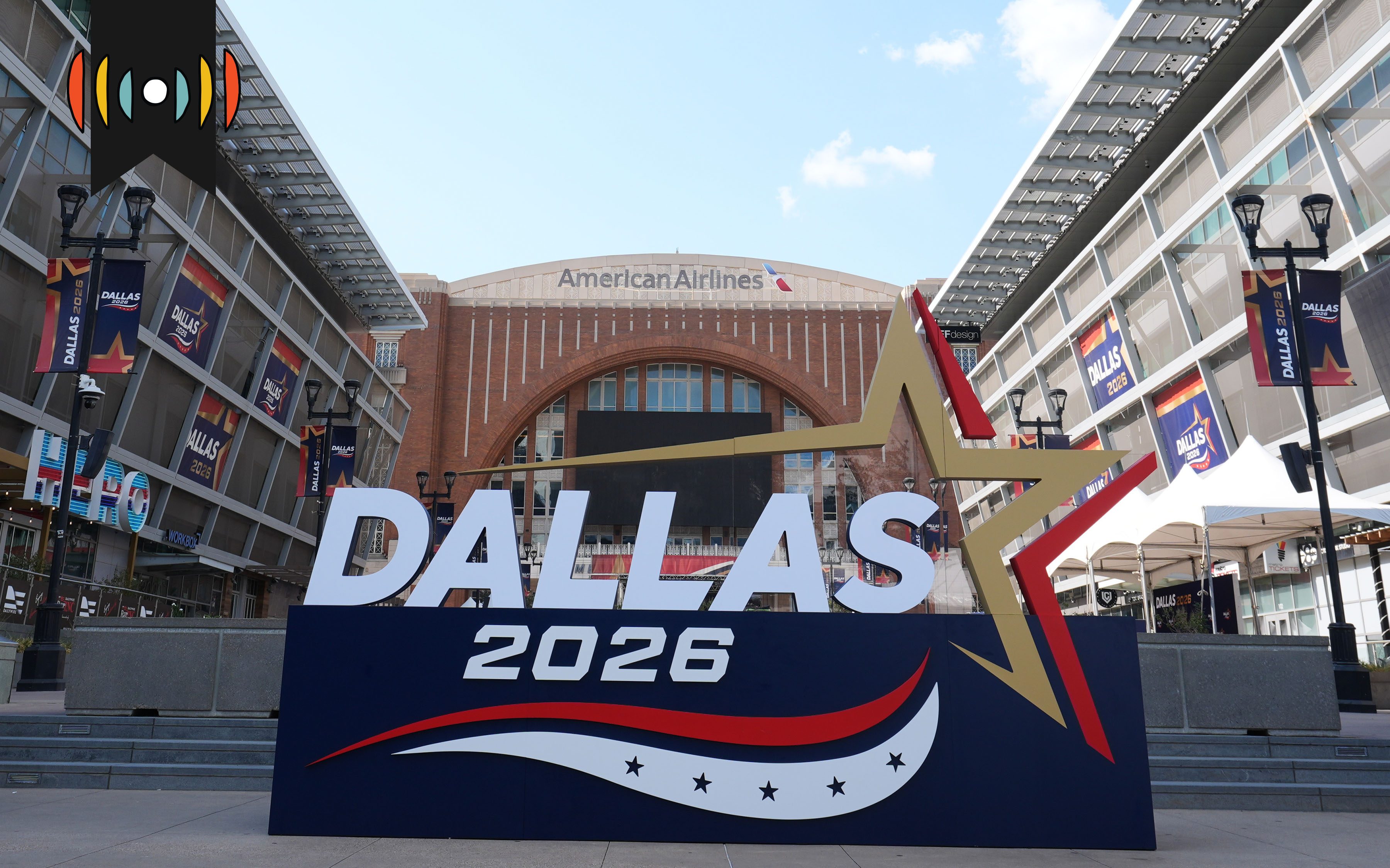
A sign marks the site of the Republican convention in Dallas on Tuesday. Associated Press / Photo by Alex Brandon
Editor's note: The following text is a transcript of a podcast story. To listen to the story, click on the arrow beneath the headline above.
MARY REICHARD, HOST: It’s Wednesday, September 9. So glad to have you along for today’s edition of The World and Everything in It. Good morning. I’m Mary Reichard.
NICK EICHER, HOST: And I’m Nick Eicher.
Time now for Washington Wednesday.
President Trump is scheduled to speak tonight at the 2026 Republican Convention in Dallas. Vice President Vance, members of the cabinet, Republican leadership, and candidates all slated to take the stage over the next two days.
REICHARD: Hunter Baker is standing by, but first we have WORLD’s Mary Muncy in Dallas with a preview. Mary.
MARY MUNCY: Good morning. The convention center is covered in red, white, and blue, and surrounded by barricades, in some places stretching almost a mile from the American Airlines Center.
Republican politicians and thousands of supporters are expected to be here later today. The GOP will take the opportunity to highlight tax relief and economic policy changes made so far during Trump’s second term. Other issues the party wants to highlight going into the midterms include efforts to root out fraud, healthcare affordability, border security, and trade policy.
About 100 leaders and candidates are expected to take the stage on Wednesday and Thursday. President Trump will make remarks both nights. Vice President Vance will give the Thursday night keynote address. Speaker of the House Mike Johnson will also be here, as well as Treasury Secretary Scott Bessent, Attorney General Todd Blanche, and Health and Human Services Secretary Robert F. Kennedy Jr.
Some Republican candidates have opted out of the convention, and four House Democrats will head to Dallas to offer counterprogramming.
Reporting for WORLD, I’m Mary Muncy in Dallas, Texas.
REICHARD: All right, and joining us now is political scientist and WORLD Opinions contributor Hunter Baker. Hunter’s a senior fellow for civic renewal and religious liberty at First Liberty Institute. Hunter, good morning.
HUNTER BAKER: Good morning.
EICHER: Well, Hunter, issue one: Trump is not on the ballot, but Trump’s on the ballot. Now, as you heard, and as you know, Republicans are staging this presidential-style convention designed to make a midterm feel like a Trump election. Do you think that solves the turnout problem or just advertises that they have one?
BAKER: I think that people on the Republican side are of different minds on this issue. I’m sure that some of them think that holding this unusual midterm convention can help get Trump voters to the ballot. As he said in one runoff, “I need you to pretend like I’m on the ballot.” He is trying to get his voters out, who are viewed as lower-propensity midterm voters.
But then there would be another side who would say, “Hey, Trump is the problem because his approval rating is low right now, 40% or lower,” and those folks might think that it would be better to let those midterm candidates make their own way.
So that’s really the question: Is this big Trump event going to actually drive turnout, or is it going to remind people of what they’re unhappy about?
REICHARD: I’m interested in this idea of nationalizing the midterms. Now, Democrats want that too because nobody motivates Democrats like President Trump does. But Hunter, do you think Republicans can nationalize the enthusiasm without nationalizing the blame? In other words, can they turn a referendum on their own record into a choice between two futures?
BAKER: I think that what Trump and the Republicans really need is progress with regard to Iran and the price of oil. As it stands right now, everybody in the country is well over $3 a gallon. And if you go out west, people are probably up around $7 a gallon. And discussions about what happens if the machines have to register something like $10 a gallon, so that’s what’s got to change.
The American public has consistently punished politicians when that price gets high, and so that’s the biggest thing that’s going to happen.
Now they’re going to have this convention. They’re going to talk about the things that have been done, and there are a lot of positives that can be discussed, such as with regard to immigration. Notwithstanding the ICE controversies, the simple truth is that they have gotten control of the border, and they are doing a much better job with that issue.
But the simple fact is, voters are always more interested in the future than they are in the past, and that’s the case that Trump and the Republicans have to make.
EICHER: All right. Well, issue two, Hunter: the Vance Doctrine. Thursday night, that belongs to Vice President Vance. That may give this a feel of a more traditional convention, with a sort of changing of the guard at the end. Do you see it that way? That the Vance speech is the first major foray into 2028?
BAKER: I would say, don’t let Donald Trump hear you say that.
EICHER: I don’t think he listens.
BAKER: He is not ready. He is not ready to turn over the reins to JD Vance. And if I understand correctly, Trump was originally going to speak on one night of this midterm convention, and now is going to headline both nights, completely unwilling to be upstaged or even possibly upstaged by anyone.
REICHARD: Well, we’ve also seen the beginning of what a Vance agenda might look like. One policy draft would let some income-qualified married couples receive childcare aid when one parent works outside the home for money, and the other stays home. We heard some about this last week.
Now, separately, Vance is asking Congress for tougher verification and fraud controls in Medicaid and food stamps. So it’s this idea of using federal money aimed at strengthening families, but also policing public aid aggressively. Now, does that add up to a governing philosophy, or just a coalition shopping list, or maybe it’s something in between?
BAKER: I think that these two things actually can go together. I want to take that second issue first—the issue of fraud. I think that people can all agree that if you’re going to have entitlements, then you want to protect the use of that money. So it should be an 80-20 issue for somebody like Vance to say that what I really want to make sure is that the people who receive the money are actually entitled to get it, specifically that they’re American citizens, or that they meet other eligibility requirements.
Now, this other thing about the married couples receiving childcare aid to incentivize one parent to stay home. I know that they’re probably thinking in many cases about women, but obviously both could apply. This is something that intuitively sounds like it would work. That maybe you get a better situation where people can stay home with their child and raise them, and then maybe people have more babies, and maybe that takes us away from some of the population decline problem that we’re having.
But what I have to say is that so far similar programs in other countries have not been very successful. It turns out that people pretty much do what they want to do, and they don’t respond terribly well to financial incentives when it comes to family formation.
EICHER: All right, we’ll move out of the convention mode here for issue three. Hunter, what 9/11 left behind. Friday marks 25 years since the attacks of September 11th. We will have more on the 9/11 remembrance later in this program, as well as tomorrow. And of course, I’ll talk to John Stonestreet on Friday, day-of.
But there is a political dimension I’d like to talk about, and Gerry Seib of The Wall Street Journal made a counterintuitive argument. His was that the extraordinary unity we saw after 9/11 also helped to sow the seeds of America’s present political division. Do you think he’s right, and why or why not?
BAKER: I do think that he’s right. I remember after 9/11 happened, and George W. Bush just flourished in that moment of challenge. He suddenly became significantly more capable of connecting with voters and projecting a spirit of unity and national confidence, and that lasted for a while.
And it was pretty great to see, not just for political reasons, but I can just remember that community spirit that I saw building, and it seemed like people were really coming together after a deeply partisan period, after that very tightly fought election of 2000.
But what happened is that in the 2002 midterms, the Republicans defied all of those usual expectations of the president’s party losing seats, and they gained seats and they gain strength. And I think that the Democrats decided, okay, it’s time not to play nice. We’ve got to oppose this guy. And I’m not attacking anyone. This is the logic of politics. You don’t want the other team to win, and unity was the price that was paid.
REICHARD: Okay, time for the lightning round. Brutal exclusive in The Wall Street Journal, based on leaks out of Senator John Fetterman’s office. The story portrays Fetterman as resisting some of the most basic work of his office. Former aides are furious. The editorial page argues that the knives are really out because of his support for Israel. Can both things be true?
BAKER: Yeah, it’s easy for both things to be true. There are many senators and other officeholders where their staff are unhappy with them, or they think that they’re lazy, or they don’t like some of their habits. But typically, they stay quiet about that because that’s understood to be the role.
But what’s happening is that he’s being attacked, especially because of his support for Israel, which stands out like a sore thumb in today’s Democratic Party.
EICHER: All right, Iran’s oil dollars are starting to dry up under the American blockade. Do you think that President Trump finally found the pressure point he should have been using all along?
BAKER: I think all the indicators are that they finally have found the pressure point. Iran is getting much, much less revenue from the oil, and the problem is that he relented back in June when he thought that a deal might be made, and I think it’s cost him time that he really needed.
REICHARD: Here’s another Journal story: “Coffee with Comrades.” So this one says young socialists are recruiting through coffee gatherings, softball, potlucks, karaoke, and a promise of belonging. What do you say to that? Is the right winning the argument but losing the clubhouse?
BAKER: I need to be emphatic about this. The right has won the argument. It’s that nobody understands that they’ve won the argument. Socialism is dead!
Socialism as socialism is dead. They do not any longer want to own the means of production and be responsible for all that stuff. What they want to do is they want to be parasitic upon a capitalistic economy and redistribute accordingly.
So socialism lost, but yes, the word is being used in a different way now, and a lot of young people are excited, and they’re finding meaning in new political possibilities involved with heavier redistribution.
EICHER: Socialism is dead, so those are zombies? Is that what you’re saying?
BAKER: (Laughs) Karl Marx is a zombie.
EICHER: Okay, Hunter Baker is a senior fellow for civic renewal and religious liberty at the First Liberty Institute. Thank you, Hunter.
BAKER: Thank you.
WORLD Radio transcripts are created on a rush deadline. This text may not be in its final form and may be updated or revised in the future. Accuracy and availability may vary. The authoritative record of WORLD Radio programming is the audio record.
Please wait while we load the latest comments...
Comments
Please register, subscribe, or log in to comment on this article.