
Winning and losing 25 years after 9/11
Looking at the growth of the DSA and other developments through the lens of al-Qaeda and its goals
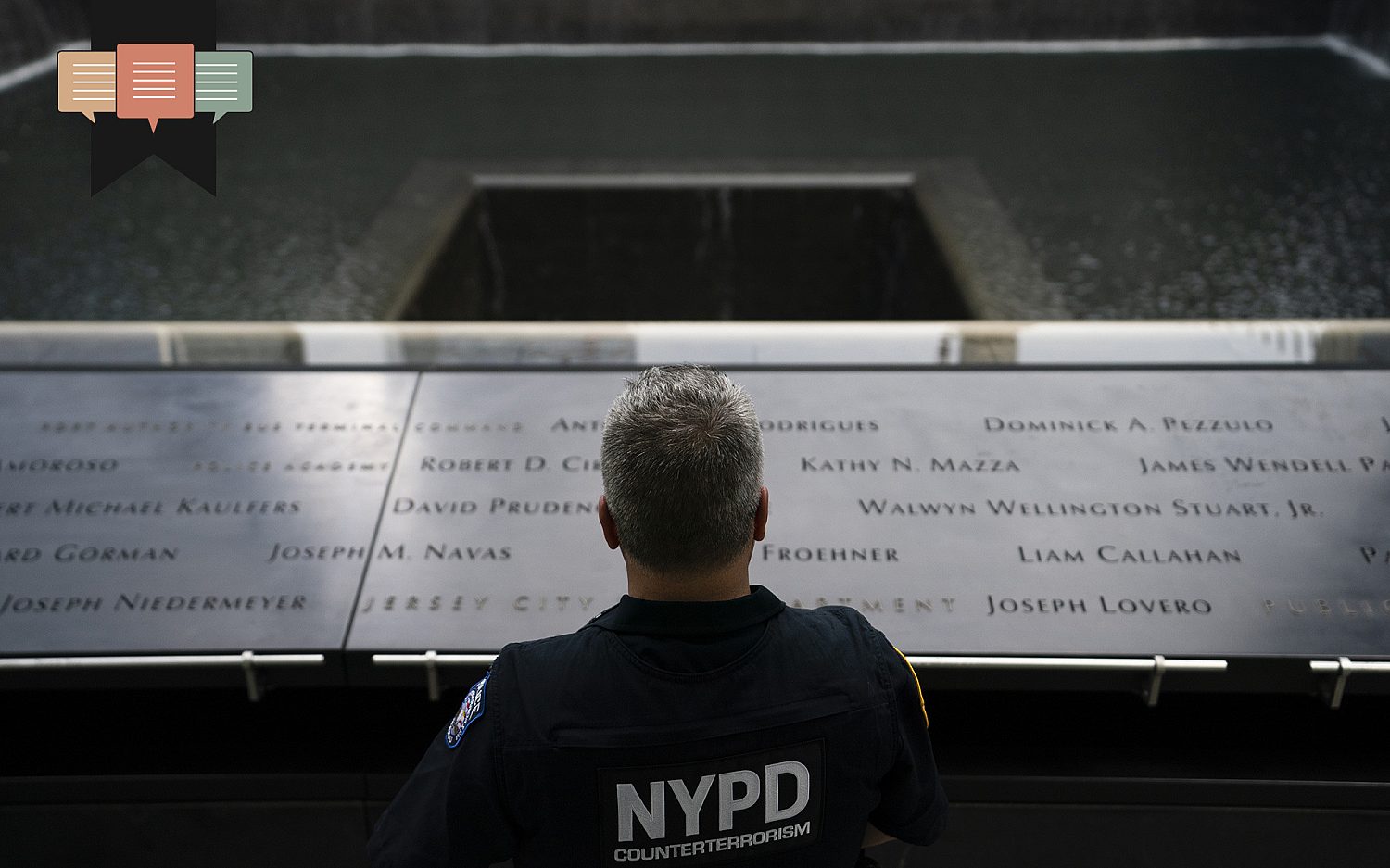
The south reflecting pool of the 9/11 Memorial & Museum in New York city Associated Press / Photo by John Minchillo
Full access isn’t far.
We can’t release more of our sound journalism without a subscription, but we can make it easy for you to come aboard.
Get started for as low as $3.99 per month.
Current WORLD subscribers can log in to access content. Just go to "SIGN IN" at the top right.
LET'S GOAlready a member? Sign in.
Twenty-five years ago today, two hijacked planes hit the World Trade Center, destroying the Twin Towers and announcing a new era of Islamic terrorism. In response, the Bush administration eventually launched what was declared to be a “War on Terror.” A quarter century after the 9/11 attacks, it is worth reflecting on what was lost that day and what victory might look like.
The terrorists’ targets were both symbolic and substantive. The World Trade Center was completely destroyed with a death toll of 2,753 people, while the Pentagon sustained damage and casualties in the attacks that day. The bravery of the passengers on United Airlines Flight 93 prevented the plane from hitting the U.S. Capitol. These targets represent American strength in its political, military, and economic expressions. Much analysis has focused on the political and military conflict with Islamic extremism, from the invasions of Iraq and Afghanistan by American-led coalitions to regimes like the Taliban and the Islamic State. But comparatively little attention has been paid to the socio-economic vision of Islamic extremists, especially given the prominence of the target of the successful 9/11 attack: The World Trade Center in New York City.
Al-Qaeda’s “Manhattan Raid” was clearly a direct attack at the heart of American economic power. Part of Osama bin Laden’s “declaration of jihad” focused on degrading the economic foundation of the West, and particularly America. As bin Laden put it in 2002, “Anyone who steals our fortunes, then we must destroy their economy.” This threat, as much of his rhetoric, reflects bin Laden’s casting of his Islamist jihad as a response to Western aggression. But beyond the substantive efforts to engage America in costly conflicts, the World Trade Center represented a meaningful ideological target as well. Al-Qaeda’s socio-economic vision is heavily influenced by Marxist and revolutionary thought, in part due to the education of the movement’s leaders in institutions steeped in socialist analysis.
Other than Afghanistan under the Taliban at the time of the 9/11 attacks, the next notable experiment in political Islam connected to bin Laden’s ideology was the Islamic State, which declared its existence in April of 2013. Bin Laden had been killed in Operation Neptune Spear almost two years earlier, and his successor was another disciple of revolutionary global Islamism, Ayman al-Zawahiri. In an essay for The Atlantic in 2015, Graeme Wood explores the motivations of the Islamic State, noting that it includes an explicit critique of Western societies, especially America. His interviews with ISIS sympathizers illustrate the comprehensive and holistic nature of this kind of political Islam, which includes an emphasis on social justice. In the words of Anjem Choudary, who is currently serving a life sentence for his role in promoting terrorism, partial implementation of Sharia is self-defeating: “When places like Saudi Arabia just implement the penal code, and don’t provide the social and economic justice of the Sharia—the whole package—they simply engender hatred toward the Sharia.” As Wood notes, those social justice elements of Sharia “would include free housing, food, and clothing for all.”
And it is on this point that the connection between the economic designs of radical Islamists like al-Qaeda and the Islamic State most resemble the platform of the newly ascendent Democratic Socialists of America. The most prominent of these politicians is Zohran Mamdani, who took office earlier this year as Mayor of New York. The symbolic significance could not be clearer: Twenty-five years after al-Qaeda’s attack on New York City, a Muslim socialist occupies the city’s highest elected office.
There are certainly many dissimilarities between Mamdani and murderous terrorists like bin Laden. But if it were possible to separate the religious fervor and ideology of Islamists like bin Laden from their economic critiques of Western liberalism, then we might find a great deal of overlap between the domestic policy priorities of the Mamdani administration and that of radical Islamic socialists. As Mamdani has said, “I’m a Democratic socialist, and what socialism means to me is a commitment to dignity, a state that provides whatever is necessary for its people to live a dignified life. So, the typical big three that we talk about are housing, health care, education.”
Among Mamdani’s initial programs is his plan for government-operated grocery stores. But Mamdani’s ultimate vision is broader, more comprehensive than providing affordable foodstuffs. He has pointed to ideas that seem to have popular support such as student-debt forgiveness and Medicare for All. He has discussed other DSA priorities, pointing specifically to the anti-Israel Boycott, Divestment, and Sanctions movement and “the end goal of seizing the means of production.”
We might think of Mamdani as representative of a kind of secular, radical politics with an Islamic veneer. Certainly, the gender-ideology of the progressives in the Democratic party and especially characteristic of Democratic Socialists of America do not cohere with the sexual politics and theology of radical Islamists. But between the rising anti-Semitism in the Democratic party and the growing influence of its radical socialist factions, there is some reason to interrogate the significance of prominent Muslims among progressives, whether or not they are card-carrying members of the DSA.
At the level of economic policy and worldview, perhaps the accession of Mamdani represents a kind of limited, symbolic victory for bin Laden, if not a vindication of his jihadism. Or perhaps Mamdani might be seen as a curious and unexpected symbol of American victory over extremism and violence. There’s certainly much that’s concerning in a reinvigorated socialism on the domestic scene. But a quarter-century after the most devastating terror attacks in American history and 250 years after an audacious declaration of independence, America still grapples with Islam among our manifold challenges.
Nevertheless, the ongoing struggle to find a modus vivendi across all of the differences and difficulties in America is itself a kind of victory. In that regard we may never be able to definitively declare “mission accomplished,” but as long as we are living together in something resembling peace, hope remains. And that’s certainly something to celebrate and to hold on to even as we remember and mourn what we lost on 9/11/2001.


These daily articles have become part of my steady diet. —Barbara
Sign up to receive the WORLD Opinions email newsletter each weekday for sound commentary from trusted voices.Read the Latest from WORLD Opinions
Ray Hacke | A male cross country runner, his female teammates, and the need for truth and justice on Nov. 3

Jonathon Van Maren | The life and work of Dr. Hugh Hodge provide a powerful example to pro-life advocates

Thaddeus Williams | America’s “existential crisis of meaning” is similar to the Babylonian king’s crisis, and the solution is the same, too

A.S. Ibrahim | In pointing to the attitudes of Muslim immigrants, Trump says what Europe’s leaders still won’t

Please wait while we load the latest comments...
Comments
Please register, subscribe, or log in to comment on this article.