
Faith and family on the docket
The Supreme Court will have much to say this term about parental rights and religious liberty
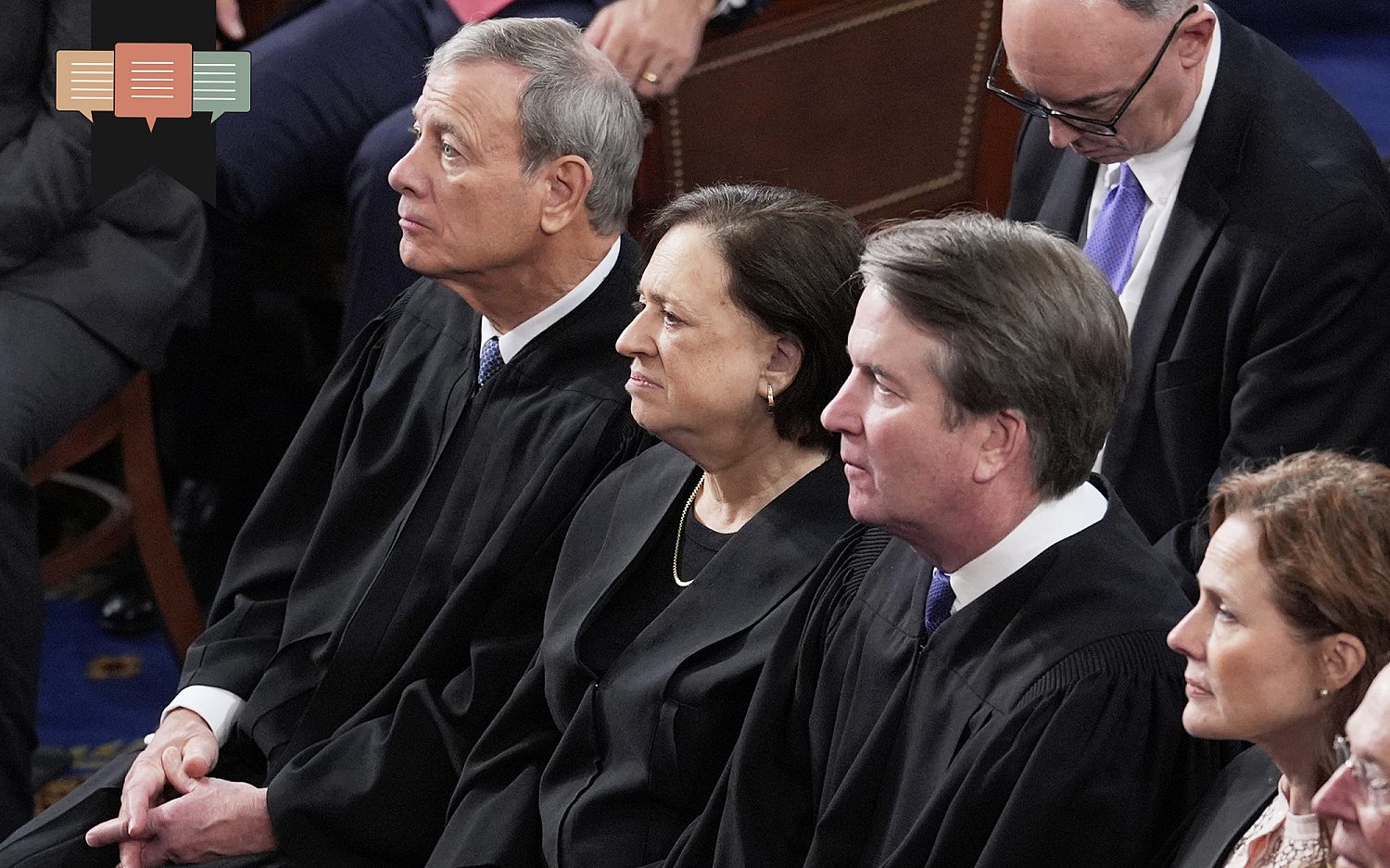
Supreme Court Chief Justice John Roberts and Associate Justices Elena Kagan, Brett Kavanaugh and Amy Coney Barrett, listen as President Donald Trump addresses a joint session of Congress on March 4, 2025. Associated Press / Photo by J. Scott Applewhite
Full access isn’t far.
We can’t release more of our sound journalism without a subscription, but we can make it easy for you to come aboard.
Get started for as low as $3.99 per month.
Current WORLD subscribers can log in to access content. Just go to "SIGN IN" at the top right.
LET'S GOAlready a member? Sign in.
The Supreme Court begins its term today, the first Monday of October. Over the course of the next nine months, the Court will decide roughly 60 cases. A handful of them will define the relationship between We the People and the government—shaping the fabric of our society for generations to come. This term’s docket involves important questions regarding religious liberty, parental rights, the Second Amendment, and whether localities may hold energy companies liable for alleged global climate change harms.
The term opens today, Monday, Oct. 5, with a consequential case. In Suncor Energy v. Board of County Commissioners of Boulder County, the City and County of Boulder sued two energy companies, Suncor and Exxon, under state law. They allege a multitude of legal theories—from state nuisance and trespass to conspiracy—and claim that the energy companies should be on the hook for a smorgasbord of natural occurrences like wildfires, pests, and drought. Boulder’s lawsuit is just the tip of the iceberg: Dozens of similar suits have been filed across the country. The case recently took an interesting turn as Justice Samuel Alito announced that he was recusing himself, leaving only eight justices to decide the case.
Before the Supreme Court, the energy companies argue that a global issue like climate change cannot be litigated piecemeal in state courts. They say the Constitution’s structure makes the question one of federal law (not state law) and that the Clean Air Act assigns the question to the federal government (not states). On the other hand, should Boulder prevail, consumers should expect energy prices to skyrocket. Energy producers could face massive liability in courtrooms nationwide. Families would pay the price.
The Second Amendment is also on the docket. In Viramontes v. Cook County and Grant v. Higgins, the Court will consider bans on AR-15s, the most popular rifle in America. In District of Columbia v. Heller, the Court held that the Second Amendment protects firearms that were in common use. And in New York State Rifle & Pistol Association v. Bruen, the Court held that the government must show that a firearm regulation has a historical analogue. Here, millions of Americans own AR-15s for self-defense, hunting, and sport. It is hard to see how an outright ban on the popular rifle can survive the Court’s precedents.
For religious families, St. Mary Catholic Parish v. Roy may be the most important case of the term. Colorado created and funded a universal preschool program open to private providers but then excluded most religious preschools. Colorado conditioned the funding on providers abiding by Colorado’s views regarding sexual orientation and biological sex, since the state says it may attach conditions to its own money.
The Supreme Court has seen this argument before. In Trinity Lutheran, Espinoza, and Carson v. Makin, the Court held that when a state offers a generally available public benefit, it may not exclude religious organizations because they are religious or because they teach their faith. Colorado responded with a work-around: conditioning funding on conditions that faithful religious schools cannot accept. The 10th Circuit upheld Colorado’s work-around. The Supreme Court’s decision to review the case, however, suggests it may not view Colorado’s attempt to evade its recent cases so kindly.
The Court should hold that states cannot avoid the First Amendment through clever conditions. If a state chooses to fund preschools, it may not force religious preschools who wish to participate to abandon their convictions.
The Court will also consider the states’ role in protecting the integrity of their elections. Arizona enacted laws requiring new voter registrants to provide proof of citizenship and authorizing citizenship checks of the voter rolls. In RNC v. Mi Familia Vota, the 9th Circuit held that the proof-of-citizenship requirement was preempted by the federal National Voter Registration Act. The Supreme Court’s decision will determine how much authority states have to ensure that only citizens vote in their elections.
Finally, parental rights return to the Court after two significant victories. In Mahmoud v. Taylor, decided in 2025, the Court held that parents were entitled to notice and an opportunity to opt their children out of curriculum—such as the LGBTQ storybooks at issue in the case—that burdens their religious upbringing. This past March, in Mirabelli v. Bonta, the Court restored a statewide injunction which prohibited California from keeping parents in the dark about their children’s gender transitions.
This term’s case, International Partners for Ethical Care v. Ferguson, concerns a Washington law governing youth shelters. When a minor who has run away from home seeks so-called gender-affirming care like life-altering drugs or surgeries, the law allows shelters to notify the state instead of the parents. The lower courts held that parents cannot challenge the law because they do not have standing. If, as seems likely, the Supreme Court finds that parental standing exists, that ruling will clear the way to decide whether the state—or parents—should be the first call when a child faces life-altering medical decisions.
As the justices take the bench today, they face a variety of cases that will deeply impact the America in which we live. We pray for wisdom, guidance, and courage.


These daily articles have become part of my steady diet. —Barbara
Sign up to receive the WORLD Opinions email newsletter each weekday for sound commentary from trusted voices.Read the Latest from WORLD Opinions
Thaddeus Williams | America’s “existential crisis of meaning” is similar to the Babylonian king’s crisis, and the solution is the same, too

A.S. Ibrahim | In pointing to the attitudes of Muslim immigrants, Trump says what Europe’s leaders still won’t

Colin J. Smothers | The liberal religion of Senate candidate Adam Hamilton

Denny Burk | A recent article on Elisabeth Elliot is way over that line

Please wait while we load the latest comments...
Comments
Please register, subscribe, or log in to comment on this article.