
The spiritual costs of technology
QUEST | Samuel D. James | Three books that shaped my thinking
Photo by Lori Borgman / Genesis

Full access isn’t far.
We can’t release more of our sound journalism without a subscription, but we can make it easy for you to come aboard.
Get started for as low as $3.99 per month.
Current WORLD subscribers can log in to access content. Just go to "SIGN IN" at the top right.
LET'S GOAlready a member? Sign in.
I was a senior in high school when I got a Facebook account. I didn’t realize it at the time, but that moment represented a profound transformation of my life. It was at that point that the internet and digital technology went from being mere entertainment to a wholly new way of making friends, expressing my personality, learning the news, and much else.
Fast-forward more than a decade. In the wake of the 2016 election, I started noticing that my reading, my conversation, and my emotional life seemed to orbit around the internet. It was exhausting. The “friends” I had spent years “following” eventually became strangers. Reading for more than a few minutes at a time felt weirdly difficult. Before long, I realized that many of my friends had similar experiences. Though the details varied, the common factor was obvious: technology.
Since then, I’ve spent a fair amount of time learning about what digital technology is, what it does, and how it has changed both my life and the wider world. My books Digital Liturgies (Crossway 2023) and Scroll Less, Live More (Crossway 2026), were my attempts to take the best insights I found and translate them into a Christian worldview.
Compromising our cognition
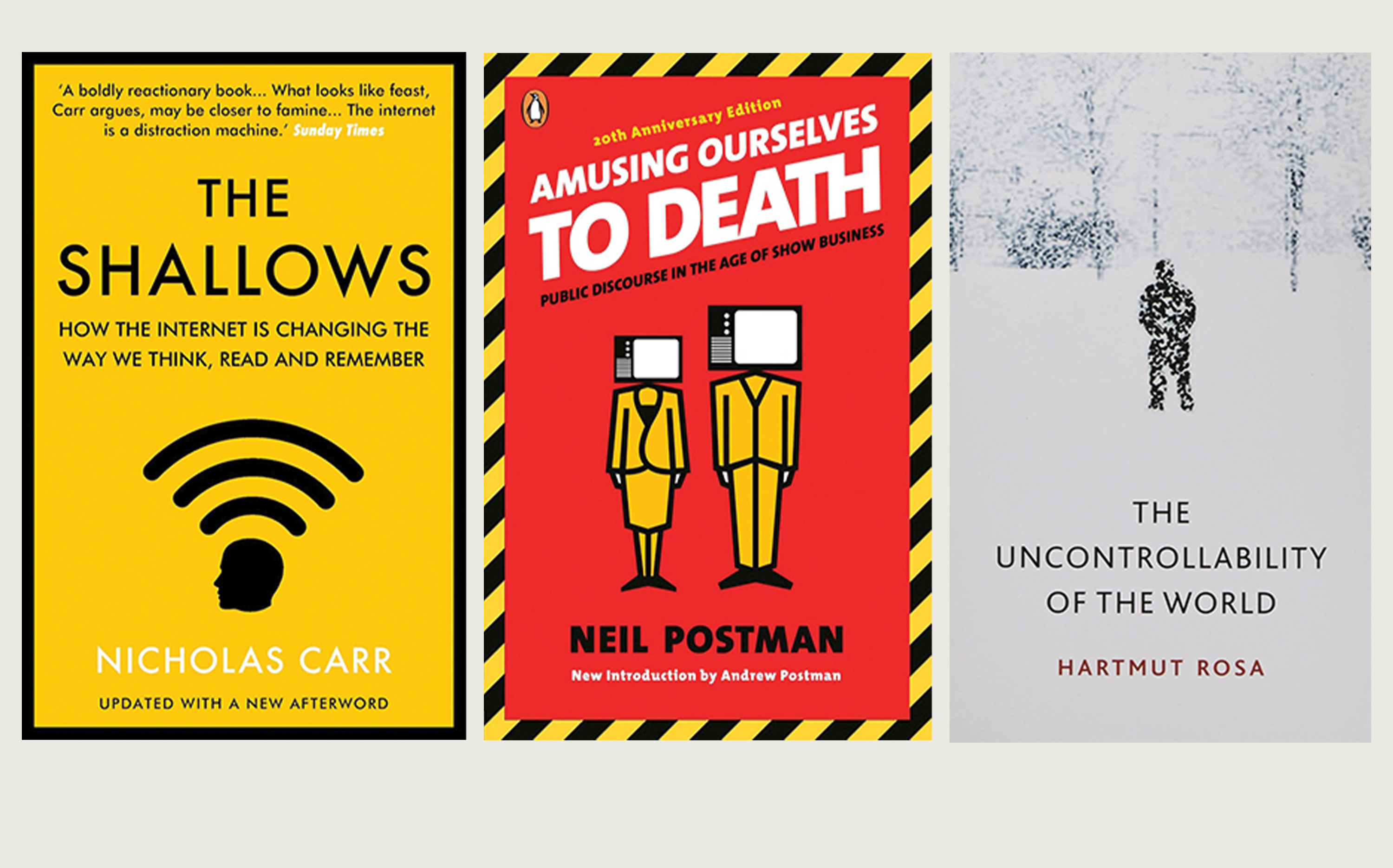
The book that pushed me into this topic more than any other was Nicholas Carr’s masterpiece The Shallows: What the Internet Is Doing to Our Brains (W.W. Norton & Co. 2010). Carr’s book, a finalist for the Pulitzer Prize, makes a convincing argument from cognitive and social science that internet-habituated people develop different ways of thinking, feeling, and communicating than those without the internet. In other words, the internet is not just a place where we consume certain things (some good, some bad). It is a habitat that changes us to resemble its own nature. Carr’s research makes it clear. There is a reason our attention is sagging, our memory is blurry, and our interaction with others so fraught—and the reason is the technology to which we have given our attention, our memory, and our relationships makes it that way.
The Shallows is a little dated in places (Carr incorrectly predicted that e-books would destroy the print book industry), but its main insights have been prophetic more than 15 years after publication. People who argue that these tools are just here to stay and we must adapt or “get left behind” need to reckon with Carr’s demonstration of technology’s effects on cognition. There is no book I’m aware of that summarizes digital technology’s intellectual and emotional power over us as well as this one.
Eroding our interactions
Carr’s work follows in the footsteps of Neil Postman. Postman’s book Amusing Ourselves to Death: Public Discourse in the Age of Show Business (Viking 1985) likewise argued that television creates a particular kind of person out of its viewer. One of Postman’s most important points is that a medium like television “re-stages the world” for its audience. As we immerse ourselves in the silly, frenetic, consumeristic flavor of sitcoms, our emotions eventually come to expect—and want—these traits in our real-world experiences. Thus, everything from politics, to education, to religion, are eventually presented in a way that’s very much like primetime TV.
It’s not hard to see how this same effect is at work in the digital age. I tend to think that a big part of the gender confusion of our age is simply the way people’s mental and emotional lives have become abstracted from their bodies, thanks to the internet. Moreover, things like cancel culture resemble the way we “mute” and “unfriend” whatever upsets us on the screen. We are bringing our experience of the digital world into our desires and expectations of the real one.
Reveling in relationships
The Uncontrollability of the World (Polity 2020) by German philosopher Hartmut Rosa is the best book on modern life that you probably haven’t read. Rosa points out that modern society is marked by two things: a drive to bring every experience of life into greater control and increasing frustration and meaninglessness. Rosa then makes the case that a sense of wonder and meaning to life—what he calls “resonance”—actually depends on acceptance of the difficult, unknown, and unpredictable parts of life. We “resonate” with life most when we are not trying to constantly eliminate risk and uncontrollability.
Rosa’s thesis makes sense of one of the most pressing ironies of our time. Our technology has made communicating with others easier than ever, yet many modern people are more desperately lonely than their ancestors. We have all these tools of connection and relationship, yet our lives are marked by isolation and retreat. Rosa says this is because the tools themselves drain something out of the experience of relationship. It’s precisely because we can connect with each other constantly that the connection itself is less desirable. Our richest relationships are not with people or things that we can summon before our eyes at will, but with the people and things that are beyond our total control, that we have to yield part of ourselves to.
Using technology wisely is only possible if we are honest about what this technology is and what kind of life we need to be pursuing. If we’re wrong about the tech, or wrong about what the good life is, the odds are good our hearts and our habits will follow the creators of the devices rather than the Creator of our souls.
—Samuel D. James is director of content development at Crossway Books. He is the author of Digital Liturgies: Rediscovering Christian Wisdom in an Online Age and Scroll Less, Live More: 10 Healthy Tech Habits for Teens

Please wait while we load the latest comments...
Comments