
Shouldering the burden of religious conflicts
MASTERWORKS | The witness of Hagia Sophia
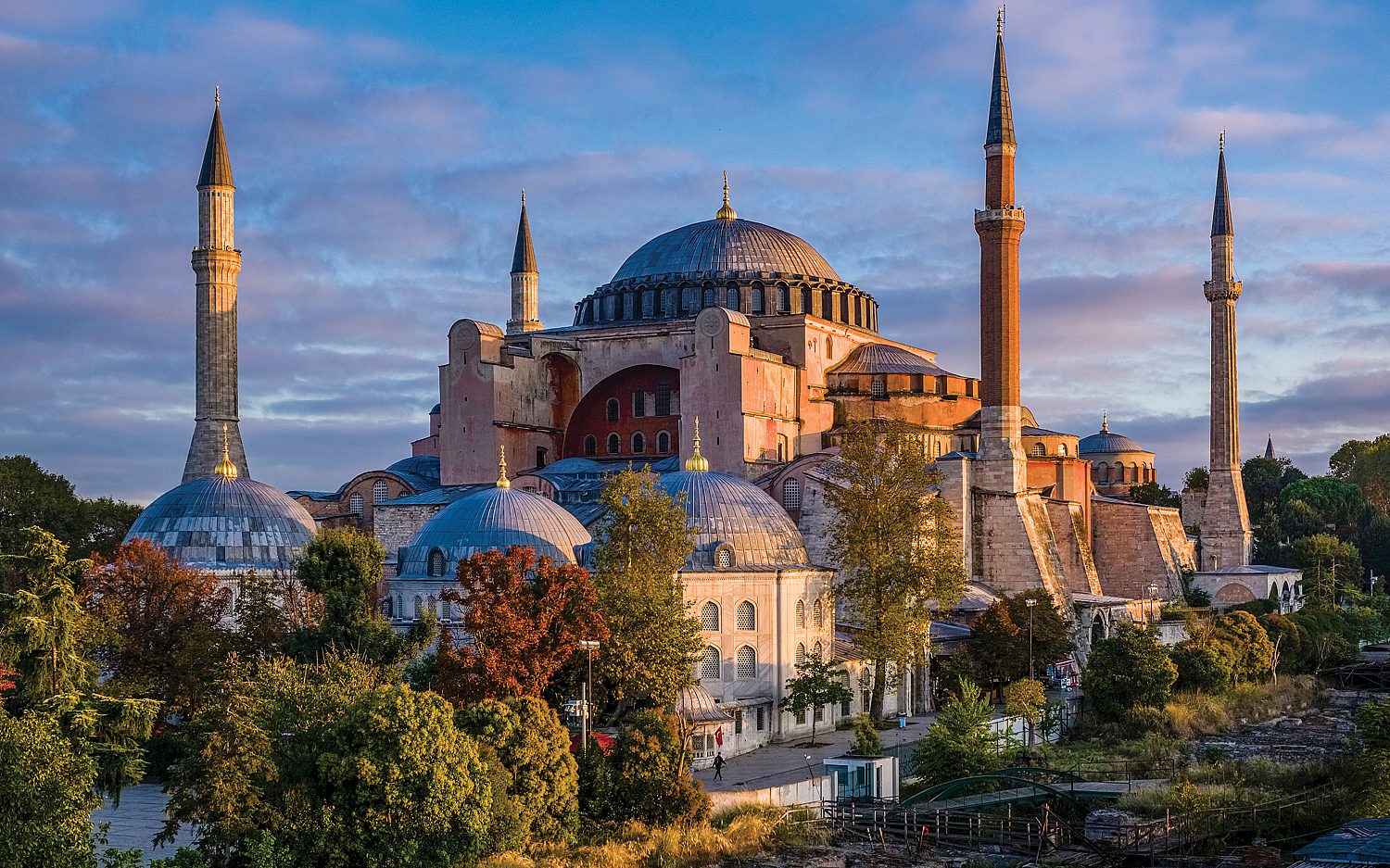
Frank Bienewald / LightRocket via Getty Images
Full access isn’t far.
We can’t release more of our sound journalism without a subscription, but we can make it easy for you to come aboard.
Get started for as low as $3.99 per month.
Current WORLD subscribers can log in to access content. Just go to "SIGN IN" at the top right.
LET'S GOAlready a member? Sign in.
In A.D. 537, when Emperor Justinian saw the completed Hagia Sophia, he exclaimed, “Solomon, I have surpassed you.” Little did the emperor know that the building he had constructed would rival Solomon’s Temple not just in grandeur but also in tumultuousness. The church dedicated to Holy Wisdom, built on the banks of the Bosporus in the city of Constantine, has seen major strife in its 1,500-year history. Its walls bear witness to the burden it has borne as it has sat at the intersection of Christianity’s conflicts.
This masterwork of Christian architecture inspired numerous churches across the Byzantine Greek world. Its plan also served as a model for mosques, including the Blue Mosque, which sits a stone’s throw from the Hagia Sophia, and even synagogues, like the Great Synagogue of Florence and the Hurva Synagogue in the Old City of Jerusalem.
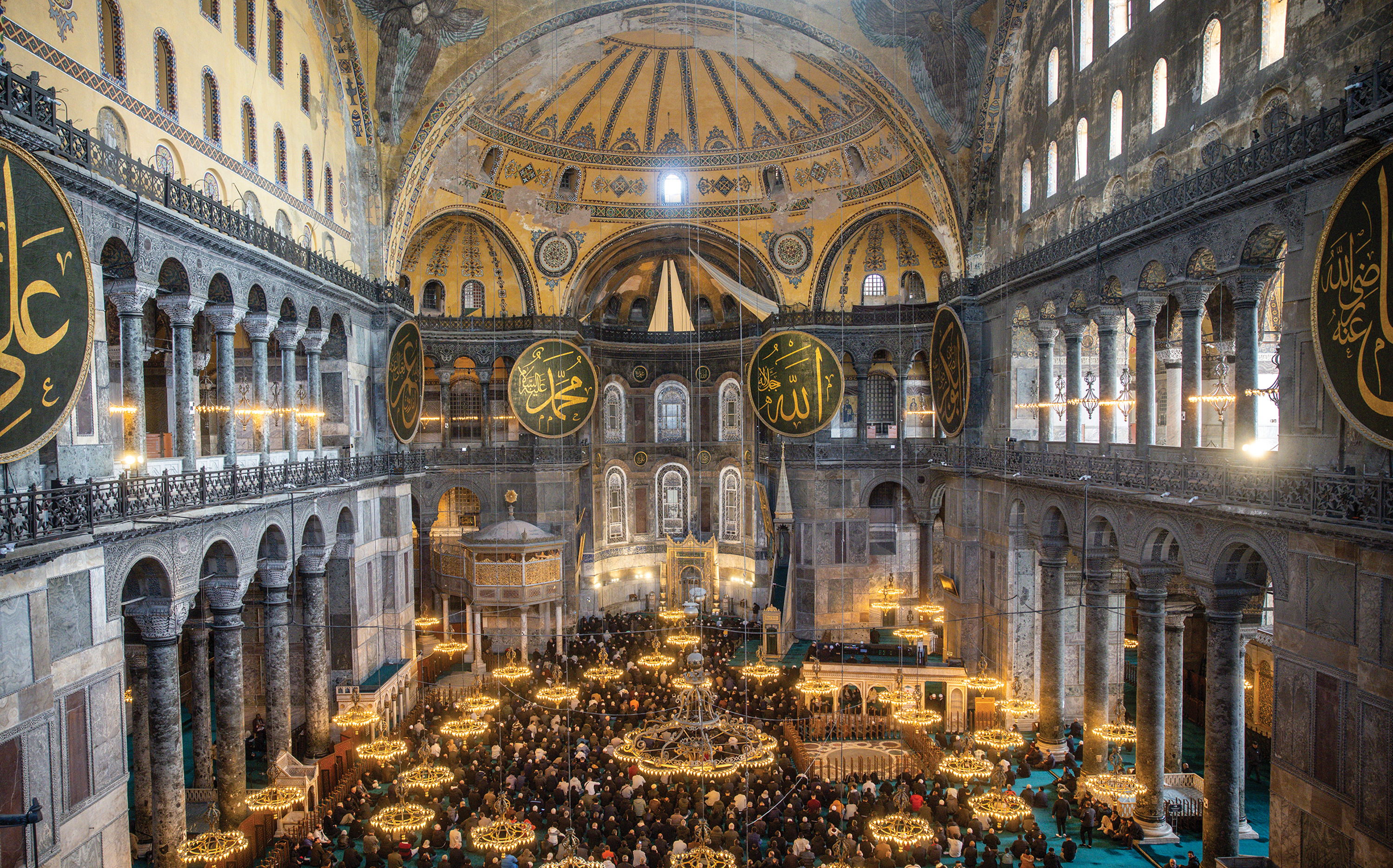
Islamic calligraphy is seen below pendentives that support the dome Chris McGrath / Getty Images
The central architectural feature of Hagia Sophia is the dome, spanning over 107 feet (32.6 meters) and rising to over 182 feet (55.6 meters) above the floor. The dome is situated on a square base and connected to it by four spherical triangular elements called pendentives. The pendentives form the corners of the square base of the dome, and they curve upward into the dome to support it. Hagia Sophia was one of the first buildings to make large-scale use of pendentives and was the largest pendentive dome in the world until the completion of St. Peter’s Basilica in 1626.
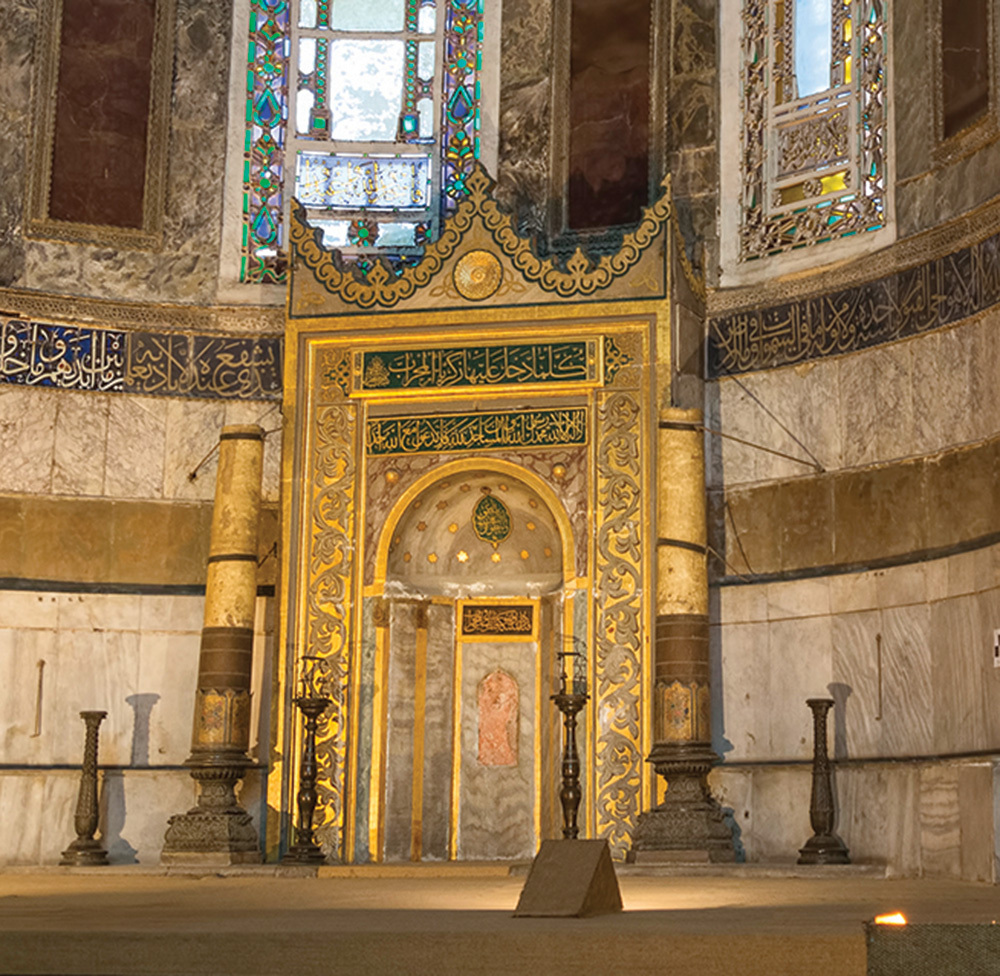
The mihrab in the east apse Czgur/Getty Images
A second significant architectural feature is the light. Most buildings modeled on Hagia Sophia support the weight of the dome with half-domes on all four sides. This creates a strong base but a dark interior. In contrast, Hagia Sophia has only two half-domes, at the west and east ends of the church. The north and south sides of the dome are supported by thick, high, flat walls and internal buttresses that create two-story galleries lining the sides of the church. These towering walls give the building an eastward orientation, fitting for a Christian church. It also allows for 40 windows that flood the interior with light and give the illusion that the dome is floating, suspended between heaven and earth.
One often-overlooked feature is found in these second-floor galleries, which are the only areas open to Christians since Hagia Sophia was reconsecrated as a mosque in 2020. When you look through the gallery, you discover that the arches supporting the dome are misshapen by the load they have been carrying for 1,500 years.
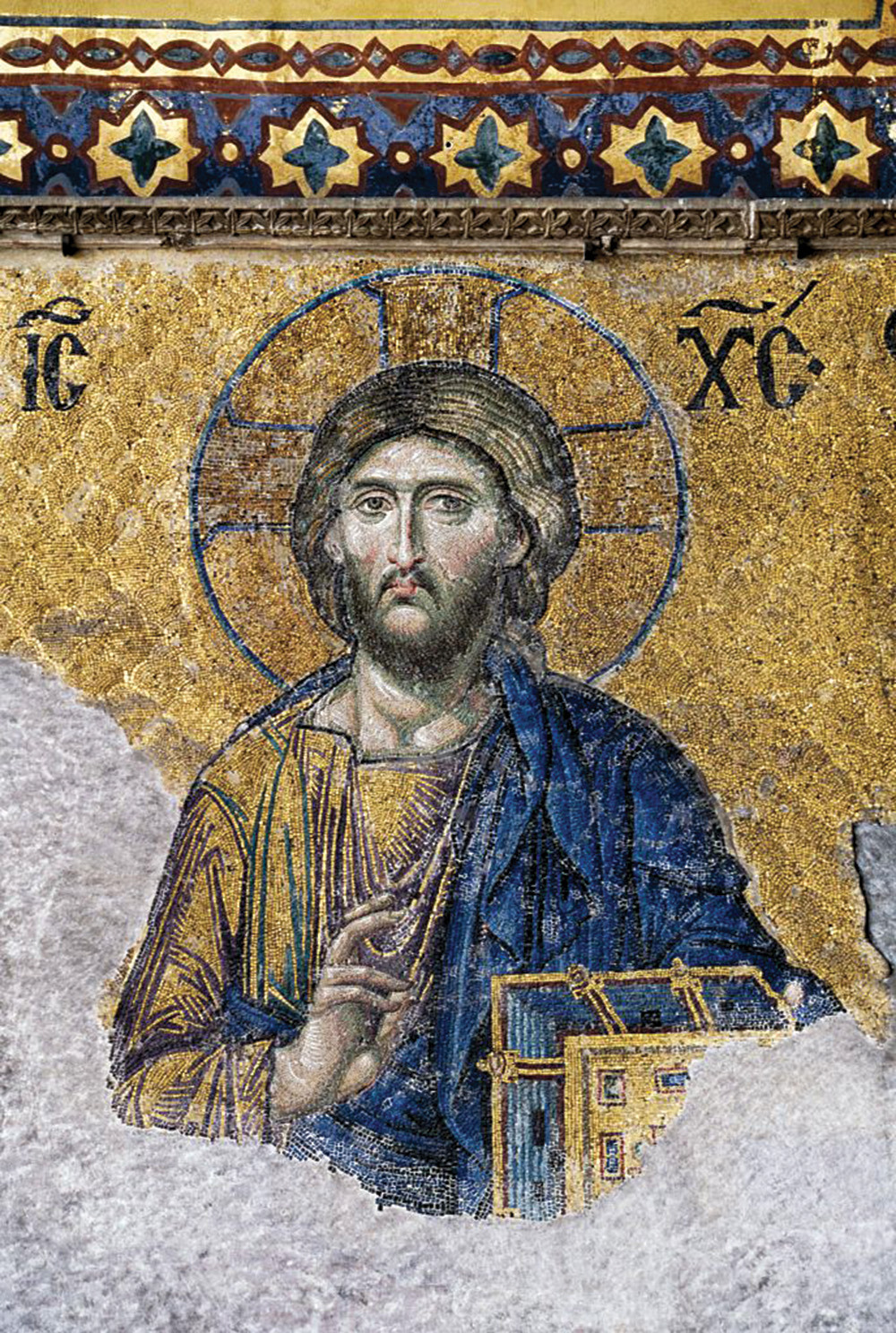
Mosaic of Jesus Pantokrator DeAgostini / Getty Images
These misshapen arches serve as poignant symbolism of the burden this building has carried in the conflicts plaguing Christianity both within and without. In 1054, Hagia Sophia witnessed the Great Schism between Eastern and Western Christianity when emissaries of the Pope in Rome laid on the altar a decree of excommunication against the patriarch of Constantinople. In 1204, Hagia Sophia once again witnessed Christianity’s war on itself. This time it was converted into a Catholic Cathedral after Constantinople was sacked by the soldiers of the Fourth Crusade, led by the doge of Venice, who is buried in the church. In 1453, Mehmed II conquered Constantinople and converted Hagia Sophia into a mosque. The east apse, which once contained the altar, now houses the mihrab, slightly off-center, pointing Muslim faithful toward Mecca.
Hagia Sophia has now spent most of the last 500 years as a mosque. But if you know where to look, you discover the bones of its Christian core peeking out: the mosaic of Jesus Pantokrator flanked by Mary and John the Baptist, the painting of Mary and Baby Jesus hidden behind canvas in the east apse, the Cross in the arched entrance through which Muslims pass on their way to prayer. The building still stands, misshapen by the centuries of conflict and by the conquerors who still claim it, but bearing silent witness to the true Lord whose wisdom it was built to celebrate.
—Steven L. Jones has a Ph.D. in classics from the University of Texas at Austin and serves as director of global theological education for Hamoreh Ministries

Please wait while we load the latest comments...
Comments
Please register, subscribe, or log in to comment on this article.