
Roses are … blue?
SCIENCE | Horticulturalists crack the secret of botany’s Holy Grail
The Asahi Shimbun via Getty Images

Full access isn’t far.
We can’t release more of our sound journalism without a subscription, but we can make it easy for you to come aboard.
Get started for as low as $3.99 per month.
Current WORLD subscribers can log in to access content. Just go to "SIGN IN" at the top right.
LET'S GOAlready a member? Sign in.
Scientists in Kyoto, Japan, have succeeded in creating blue roses. For centuries horticulturalists have cross-pollinated rose bushes to develop new rose colors, but no rose bush naturally possesses the enzyme needed to create blue pigment. In the Victorian era, blue roses symbolized an impossible achievement, romanticized by Rudyard Kipling’s 1887 poem “Blue Roses.”
In 2004, a research center affiliated with the Suntory Group, one of the world’s largest beverage companies, genetically modified a rose to produce blue pigments. The team inserted the gene for an enzyme found in the delphinium flower, but the resulting roses were only faint purple.
Now the same group has inserted four genes into a rose DNA: two from wishbone flowers, one from Canterbury bells, and one from gentian. The resulting color: violet-blue according to flower color charts. The scientists waited years before announcing their discovery, ensuring that their rosebushes continued to produce blue flowers both in greenhouses and in outdoor settings.
The research center plans to continue its pursuit of “even bluer roses.” Other projects have involved sending whiskey to mellow on the International Space Station and studying the physiological effects of drinking carbonated water.
Robots make lasers
MIT scientists have built a physics laboratory that is completely run by a robot. The lab performs experiments that use lasers to measure optical properties of materials. Scientists have to perform countless laser experiments for each new model of phone display, TV screen, or solar panel. The setup for these ultra-precise experiments can take up to days or even months.
“A robot isn’t going to get bored,” said Marin Soljacic, a physics professor at MIT. “It can work 365 days, 24 hours a day, on very boring things. That will free up so much creativity and time for scientists.”
The lab consists of a robotic arm attached to a metallic table. Given an assortment of standard equipment, the robot can build a fully functioning laser according to a researcher’s specifications. The scientists dream of designing a lab that could autonomously perform experiments submitted by scientists from anywhere in the world. —E.S.
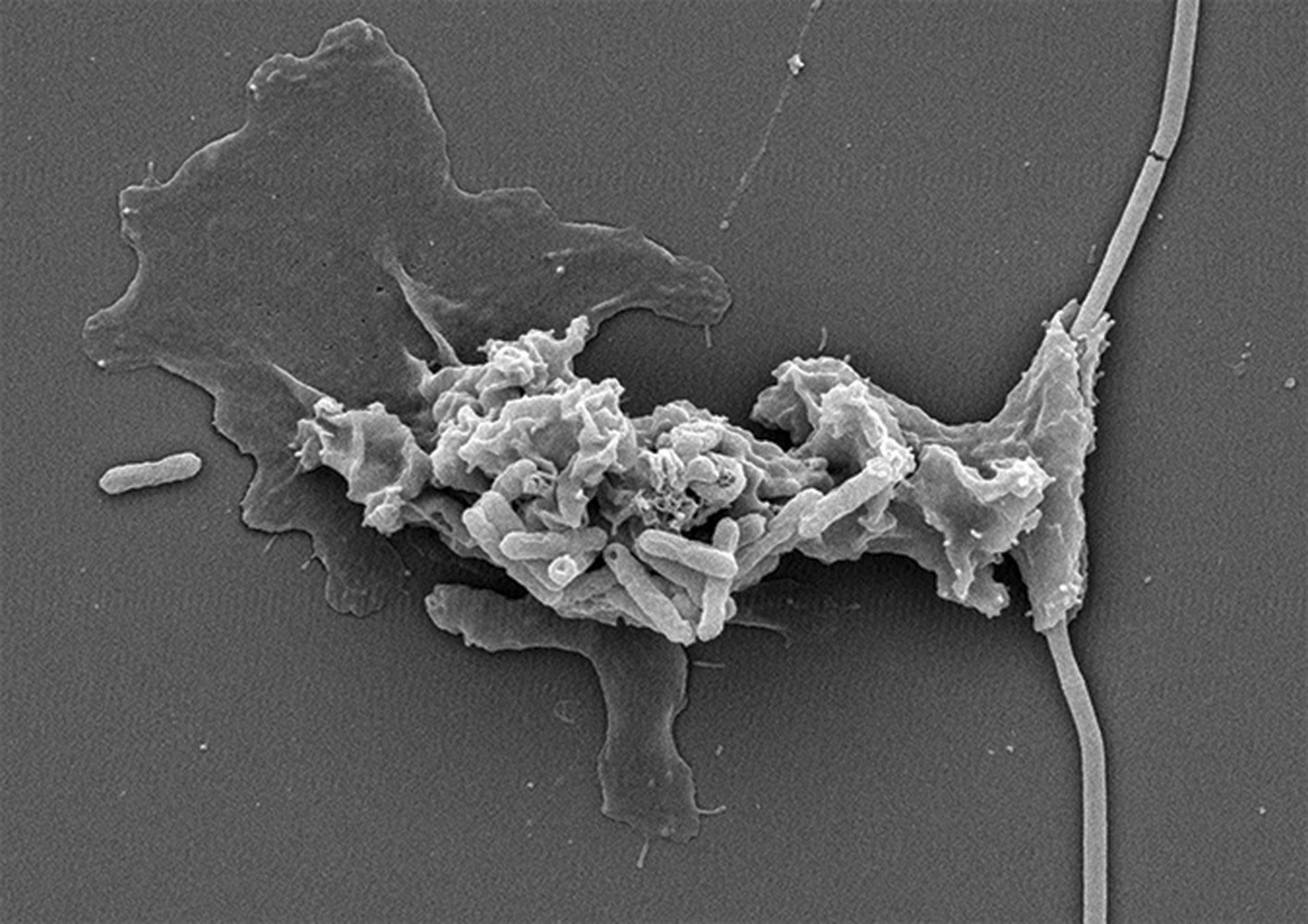
Incendiamoeba cascadensis Syracuse University / Natalie Petek
Fire amoeba
A microbiology team from Syracuse University discovered a new species and named it Incendiamoeba cascadensis, or “fire amoeba of the Cascade mountain range.” Ph.D. student Beryl Rappaport found the amoeba in water samples taken from a hot spring in Lassen Volcanic National Park. She recognized typical amoeba movement under the microscope, but this amoeba reproduced at 145°F, a record for a eukaryotic organism with complex cell structure. Rappaport confirmed it was a new species of amoeba after studying its genome. —E.S.

Please wait while we load the latest comments...
Comments