
Returning to the land
Could a real estate development in rural Tennessee spark civic revival?
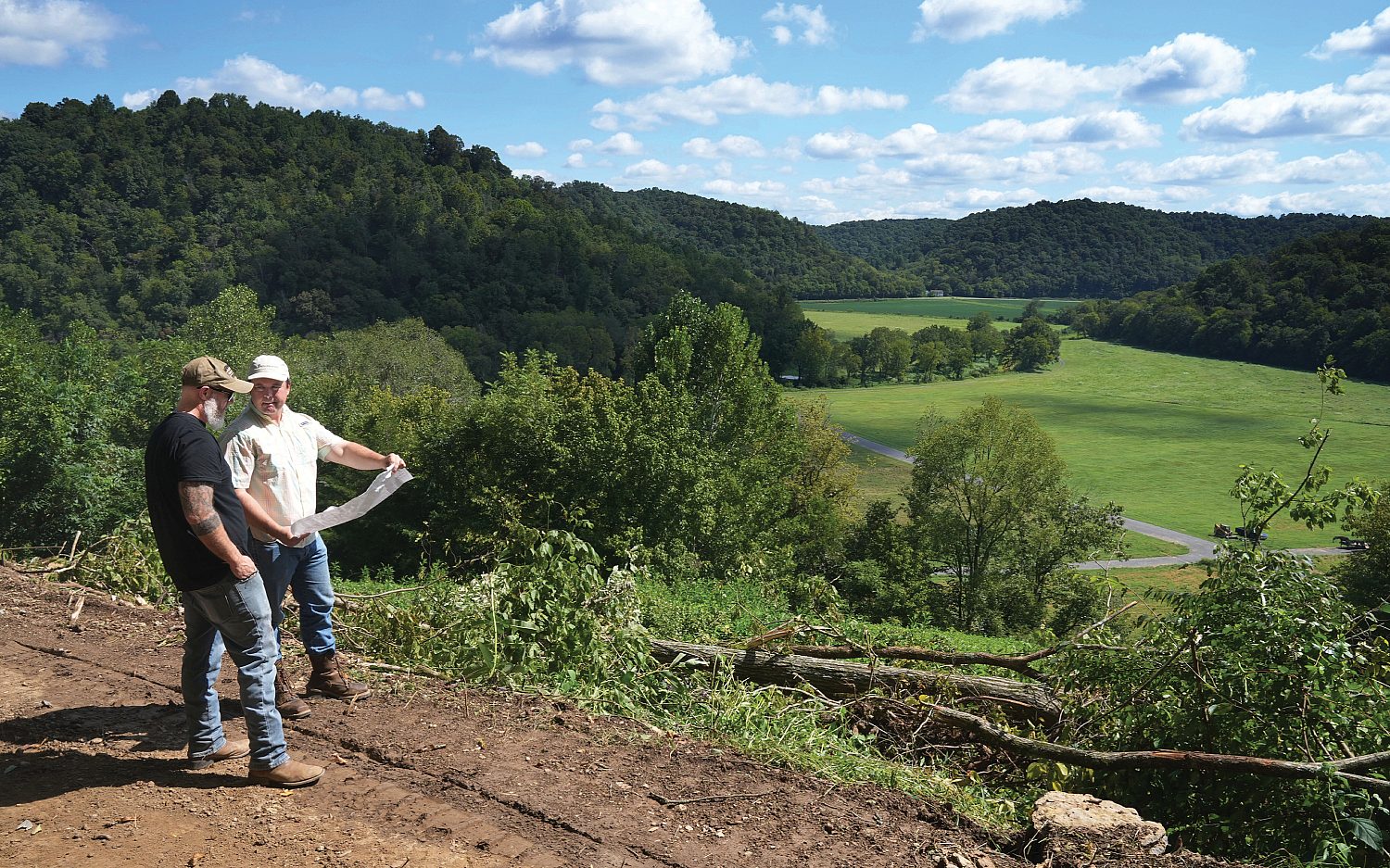
Josh Abbotoy talks with project manager Dave Reeder on a hillside that overlooks Brewington Farms in Gainesboro, Tenn. Photography by Larry McCormack / Genesis
Full access isn’t far.
We can’t release more of our sound journalism without a subscription, but we can make it easy for you to come aboard.
Get started for as low as $3.99 per month.
Current WORLD subscribers can log in to access content. Just go to "SIGN IN" at the top right.
LET'S GOAlready a member? Sign in.
A gentle breeze rustles through the bright green leaves of a hickory tree. Nearby a few children scamper up mounds of dirt left by an excavator that stands parked to the side. Their parents sit under a tent at folding tables covered with crisp white tablecloths and bouquets in mason jars. An Australian shepherd puppy darts between the tables.
This day feels like a community cookout, but it’s actually a customer event for RidgeRunner, a real estate development company that aims to build residential communities around a shared conservative, rural ethos. RidgeRunner has been buying up large tracts of land in the Highland Rim of Tennessee and Kentucky.
The customer event takes place in a valley with a sprawling meadow full of white clover and buttercups. It’s part of Brewington Farms, a 450-acre plot in Jackson County, Tenn., that RidgeRunner bought in 2025 and is selling in parcels.
Josh Abbotoy, RidgeRunner’s founder and CEO, is standing just outside the tent by a table with a large map of Brewington Farms. He talks with potential customers, pointing out different spots on the map. White dots mark lots that are already sold. After explaining the layout, Abbotoy drives would-be buyers around the property in a side-by-side to give them a better view.
In some ways, RidgeRunner is a typical real estate development catering to consumer demand. Since the pandemic, Americans have been leaving big cities and blue states by the millions and moving to conservative, often rural, areas. In other ways, though, it is anything but a typical real estate development. Abbotoy hopes RidgeRunner could produce civic renewal in America. He argues the rural-agrarian lifestyle in the areas where RidgeRunner operates is “kind of a training ground for political self-governance.” And thanks to the local Bible Belt culture, conservative Christians who move here from other parts of the country can “bring their whole selves” to the public square, he says. But such an audacious vision comes with many potential pitfalls, and it’s already ruffled more than a few feathers.
If Abbotoy had planned the perfect day to showcase Brewington Farms, he couldn’t have done better than this Saturday in May. The temperature stays in the 70s and fluffy white clouds dot the blue sky. He invited friends and business associates to join the event, and many brought their families. They provide a friendly atmosphere and also give potential customers a sense of the community they would be joining.
And that community is a big part of what Abbotoy hopes will attract customers to RidgeRunner. He argues that until recently the “conventional wisdom for how to do economic growth in the rural South” was to downplay the Bible Belt vibes and regional identity. “Elected officials made the gambit: Let’s just recruit any business that will come, because they’ll bring jobs,” he says. But Abbotoy thinks that mindset is changing. People are realizing that not all growth is created equal. According to Abbotoy, that’s driven by “long-term generational families out here who want to fight to perpetuate the culture, and they’re finding there’s a ton of Americans who want precisely that.”
There’s no question that Americans are interested in moving to places like the Highland Rim. In his 2008 book The Big Sort, Bill Bishop argued that Americans are gravitating toward communities of people who share their values and backgrounds. The pandemic supercharged that trend. It gave a tangible lesson in how much power local government has over our lives, and many Americans weren’t happy with their experience. Between 2020 and 2024, Florida gained well over 1 million residents. States like Texas and Tennessee also showed major gains.
The growth of remote work during the pandemic also plays an important role because it opened doors for relocation that were closed before.
Younger Americans are particularly interested in moving to rural communities. In the early 2020s, 63% of rural counties saw population increases in the 25 to 44 age demographic, a major increase from the early 2010s.
Jake and Alexis Swartz embody many of those trends. Alexis heard Abbotoy discuss RidgeRunner on a podcast, and the concept immediately resonated with her. She encouraged Jake to listen, and he felt the same way. “When we got married, I think we secretly both always had this idea of wanting land,” Jake says. “We’re in our 30s. We’ve lived in major cities, and I guess we’re kind of tired of it,” Alexis adds. They spent the pandemic in Chicago, an experience they describe as “difficult.”
They visited Tennessee and fell in love with the area. “It felt like a place we wanted to raise our kids,” Alexis says. They got on board so early that RidgeRunner didn’t have many properties available yet, so they bought land nearby. They both work remotely and will take their jobs with them when they move.
They realize they are walking away from some conveniences and amenities of city life. But Alexis says she doesn’t consider those things a loss: “I think of it as gaining a different kind of life.”
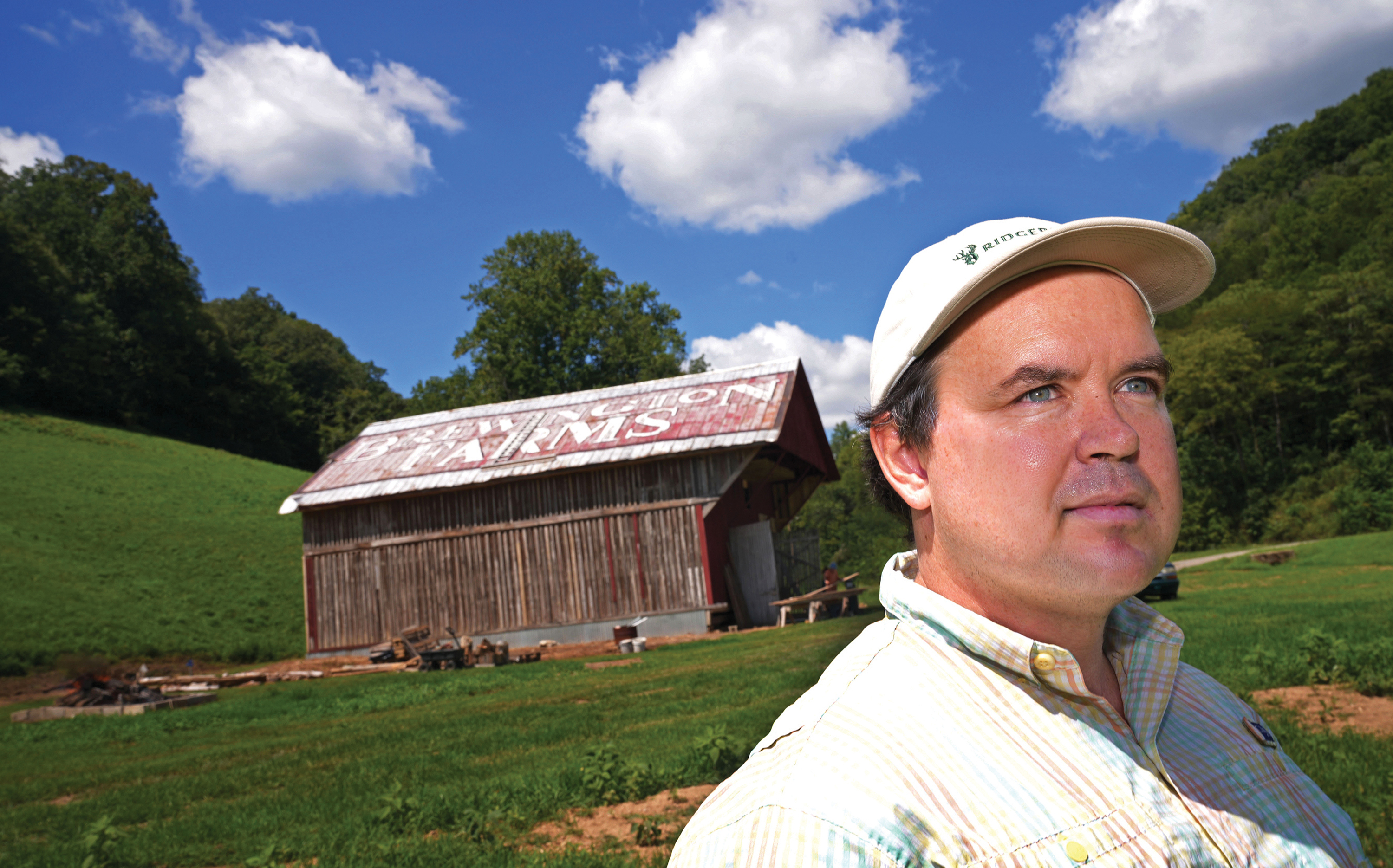
Josh Abbotoy at a dilapidated red barn that RidgeRunner is restoring as a farm store. Photography by Larry McCormack / Genesis
ABBOTOY, who is married with four children, graduated from Harvard Law School and went on to work in private practice. But when I meet him at his office on a Friday morning, he’s clearly put his corporate days behind him. He’s wearing shorts, brown lace-up boots with white socks, a camouflage-pattern button-down shirt, and a baseball cap. RidgeRunner’s office is an unremarkable one-story building in Gainesboro, a town with a population of 920 people, according to the 2020 census.
They’re still settling into the space. One room is a jumble of office furniture, unconnected TV monitors, and a taxidermied turkey. Abbotoy’s office is dominated by a large damask sofa with a floral pattern that he salvaged from Brewington Farms. “I like to sit on it when I host heads of state,” he jokes.
Abbotoy says the pandemic was a turning point in his own life. He was living in Houston, and on July 4 he reflected on how little autonomy you have when you live in a city. By contrast, “if you own land and control it, you’re sort of like a little king or queen in your corner of the world,” he says. He bought a ranch near Brewington Farms, a former working farm that belonged to a family of the same name for four generations. In 2021, he became managing director at New Founding, a venture capital firm of which RidgeRunner is an affiliate. Abbotoy is also the executive director of American Reformer, an organization that describes its mission as promoting a Christian approach to today’s cultural challenges “rooted in the rich tradition of Protestant social and political thought.”
We talk in his office for a while, and I ask him about Rod Dreher’s influential 2017 book The Benedict Option. Dreher encouraged Christians to respond to an increasingly secular, hostile culture by building intentional communities. Is RidgeRunner an attempt to build the Benedict Option?
“Not really,” Abbotoy says. He thinks America’s rural Southeast still has a vibrant cultural Christianity. By moving here, people are doing the opposite of cloistering themselves. “They move here because they think the broader culture is great and healthy, and they want to live somewhere where, long term, they can be fully integrated into public civic life.”
He also stresses that while many of his customers are Christians, “they’re not totally Christian.” RidgeRunner has no litmus test or vetting for buyers. “We’re developing neighborhoods and selling them with a particular vision. If somebody likes that, we sell to them,” he says. “That’s the law. We happily abide by that.”
After we chatted for about half an hour, Abbotoy and I drive out of Gainesboro in his pick-up truck. We cross the Cumberland River and—after about 10 minutes—stop at a dilapidated red barn with the words “Brewington Farms” still visible on the roof. RidgeRunner is restoring it as a farm store. “Our bias is always to preserve as much as we can,” he says, explaining this includes both natural conservation and conservation of the historic way of life.
Then we take a shortcut through a dried-out creek bed and drive to a large meadow surrounded by low hills. Abbotoy hops out to talk to one of his workers and helps him roll a culvert to the side. Another worker is driving an excavator to dig a trench for underground electric and fiber optic internet. There will be no power lines here disrupting the view. RidgeRunner has deed restricted about 85 acres of Brewington Farms as farmland, meaning customers in this valley will look out on meadows with cows and sheep—guaranteed to never change. Houses on Brewington Farms must follow strict architectural guidelines, which Abbotoy summarizes as, “It has to look like something that could have been built here 100 years ago.”
But can an influx of newcomers avoid changing a community’s historic way of life? That question is salient in Cookeville, a city roughly 20 miles south of Gainesboro. The city serves as the regional hub, and it’s in the midst of a boom. Cookeville has been one of Tennessee’s fastest-growing small cities, growing 14.5% between 2010 and 2020 and then adding nearly another 10% in just the five years after the pandemic.
Kelly Parkison, a pastor’s wife and mom of six, was recently elected to the city council. She understands that people are attracted by the area’s low taxes and beautiful natural scenery. “Then they see that it’s such a warm, hospitable place to live,” she tells me.
But she is concerned about the price of real estate. It’s risen so fast she wonders if her own children will be able to live here.
Jeff Wright, the pastor of a local Baptist church and owner of a farm, goes even further. He thinks the rising cost of real estate is a threat to the local way of life because it incentivizes farmers to cash out on land that has often been in their families for generations. “That quick buck is pretty appealing over the labor it takes to make a farm profitable long term,” he says. Wright wishes he had the power to remove that incentive.
There are also more pedestrian areas of friction. Some newcomers complain about the lack of street lights. Wright explains that’s because “we like seeing the stars at night.” They also complain about stores closing early or insufficient public services. He argues those things help keep taxes and cost of living low.
Caleb Davidson, who lives near Brewington Farms, was initially wary of RidgeRunner. He’d seen his hometown in another part of Tennessee transmogrified by development, and he feared RidgeRunner would do the same. But that changed after he became friends with Abbotoy and heard about his plans to preserve the land. “If I’d never met him, and I was driving by the development all the time, I’d just be seething and not understanding what he’s doing,” Davidson says, adding, “I might have eventually come around when I saw that they had kept the farmland.”
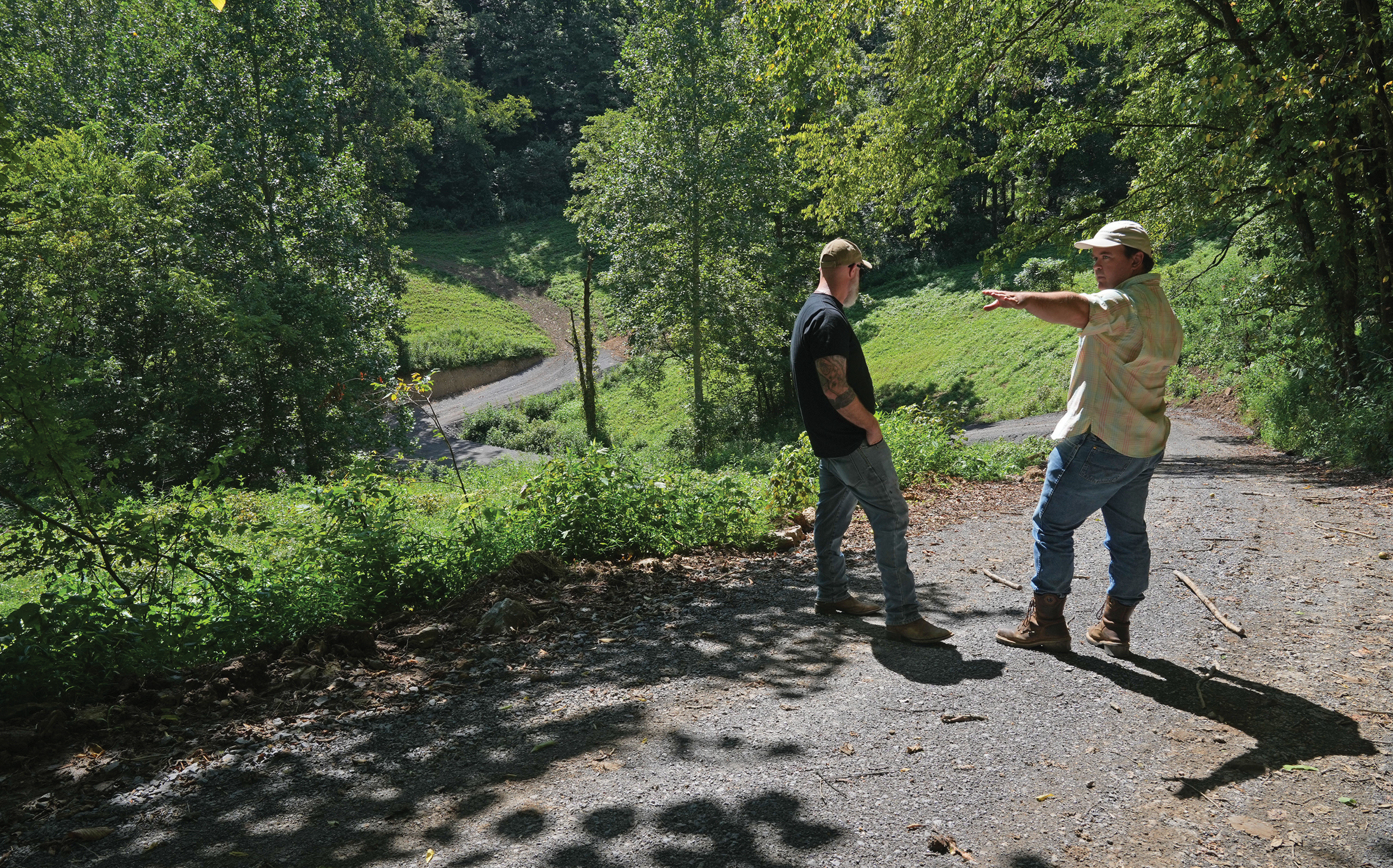
Josh Abbotoy talks with project manager Dave Reeder on a hillside that overlooks Brewington Farms in Gainesboro, Tenn. Photography by Larry McCormack / Genesis
BUT RIDGERUNNER has also generated disruption of a very different kind.
Rows of white plastic folding chairs gleam in the sunlight. It’s Sunday morning, and people are arriving for a church service. Two little boys solemnly hand out bulletins.
Pastor Andrew Isker wears a white vestment. He preaches from a lectern behind a makeshift communion table. It’s assembled from large rocks quarried from nearby hills by men in the church. The rocks are intended eventually to pave a courtyard.
The congregation, which is not currently affiliated with any denomination, has been meeting in rented spaces, but for a special occasion they’re having an outdoor service at the site of their future building at Brewington Farms. About 75 people come out to participate.
After Isker gives the benediction, attendees scurry out of the sun into a tent, the same one used the day before at RidgeRunner’s customer event. It’s decorated with gauzy ribbons for the church’s “spring festival.” Little girls put on flower crowns and wave streamers. Children get their faces painted. After a fellowship lunch, a dozen or so of the attendees get up for some country dancing.
It’s hard to believe this wholesome scene is one of the most controversial parts of RidgeRunner. The development attracted significant media attention as soon as Abbotoy announced it, and much of that focused on Isker. The coverage suggested he was part of a plot to start a “far-right Christian nationalist community” and accused him of racism and misogyny. Isker has no official role with RidgeRunner, but he promoted it on an appearance on Tucker Carlson’s podcast.
Isker is a sixth-generation Minnesotan, but he moved to Tennessee with his wife and children because of his home state’s far-left policies. He was particularly concerned about a law signed by Gov. Tim Walz that allows the state to strip custody from parents who don’t support a child’s so-called gender transition.
Isker studied at Greyfriars Hall in Moscow, Idaho, where he was taught by Douglas Wilson. Isker tells me they “still have a pretty good relationship.” Like Wilson, who has built a reputation for combative rhetoric, Isker is not known for mincing words. In his book The Boniface Option—which Wilson has publicly recommended—Isker laments modern society as being “Trashworld” and calls it “fake and gay.”
Isker contends his approach echoes a time when people spoke more frankly than they do now. Among his influences are earlier periods of American history and the Reformers, particularly John Calvin. “He would slam people,” Isker says. Though he adds that people tend to assume he’s speaking in anger when “I might have a twinkle in my eye or a bit of a smirk.”
Isker denies accusations RidgeRunner is a Christian nationalist project. “It’s really just a residential subdivision.” But he thinks it will be home to plenty of Christians who “think our rights come from God and God’s standard of right and wrong is how we should order our society. But that’s just like the rest of Jackson County, Tennessee.”
Media coverage of RidgeRunner often compares it to Moscow, the city in which Wilson’s ministry is headquartered. But Abbotoy bristles at that comparison, noting that RidgeRunner isn’t centered around one church or pastor. “The American way has always been a good kind of ecumenism,” he says.
Abbotoy is careful and measured during our interview. But in 2023 he landed in hot water over a post on X that said, “Basically, America is going to need a Protestant Franco.” Writing in Providence magazine, Mark Tooley, president of the Institute on Religion and Democracy, called this an example of “a new Christian authoritarian chic,” adding, “contemporary America is superior to a single day under Franco.” Abbotoy tells me his post wasn’t an endorsement but a warning. He was alarmed by what he calls the “rapid breakdown in the rule of law and trust in the democratic process” during the Biden administration. If order breaks down, it creates space for the rise of a strong man, Abbotoy insists.
In a way, RidgeRunner is his attempt to prevent such a scenario. He says life in places like Jackson County encourages self-reliance, neighborly responsibility, and civic engagement, making it the perfect training ground for political self-governance. RidgeRunner is part of broader “re-ruralization” driven by people with agency and resources, Abbotoy says. “There’s more white-collar people moving to the country, there’s money, talent, and economic activity moving to the country.” What happens if those trends continue? “I think, optimistically, we could see civil renewal from that.”
He believes other white-collar workers from cities will adapt to rural life as successfully as he has. “Life is just as nice. It’s just ordered a bit differently. You have a domain where you can exercise more agency, and you spend more of your life in spaces controlled by friends and neighbors. And I think people like that.”

Please wait while we load the latest comments...
Comments