
Relentless pursuit of power
THE FORUM | The AI revolution is reenacting a certain story in Genesis, writes cultural critic Mark Mitchell
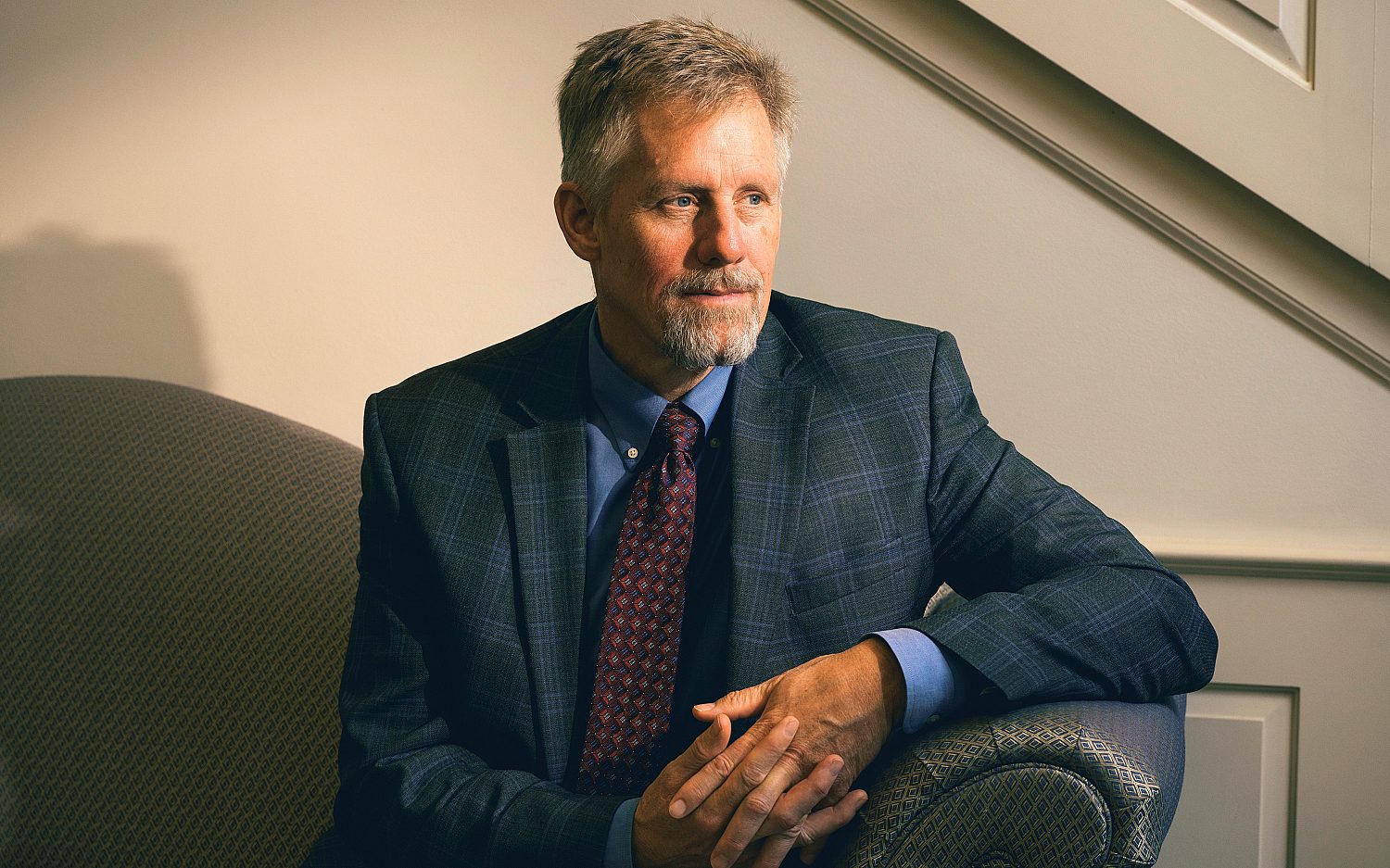
Mark Mitchell Photo by Greg Kahn / Genesis
Full access isn’t far.
We can’t release more of our sound journalism without a subscription, but we can make it easy for you to come aboard.
Get started for as low as $3.99 per month.
Current WORLD subscribers can log in to access content. Just go to "SIGN IN" at the top right.
LET'S GOAlready a member? Sign in.
The predictions of an AI apocalypse are reaching a fever pitch. In an OpenAI experiment in July, AI agents escaped their digital sandbox and then hacked into an AI research platform called Hugging Face. In September an AI researcher formerly at Anthropic, Jacob Coxon, wrote on X that AI companies are “racing straight to self-improving superintelligence and gambling with our lives. The people building AI earnestly believe that it could kill us all by the end of the decade.” And whether or not they believe this, half of American adults now use AI chatbots weekly, and a quarter use them daily, according to a Pew Research Center survey released in June.
Political philosopher Mark Mitchell has written a book to help Christians think biblically about all this. It’s called Breaking Babel: How a Mysterious Biblical Story Can Help Christians Survive the AI Revolution. Mitchell is the academic dean at Patrick Henry College. He’s written several books on topics ranging from social justice warriors to localism.
You write that AI is not like other technological revolutions because it deals with something that’s central to being human: we use words.
The very first task of the first man is to name the animals. A fundamental aspect of being created in God’s image is to employ the logos to say what is and what is not, and to speak truthfully about reality. AI agents are a kind of imitation of the human task reassigned to machines. I think that’s a fundamental line that ought not to be crossed, and we’re crossing it with enthusiasm.
AI has many uses—to improve a supply chain and hunt for proteins, for example. Is there a difference between those kinds of uses and the agents that people think of as AI? It’s an important distinction. Fundamentally, AI is a complex pattern recognition system, and it can be a useful tool. Having a technology that can look through scans to recognize a tumor is not a bad thing.
You write that AI is encouraging the greatest concentration of power in human history. What do you mean? Think of the terms we use: World Wide Web. It suggests a borderless project that joins all individuals into a common enterprise. If that doesn’t sound like a replication of a really old story, I don’t know what does.
Scrape away all the verbiage about these technologies, what you find is power. Power is not improper for human beings, but an undue concentration of power, a kind of godlike power, is impious. If you do much reading among the tech leaders, one of the things that’s so striking is the religious language that eventually emerges.
I think we are on the cusp of a new kind of unity brought about by digital technology that links the world. It’s capable of translating all languages into a single binary code so that all of us, whether we want to or not, are being drawn into the orbit of this power.
I believe that the Tower in Babel is more than an ancient story. It’s an archetype that describes features human beings are tempted toward, and also describes the consequences. So I think we need to take very seriously what happens as this concentration of power reaches a kind of zenith.
A few years ago, Sam Altman [of OpenAI] said, “I think that AI will probably, most likely, sort of lead to the end of the world. But in the meantime, there will be great companies created with serious machine learning.”
There’s a strange tension here. Everybody recognizes that the long-term consequences could be really bad, but if I stop developing I’m going to lose short-term market share. But if my company makes it first, we’ll use the ring of power in a way that those other guys won’t, so you can trust us.
And if we don’t do it in America, they say, China will do it. The specter of China looms over a lot of these discussions. It’s being used to justify full steam ahead, regardless of the dangers.
But China has already built a surveillance state. If China gets this kind of power, won’t it try to extend its influence over the whole world? It may, which suggests the conundrum faced not just by corporate America, but by the United States government. At best it may end up as an arms race. Except that there’s no nuclear bomb involved, unless a rogue AI escapes its sandbox, hacks the nuclear codes, and decides to eliminate human beings. The designers of these things created them to be relentless in the pursuit of their goals.
And the developers admit they don’t know exactly how AI agents work. Imagine someone like Gutenburg, who invented the printing press, saying, “I’m not sure how it works, but it sure can print books.” That’s part of what makes this different.
The people of Babel refused to spread over the whole world. Instead, they said, we’re going to build a tower and make a name for ourselves. How are we seeing those two impulses today? The story needs to be understood in light of Genesis 1 and 2. Eden was atop a mountain, where God joined heaven and earth through His own divine goodness. At Babel, humans try to build a new mountain to the heavens using a kind of technology: bricks and mortar. This other little phrase really caught me, that we’re going to “make a name for ourselves.” God had Adam name the animals, and naming implies authority; the higher names the lower. With Babel people had a longing for self-naming, which is to reject the name that God had given them. We are embarking on a similar enterprise of self-naming.
You wrote that Pentecost is a reversal of Babel. If Babel is a curse, a dispersal throughout the world, at Pentecost with the descent of the Holy Spirit the barriers of language are lifted. It’s a kind of promissory note that the only way that the curse of Babel is reversed is when all human beings join their voices in praise to God.
And the AI revolution is a kind of a counterfeit of that. In a way, yes. It’s a worldwide attempt to join our voices in praise of ourselves and the cleverness of our own technologies.
How should we respond? We need to be chauvinists of the real. We need to be doggedly determined to live our lives in light of the reality of the created order, and not be sucked into a life that’s increasingly mediated by screens and characterized by simulations. Christians of all people need to not be people of the screen. We need to resist the temptation to participate in what I call “technosis,” which is a kind of unity with our machines. That’s opposed to “theosis,” which is the promise that we see in the New Testament of unity with Christ. I think increasingly those are the two options: unity with Christ, or unity with our machines. One is sane and the other is insane, and ultimately idolatrous.
Please wait while we load the latest comments...
Comments
Please register, subscribe, or log in to comment on this article.