
Our aesthetic calling
BOOKS | Thinking about Christianity and the arts
David Taylor Photo by Lindsey Sheets

Full access isn’t far.
We can’t release more of our sound journalism without a subscription, but we can make it easy for you to come aboard.
Get started for as low as $3.99 per month.
Current WORLD subscribers can log in to access content. Just go to "SIGN IN" at the top right.
LET'S GOAlready a member? Sign in.
Throughout his career, first as an arts pastor and then as a speaker and writer, W. David O. Taylor—an Anglican priest and associate professor at Fuller Seminary—has been an enthusiastic advocate for Christian artists and for the place of art in Christian life and worship. In To Set the World Aflame: How Artists Bear Witness to the Fullness of God’s Creation (Brazos Press, 288 pp.), he shares the wisdom he has accumulated in his years of ministry and offers a wide-ranging account for how Christian artists can more fully live their faith through their work.
Taylor says that the role of an artist is to deal with the aesthetic aspect of human life. Does this include anyone who decorates a home, cooks a meal for friends, arranges flowers, or any number of other pursuits and hobbies we don’t often classify as art? Yes it does, Taylor says; and that’s why it often seems that Taylor’s advice to artists is applicable to everyone: All people, to a greater or lesser degree, must make aesthetic choices.
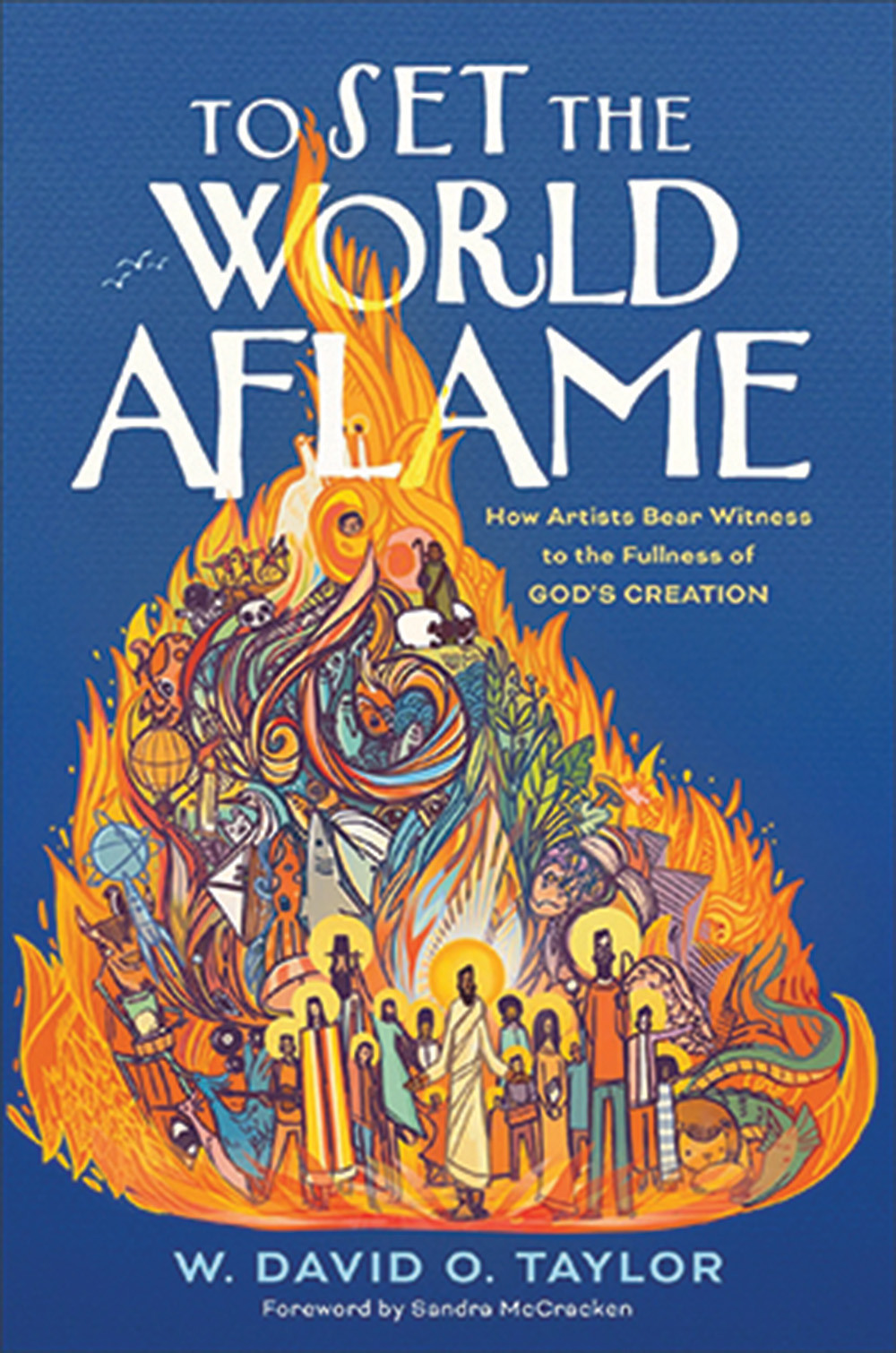
To Set the World Aflame W. David O. Taylor
Taylor refuses to give easy answers or quick formulas, nor does he spell out any precise biblical agenda for how artists should conduct themselves. The closest he comes to issuing a general principle for all artists is when he says an artistic practice ought to exist for the benefit of others; it should seek the flourishing of other people and not merely advance the artist’s career. In Taylor’s view, then, the arts are not much different from any other Christian career or calling—a helpful way to view the activities of artists.
This book serves as a broad overview of topics that working Christian artists have had to think about during the course of their careers rather than a deep dive. He mentions the topic of nude life drawing class—a core element of academic art training and one which many Christian artists find discomforting—yet he sidesteps the issue, not venturing any thoughts on it. He similarly does not address the issue of images of Jesus as potential violations of the second commandment, an issue which remains particularly divisive in some branches of Protestant Christianity.
One of Taylor’s favorite prose tactics is to follow any abstract concept with a barrage of hyperspecific examples. This is his style in other books as well, and it could be that by doing so he is seeking to bear witness to the love of particularities, of things in the world, which he says should characterize the Christian artist who is seeking to reflect Christ’s love of the variety of the physical creation.
Taylor’s pastor’s heart is evident in this book—a heart concerned for the artists who are often hard for the institutional church to minister to and support. And the bibliography, with Taylor’s comments, is a fine resource for anyone who wants to go deeper into the themes presented here.

Please wait while we load the latest comments...
Comments
Please register, subscribe, or log in to comment on this article.