
Keeping the faith
In eastern Ukraine, one family of pastors presses on despite constant danger—and an uncertain future
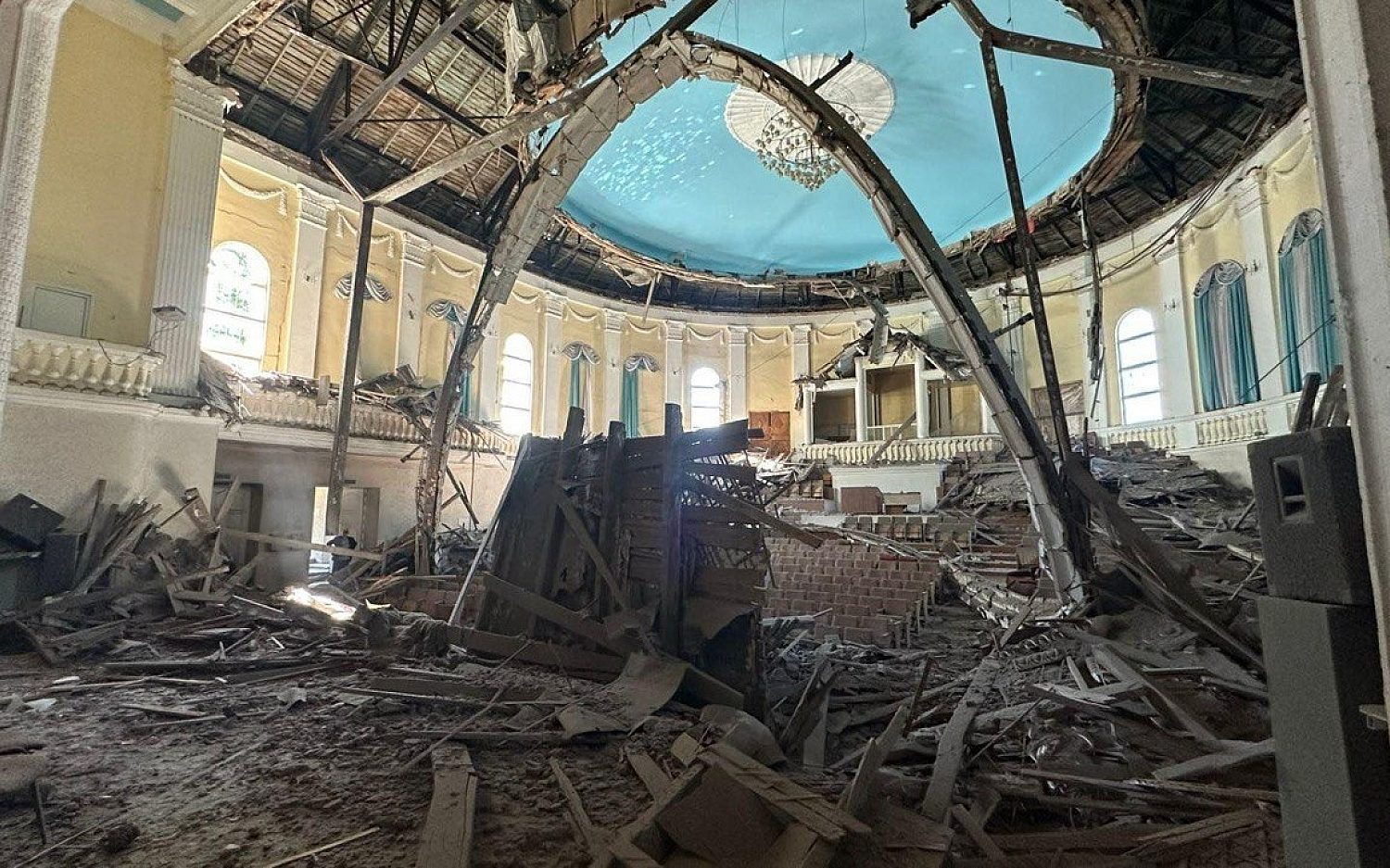
Good News Church is Kramatorsk, Ukraine, suffers damage in a Russian bombing. William Fleeson
Full access isn’t far.
We can’t release more of our sound journalism without a subscription, but we can make it easy for you to come aboard.
Get started for as low as $3.99 per month.
Current WORLD subscribers can log in to access content. Just go to "SIGN IN" at the top right.
LET'S GOAlready a member? Sign in.
Just before midnight on June 30, a Russian rocket landed a hundred yards from Good News Church, in the town of Kramatorsk—part of eastern Ukraine’s embattled Donbas region. Though not a direct hit, the rocket’s blast nearly collapsed the Pentecostal church’s roof, among other damage throughout the building.
Viktor Pávenko, the church’s 65-year-old longtime pastor, immediately set to work cleaning up debris and broken glass. Caring for his church extends a long pattern Viktor has maintained since the outbreak of full-scale war in February 2022—modeling Christian service while meeting the ever-growing need to provide material and spiritual support to locals.
The damage to Good News serves as a sobering metaphor for Kramatorsk, the region’s other churches, and Ukraine itself: battered, yet somehow, still standing.
“Only thanks to God, does Ukraine still stand,” Viktor told me during my four-day visit in mid-June.
While recent developments suggest the war may be turning in Ukraine’s favor, the Donbas, a territory roughly the size of West Virginia, has only become more dangerous. In Kramatorsk alone, almost 30 civilians have died since the start of this year, with scores more injured.
Similar attacks have reverberated across Ukraine. June became the bloodiest month for civilian casualties almost since the war began, with nearly 2,300 total dead and wounded, according to data from the United Nations. That figure slightly exceeded the toll from May—itself a four-year high. A six-month period ending in May brought a 40 percent jump in civilian casualties over the same time last year, according to the UN.
Kramatorsk forms part of Ukraine’s “Fortress Belt,” a string of four large towns that provide a bulwark against further attacks—even as Russia continues its molasses-slow advance in the region.
Amid daily strikes and casualties, a July 20 attack killed two Kramatorsk locals and injured four others, the result of six bursts of predawn shelling. Kramatorsk lies about 10 miles from the front line, for now.
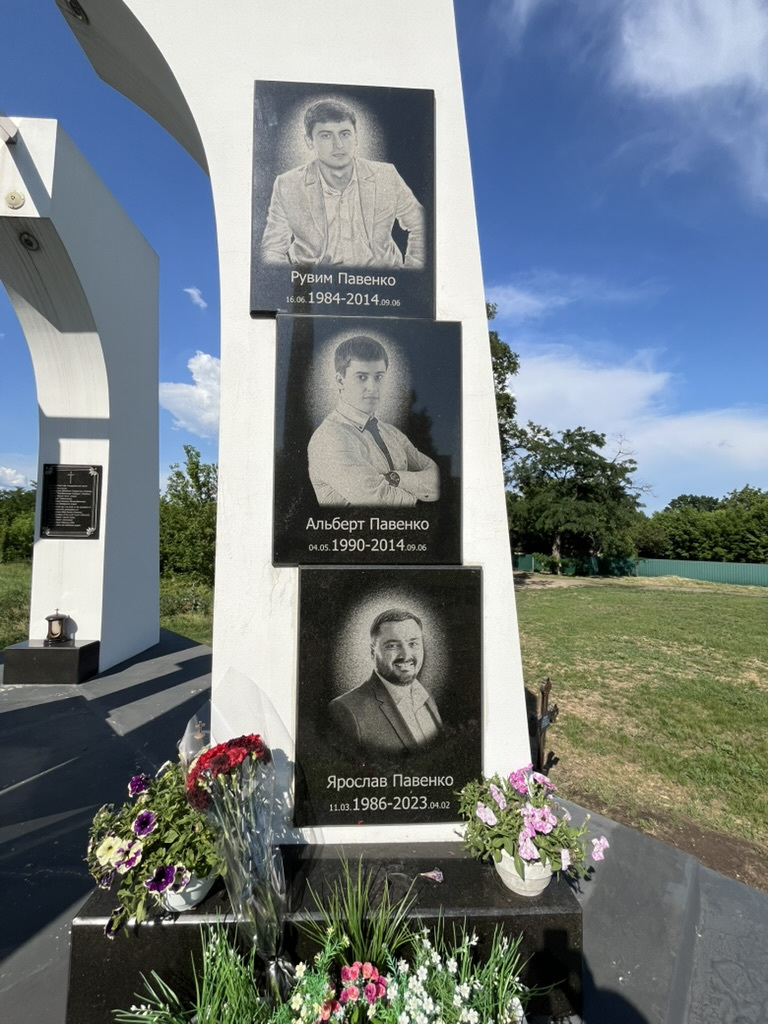
A memorial to three members of the Pávenko family killed during the Russian invasion of Ukraine. William Fleeson
Understanding Viktor’s story helps explain the war: its small-scale start in 2014, its terrifying escalation to full-scale conflict in 2022, and the uncertain future for Donbas residents.
Viktor Pávenko was born in 1961 in Kazakhstan, where his father, a Ukrainian pastor, had been exiled. Amid the loosening restrictions of the Soviet Union’s final years, Viktor relocated, along with some of his nine siblings, to Kramatorsk.
He built his church with his own hands and money while working full time as a factory director and raising a family. His eldest son, Eduard, now 38, remains in Kramatorsk, and works as a humanitarian aid coordinator for Good News and its partners. The church runs a soup kitchen twice a week, gives out dry goods once a week, maintains a 24-hour outdoor water tap, and runs deliveries to the infirm and elderly.
The Pávenko family produced several other pastors among Viktor’s brothers. Today, the Pávenko clan leads a total of four churches across Kramatorsk, the neighboring town of Sloviansk, and the surrounding region.
As for many Ukrainian churches, the war has required a shift in the Pávenkos’ efforts: from essentially spiritual matters in peacetime, to humanitarian work amid the slow-grinding conflict. The full-scale phase of the war sparked by Russia’s invasion has now lasted longer than World War I.
The war has cost the Pávenkos more than many Ukrainian families. On April 12, 2014, Russian forces began a brief occupation of Kramatorsk. For 84 terrifying days, Russian troops patrolled the streets, hunting down those they considered a threat. In early June 2014, two of Viktor’s nephews—brothers Ruvim Pávenko, 29, and Albert Pávenko, 24—were found murdered in Sloviansk. Both were active in their Pentecostal congregation. Local observers and later reporting asserted that the killings were religiously motivated, the result of an extremist Russian Orthodoxy that runs through parts of Russia’s military.
A third tragedy struck on Feb. 4, 2023, when Russian shelling killed Ruvim and Albert’s brother, 36-year-old Yaroslav, who was serving as a chaplain in the Ukrainian army.
According to witnesses, the chaplain’s last words were: “I’m going to heaven.”
The Pávenko family, against the war’s fever pitch and their own private griefs, pushes on.
“We have a duty and responsibility to do what we can, as a church,” Viktor told me.
Ukraine has built up its Fortress Belt in visually spectacular ways. Trenches, checkpoints, barbed wire, and lines of waist-high, pyramid-shaped concrete blocks—known as “dragon’s teeth”—cover the region. Much of the defense infrastructure lies behind the Fortress Belt’s four cities: Kramatorsk and Sloviansk, as well as Druzhkivka and Kostiantynivka. The latter town is currently all but surrounded by Russian forces.
The Donbas, short for the Donetsk Basin, includes the Donetsk and Luhansk oblasts, or administrative regions. Four-fifths of Donetsk Oblast is under Russian occupation, and Moscow has long fought to take the rest of it. Russian President Vladimir Putin has made seizing the Donbas a cornerstone of the war effort. Russia’s foreign minister in July reiterated that controlling the Donbas is a precondition to any ceasefire.
For Ukraine, the Fortress Belt represents the last defensible part of its mostly flat eastern lands. Should Russian forces break through, the military and diplomatic consequences could be disastrous.
An April report from the Institute for the Study of War, a Washington-based research group, noted that “west of the Fortress Belt—the land that would serve as the new front line if Ukraine lost the Fortress Belt—is poorly suited to serve as a defensive line.”
This spring, Ukraine declared a six-month push—roughly the time until winter complicates on-the-ground fighting conditions—to compel Russia toward peace.
Eduard Pávenko makes his rounds in a constant state of hurry. He drives his black Ford Transit van too fast, but he has good reason to rush: Kramatorsk, like other frontline cities, has arranged anti-drone netting above most of its streets, to hinder Russian attacks. Anyone—military or civilian—counts as a target here, as Russian strikes have shown. We pass bombed-out buildings and blasted façades. War-inspired graffiti plays over the city walls still standing, with evocative slogans like “God and the [Ukrainian] army are with us,” and “Don’t worry, Mama, we won’t give up the Donbas.”
Under a hot sun, Eduard winds through potholed roads and brown summer dust, a product of the area’s famously fertile farmland. In one hand he cradles a device resembling a walkie-talkie. The gadget, called a Chuyka, is actually a drone-detection tool. It can intercept a drone’s video feed in real time, letting you see what an enemy drone sees.
When the screen changes from black-and-white to color, and you can see an image of yourself or your vehicle, it means a drone has spotted you.
Keeping one eye on the Chuyka, Eduard talks about his experiences during many years of living with war. In 2014, he saw Russian tanks and soldiers with his own eyes. The city emptied out—“like a horror film,” he recalls.
Losing three of his cousins was “a major shock,” he says. “We didn’t expect life to end so quickly.”
Eduard describes the most recent developments, from the increased attacks to the new netting around town, as part of a significant worsening of local conditions overall.
As for the future, Eduard alternates between denial and resignation. If Russia overtakes Kramatorsk, he will have to decide whether to leave—or suffer under a new occupation. As an evangelical with a well-known family name, he risks a similar fate to that of his cousins.
“There will simply be no life here,” Eduard tells me. “For Christians, for the church. I’m trying not to think about it.”
After a nerve-wracking 15 minutes we arrived in the older part of Kramatorsk, where Zheniya Pávenko, 45, helps manage the Ark of Salvation Church. Short and slim, with a constant smile, Zheniya is the son of head pastor Leonid Pávenko, 72, one of Viktor’s older brothers.
Since 2022, Ark of Salvation has operated as a major humanitarian hub, partnering with the city government and aid groups. The church was until recently a main rallying point for buses evacuating civilians. Zheniya estimates his church has helped at least 12,000 evacuees, while also providing food, water, and secondhand clothes.
Some 2,000 people have spent the night at the church before leaving town, Zheniya tells me. That also comes with serious risk: In December, a night drone struck the pavement just outside the church, blowing out the windows amid freezing conditions. In June, another drone struck near the church’s outdoor entrance, carving a scar into the sidewalk.
In April 2022, outside a train station less than 300 yards from the church, Russian forces executed a “double-tap” strike, in which two airborne weapons land a few minutes apart. The strategy exploits the chaos of the first strike—and makes additional victims of the first responders and good Samaritans helping the wounded. Some 4,000 evacuees were at the station at the time, almost all of them women and children. The two blasts killed 63, including nine children, and wounded 150.
Despite the danger and stress, Zheniya says his biggest challenge involves his home life, or what’s left of it. His wife and children have moved to the relative safety of western Ukraine. He visits them only every three months. Zheniya quit his job as a computer programmer to work full time at the church, giving up a better salary in the process. But the switch exempts him from Ukraine’s military draft. His wife, formerly a homemaker, now earns most of the family income.
“We’ve switched roles,” Zheniya said. “It’s very unpleasant.”
On phone calls, his wife often breaks down in tears. Zheniya fears he and his spouse are “becoming different people.” Their children sit at home a lot, struggling to make friends and a new life in Ukraine’s west.
Zheniya remains in Kramatorsk out of a sense of obligation—yet senses a unique opportunity to serve others. Whereas in the early months of the war, people banded together with energy and motivation, today’s volunteers feel deep fatigue.
“I hope God blesses my sacrifice—and protects my wife and children,” he says, insisting he remains confident his daily work is worthwhile. “I’m really needed here,” he adds. He feels God has put him, and his service, “in the exact right place in the world.”
Two weeks after Good News Church’s roof nearly collapsed, I asked Viktor Pávenko whether his outlook had changed. With danger so close, would he reconsider leaving Kramatorsk? He answered with a definite no.
He couldn’t countenance leaving his church, his home, and the many whose lives depend on his wartime provision, he said.
“We absolutely have to deliver” humanitarian help, he told me. Good News has continued its food and water ministries, even as it grapples with how to restore its damaged building.
“God will not leave us halfway,” the pastor said. “For now, we will stay put.”

Please wait while we load the latest comments...
Comments
Please register, subscribe, or log in to comment on this article.