
Hold the phone
EDUCATION | Schools increasingly restrict cellphone use in class
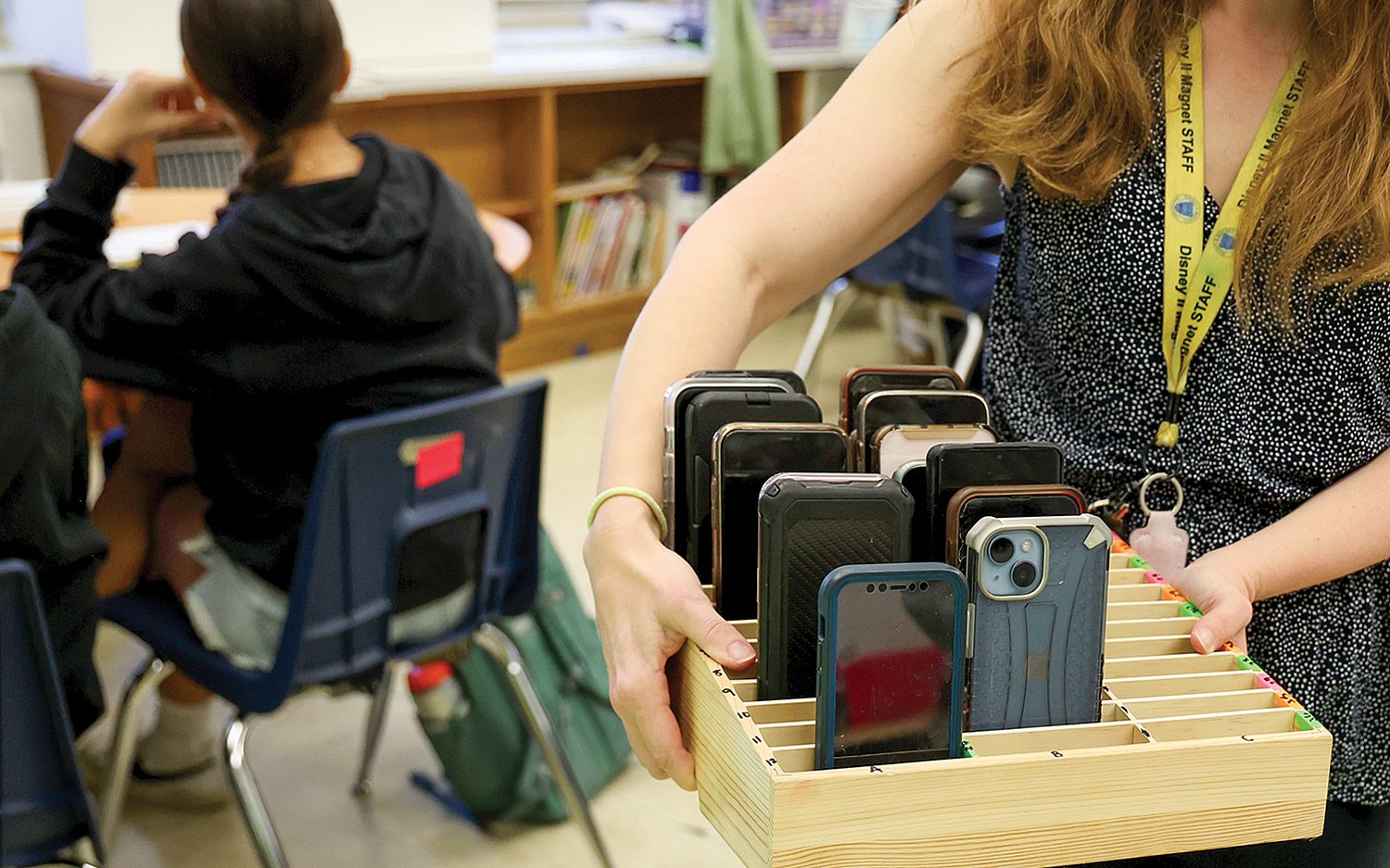
A Chicago teacher collects students’ cellphones. Antonio Perez / Chicago Tribune / Tribune News Service via Getty Images
Full access isn’t far.
We can’t release more of our sound journalism without a subscription, but we can make it easy for you to come aboard.
Get started for as low as $3.99 per month.
Current WORLD subscribers can log in to access content. Just go to "SIGN IN" at the top right.
LET'S GOAlready a member? Sign in.
School cellphone policies are sweeping across the nation, with currently over 40 states mandating that schools must develop policies or comply with state-legislated ones. Phone-Free Schools State Report Card grades state directives in five key areas that promote student welfare: academic performance, mental and physical health, student relationships, teacher satisfaction, and overall student safety and privacy.
North Dakota receives the top grade with the most comprehensive phone-free school law. Students must store all personal electronic devices so they are inaccessible during the entire school day (“bell-to-bell”). Indiana, Kansas, and Rhode Island are also top graders with similar guidelines.
Montana is the only state that hasn’t yet introduced a phone-free school bill. Hawaii, Illinois, Massachusetts, and Pennsylvania have bills pending, marking state grades as “incomplete.” Connecticut, Mississippi, South Dakota, and Washington currently hold “F” grades, with bills that were introduced, but have failed to pass.
While legislation is a first step toward addressing the disruption classroom cellphone use creates to learning, laws sometimes struggle to translate into meaningful change at school. Sabine Polak is cofounder of the Phone-Free Schools Movement, a certifying organization that provides tools for administrators who are serious about curbing cellphone use.
“Most schools just have to have a policy that fits the criteria on paper,” Polak says. She warns that as more bills are passed, parents, teachers, and lawmakers may applaud themselves prematurely. What happens behind the school’s closed doors doesn’t always reflect the state’s written mandate, or even its “report card” grade. “If you’re leaving it up to the individual teachers, it is going to be really varied and inconsistent,” she says. “You get a lot of student pushback because one teacher is enforcing it, and the other teacher isn’t.”
Polak warns that’s likely to cause skewed results from researchers who study the impacts of taking phones out of schools. It might look like the policies aren’t working, when in reality the problem is that they aren’t enforced. She’s concerned states may reverse legislation or schools may give up altogether based on such inaccurate data.
Some administrators aren’t waiting around for legislation. Kevin McCaskill is principal of Brockton High School, the largest public high school in Massachusetts with over 3,500 students. While Massachusetts struggles to nail down a bill, he’s decided he has seen enough negative outcomes from students using cellphones. In 2024 his team of administrators and teachers began promoting a “cellphone-free environment.” Personal digital devices are stored away for the entire school day without access until the last bell rings.
For McCaskill, it’s an opportunity to change the cultural mindset. “It’s not punitive,” he tells students. “We want your focus inside the classrooms. We want your focus on people.” He’s seen a seismic positive shift in the culture of the school building as teenagers return to human interaction. Tracking his own school outcomes allows him to gather solid evidence that removing access to cellphones produces many positive outcomes.
Polak says that while legislation is a step in the right direction, it cannot stop there. “You know that the problem is huge, when the solution needs to come from us all collectively saying, ‘Enough is enough,’” Polak says. “Legislators, schools, parents, we’re all a part of it. And we all have to fight for our children’s future.”

Please wait while we load the latest comments...
Comments
Please register, subscribe, or log in to comment on this article.