
Healthcare cartel
Can the free market fix out-of-control medical costs?
Full access isn’t far.
We can’t release more of our sound journalism without a subscription, but we can make it easy for you to come aboard.
Get started for as low as $3.99 per month.
Current WORLD subscribers can log in to access content. Just go to "SIGN IN" at the top right.
LET'S GOAlready a member? Sign in.
Chest pains began startling Jeremy Wells awake in the middle of the night in the fall of 2025. Sometimes the pains would subside when he drank water. But other times, they’d come back. “In hindsight, we figured out that was probably part of the process of the nerves dying in my esophagus,” he said.
Soon, he could barely swallow. Certain foods, especially steak and bread—staples for the South Dakota fence builder—just wouldn’t go down. “I carried puke bags in my purse,” his wife, Amanda, recalled.
The 51-year-old racked up about $15,000 worth of bills for tests—all before he received an official diagnosis. Wells had developed a condition called achalasia, a rare swallowing problem that affects the esophagus’ ability to move food into the stomach.
To fix the problem, Wells needed surgery to open the valve between his stomach and esophagus. But the operation came with a hefty price tag: an estimated $96,000 for the procedure and a two-day hospital stay at Monument Health Rapid City Hospital—a sum Jeremy described as “mind-blowing.” The Wellses, who are both self-employed, can’t afford traditional health insurance, and the gargantuan quote didn’t even include the cost of the anesthesia or the doctors’ fees. All told, they estimated it could cost up to $150,000.
But after doing some online research, the couple got connected with a unique facility in Oklahoma City able to do the same procedure for a fraction of the cost, with no trade-offs in the quality of care. In fact, the couple described the care at the Surgery Center of Oklahoma as exceptional: “If anything else comes up, we dang sure will be going back there,” Amanda said.
American families spent an average of almost $27,000 on health insurance last year—more than double what they spent in 2010—leading a rising share of employers, providers, and patients to eschew the traditional health insurance system altogether. A growing network of independent surgery centers, direct primary care providers, health sharing networks, and third-party healthcare vendors are banding together in a quest to bring price transparency and free market competition back to the industry. They argue it’s up to employers and individual healthcare consumers opting for alternatives—not more well-intended government regulation—to tamp down inflated costs.
But skeptics say these efforts alone won’t propel a system overhaul because of a seemingly innocuous section of the U.S. tax code that built perverse incentives into the modern health insurance system from the beginning.
JEREMY AND AMANDA WELLS run two businesses from their 15-acre strip of land tucked into the edge of the Black Hills, in Sturgis, S.D. Jeremy and his four employees install fences. Amanda balances the books while also managing her own dog grooming and boarding facility on the property. Aside from job site accident insurance, the pair don’t provide health insurance for their employees—or themselves. A plan for just the two of them would have cost over $1,500 a month.
“It’s just not affordable for self-employed people,” Amanda said.
Forgoing traditional insurance, the couple joined Christian Healthcare Ministries in 2021, and together pay just shy of $600 per month for the organization to reimburse medical expenses for incidents that exceed $1,250.
American families’ contributions toward their health insurance premiums increased 308% between 1999 and 2024, while general inflation climbed 64%. In 1930, the average American spent about $23 on healthcare per year. In 2015, total healthcare spending hit $3 trillion or $9,536 per person. By 2024 it tallied $15,574 per person for a grand total of $5.3 trillion dollars—18% of the country’s gross domestic product.
Sweeping medical advancements in the latter part of the 20th century account for much of that spending surge, said Chris Pope, a Manhattan Institute senior fellow who researches health policy. More than 90% of the modern medicine we rely on today wasn’t available prior to the 1950s. Stents, kidney transplants, pacemakers, and ultrasounds, to name just a few life-saving medical inventions, didn’t exist. Healthcare includes a bundle of services, and “that bundle gets bigger every year,” Pope said.
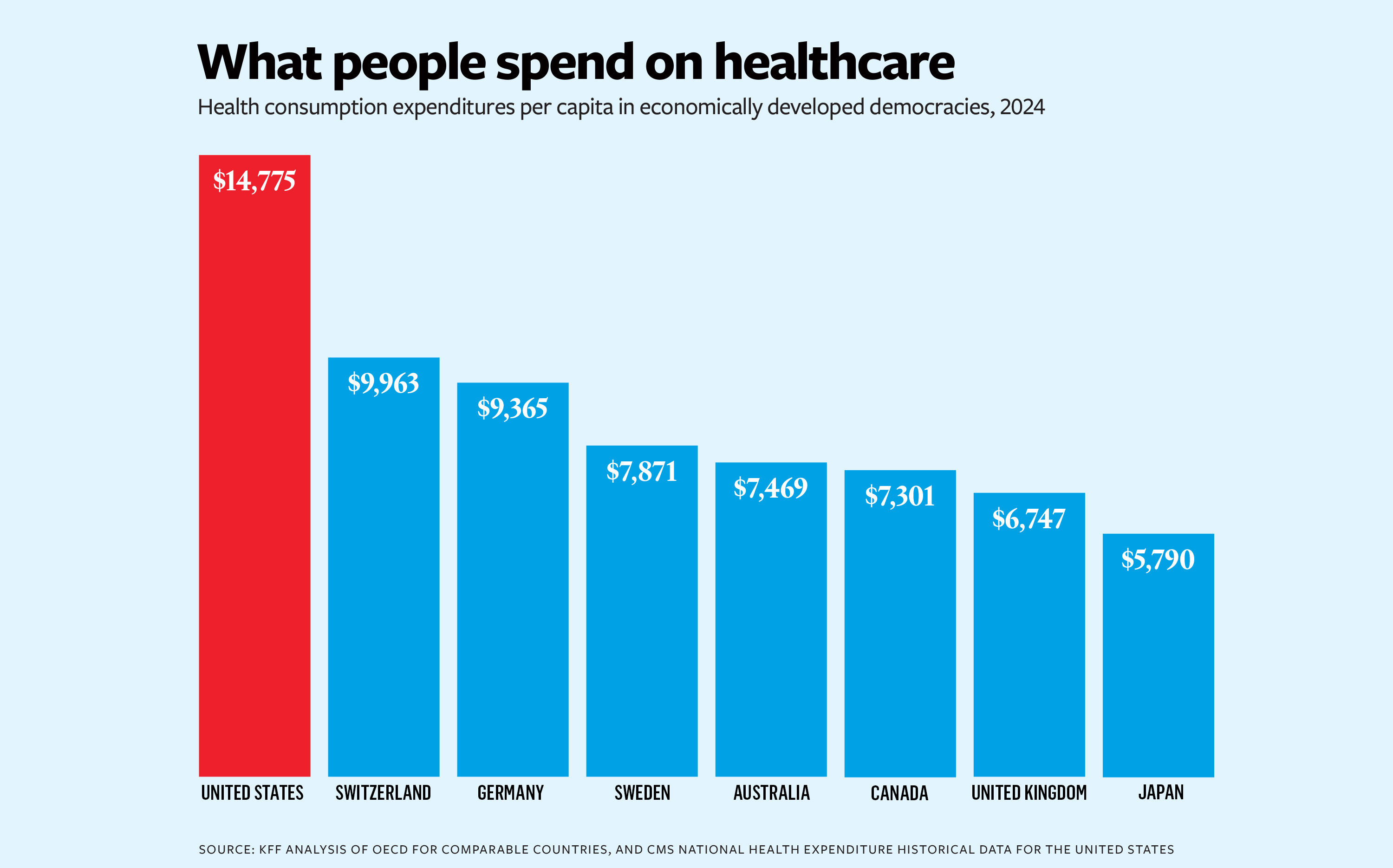
But scientific innovation doesn’t fully explain the extraordinary inflation that characterizes the healthcare industry, said John Steele Gordon, the author of several books on American economic history. Or why Americans spent about $14,775 on healthcare per person in 2024 while the average among other large, wealthy countries totaled about half as much, according to the Organization for Economic Co-operation and Development.
Ballooning costs are symptomatic of a deeper, underlying economic distortion, the 82-year-old quipped. Gordon offered a succinct diagnosis in a 2018 speech for Hillsdale College, and almost 10 years later his prognosis hasn’t changed: “Whenever one segment of an economy exhibits year after year inflation above the general rate and there is no constraint on supply, then either a cartel is in operation or there is a lack of price transparency—or both, as is the case with American medical care.”
Keith Smith broke down the skewed pricing incentives underpinning the system in his characteristic Southern twang. The graying anesthesiologist opened one of the first independent, cash-pay surgery centers in Oklahoma City with his partner, Dr. Steven Lantier, in 1997. From the beginning, the Surgery Center of Oklahoma quoted prices to prospective patients that were thousands if not tens of thousands of dollars lower than many hospitals. Then, in 2009, Smith began posting complete, bundled prices available to anyone who scrolls through the center’s website.
“I wanted to start a price war,” said Smith, who watched astronomical bills for minor procedures bankrupt patients and their families. “I’m angry, and I still am.”
His fire for free market healthcare alternatives hasn’t cooled, but it’s cloaked in a cordial, disarming demeanor that makes it easy to see how Smith quickly puts patients at ease when he welcomes them to the facility. At first, he wasn’t sure the center would survive: “I naively thought cheaper and better would create a line around the block.”
But insurance companies refused to work with his facility. That’s because all the major players benefit from a bigger bill, Smith explained. Hospitals inflate their prices way beyond the value of a procedure, expecting insurance companies to pay a discounted price depending on the contract they’ve negotiated with their network. Insurance companies want a gigantic bill to start with, Smith said, so they can claim they’ve saved their clients thousands of dollars through customized discounts.
Prices vary widely as a result. Take heart surgery: In 2016, researchers at the University of Iowa obtained estimates for coronary bypass surgery from a random sample of 101 U.S. hospitals. Prices ranged from $44,824 to $448,038, with no evidence that price difference correlated to quality of care.
When patients receive out-of-network care, the incentives apply even more pressure. Major insurance companies often act as third-party administrators (TPA) for self-funded employers, companies that pay for their employees’ claims directly rather than paying fixed premiums to an insurance carrier. TPAs help process employee claims. They also help negotiate discounts and “reprice” out-of-network claims, and tack on a shared-savings fee—typically an agreed-upon percent of the original bill—to the employer’s overall health plan bill. In other words, the more gigantic the bill, the bigger their fee.
“Placing prices online and having the real price known up front? That’s a foregone opportunity,” Smith said.
AS JEREMY’S CONDITIONED WORSENED, the Wellses knew they couldn’t postpone the surgery any longer. The active father to four boys lost about 30 pounds; even drinking water on the jobsite induced a gag reflex.
The Wellses told the health share they were willing to go anywhere, and the organization’s surgical care team quickly lined up first-class flights and a hotel so they could have the procedure done at Smith’s facility.
The couple paid nothing for their trip to the Surgery Center of Oklahoma. The ministry even waived the usual $1,250 out-of-pocket portion. Jeremy was draped in a hospital gown lying on a gurney, chatting with Smith, when he found out just how much less the procedure cost: a grand total of about $14,000—roughly $80,000 less than their original hospital quote.
He was shocked.
Not all healthcare is shoppable due to emergency situations requiring specialized care. But a good portion of it is, with estimates ranging from at least 40% to upwards of 60%. Smith and other free market advocates argue it’s not up to the government to combat the opaque pricing and cartel-like tendencies of the healthcare system. It’s up to consumers like the Wellses to kickstart the free market by transferring their business to quality providers with reasonable prices.
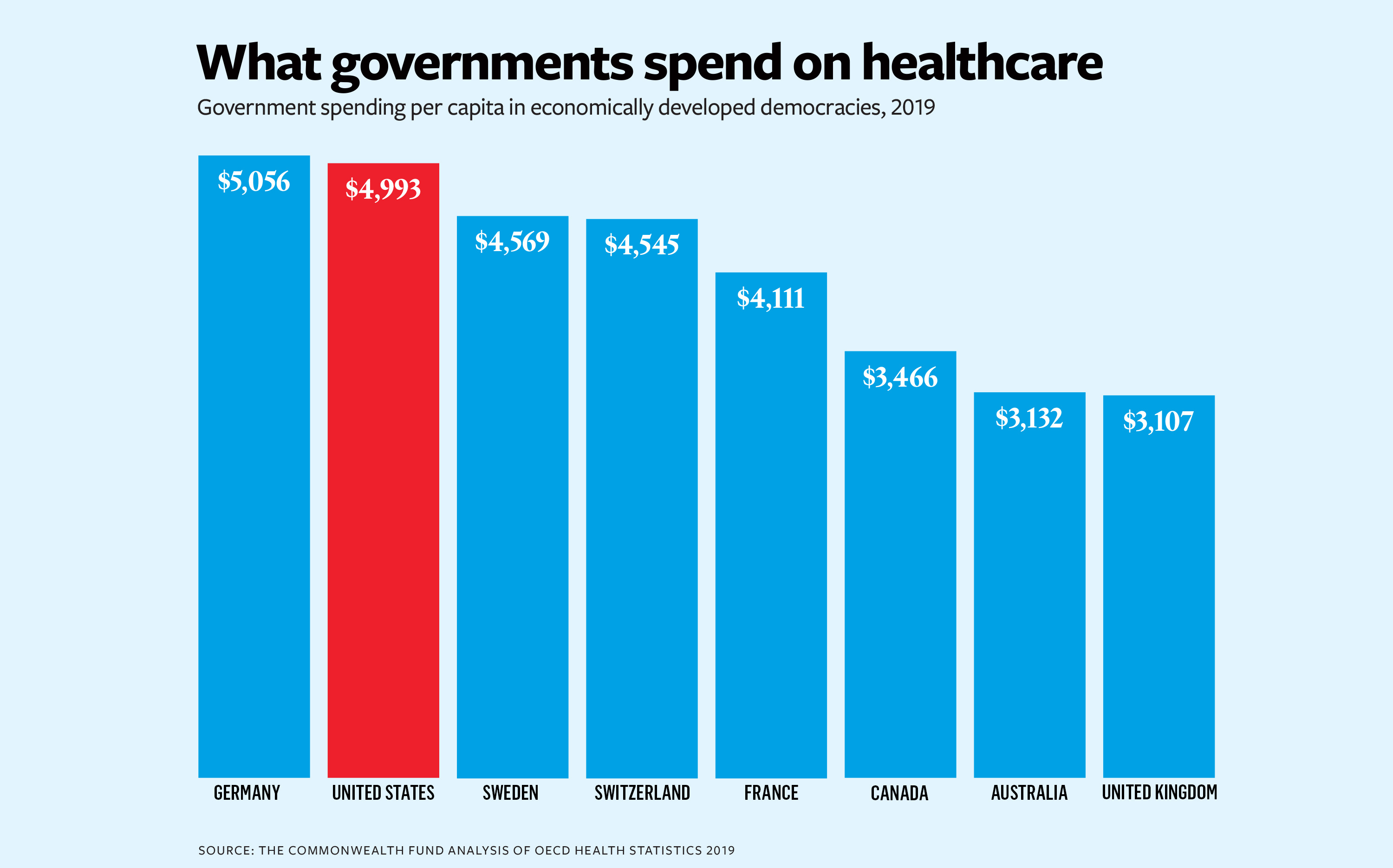
Contrary to popular assumptions, the United States does not have a free market healthcare system, though it’s not explicitly socialized like Canada or the United Kingdom. Still, our federal and state governments together spent more than both those nations per capita on healthcare in 2019, data from the Organization for Economic Co-operation and Development shows. U.S. government spending dominated more than half the healthcare market in 2020 during the COVID-19 pandemic and still accounted for 48% in 2023.
Then there’s the plethora of regulations, mandates, taxes, and subsidies that often prop up the big players, who don’t want free market forces at work, Smith argued. That also fuels higher prices. Hospital systems, pharmaceutical companies, and insurers spent a record $868 million lobbying the government in 2025—more than any other industry.
Many of these well-meaning government regulations have exacerbated prices. For instance, the Affordable Care Act, better known as Obamacare, mandated that insurance companies spend 80% of every premium dollar on medical care instead of administrative costs and investor dividends. Practically, that made insurance companies more likely to tolerate big payouts to hospitals, then turn around and raise premiums.
Smith attended the signing ceremony for President Donald Trump’s 2019 executive order mandating hospitals disclose their standard gross charges, the prices they’ve negotiated with specific insurers, and the amount they’re willing to accept in cash from a patient for a service in a single, machine-readable file. But it’s still difficult for patients to compare prices due to a lack of standardization in how hospitals report them. Enforcement is also a problem, with some hospitals preferring to just pay the fine rather than comply.
That’s just one reason Smith believes it’s time to look beyond the halls of Congress for change: “The only answer is to create an alternative and to turn our backs on this mess that Washington, D.C., has created for the benefit of their cronies.”
After he opened his doors, Smith’s surgery center business quickly grew, despite backlash from major insurers. Canadians disgruntled with long waits in their publicly funded system showed up first. Then came the uninsured or those with high deductibles. “And the next thing I knew there were self-funded companies outside of Oklahoma who wanted to buy from me,” Smith said.
A Business Group on Health survey projected employer healthcare costs in 2026 to be 62% higher than they were in 2017. The center now has contracts with employers in 49 states, Smith said.
Smith is preaching this free market gospel alongside Jay Kempton, the president and CEO of third-party administrator the Kempton Group. The unlikely pair—the product of an accidental meeting through Smith’s neighbor in 2011—joined forces to create the Free Market Medical Association. The group now has 32 local chapters in 27 states, according to its executive director, Matt Ohrt.
Fed up with the pricing games taking advantage of both employers and patients, Kempton recommended his employer clients waive their employees’ out-of-pocket expenses if they chose to have their procedure done at the Surgery Center of Oklahoma for a fraction of the price of a local hospital. Soon, one of the center’s competitors called Kempton, fearful of losing the business of his employer clients, and offered to create its own bundled prices. Then, a few of Kempton’s TPA competitors began doing business with Smith’s center, afraid employers would transfer their business to Kempton.
“This was not done based on negotiations or arm-twisting or the federal government passing legislation,” he noted. “We’re starting to see free market competition occur dynamically and organically.”
WHILE ACKNOWLEDGING POCKETS OF CHANGE, other proponents of healthcare reform I spoke with doubt these free market crusaders can trigger a total system overhaul. That’s because the U.S. tax code baked perverse economic incentives into the employer-sponsored healthcare system decades ago.
Today’s modern health insurance system traces back to the aftermath of World War II when employers scrambling to fill empty positions started using benefits to compete for workers due to the government’s lingering wartime wage and price controls. The federal government cemented this system in place when Congress made the cost of employee health insurance and employee’s contributions to the plan a business expense exempt from taxes.
Most types of non-health-related insurance stick to covering catastrophic events. But the government’s preferential tax treatment of employer-sponsored health insurance incentivized employees to take a higher portion of their salary in health benefits covering more and more types of care, said Avik Roy, president of the Austin, Texas–based Foundation for Research on Equal Opportunity.
Take car insurance. It covers the unexpected rear-end collision, but it doesn’t pay for your gas or wiper fluid, he noted. That’s why consumers go out of their way to purchase cheaper gas. But frugality flies out the window when patients pick a hospital, expecting their employers’ insurance to pick up most of the tab. It isn’t surprising then, Roy added, that hospitals can get away with mysterious prices.
Data from a Medical Expenditure Panel Survey shows 5% of the U.S. population accounted for nearly half of total healthcare spending in 2023, a KFF analysis revealed. These cost-intensive consumers, spending an average of $72,918 annually, are spread across many different neighborhoods. Employers can’t risk leaving someone’s neighborhood hospital out of their network, even if it routinely charges 10 times more than another hospital across town. They just pass on the expense to all their employees in the form of higher premiums.
“American healthcare is not expensive because it’s a free market,” Roy argued. “It’s expensive because we have the worst of both worlds.”
Medicare and Medicaid built on this existing system with taxpayers footing the bill. Obamacare forced individual insurance plans—once a cheaper alternative for people looking outside their employment for coverage—to become more like their employer-sponsored counterparts by mandating they cover individuals with preexisting conditions and pay for a broader range of services.
Roy isn’t holding his breath that politicians will end the employer-sponsored insurance tax break anytime soon. Even incremental efforts at reform have “proved to be very politically unpopular.”
But he believes there are still ways to work within the employer-sponsored insurance model to make individual consumers the primary customers. One of those is called an Individual Coverage Health Reimbursement Arrangement, or an ICHRA. It allows employers to put the pre-tax health benefit money into an account, leaving it up to patients to shop strategically for their providers and insurance plan—one they can keep even if they change companies or leave the state.
The Affordable Care Act prohibited employers from allowing their employees to use tax-free funds to purchase their own insurance plan, but a 2019 regulatory change during Trump’s first term allowed employers to reimburse employees who purchase their own insurance with pre-tax earnings. The Health Reimbursement Arrangement Council estimates ICHRA adoption grew 29% between 2023 and 2024.
Still, uptake is slow, with some sources estimating the plans cover hundreds of thousands of people, but not millions. In a white paper for the Foundation for Research on Equal Opportunity, Roy argued in favor of requiring that newly incorporated businesses fund these types of accounts. Even better, he told me, employees should be allowed to pocket the savings or roll it over into their retirement accounts.
JEREMY WELLS HAD HIS SURGERY on Friday, Feb. 6. The couple landed back in South Dakota on Saturday night. Within two weeks, he was enjoying steak and Amanda’s homemade pizza. He quickly regained the 30 pounds he’d lost “and then some,” Jeremy chuckled.
The couple spoke enthusiastically about the center’s efficiency and Smith’s reassuring welcome. “I would say 100% there’s a little bit of faith in the system after that,” Jeremy said.
At the rate healthcare costs keep rising, Smith believes a regulatory change won’t be necessary to push patients toward cost-effective alternatives: “Deductibles are becoming so high that people are becoming shoppers … you’re looking at facilities like mine because you can buy the surgery for a fraction of your deductible.”
Spin-offs of Smith’s model have multiplied since the center began posting its prices. Businessman Jeff Williams threw his ball cap into the healthcare arena, appalled when his printing company’s healthcare costs increased 43% in 2017. Four years later, the blue-collar, no-nonsense entrepreneur co-founded WellBridge Surgical in Indianapolis with his best friend since fourth grade, anesthesiologist Dr. Eric Inman.
Like its Oklahoma counterpart, the multi-specialty center lists its bundled, out-the-door pricing on its website—some 50% lower than the market average. It’s not rocket science, Williams said, just a simple calculation that includes the cost of materials, labor, and a profit margin similar to that of a “meat and potatoes” manufacturing company.
To Williams’ knowledge, WellBridge is one of the only independent surgery centers that publicly lists its all-inclusive prices and also accepts a few major insurers. United Healthcare agreed to its pricing in 2021. Anthem caved in July 2025 when some of its employer clients demanded the company add the surgery center to its network. “We’re working on Cigna and Aetna now,” Williams said.
In Wisconsin, Dr. Timothy Murray opened the first and only cash-pay ambulatory surgery center connected with a direct primary care practice, another alternative healthcare model that’s gaining traction. Individuals or employers pay a monthly subscription fee that allows their employees to see a primary care physician whenever the need arises.
Concierge and direct primary care practice sites grew 83.1% across the country between 2018 and 2023. Solstice Health, Murray’s practice, now operates five direct primary care locations across the state. To the south, Dr. Andrew Anderson operates one of seven separate DPC practices in the small city of Lynchburg, Va. He told me Kaya Health plans to open another location next year.
Then there’s Dr. Peter Lazzopina, another disillusioned family physician, who spent the last eight years figuring out how to scale direct primary care in the Rio Grande Valley and up through central Texas. Frontier Direct Care provides services to at least 10 large employers, typically municipalities or school districts, along with dozens of small businesses and individuals at 12 clinics. Lazzopina’s goal is to “create an alternative system that will be so large it can’t be ignored.”
He believes employers starting to buckle under skyrocketing costs will be the ones to force change, not the government.
Back at WellBridge Surgical in Indiana, Williams agreed emphatically. “If we put up a bunch of these, we are going to get enough market share that hospitals are going to have to start getting transparent. They’re going to have to start getting competitive,” he said.
“There’s a shift coming.”

Please wait while we load the latest comments...
Comments
Please register, subscribe, or log in to comment on this article.