
Have Californians had enough?
Dissatisfaction with the fruit of far-left policies is pushing some voters toward the middle
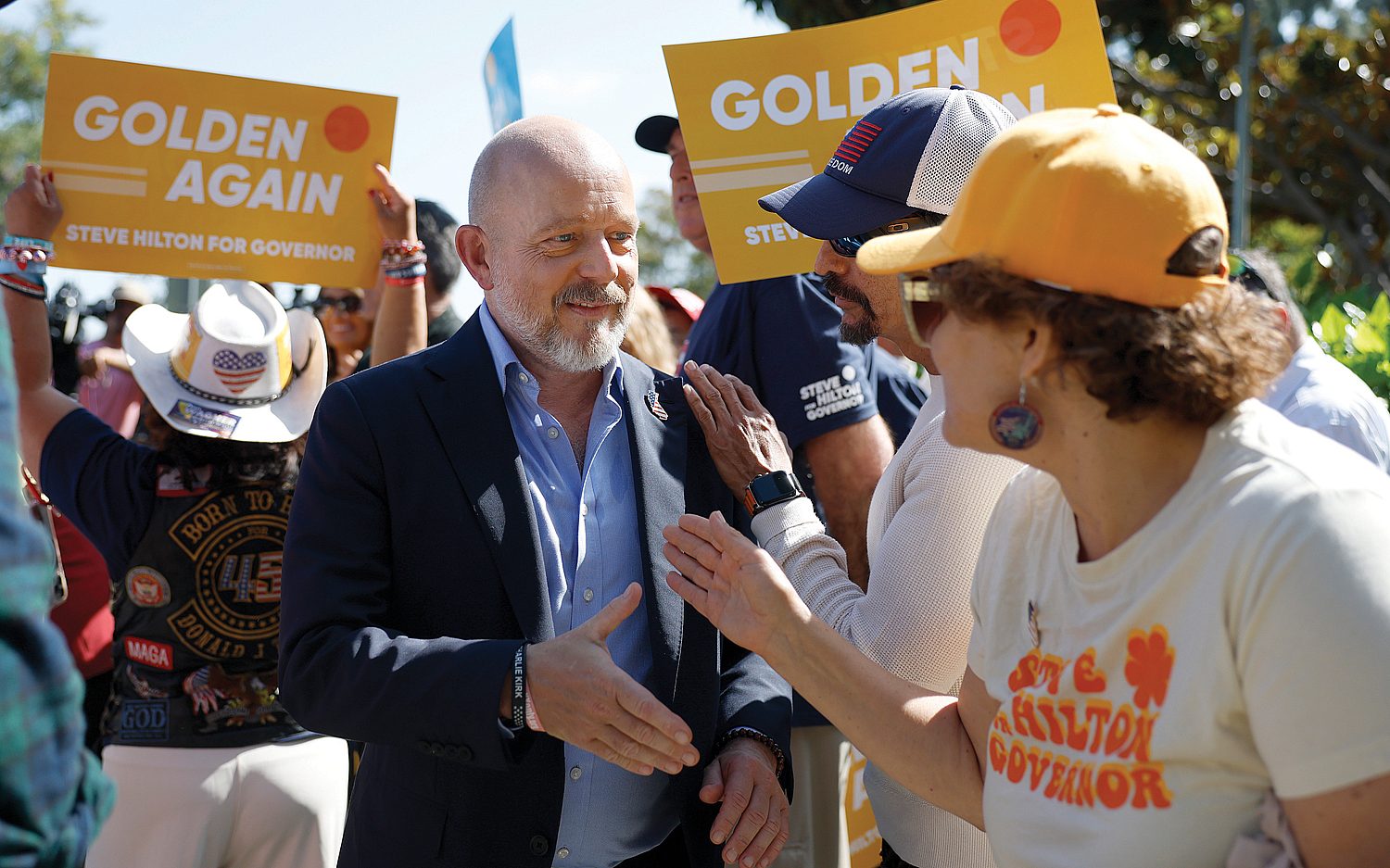
Republican gubernatorial candidate Steve Hilton greets supporters in Norwalk, Calif. Getty Images / Photo by Justin Sullivan
Full access isn’t far.
We can’t release more of our sound journalism without a subscription, but we can make it easy for you to come aboard.
Get started for as low as $3.99 per month.
Current WORLD subscribers can log in to access content. Just go to "SIGN IN" at the top right.
LET'S GOAlready a member? Sign in.
Samba music wafted over a grassy square in San Francisco’s North Beach district on an unusually warm and idyllic July night. A bright blue-and-yellow truck branded with “Golden Again” and “Steve Hilton for Governor” parked outside an Italian athletic club. Inside, about 300 people seated in a ballroom applauded as Hilton, a Republican endorsed by President Donald Trump, made his way to the podium.
“We are done with 16 years of one-party rule,” Hilton told the crowd. “We are done with the cost and the hassle and the nonsense all around us.”
San Francisco was just one stop in Hilton’s “Califordable Town Hall Tour” before he squares off with Xavier Becerra, a Democrat who served in the Biden administration, in the November election to succeed Democratic Gov. Gavin Newsom. Since securing the second spot in the state’s June primary, Hilton has sought to convince one smattering of voters at a time that California is in bad enough shape they should do something they haven’t in two decades: elect a Republican governor.
In the deep blue state, the closely watched partisan matchup in a midterm election year may serve as a gauge for how desperate voters are for an alternative to progressive governance. Win or lose, Hilton’s ascent in California politics is a sign of the state’s pivot to the political center—a trend that bucks the surge of extreme left-wing candidates gaining traction elsewhere.
Hilton, 56, a British American former Fox News host, has led a spirited campaign with a populist message aimed at appealing to voter frustration over affordability, fraud, crime, and homelessness, among other issues. His proposals include $3 gas, cutting utility bills in half, slashing state bureaucracy and the small business tax, and providing starter homes for young families. Hilton also supports banning males who say they’re transgender from competing in female sports and extraditing California abortionists who face prosecution for mailing abortion pills to women in states where it’s illegal. He describes his campaign as “non-ideological, non-partisan, and pragmatic.”
“We’ve had a longer period of one-party rule, so we’ve had a longer experiment in far-left extremism, and the results are even worse,” he told me.
Hilton labeled Becerra a “puppet of the machine” who would perpetuate the state’s problems under Newsom. He’s borrowed from the viral ad campaign of former Los Angeles mayoral candidate Spencer Pratt, releasing AI-generated videos made by the same filmmaker. Hilton’s ads portray him as an outsider defending downtrodden working-class Californians against a giant robotlike machine symbolizing the state’s elite Democratic establishment.
But even Hilton’s allies aren’t sure the state is ready to usher in a Trump-aligned Republican candidate. “A cold-eyed realist would say he’s the underdog,” conservative activist Christopher Rufo, a senior fellow at the Manhattan Institute, told me. Mike Madrid, a conservative political consultant who studies Latino voter trends, called the president a liability: “If it wasn’t for Trump, Hilton would be competitive.”
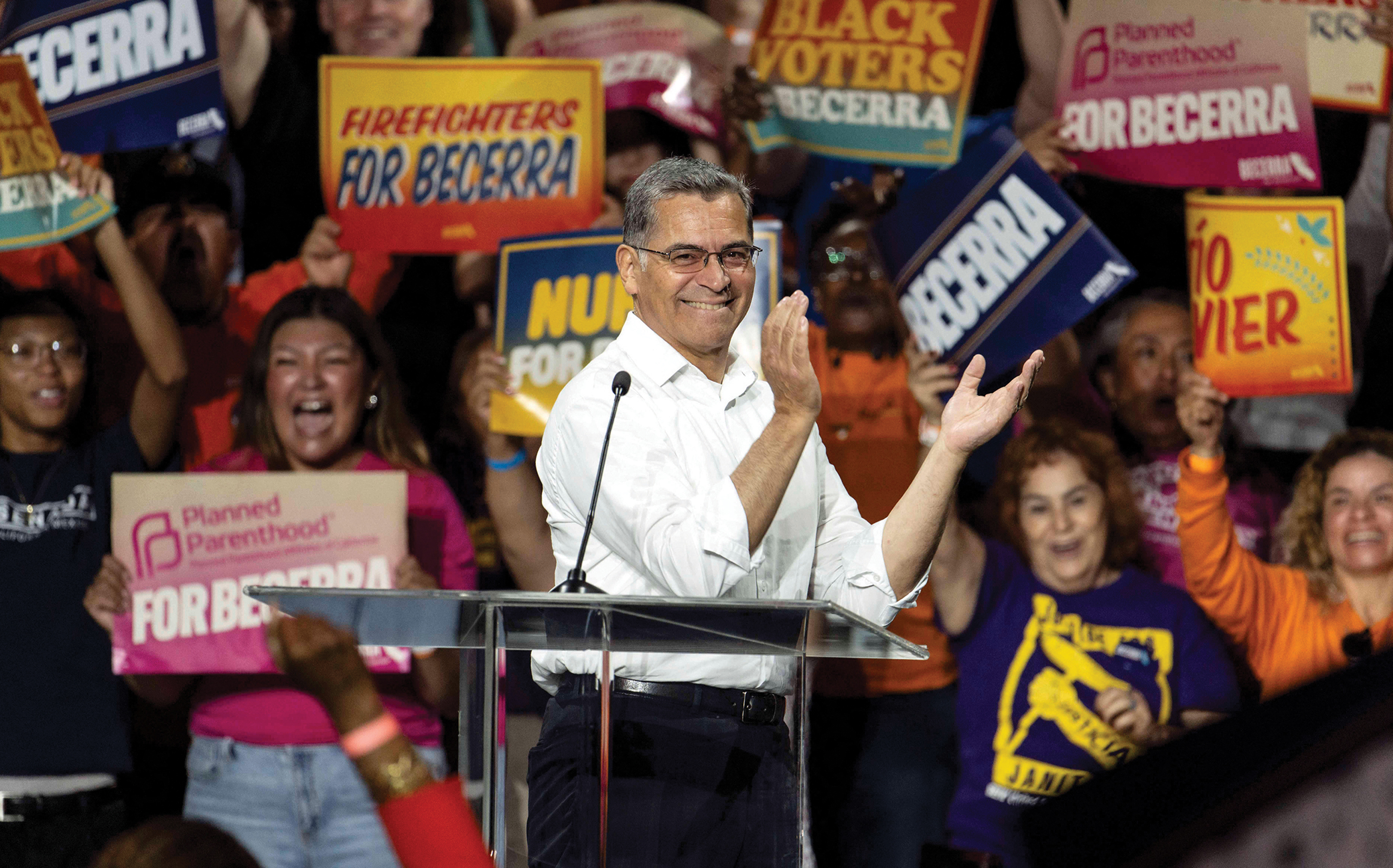
Becerra has largely campaigned on his anti-Trump credentials, seizing upon the president’s low approval ratings and unpopular decisions, especially in California, including the war in Iran, tariffs, and ICE enforcement.
An early poll indicated Becerra leading Hilton with a nearly 25-point advantage, roughly the same margin Democratic candidates held in local House district races, according to the Public Policy Institute of California (PPIC). Nearly 45% of Californians are registered Democrats, while 1 in 4 voters sides with the Republican Party, according to the California secretary of state.
Brian Cahn / Zuma Press, Inc. / Alamy
Hilton is banking on Republican voter turnout and capturing some of the state’s growing independent block. About 23% of California voters claim “no party preference.” He’s also hoping to pick up some disenfranchised Democrats. Hilton’s running mate, Gloria Romero, who is campaigning for lieutenant governor, could help his chances. She’s a former state senator and Democratic majority leader who joined the Republican Party in 2024.
Mark Baldassare, PPIC’s statewide survey director, said Hilton is “raising real concerns that people have, and most people would agree with what he has to say about California.” The question, he believes, is “whether opinions today are so hardened around partisanship.”
At Hilton’s San Francisco gathering, a handful of people who stood and asked questions identified themselves as lifelong Democrats.
Jim Leuschner is a general contractor and 38-year San Francisco resident. He’s also homosexual and a long supporter of Democratic candidates. But he referenced the city’s lawlessness after progressive “defund the police” measures under its previous mayor as issues that prompted him to rethink his vote. “My partner and I, we’re registered Democrats, and we’ve become completely disillusioned. … You are such a breath of fresh air,” he told Hilton. Later, as Leuschner stood in line to get a photo with Hilton, he expressed other concerns, such as voter fraud and illegal immigration. “We need to turn the boat around,” he told me.
Robert Dalby, an attorney from Alameda, Calif., told me he’s a registered Democrat “leaning toward Hilton.” Dalby says Hilton appeals to him because “he doesn’t embrace socialism. He wants to reduce taxes. He wants to reduce regulations, make the government more efficient.”
Dalby’s primary concerns are inflation and cost of living. He voted for Trump in 2024, but he worries the president’s support for Hilton “may not be a positive thing and … may have alienated a lot of potential voters.”
During his opening speech, Hilton noted that 6 million Californians voted for Trump in 2024. Despite losing the state’s electoral vote to Kamala Harris, the president earned 1.6 million more votes than he did in his first presidential bid in 2016, signaling greater support for a Republican candidate in the Democratic bastion.
In the June primary, Pratt led an attention-grabbing close but failed bid for a runoff spot in the Los Angeles mayoral campaign against Democratic incumbent Karen Bass. Like Hilton, Pratt ran as a Trump-endorsed populist Republican and political outsider. Despite his loss, Pratt has continued to critique progressive policies and problems in the LA area—from the city’s wildfire mismanagement to open-air drug markets and widespread government fraud.
Rufo has similarly focused on highlighting problems in the state. In an April City Journal investigation, Rufo and his colleagues exposed billions of tax dollars lost to Medi-Cal fraud under Newsom’s watch. He says the scope and scale of the corruption in California “should cause deep concern for all Americans.”
That exposure could provide a boost for Hilton. But whether it’s enough to move California voters is still an open question. Rufo says the conservative exodus from California and “an immense Democratic Party apparatus” leave him with serious doubts.
“I’m not sure at this point California voters have felt a significant amount of friction or discomfort to really break out of the ideological programming that seems to have captured a huge part of the state,” he said.

Please wait while we load the latest comments...
Comments
Please register, subscribe, or log in to comment on this article.