
Criminals, clues, and romantic chemistry
BOOKS | Several cozy-ish mystery picks
Full access isn’t far.
We can’t release more of our sound journalism without a subscription, but we can make it easy for you to come aboard.
Get started for as low as $3.99 per month.
Current WORLD subscribers can log in to access content. Just go to "SIGN IN" at the top right.
LET'S GOAlready a member? Sign in.
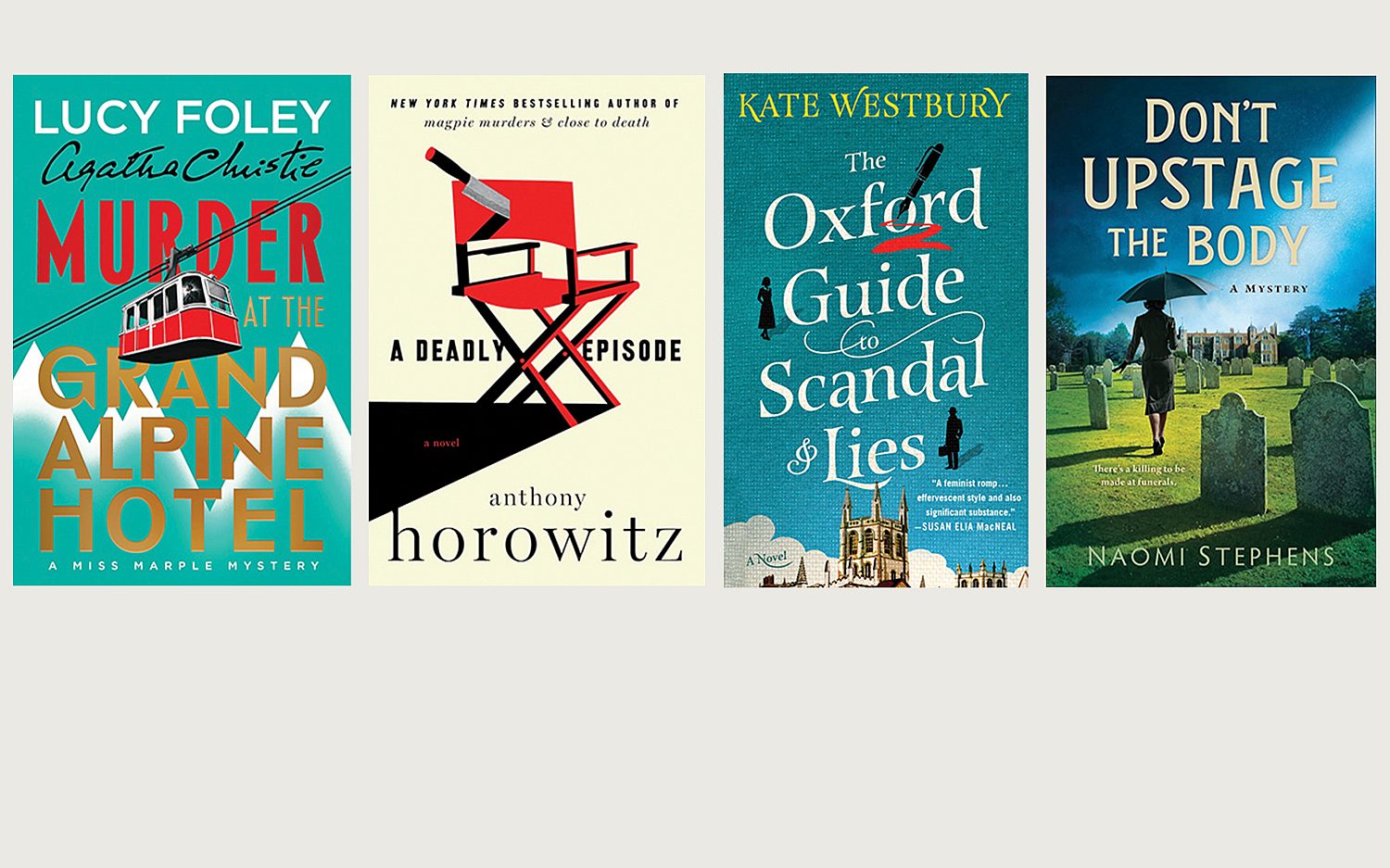
Murder at the Grand Alpine Hotel
Lucy Foley
William Morrow, 304 pages
Agatha Christie has been dead for 50 years, but that isn’t going to stop her estate from publishing new stories based on her beloved characters. Over the last decade Sophie Hannah has written a half dozen Hercule Poirot books, and now bestselling author Lucy Foley is giving Miss Marple the same treatment.
Murder at the Grand Alpine Hotel takes Miss Marple out of the small English village of St. Mary Mead and deposits her at a resort in the Swiss Alps where she’s on holiday with her old friend Mrs. Bantry. A murder occurs after the hotel guests get snowed in. It’s up to Miss Marple to sniff out the culprit and figure out how the murder is connected to a shipment of gold that went missing during World War II.
Foley shifts the narrator throughout the novel. Chapters alternate between different points of view. Through this shifting perspective we meet a lady’s maid, a high-society wife, an aging film star, and a disreputable friend from the past. Did any of these commit the murder? Miss Marple, for her part, sticks to the background, which isn’t uncommon in Christie’s Marple mysteries. Foley’s plot is just as complicated as those in Christie’s novels, but she lays the red herring on a little too thickly. Murder at the Grand Alpine Hotel feels more like a mimicry of Christie’s classic novels rather than its own story, but it’s not a bad choice for folks who’re looking for something to read after finishing Christie’s 12 Miss Marple books.
A Deadly Episode
Anthony Horowitz
Harper, 384 pages
A Deadly Episode is the sixth novel in the Hawthorne and Horowitz series in which prolific novelist and screenwriter Anthony Horowitz writes himself into the story of his fictional private detective Daniel Hawthorne. The series revels in the self-referential, with Horowitz adapting aspects of his real life in London for the narrative.
In this installment, Hawthorne and Horowitz act as consultants on a film production based on their first adventure together, The Word Is Murder (2017). As is always the case, everyone involved is much more interested in Detective Hawthorne than they are in the guy who wrote the book, and Horowitz can’t help but feel taken for granted. He feels even worse when he realizes that the film adaptation of his book isn’t going to be any good. Problems with the script, however, don’t seem so important after the lead actor is found dead. It appears almost everyone on the production had some reason to kill him.
Hawthorne and Horowitz is a strong series that showcases Horowitz’s sly humor (the real author, not the character). As with some other Horowitz novels, this book offers two mysteries for the price of one, and there’s the additional benefit of getting more insight into the mysterious Hawthorne’s background. Even so, this installment isn’t quite as engaging as some of the previous books, and the series isn’t for kids. It contains occasional bad language, and some of the supporting characters lead immoral lifestyles.
The Oxford Guide to Scandal and Lies
Kate Westbury
Minotaur Books, 352 pages
The Oxford Guide to Scandal and Lies takes place in 1951 at—unsurprisingly given the title—Oxford University. The Honorable Ginevra Bishop is an aristocratic first-year student studying German at the venerable institution. Her nemesis is Sidney Braithwaite, a young World War II veteran who’s returned to the university to study Latin. How did these two become enemies? They both want to use the same table in the Bodleian Library, and neither wants to share. But Ginevra and Sidney will have to put their animosity aside if they’re going to solve the murder of a beloved librarian.
The blurb on the cover of this novel describes it as “a feminist romp,” but don’t let that bit of marketing turn you away if the premise interests you. The book might have a strong heroine and offer some mild commentary on midcentury British social conventions, but this isn’t an agenda-laden tale of female empowerment. It’s a delightful mystery with aspects of the espionage genre that features two utterly charming protagonists.
Ginevra is brilliant, while Sidney has cloak-and-dagger experience he gained during the war. She’s eager to chase down danger. He’s been there before, and he tries to keep both of them from delving too deeply into this mystery. And despite getting off on the wrong foot, they’re both attracted to each other, though neither of them knows the other is interested. The will-they-or-won’t-they aspect of the story is just as compelling as the murder mystery. Though sensitive readers should note, the novel contains two objectionable words and a discussion of dubious parentage.
Don’t Upstage the Body
Naomi Stephens
Bethany House, 304 pages
Another mystery novel set in midcentury England with likable characters and a charming romantic side plot is Naomi Stephens’ Don’t Upstage the Body from the Christian publisher Bethany House.
Hippolyta Halfpenny’s family has found an unusual form of employment. She, her father, and her siblings work as professional mourners at funerals that might need help in getting to a respectable attendance level. Each takes on a different persona as they weep for dead people no one else will weep for, leaving the other attendees none the wiser. The only rule? Don’t upstage the body.
Their latest assignment is a funeral at the country estate of the unloved Earl of Montfort, but the day takes an unexpected turn when someone poisons the undertaker. The story takes a farcical turn when the police get involved, and Hippolyta and her family decide to remain undercover rather than announce that they’re strangers, not friends and family of the deceased. Hippolyta decides the best way to keep the police from digging into her own background is to find the killer. Could it be that someone besides her own family is pretending to be something he’s not?
The story is a little outlandish, but it’s an entertaining novel with more wit than the average cozy mystery.

Please wait while we load the latest comments...
Comments
Please register, subscribe, or log in to comment on this article.