
An education in irreparable harm
Parents and teachers team up to fight pro-transgender policies in public schools
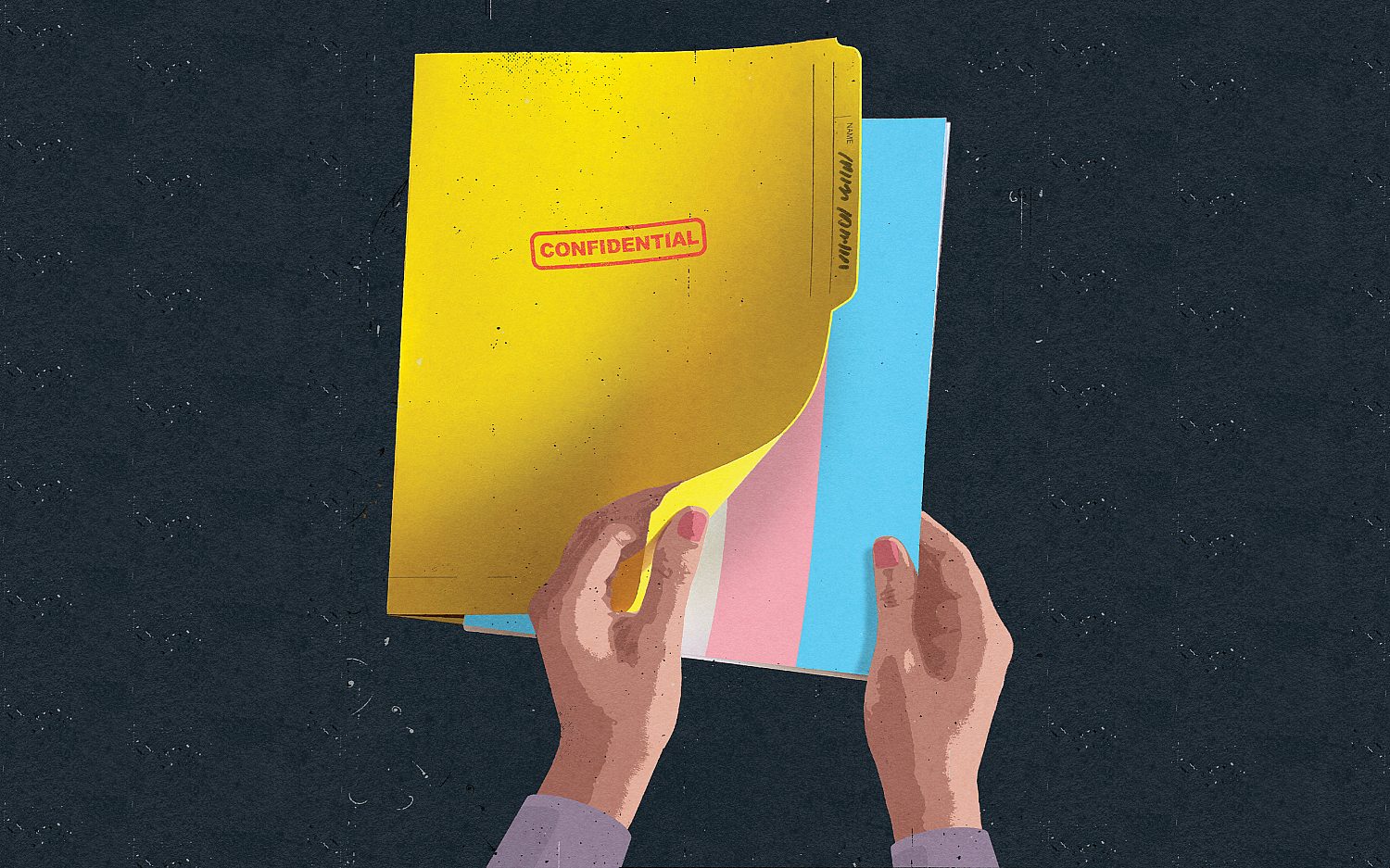
Illustration by Richard Mia
Full access isn’t far.
We can’t release more of our sound journalism without a subscription, but we can make it easy for you to come aboard.
Get started for as low as $3.99 per month.
Current WORLD subscribers can log in to access content. Just go to "SIGN IN" at the top right.
LET'S GOAlready a member? Sign in.
Sixth grade teacher Ramona Garcia squirmed as the mother sitting across from her began to cry. Upset by her daughter’s deteriorating mental health, the mother had asked for a meeting. They sat together in Garcia’s classroom as the teacher considered what to say.
“I knew her daughter had been using a boy’s name at school,” Garcia said. “I had avoided using anything but general greetings for her, because I didn’t want to use the new name. But I couldn’t tell her mom that.”
In 2016, the California School Board Association suggested changes to an administrative regulation that prevented teachers from telling parents about their student’s social gender transition at school—unless the student said it was OK. Most school districts in California adopted the changes without question.
Garcia recalls the mother asking her several times whether there was something she was missing about her daughter’s mental health crisis. Then she said, “Is it the ‘they/them’ thing?”
Garcia was relieved. If the mother already knew about her daughter’s gender confusion, Garcia believed she could share her own insights. “Yes,” she affirmed. “I think that has something to do with it.”
The following Monday, the school’s principal issued Garcia a formal reprimand for having discussed her student’s “gender identity” with the mother. According to Garcia, the whole atmosphere at school changed after that. Fellow teachers became cold and even confrontational. The student became hostile. Eventually, Garcia hired a religious rights attorney, Dean Broyles, to defend her. Broyles petitioned for and won a religious exemption from the regulation. But the policy’s effects still concerned Garcia.
It concerned other teachers, too. In April 2023, teachers Lori Ann West and Elizabeth Mirabelli sued the Escondido Union School District, the same K-8 district that oversaw Garcia’s school. The suit, filed by the Thomas More Society, also included California Superintendent of Public Instruction Tony Thurmond, California Attorney General Rob Bonta, and California Gov. Gavin Newsom as defendants. In October 2025, the case became Mirabelli v. Bonta, a class action lawsuit pressed by both teachers and parents whose students had been secretly transitioned at school.
On Dec. 22, 2025, Judge Roger Benitez, a George W. Bush–appointed federal district court judge, issued a summary judgment and permanent injunction holding that the statewide “parental exclusion” policies violated federal constitutional rights for both teachers and parents. California appealed, and the 9th U.S. Circuit Court of Appeals put a stay on Benitez’s decision. The Thomas More Society made an emergency appeal to the U.S. Supreme Court. On March 2, 2026, the Supreme Court vacated the 9th Circuit’s stay, citing, in part, the possibility that “the denial of plaintiff’s constitutional rights during the potentially protracted appellate process constitutes irreparable harm.”
“Irreparable harm,” of course, has a specific legal definition. But it also describes what families, students, and teachers experience in public schools across America every day because of these policies. About 12 million students learn in school districts that have similar rules protecting gender transitions on campus.
MASON AND LISA WILLIAMS first learned that their youngest daughter, Laney, was secretly transitioning at school when they saw a different name in her profile on Schoology, an online learning management system. “Without our consent, she had gone to the administration in September 2021 and asked them to change her name and pronouns,” Lisa said. “And they did not tell us about that. We didn’t know anything.”
During that school year, Laney had formed a close relationship with a teacher who was also the staff adviser for a Gay/Straight Alliance (GSA) club on campus. Her friend group, many of whom identified as LGBTQ, began addressing her by her new name. (WORLD agreed to use pseudonyms for the family to protect their privacy.)
Lisa, who is also a teacher in the same school system, emailed Laney’s school administrators and requested they restore her daughter’s information to reflect reality. School leaders, who advertise themselves as close partners with parents in education, informed Lisa that due to Title IX privacy requirements, they could not. A school counselor also informed Lisa and Mason that she could not discuss Laney’s gender identity with them due to confidentiality requirements. When they asked Laney to make the changes in the database herself, she refused.
“This is my identity,” she told them.
The Williamses eventually decided to keep Laney home for a week. “We’ve done that with all of our kids when there were social or emotional concerns and we just needed sort of a reset,” Lisa said. As they sought some emotional relief from the strain of all that had happened at school, Child Protective Services knocked on their door.
A school friend believed their refusal to use Laney’s new name and pronouns was abuse, and the friend’s mother reported them. “So we had a CPS investigation going on just for keeping our own daughter in the safety of our home and pulling her away from those influences,” Mason said. “That was a lot of PTSD for Lisa, at least. I mean, every time there was a knock at the door it was, ‘What’s going on?’ or ‘Who is that?’” After several weeks, CPS investigators completely exonerated the Williamses.
Finally, the couple decided to move Laney to a different school. But by that point, she had embedded herself deeply enough in the LGBTQ community that she still had access to information and resources to support her in her transgender identity. Eventually, Laney ran away from home. Though the Williamses know she’s safe, they have almost no contact with their daughter.
“I just feel like the wedge that exists now is largely because of these institutions … the educational institution, the medical institution, the government,” Lisa said. “Your child has a whole world system that will help them to demonize you, and make you feel like you’re the absolute enemy.”
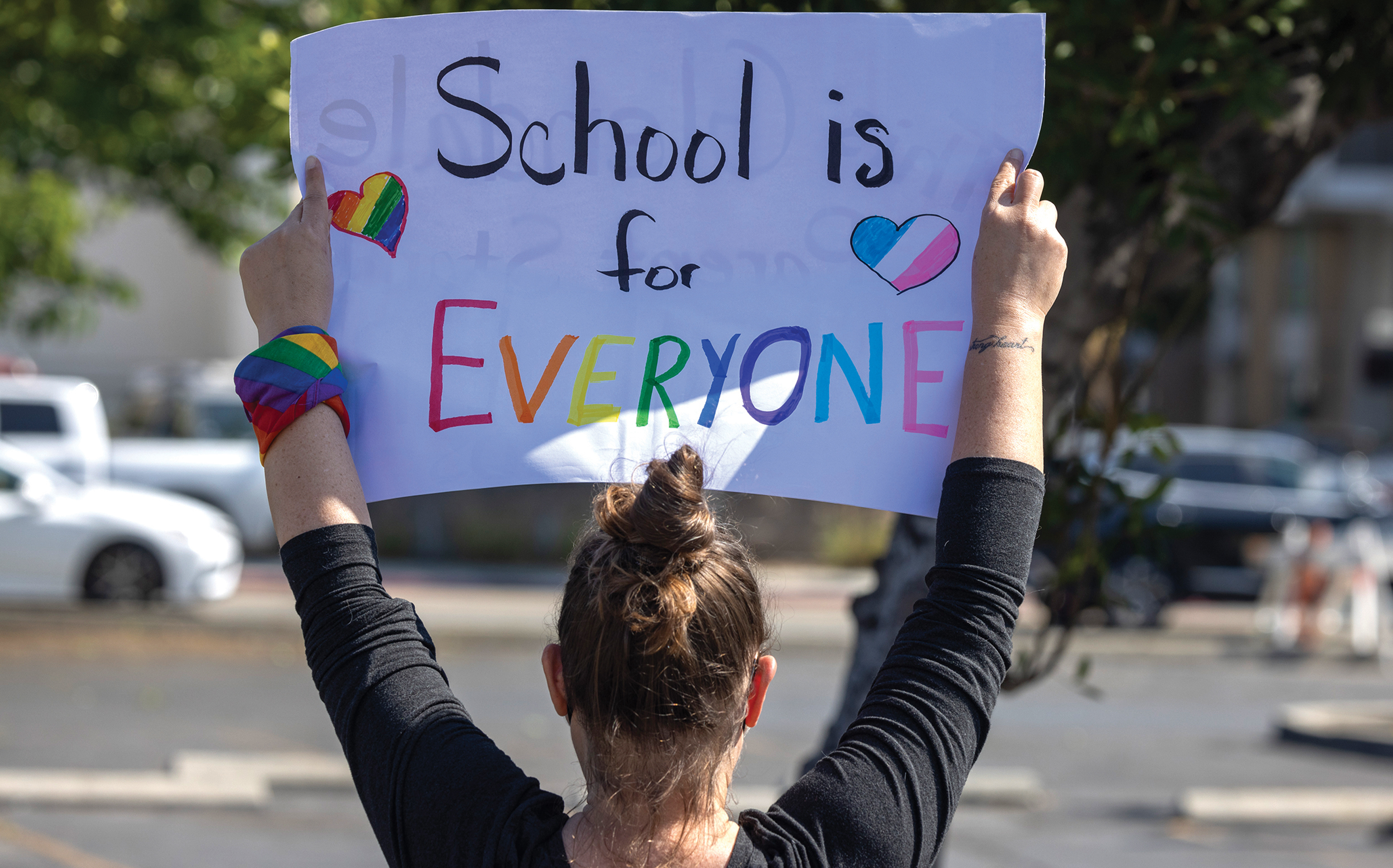
A pro-LGBTQ+ demonstrator protests outside a 2023 school board meeting in Glendale, Calif. David McNew / Getty Images
BETH BOURNE FACED A SIMILAR SITUATION when her daughter announced she wanted to live as a boy. Bourne was a single mother at the time, and her ex-husband was willing to affirm their daughter’s new identity. He was also good friends with a counselor at their daughter’s school. Bourne described how, emboldened by the school’s pro-trans policies, the school counselor felt she could team up with the affirming father while cutting Bourne out of the loop if she did not agree with her daughter’s plan to transition. “In the case of a divorced parent … it was like, ‘If you don’t also affirm, you’re going to lose your child,’” Bourne said.
The original Mirabelli lawsuit against Escondido Unified School District included evidence of similar pressure. The suit contained a heavily redacted email from a school counselor at Rincon Middle School that lists seventh grade students who were socially transitioning on campus. In each instance, teachers were told whether or not parents were allowed to know about their child’s gender transition. In one particularly troubling line, the school counselor pointed to the case of a female student who wanted to be called by a male name and pronouns.
“Dad and stepmom are NOT aware, please use [female name redacted] and she/her pronouns when calling home,” the counselor wrote. For another female student the email instructs, “Mom is aware but dad is NOT aware, but student is okay with you using [female name redacted] (she/her) with both parents to make it as easy for you as possible when communicating home.”
Although Mirabelli v. Bonta centers on policies in California’s schools, at least 1,217 school districts across America hold policies that require or suggest personnel keep a student’s transgender status from parents. That puts parents and many teachers in an impossible position. Whether because of sincerely held Christian beliefs or because of simple dedication to truth and reality, many teachers are uncomfortable with the idea of speaking to children in a way that does not reflect reality—or with lying to parents about their student’s life at school.
Arienne Adamčíková, who teaches Spanish at a Northern California high school, refused to comply when school administrators sent a faculty-wide email instructing teachers to keep the trans identity of one female student a secret.
“I’m sorry, but I will not lie to a parent,” Adamčíková responded. “I have never been asked to lie to a parent about anything in my 20 some years as a teacher, and I will not start today.”
For now, she’s free to take that stand. The U.S. Supreme Court concluded in its emergency ruling that California’s policies “will likely not survive” based on previous court rulings regarding parental rights, but the state continues to fight the case fiercely. A final decision may take years.
—Mary Weller works for the apologetics ministry truthXchange and is a graduate of the WJI mid-career course

Please wait while we load the latest comments...
Comments
Please register, subscribe, or log in to comment on this article.