
Closing arguments delivered in Lindsay Clancy triple murder trial
Defense attorney Kevin Reddington delivering closing arguments Associated Press / Photo by Greg Derr, Pool / The Patriot Ledger
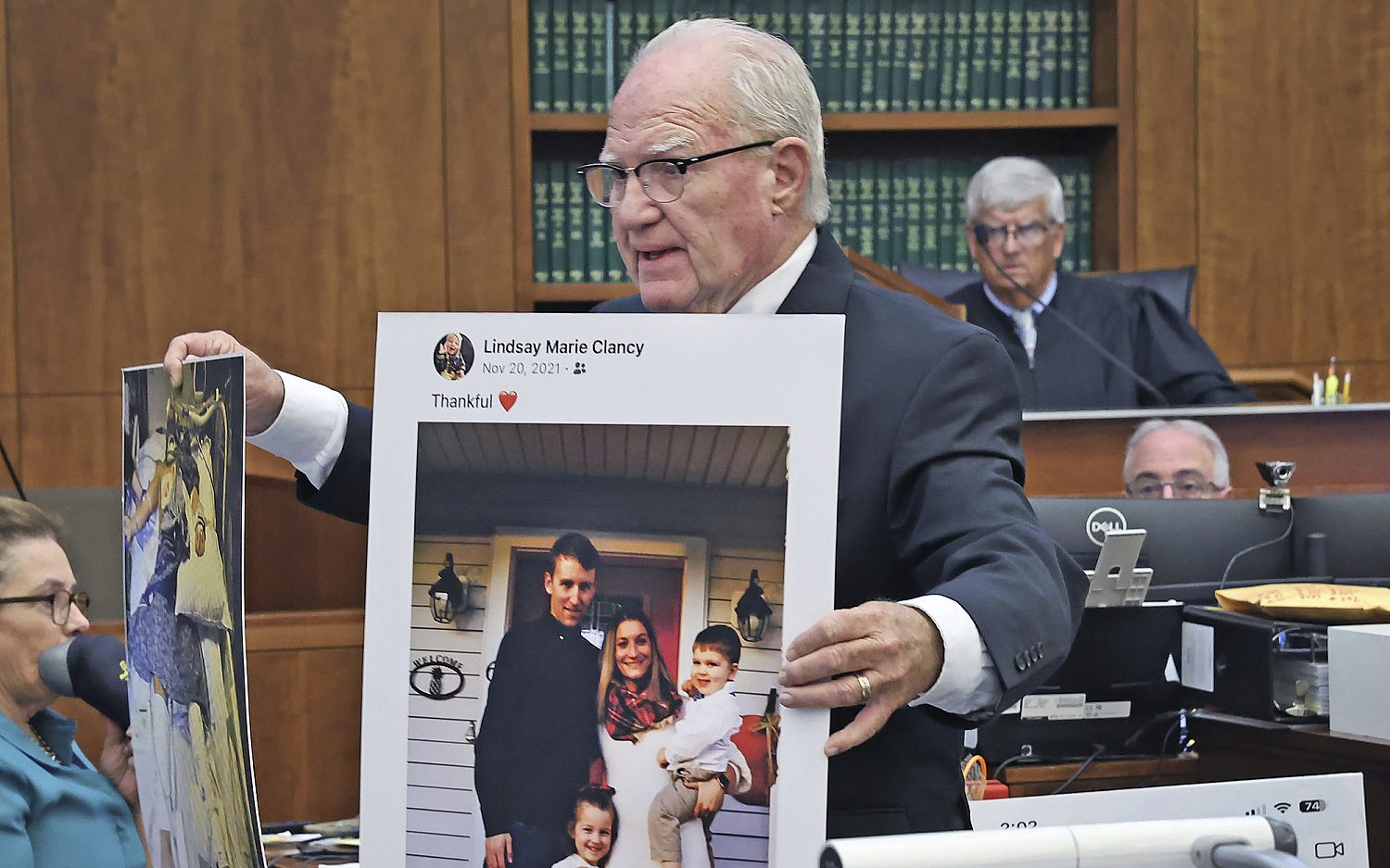
Prosecutors representing Massachusetts as well as defense attorneys for the woman charged with fatally strangling her three young children addressed the jury, delivering their closing arguments on Friday. The high-profile trial began over a month ago to determine whether Lindsay Clancy may be held legally responsible for the deaths of her children. The 36-year-old mother pleaded not guilty to murdering her children in January 2023 by reason of insanity, alleging that she suffered from postpartum psychosis despite repeatedly seeking medical help.
Lindsay’s now-ex-husband, Patrick, called first responders on the evening of Jan. 24, 2023, saying he found his wife lying in the snow outside their home with self-inflicted wounds. Authorities reported Lindsay suffered a severe spinal injury after taking a headfirst fall out of the couple’s second-story bedroom window before Patrick found her. Clancy's ex-husband then said he discovered 5-year-old Cora, 3-year-old Dawson, and 8-month-old Callan deceased in the basement while on the phone with 911 dispatchers. Lindsay’s apparent failed suicide attempt left her paralyzed from the waist down, after spending a week on a ventilator and several days in a coma. About a week after the incident, Lindsay told Patrick that a male voice instructed her to kill the children and herself.
The case centered not on whether Lindsay killed the children, but rather whether she could be held legally responsible for her actions during what defense attorneys describe as a psychotic episode. State prosecutors aimed to prove Lindsay intentionally planned and carried out the murders after sending her husband out on errands. Lindsay intentionally carried out the crimes while rationally understanding the difference between right and wrong, allowing her to be held legally responsible, the state argued.
How did closing arguments go? Lindsay’s defense attorney, Kevin Reddington, addressed the jury first, and alleged that prosecutors repeatedly and intentionally manipulated evidence to Lindsay’s disadvantage. He emphasized the state’s responsibility to prove the case with evidence beyond a reasonable doubt and not just paint Lindsay in a bad light. This prosecution ripped the soul out of Lindsay and undermined her character, claiming she lied to her husband and faked her suicide attempt, Reddington said.
In reality, Lindsay was a good mother who sought help with her mental illness and received lousy healthcare and overmedication, he said. Lindsay’s diary, medical records, and testimony from her family and doctors showcased how she repeatedly sought help, going to multiple doctors and calling suicide hotlines, but to no avail, he said. Several doctors testified that they believed Lindsay was in a psychotic state during the murders, which prosecutors haven’t been able to disprove, Reddington said. Prosecutors bear the burden of proof, and they can't prove she's guilty because there's no evidence suggesting Lindsay lied about anything, Reddington concluded.
What did prosecutors have to say? Assistant District Attorney Jennifer Sprague delivered the prosecution’s closing arguments and characterized Lindsay as a patient who wasn’t truthful with her doctors. The mental health system and its treatment of women wasn’t on trial, she said. Defense attorneys weaponized those subjects to inflame the jurors and distract them from the real issue at hand, she said. There was no question Lindsay suffered from mental illness, the question was whether she could understand the difference between right and wrong at the time of the murders, Sprague said. Lindsay wasn’t overworked or undersupported; she struggled with depression and got poor treatment because she wasn’t honest with her doctors, the prosecutor alleged.
Mental health providers diagnose medications based on patient feedback with a trial-and-error system, which is standard across the field, but Lindsay was dishonest with her doctors, Sprague said. Lindsay told her mother and husband about her thoughts of harming the children a month before the murders, but she never told her doctors because she knew the children may be taken from her, Sprague said. That showed rational thought from Lindsay, understanding the difference between right and wrong, she said. Lindsay didn’t just take advantage of Patrick leaving the house, she orchestrated it, Sprague continued. The prosecutor questioned why Lindsay mapped Patrick’s errand route hours before the murders, and why medical exams showed hesitation marks in the cuts to herself. Lindsay never heard the alleged male voice telling her to kill her children before that day, and never reported hearing it again, suggesting it’s completely made up, Sprague said.
The jury is now expected to decide whether Lindsay was of sound mind at the time of the crime or if she was suffering from insanity and did not understand what she was doing. After more than 20 days of testimony, it remained unclear how long the jury would deliberate.


An actual newsletter worth subscribing to instead of just a collection of links. —Adam
Sign up to receive The Sift email newsletter each weekday morning for the latest headlines from WORLD’s breaking news team.


Please wait while we load the latest comments...
Comments
Please register, subscribe, or log in to comment on this article.