
Toiling in Pakistan’s brick kilns
An exploitative debt repayment system entraps many Christians and Hindus in what experts deem a human trafficking scheme
Child carries mud for bricks in Kasur District, near Lahore, Pakistan. Photo by Solomon K.
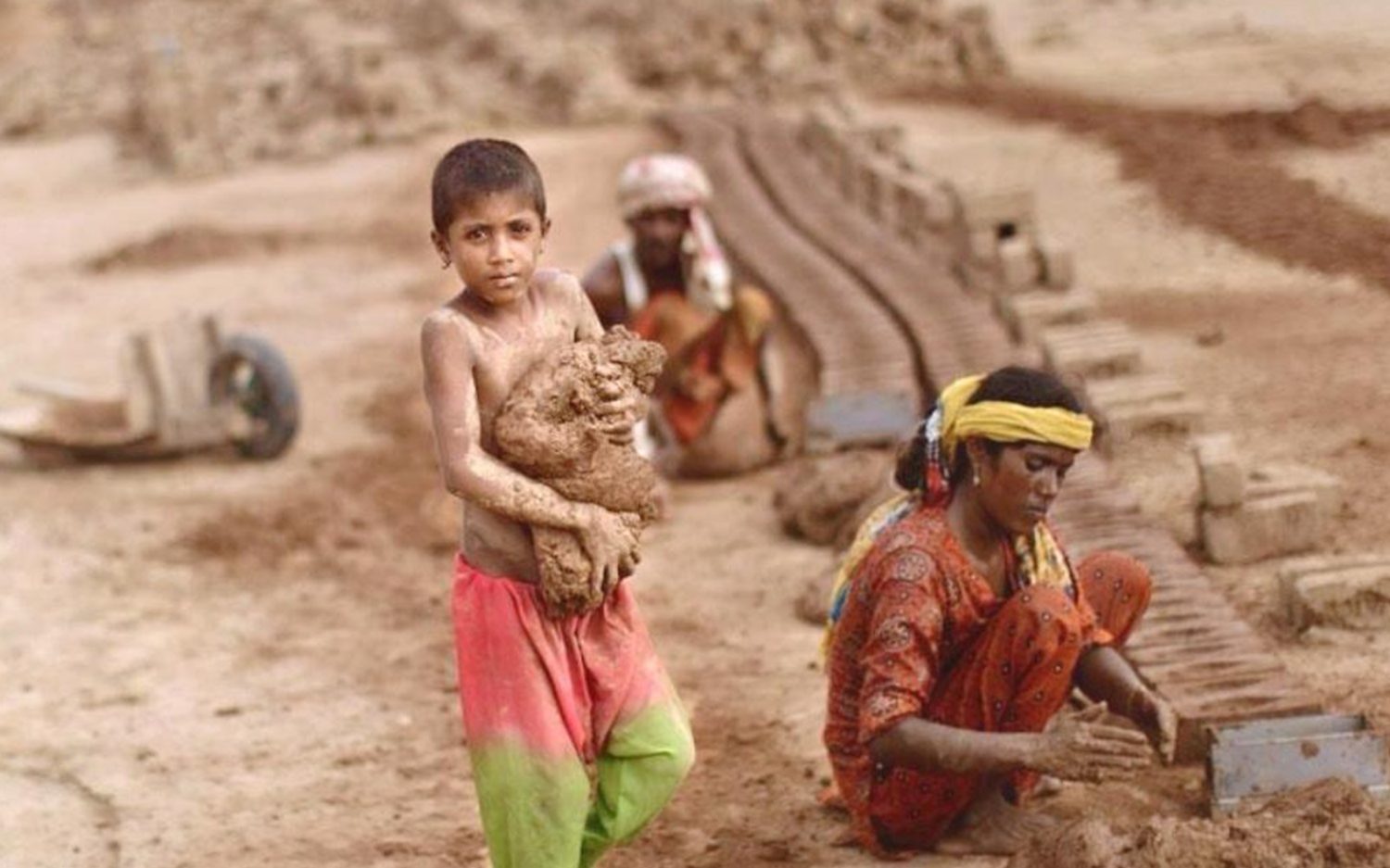
In 2011, Barkat Masih’s father took a $1,200 loan from one of Pakistan’s brick factory owners. Masih has been working for the past 15 years to pay off the debt. His father worked four decades before him.
Like others trapped in the brick kilns’ exploitative debt system, Masih told me through a translator that he works 10 to 14 hours each day without a break to eat. According to the brick kiln owner, Masih still owes $1,000.
Masih, a Christian, is one of the millions of laborers employed in Pakistan’s roughly 20,000 brick kilns, an industry stretching back centuries. Many of the laborers are Christians and Hindus, minorities forced into difficult, low-paying jobs amid systemic discrimination in the Muslim-majority country. Advocates are calling for more effort to help those trapped in the industry’s endless cycle, rife with stories of abuse and exploitation.
WORLD has changed the first names of the brick kiln workers quoted in this story out of concern for possible reprisal from kiln owners. The story includes their actual surnames, which are common among Pakistani Christians.
The brick kilns in Punjab province and throughout Pakistan “employ somewhere between 3.5 and 5 million people,” according to Anthony Williams, senior writer and researcher with persecution watchdog Barnabas Aid. “Although more than 95% of Pakistanis are Muslim, half of brick kilns’ laborers are drawn from religious minority groups, mainly Christians and Hindus.”
Most kiln workers get involved in the industry in a similar pattern. Families enter bondage when they take out a loan from the owner of a brick factory to pay for a daughter’s wedding, hospital expenses, crop failure, or other emergencies.
Since many low-income families are illiterate, they often sign contracts they cannot read. That traps them in bondage “from generation to generation,” said Solomon K., a Christian who has ministered in the brick kilns with his sister for nearly two decades, providing food and education. (WORLD withheld his full last name to protect his work with kiln laborers.) Some families have been in bonded labor for the past 70 or 80 years.
When a family meets their quota of 2,000 bricks, Williams said, they only receive about $5.75 per day, which cannot cover medicine “or even regular necessities such as food.” Nearly 70% of bonded laborers in the brick kilns are children under 16, a practice that violates Pakistan’s Employment of Children Act 1991. At least “23,642 under the age of 14 work in brick kilns in Punjab alone,” said Williams, referencing data from the Punjab Labour and Human Resource Department and adding that the actual number is likely higher.
During the winter and rainy season, kiln laborers are unable to work, so they take out more loans, keeping them even longer in an unending cycle of increasing debt. The average loan keeping a family in bondage is between $1,500 and $2,000, Solomon said.
Out of desperation, thousands of laborers go as far as selling their kidneys. They are taken to “private hospitals” operating out of houses and undergo risky procedures, then are still expected to return to work almost immediately. Even so, Solomon said, they do not receive the full amount owed. Freedom United, a group working to end modern slavery, said this illegal practice qualifies as human trafficking.
Solomon said the workers also face inhumane living conditions. “They do not have proper houses … just broken walls, no electricity, and the children have no education and no medicine,” he said. “Only work, work, work, and food.” Many people face herniation, illness due to lack of clean water, and breathing problems because of smoke and smog. If laborers try to escape, they are beaten and tortured, Solomon said.
Shoukat Masi has worked in the kilns for 40 years. His son is permanently hospitalized, and his daughter-in-law died due to pregnancy complications, leaving him to raise two grandchildren and pay his son’s medical expenses through the loan system. If he dies without paying off his debt, the burden will fall on his grandchildren, who are currently 8 and 10 but look younger due to malnutrition. The two children already work in the kiln. “I wish they could get a proper education … a place where they can grow up,” Masi told me through a translator.
In a 2025 report, the U.S. Department of State recognized the brick kiln industry as a form of trafficking. That same year, the U.K. Parliament debated reports of modern-day slavery in Pakistan’s brick kilns.
But advocates say the Pakistani government has still not sufficiently addressed the issue. “Changing the entire brick kiln system would require an unprecedented level of intervention from provincial and federal government, and a willingness from all stakeholders that doesn’t yet exist,” Williams said.
Shahzeb Ali, a lawyer for the Sindh Bar Council, admitted that although Pakistan “has an extensive framework to protect the rights of laborers … [they] are often exploited.” He said that because of extensive poverty, there are more laborers looking for work than there is demand for their services. While each of Pakistan’s four provinces has its own labor department, they do not “have enough capacity” to implement protective policies, he added.
Ali argued that laborers are exploited in brick kilns not because of their religious affiliation but because of their poverty status. “There is discrimination, but that is not to the extent as it is portrayed by Western media,” he said.
But advocates say systemic discrimination pushes Christians into low-paying jobs.
Since the partition of Pakistan and India in 1947, “Christians’ properties and Christians’ assets have been occupied by the Muslims,” Solomon said. According to Solomon, even if a Christian opens a food shop, Muslims in the community come and shut it down.
“Christians are a despised minority in Pakistan,” explained Williams. “[They] continue to be regarded as ‘chura,’ an offensive term that has come to mean ‘filthy.’”
“Sometimes they burn Christian people alive … in the furnace,” Solomon said.
In one notable case, an irate mob in 2014 burned alive Sajjad Maseeh and his pregnant wife in a brick furnace after accusations that they burned pages of the Quran. The owner of the brick factory prevented them from fleeing as the angry crowd grew.
Orphaned Christian girls are particularly at risk, as relatives often send them to the city to work for $45 to $55 per month as house cleaners, where they are vulnerable to sexual abuse and forced conversion to Islam, Solomon said. In order to avoid the legal consequences of a rape allegation, Muslim abductors forge marriage certificates and even fake documents claiming the girls are over 18, as in the case of 13-year-old Maria Shahbaz, whose situation was highlighted by the U.S. Commission on International Religious Freedom.
Ali insisted that “the illiterate, the poor do have many opportunities to seek free legal aid in Pakistan.” But according to Williams, “brick kiln [laborers] in general are not empowered to advocate for their own rights.”
Solomon said he has spoken to many pastors, but none has stood firmly to support those struggling in the industry. He called for more legal support from international organizations. “The international community … [needs to say], ‘We will stand with them, and we will raise our voice,’” he said.

Please wait while we load the latest comments...
Comments