
Your money’s no good here
Former U.S. Ambassador Sam Brownback’s religious-freedom organization lost its bank account. He and ADF attorney Caleb Dalton tell WORLD’s Mary Reichard how banks have used “reputational risk” to turn away customers—and what a new federal report reveals about the practice.
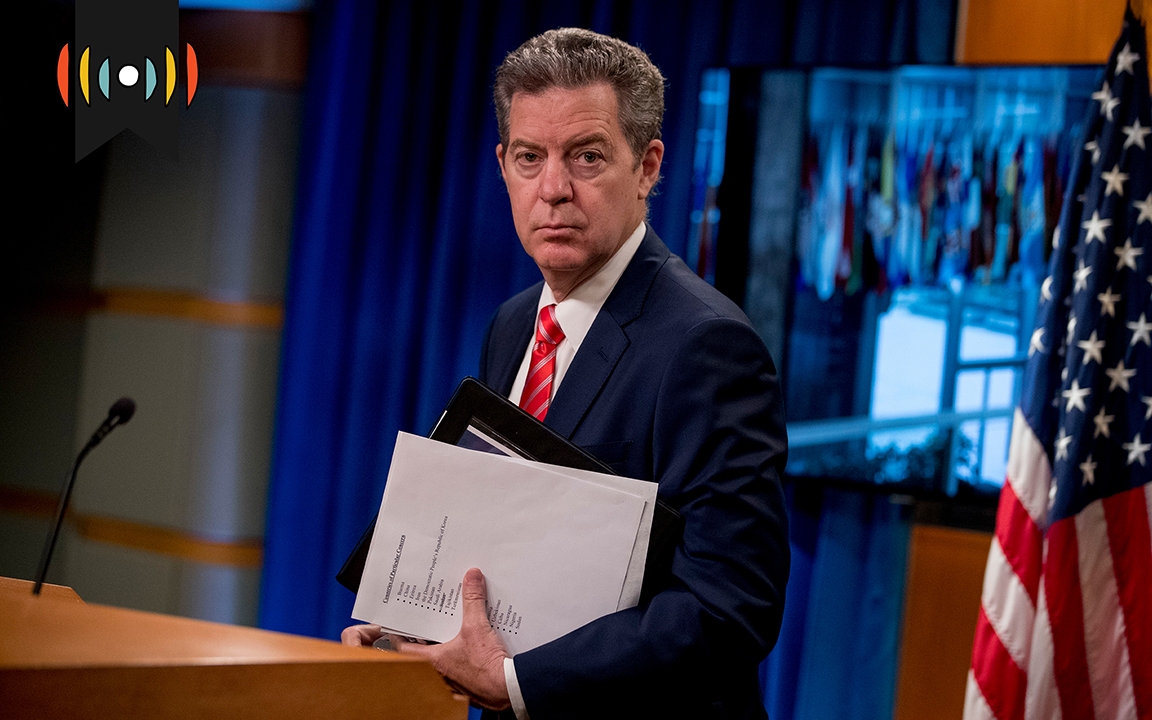
Sam Brownback, Ambassador at Large for International Religious Freedom Getty Images / Photo by Andrew Harnik / Pool / AFP
Editor's note: The following text is a transcript of a podcast story. To listen to the story, click on the arrow beneath the headline above.
MYRNA BROWN, HOST: Coming up next on The World and Everything in It: Debanking.
A report released last week by the Office of the Comptroller of the Currency lays out subjective policies of banks that contributed to unfair denials of their financial services.
MARY REICHARD, HOST: Two guests join us now to talk about it: Former U.S. Ambassador at Large for International Religious Freedom Sam Brownback. He is founder and chairman of the National Committee for Religious Freedom. His organization was debanked.
And Caleb Dalton is senior counsel with Alliance Defending Freedom, which represents clients who have experienced debanking.
REICHARD: Ambassador Brownback, for listeners who haven't heard the term before, what is debanking and what makes that different from a bank just closing an account for legitimate reasons?
SAM BROWNBACK: Debanking is where you become, you're a customer of a bank and they say we don't want you anymore, and they just cut you out for whatever reason they may cite. what was cited often in this case was reputational risk. I think it was a lot of just social engineering being done by various institutions to comply and go along with an administration that was pushing everything to the hard left, particularly culturally.
REICHARD: Well, let's get concrete about that. Ambassador, one case I see involved a conservative Christian nonprofit whose account was closed. Based on what if you know, and what does that example tell us about the vulnerability of religious organizations?
BROWNBACK: They took in the report and they took out the names and so they just were saying some examples of different things. But in our case, what it was is we were the National Committee for Religious Freedom. We were going to stand for religious freedom for everybody everywhere in the United States. We were gonna fight for it. But it was interpreted that these religious groups have a a orthodox view of cultural norms, I guess you would put it. These are people that go to Sunday school and they kind of try to live by this set of values. And they decided we don't like that because the culture is moving left, it's moving away from that, and therefore we want to kick them out. And when we went public with our case in 2022, I had over a dozen other groups pretty similar to us in a sense that they were culturally conservative groups. They say this had happened to them as well, but they had just gone silently 'cause they were afraid it would hurt their organization too much if they were public about it.
REICHARD: Now Caleb, you say this mostly affected right leaning organizations–why
CALEB DALTON: So the report documents I would say mostly what you would qualify as right leaning organizations. And one of the reasons why, if you dig into the details of the report, you see some banks were using the Southern Poverty Law Center as a as a proxy to decide who to debank. And as I think many of of your listeners may be aware, the Southern Poverty Law Center is a discredited left-wing organization that just smears their political opponents. But banks were using that as a proxy to decide who to kick out of their programs and who to discriminate against.
REICHARD: Ambassador, why should people across the political spectrum be concerned about this?
BROWNBACK: A bank should be about a being a financial institution and particularly these large too big to fail banks that get all this federal backing implicitly and sometimes explicitly, they should not be in the business of picking a societal favorite from a cultural standpoint, left or right.
REICHARD: Well, what about Islamists who want to have a bank account to fund terrorism on our own soil? Can you distinguish between what you're talking about in this report and that kind of thing?
BROWNBACK: Well, I sure could, because as governor I had two cases of militant Islamist who wanted to blow up buildings in the state of Kansas, and we prosecuted them to the full extent of the law and they're in jail now. And they're gonna be in jail for a long period of time. But as a governor, I stand and I celebrate faith of everybody's, peaceful faith. But you cannot use that in a terroristic fashion. But we have freedom of religion in Kansas and the state of Kansas will protect that for everybody, but we're not gonna protect anybody that goes to blow up buildings.
REICHARD: So Caleb, what recourse would someone have today if a bank did close an account without a meaningful explanation?
DALTON: The OCC actually set up a website you can go to called helpwithmybank.gov. And if you've experienced some this you should go there and and let the OCC know and let the government know so they can investigate.
REICHARD: I’m curious if there is there anything else authorities can do to make this right?
BROWNBACK: Push for the statutory change in your state. those are doable. Federal legislation is really hard to come by anymore, but it should happen. But a number of states could really push these fair access bills like what Tennessee pioneered and several other states have done. And I, I hope a number of states really pick those bills up and move and make into law.
REICHARD: Excellent. Ambassador Brownback and Caleb Dalton with ADF, thank you so much for your time. Appreciate it.
BROWNBACK: Thank you.
DALTON: Thanks for having us.
WORLD Radio transcripts are created on a rush deadline. This text may not be in its final form and may be updated or revised in the future. Accuracy and availability may vary. The authoritative record of WORLD Radio programming is the audio record.
Please wait while we load the latest comments...
Comments
Please register, subscribe, or log in to comment on this article.