
WORLD Tour: The winner stays out
After the AfD wins nearly 44 percent in Saxony-Anhalt, the longstanding political firewall may still keep it from governing. WORLD’s Jenny Lind Schmitt reports on the uneasy coalitions that barrier creates—and the next tests coming Sunday.
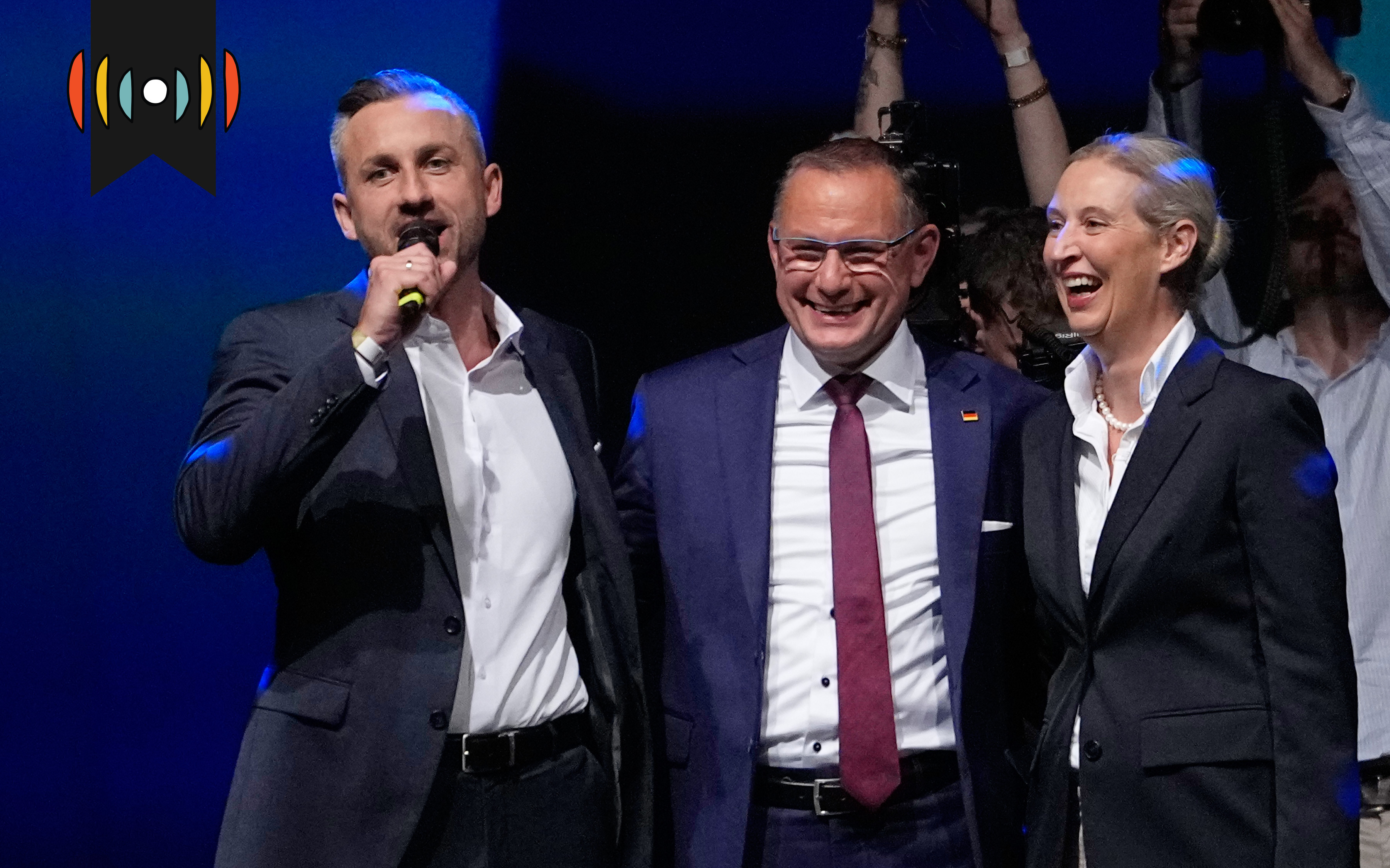
Top candidate Ulrich Siegmund, left, stands with party leaders Tino Chrupalla and Alice Weidel at an election party of the AfD after the Saxony-Anhalt state elections in eastern Germany, Sept. 6. Associated Press / Photo by Matthias Schrader
Editor's note: The following text is a transcript of a podcast story. To listen to the story, click on the arrow beneath the headline above.
LINDSAY MAST, HOST: Coming up next on The World and Everything in It: World Tour.
Local elections this weekend in Germany will help show whether voters there are swinging further to the right, and test a post-War political firewall.
NICK EICHER, HOST: That’s a legal mechanism keeping political parties on the fringes from ever gaining control again.
WORLD’s Global Desk Chief Jenny Lind Schmitt has this report.
JENNY LIND SCHMITT: For over three quarters of a century, there has been one overarching rule in German politics: Die Brandmauer. The Firewall.
After World War II, mainstream political parties made a pact to exclude subsequent hard right parties from being part of any coalition government. They wanted to keep the successors of the Nazis from ever regaining power.
That idea has continued to be applied to current parties on the far left and the far right. Phillip Turle of France 24 explains:
TURLE: The mainstream parties come together quite often to keep these far-right parties or far-left parties out of power. And therefore, even though those parties have different political views, uh different political standings, they may not agree with each other on policies that need to be taken, uh they will come together to keep uh the far-out parties out of office.
But last week voters in a regional election in Saxony-Anhalt shocked the country. The controversial AfD–Alternative for Germany–party got 44% of the vote. Not an absolute majority, but a big upset.
People in Berlin took to the streets in protest.
SOUND: Protest
The AfD is considered far-right. It has called for stricter borders, distance from the EU, remigration of undocumented migrants, a traditional definition of marriage, and a better relationship with Russia. Its position on the incompatibility of Islam with German culture resulted in the opposition labeling it far-right.
Last week’s results suggest those platforms resonate with more people than expected. Here’s Ulrich Siegmund, the leading AfD candidate in Saxony-Anhalt speaking on German television after the vote.
SIEGMUND: (Speaking in German)
He says, this is a very clear mandate. It could hardly be clearer. This is the best election result in Saxony-Anhalt since 19-90.
But other Germans see the Saxony-Anhalt vote as a referendum on Chancellor Friedrich Merz.
ROUGH: The governing parties are rather unpopular.
That’s Peter Rough of the Hudson Institute.
ROUGH: Chancellor Merz himself is the most unpopular chancellor in the modern German history. His personal approval ratings are in the teens. And Germany is struggling against a wave of deindustrialization. The establishment has really taken it on the chin.
Regardless of the reasons for the result, forming a state government led by AfD will be a challenge.
ROUGH: The German conservatives have made clear that they will not govern with the populist AFD. They view them as a threat for historical reasons. And so that forces them into coalitions with ideological left-leaning or left-wing parties, which... creates really an incoherence.
One way forward for the AfD to govern in Saxony-Anhalt would be to work with the left-wing BSW party. The two groups share views on restricting immigration and working with Russia, but not much else. That’s a recipe for political stalemate and further voter frustration.
For decades, the establishment meant coalitions across “Die Mitte”: The Middle: between the two mainstream parties–center left and center right. But with a stagnant economy, many Germans seem ready to change the status quo.
Volker Resing is a German journalist and political analyst.
RESING: (German) Saxony-Anhalt, there was a landslide victory for the AfD, the Alternative for Germany. In fact, the party’s lead candidate, Siegmund, created a positive atmosphere in the state—one that differed from the AfD’s usual approach—and that resonated with voters. He won over non-voters in particular. Forty percent of AfD voters did not vote five years ago.
He says the AfD succeeded in Saxony-Anhalt largely because Ulrich Siegmund was able to mobilize non-voters. Forty percent of voters in this election did not vote in the last one five years ago.
The AfD has been growing steadily stronger over the last decade, and many in Merz’s CDU party think it’s time for him to open discussions with them.
RESING: (German) If Friedrich Merz were to start talking to the AfD, cooperating with it, and, for example, ousting the SPD from the government—it would lead to massive divisions, if not a split within the CDU.
But Resing says that could lead to massive divisions or potentially, a split in the CDU. Risky, given upcoming state elections in Berlin and Mecklenburg-Vorpommern.
ROUGH: In both states, the AFD is scheduled to do well. Right now, the opinion polls still have the CDU just hanging on by a very thin slice to the first place in Berlin. But if those two elections go very poorly for the CDU, then we'll see, what are already grumblings in the CDU, only pick up heading into 2027.
Those elections are scheduled for Sunday. That’s this week’s WORLD Tour, I’m Jenny Lind Schmitt.
WORLD Radio transcripts are created on a rush deadline. This text may not be in its final form and may be updated or revised in the future. Accuracy and availability may vary. The authoritative record of WORLD Radio programming is the audio record.
Please wait while we load the latest comments...
Comments
Please register, subscribe, or log in to comment on this article.