
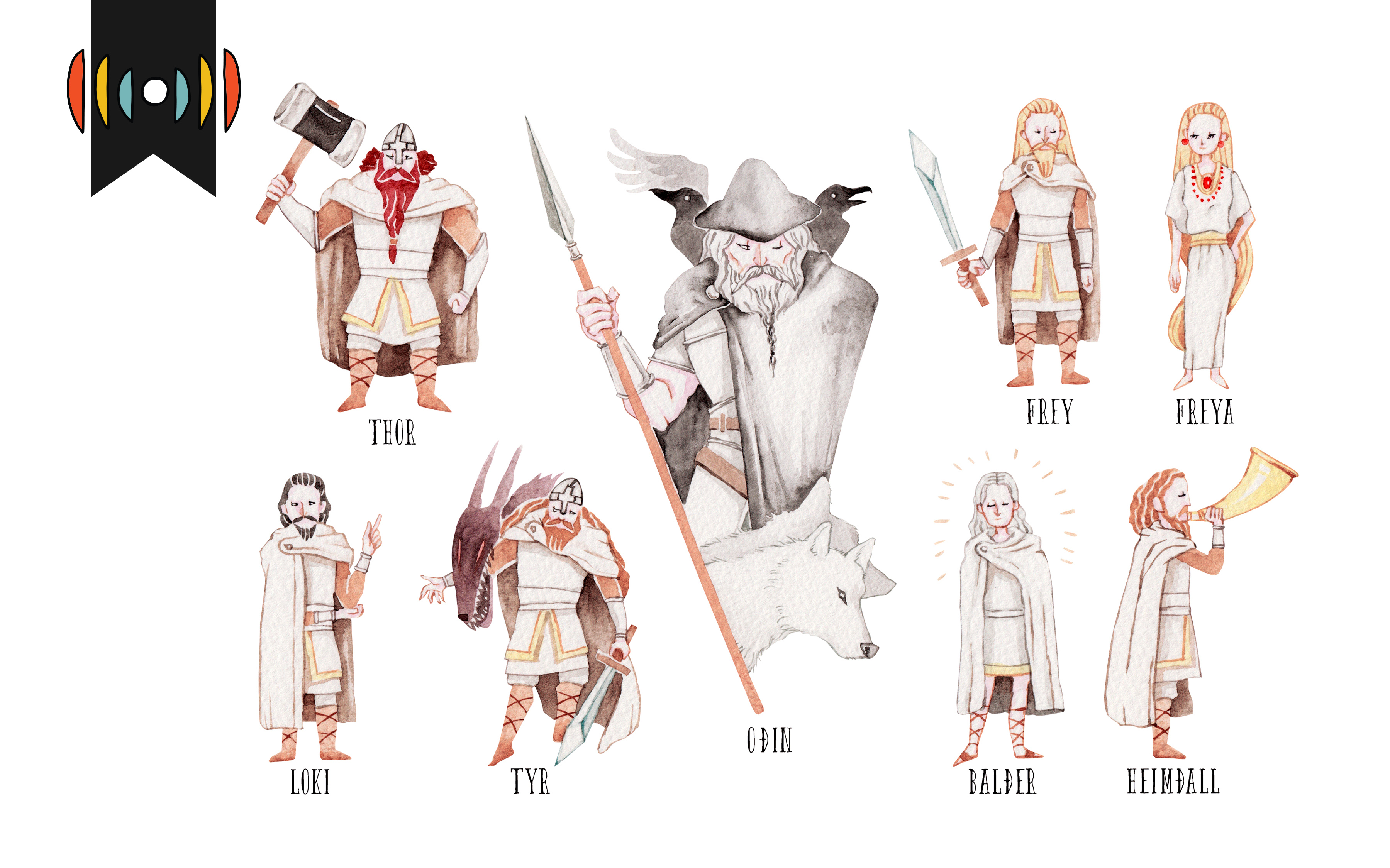
Gods of norse mythology tada / iStock / Getty Images Plus via Getty Images
Editor's note: The following text is a transcript of a podcast story. To listen to the story, click on the arrow beneath the headline above.
MYRNA BROWN, HOST: Good morning! This is The World and Everything in It from listener-supported WORLD Radio.
I’m Myrna Brown.
NICK EICHER, HOST: And I’m Nick Eicher.
Producer Lindsay Mast is here now with a quick note about our next WORLD Journalism Institute course.
LINDSAY MAST: Our next Mid-Career Course is at the end of February—but we’re talking about it now, because applications are still open, the deadline is just weeks away, and this fills up fast.
Mid-Career runs from February 28th to March 6th. It’s for writers, journalists, and wanna-be journalists in their mid-30’s and up. As far as experience, we usually have a range of experience in the class from true novices to some with a lot more experience. The course is built for that range.
Myrna, you came to the course with a long career in journalism.
BROWN: I did. Thirty years in TV before I attended WJI Mid-Career in 2018. It was a wonderful chance to sharpen my skills and learn to report from a Biblical worldview. And I’m here!
EICHER: Good for us!!
MAST: And it’s also a way to explore a new calling or return to work after raising a family. I attended in 2023 after thinking I’d left journalism behind. It was a challenging, exhilarating week, and my favorite teacher was Nick Eicher. I made great friends and wound up back in journalism.
EICHER: And the price is right, you just have to trade a week of your time and cover your transportation. But WORLD donors get the rest. Successful admission means you’ve locked in a scholarship that covers most meals, plus housing and tuition. And the goal is for students to have a chance to publish something with WORLD.
MAST: All journalists work on deadline so here’s your first one: Applications are due on Monday, November 2. That’s just over three weeks and it’s a lengthy application so get started! Visit wji.world and look for the blue Mid-career information icon to submit your application. Again, that’s wji.world.
EICHER: Time now for Wordplay for October. Here is our resident logophile George Grant.
GEORGE GRANT: In linguistics calquing is the technical name for the process of creating loan words–words that are translated or transliterated and then borrowed from another tongue to fill a gap in the vocabulary necessary to describe emerging ideas, circumstances, or objects. An example of calquing is the long and winding linguistic road that gave us names for the days of the week.
I learned in elementary school that these names came from the Romans who dubbed the days using Latin terms for the Sun, the Moon, and the five known planetary spheres. But it is a little more complicated than that—involving a great deal of calquing.
Sometime during the second century AD, the Roman Empire began replacing the old Republic’s eight-day Nundinal calendar with the Hellenistic Hebdomas calendar. The Greeks had borrowed the system from the Babylonian Magi who linked the seven days to the seven visible astronomical luminaries. The days of the week were thus named for the Hellenistic mythological pantheon: Helios, Selene, Ares, Hermes, Zeus, Aphrodite, and Cronos.
The Romans then calqued each of those names. Thus, the first day of the week became Dies Solis or Sol’s Day, named for the Roman sun god. The second day became Dies Lunae, named for Luna the moon goddess. The third day was dubbed Dies Martis, for Mars the god of war. The fourth day was called Dies Mercurii, named for Mercury the messenger of the gods. The fifth day became Dies Jovis or Jove’s Day to honor Jupiter, the god of sky and thunder. The sixth day was Dies Veneris or Venus’ Day, for the goddess of love. And the seventh day was called Dies Saturni, named for Saturn, the god of agriculture.
When barbarian tribes like the Franks, Danes, Normans, Angles, and Saxons swept down from the steppes of the Caucuses and the fjords of Scandinavia, they migrated to northern and eastern Europe and adopted the seven-day week. But predictably, they too calqued the names, replacing the Roman gods with deities in their own mythic pantheon who had similar traits.
Thus, the first day of the week was named Sunnandæg, Anglo Saxon for the Day of the Sun, or Sunday. The second day was named Monandaeg, Anglo Saxon for the Moon Day, or Monday. Tuesday came from Týr, the Norse god of war. Wednesday was named after Woden, the chief of the Danish pantheon. Thursday came from Thor, the mythic god of thunder. Friday was named for Freya, the goddess of love. Because these nomadic peoples had no god of agriculture in their own mythology, Dies Saturni merely morphed to Saeterndaeg, or Saturday.
Layer upon layer of calquing, makes the task of tracking down the etymological snippets, scraps, and snatches of our everyday vocabulary something of a scavenger hunt. Perhaps that is why the Language Learning Institute has called English the “archetypal magpie language.” Just like the unkempt nests of its black and white aviary counterpart, English is a bit of a ragtag jumble of words that are begged, borrowed, stolen, and calqued from a myriad of arcane sources.
I’m George Grant.
WORLD Radio transcripts are created on a rush deadline. This text may not be in its final form and may be updated or revised in the future. Accuracy and availability may vary. The authoritative record of WORLD Radio programming is the audio record.
Please wait while we load the latest comments...
Comments
Please register, subscribe, or log in to comment on this article.