
Word of mouth
Translators working on the Spoken English Bible study the original languages, then tell the stories aloud without writing down a word of their translation. WORLD’s Todd Vician meets the team trying to bring Scripture to those who learn best by listening.
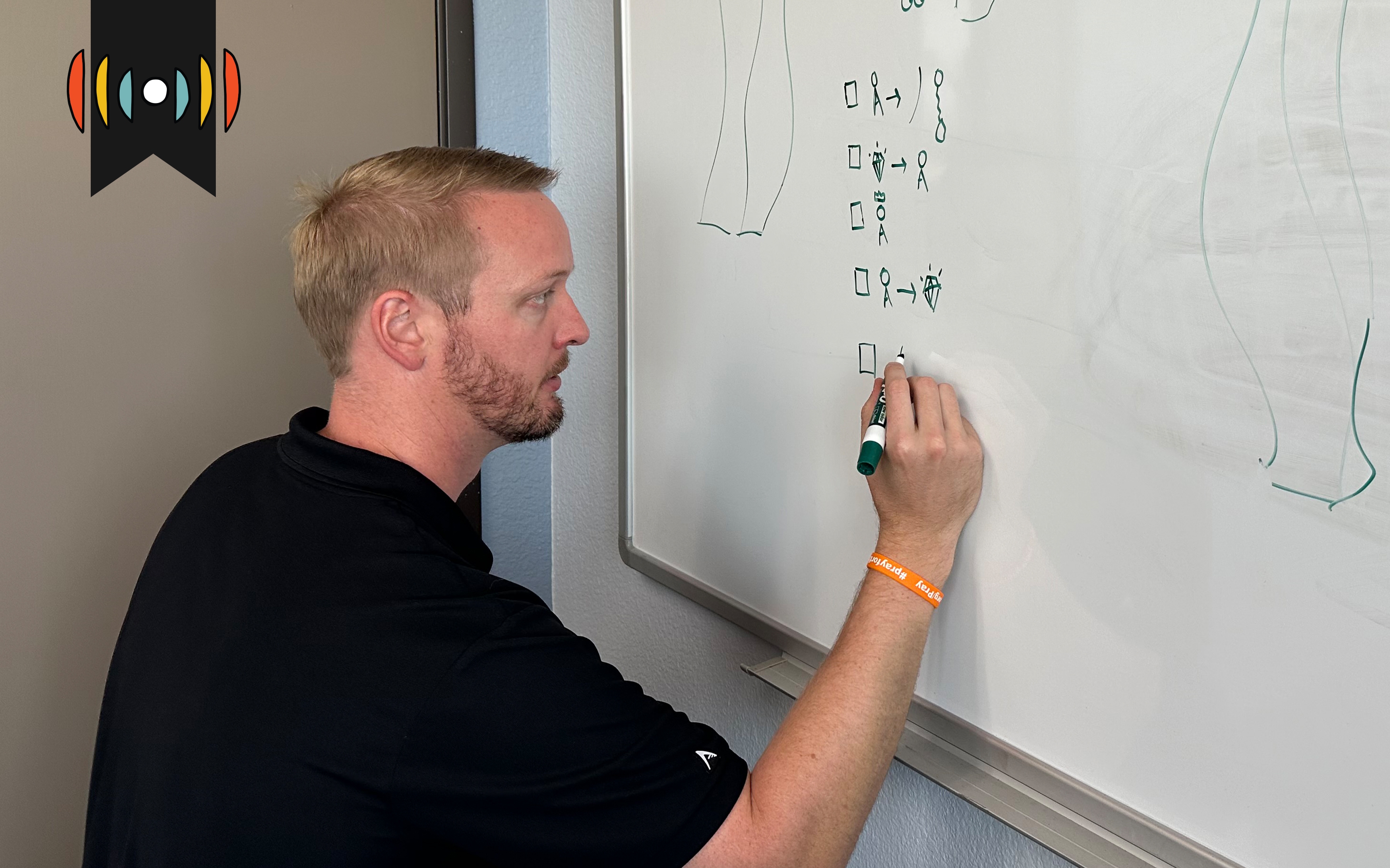
A translator storyboards a Scripture passage on a whiteboard. Photo by Todd Vician
Editor's note: The following text is a transcript of a podcast story. To listen to the story, click on the arrow beneath the headline above.
LINDSAY MAST, HOST: Today is Wednesday, October 28th.
Thanks for joining us.
Good morning. I’m Lindsay Mast.
NICK EICHER, HOST: And I’m Nick Eicher.
Coming next on The World and Everything in It: translating the Bible without writing it down.
Most translations begin with a written text. This one begins with people speaking from memory.
MAST: The translators work directly from the original languages, studying the text carefully before developing a version meant to be heard, rather than read.
WORLD’s Todd Vician has the story.
PARKER: ...Vayalech…Yahweh.
TODD VICIAN: Rett Parker is reciting from the twelfth chapter of Genesis…painstakingly translating the first book of the Pentateuch into the Spoken English Bible. It’s an oral version told from memory after diligent study–not an audio version of an existing Bible translation. This one is spoken, but not read.
HUSBAND: An audio Bible is designed for the eyes and then performed for the ears, whereas an oral translation is from the beginning designed to be performed for the ears.
That’s Mark Husband—an ordained pastor with a master’s degree in linguistics. He’s spent the last four years working with two other theologians to translate the Spoken English Bible through SIL Global. They’re working to serve approximately two-thirds of the world’s population who learn best by listening, watching videos, or talking.
HUSBAND: One of the beautiful things about oral Bible translation is that when you’re hearing it orally it’s a lot easier to listen to for a long longer because the mental processing is so much lighter.
Today the translators are working on the Genesis passage where the Lord directs Abram to take his family and possessions from Canaan to Egypt. God said he would bless Abram and curse those who dishonored him. The translators’ first task is to focus on the intended meaning of the Hebrew Scripture, so they don’t inadvertently force new ideas into the translation.
HUSBAND: Our translation cannot be better than our exegesis was.
Another distinction: the Spoken English Bible is not a paraphrase. The process is the same used for written translations. But it adds a step called internalization. That’s more than memorization. The translators want to be able to explain what happened, who the characters were, and even maintain the original tone while staying true to the ancient text. Parker and Husband spent nearly 40 minutes discussing the meaning and translation for just two words—“bless” and “blessing.”
PARKER: We want the only stumbling block to the gospel to be the gospel. If they’re going to reject God’s Word, we want it to be because they understood it and chose to say ‘no’ to it.
Joy has been working on the oral Bible project since 2023. She goes by a pseudonym to protect her identity when translating in countries that persecute Christians. Joy says internalization is like that story everyone in your family knows, they may tell it a little differently, but the core details always remain the same.
JOY: Once you get to that level of familiarity with a passage of Scripture then you can come up with lots of different ways to communicate the same truths.
Today, the three translators are storyboarding the passage—drawing on a whiteboard and even the conference room windows.
HUSBAND: He’s going to leave all of his people... so I’ve got these little stick figures and like a family tree. The Lord gives him a list of seven things that he’s going to bless Abram with, so I’ve got seven little checkboxes.
They’ve drawn lots of figures around the room. But not a single word.
JOY: We don't write anything down. It's all an audio file. Because the moment you start writing, you lose some of that naturalness in the storytelling.
The Spoken English Bible team is trying to reach more oral learners and the 10% of American adults who say they’ve never read the Bible. But Christian concepts like sin and blessing can be difficult to understand. So before they finalize the translation they run it by people wholly unfamiliar with the Bible. It’s here they sometimes discover translation hiccups.
JOY: We asked someone whether committing genocide could be a sin. And the person said no, because genocide is too serious to be a sin…
That showed them an obstacle to understanding when a single word can’t express several thoughts. So the oral translators come up with ways to draw out information implicit in the text. Instead of sin, they’ve used words like, “failing God,” “evil,” and “needing to be forgiven.”
JOY: If the English word sin was not communicating the full extent of what that concept communicates, then it means that when the translation says Jesus came to save you from your sin, people are misunderstanding the gospel.
Parker recorded the first draft of Genesis 12 near the end of the second day. Husband followed along, scanning the pictures he had drawn on the white board.
PARKER: But when Yahweh appeared to Abram, he told him, "I'm going to give this land to your descendants." When Abram heard that, he was so moved that Yahweh had appeared to him that he built an altar and dedicated it to Yahweh.
The draft that Parker recorded will be peer reviewed, revised, community tested, and checked by a consultant before it’s completed. It can take several months to complete each book. So far, they’ve finished six books and released them in the Spoken English Bible app.
Their latest challenge has been funding after a grant ran out. For now, they’re balancing translation with finding supporters so they can continue their mission to help people hear–and understand–the word of God.
Reporting for WORLD, I’m Todd Vician, in Dallas, Texas.
WORLD Radio transcripts are created on a rush deadline. This text may not be in its final form and may be updated or revised in the future. Accuracy and availability may vary. The authoritative record of WORLD Radio programming is the audio record.
Please wait while we load the latest comments...
Comments
Please register, subscribe, or log in to comment on this article.