
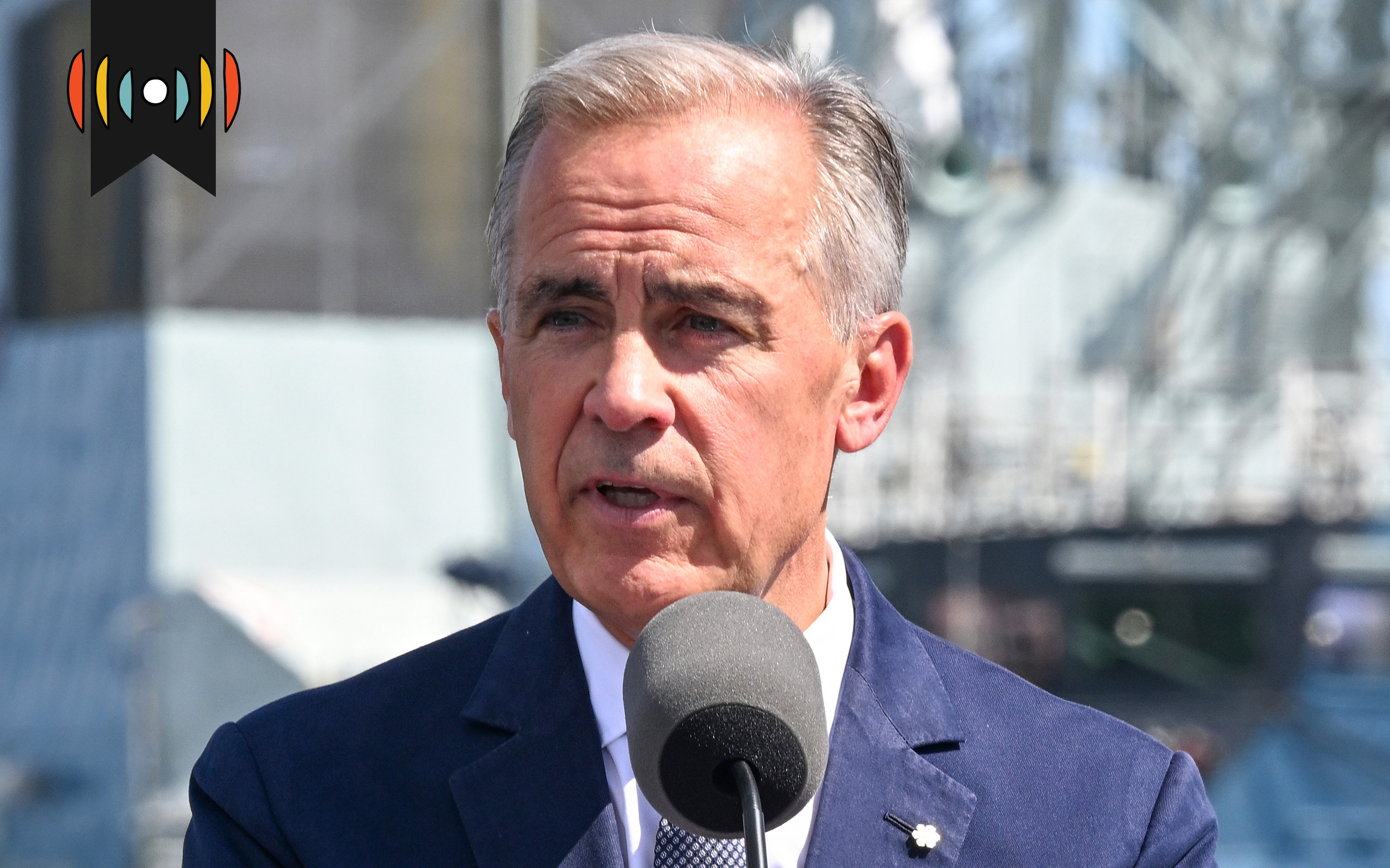
Canadian Prime Minister Mark Carney speaks at the Davie shipyard in Levis, Quebec on Monday. Associated Press / Jacques Boissinot / The Canadian Press
Editor's note: The following text is a transcript of a podcast story. To listen to the story, click on the arrow beneath the headline above.
NICK EICHER, HOST: It’s Tuesday the 25th of August.
Glad to have you along for today’s edition of The World and Everything in It. Good morning, I’m Nick Eicher.
MARY REICHARD, HOST: And I’m Mary Reichard.
First up: the trade war with Canada.
President Trump is threatening 50 percent tariffs on Canadian cars, trucks, and auto parts. Canada plans to answer with tariffs of its own next month. Both governments say the other side walked away from a nearly finished deal.
U.S. Trade Representative Jamieson Greer:
JAMIESON GREER: We had found a way to a deal, and then we set about to finalize it, and then in the last hours, I think there were things that the Canadians just, you know, they wanted more.
EICHER: Joining us now, Stockwell Day, a former leader of Canada’s opposition and former minister of international trade. He’s now a political consultant and commentator.
REICHARD: Stockwell, good morning.
STOCKWELL DAY: Good morning, good to be with you.
REICHARD: Well, last we spoke after Prime Minister Justin Trudeau resigned and Mark Carney took the reins. You said Carney was enjoying positive polling because he campaigned on countering President Trump. Now we are one year later. How's that working out for him?
DAY: For him, it's really working out well, that's a great question, and it's probably stronger or higher than ever. And just to assure my American friends, this sometimes resentment, feeling resentment against Americans, this goes way back in Canadian history, way, way back before we even a country. It always has to do with economic interests. And of course, there was a concern at one time way back in the mid 1800s that the soon to be U.S. was going to annex what was soon to be Canada. So these are historic frictions. And I would say they are at record high right now because there's a lot of personal feeling against President Trump in a personal way. Add to that the sort of historic opposition to U.S. trade that's built into our DNA, those add up now to the fact that gives Prime Minister Carney high approval ratings. As a former minister of international trade, I don't think he's dealing with this 100% correctly, but certainly he's got the broad support of Canadians.
REICHARD: Well given all that, Canada says the latest U.S. demands are just unfair. Washington says Canada just moved the goalposts. So from what you can tell, who walked away from a workable agreement?
DAY: Well, sifting through those tea leaves is really difficult. And, you know, I think on both sides, there are accusations that could fairly land. The concern when Prime Minister Carney did the press interviews right following the, you know, the final walk away, he broadly said this is because the U.S. wanted to restrict trade between Canada and other countries.
And what's emerging now, and it's what I thought and what I was talking about over a week ago, the fact that Canada has, in my view, unfortunately, overly pursued a closer relationship with China, that has not helped. And as a backdrop, as an underlay, does not help negotiations with the U.S. When you look at the fact that China is, you know, sponsoring and helping Russia kill Ukrainians, China has always been soft on and allied to a degree with Iran.
And then you have the prime minister trying to get Canada to snuggle up closer to China. That's not good ground on which to try and plant the seeds of a good trade relationship. So that's specifically what the U.S. was referring to, was what they call trans shipments, where goods could come in other ways than directly say from China into the U.S. They suspect Canada could be involved in that. I think Canada frankly has a bit of a weak spot there in terms of pursuing China so closely. And if it's with other nations, then Prime Minister would be right to say there's no blanket prohibition, there shouldn't be a blanket prohibition on Canada with other nations, but the accusation related to China probably has some merit.
REICHARD: Mm-hmm. So is there some path that you can see back to the negotiating table before September eighth, given all that?
DAY: Well, I think there is. What you have to do, and what I found out as a minister of international trade using the WTO, the World Trade Organization, with any country you can find some specific areas that you can minimize the harm. And I think Canada's got to be doing that aggressively. And I think Prime Minister Carney will be thinking that might look like a sign of weakness on his part, but it's not. He has said that by September 8th, retaliatory tariffs are going to be in place, which is just another reason why I and most economic students of economies, we are opposed to tariffs generally. Tariffs do not make for good economic policy, but we're stuck with them. But we should be aggressively pursuing on a case-by-case basis some better carve-outs for Canada. I think we've got a case to make with some of the governors along the Northern border. I have found that at different times in negotiations with the U.S. There are governors whose states are going to be hurt more and maybe say some of the southern states. So we should be pursuing that. And this has to do with the U.S., but I am joining our leader of the Canadian opposition saying we've got to call Parliament back into session so that the people of Canada can really see specifically what were the major irritants, where can we carve out some things that will help Canadians. I'm concerned about on September the 8th Canada coming back, which is blanket reciprocal tariffs. It's just going to mean more Canadians getting hurt.
REICHARD: Stockwell Day is a former member of the Canadian Parliament and now a political commentator. Stockwell, thank you so much.
DAY: Thanks for your interest. Appreciate it.
WORLD Radio transcripts are created on a rush deadline. This text may not be in its final form and may be updated or revised in the future. Accuracy and availability may vary. The authoritative record of WORLD Radio programming is the audio record.
Please wait while we load the latest comments...
Comments
Please register, subscribe, or log in to comment on this article.