
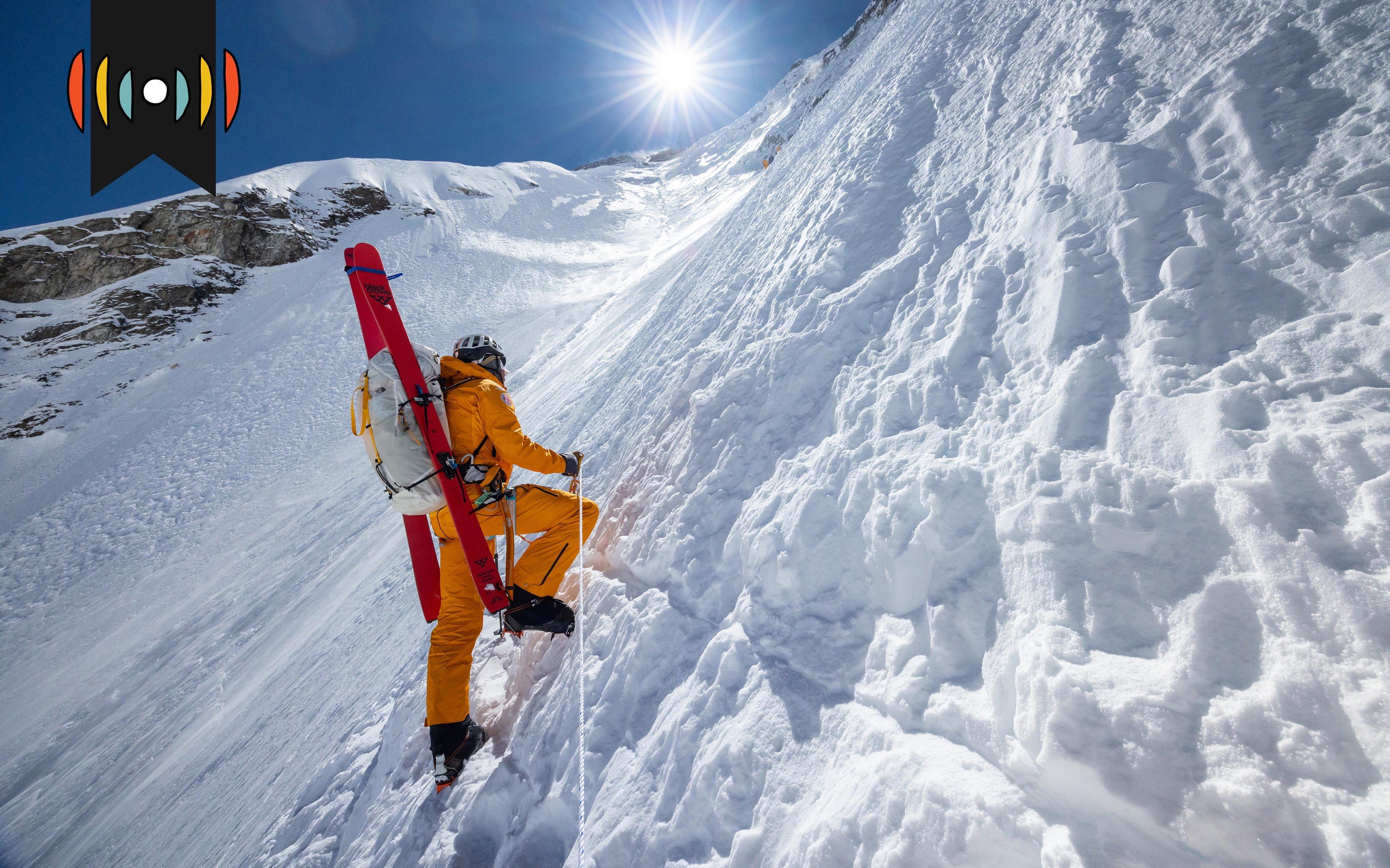
Jim Morrison climbs Mount Everest in a scene from Everest: The Other Side. Associated Press / Jimmy Chin / National Geographic
Editor's note: The following text is a transcript of a podcast story. To listen to the story, click on the arrow beneath the headline above.
MYRNA BROWN, HOST: Today is Friday, October 30th.
Thank you for turning to WORLD Radio to help start your day.
Good morning. I’m Myrna Brown.
NICK EICHER, HOST: And I’m Nick Eicher.
Coming next on The World and Everything in It: A new National Geographic documentary follows a daring attempt to ski the north face of Mt. Everest.
The documentary hits IMAX screens this weekend. WORLD’s arts and culture editor Collin Garbarino has our review.
COLLIN GARBARINO: Everest: The Other Side recounts the story of how in October of last year, mountaineer Jim Morrison completed one of the most daring ski expeditions in history.
MORRISON: The north face of Mount Everest. It’s the ultimate ski run on planet Earth.
Thousands of people have climbed Everest over the last 73 years, but most approach the summit from the south side of the mountain in Nepal. Only a handful of climbers have braved the punishing direct route on the Chinese side where the weather is worse and the climbing more difficult. Morrison’s plan was to take that more difficult path to Everest’s summit. And then ski back down over 9,000 feet of treacherous terrain that contains sustained slopes of 50 degrees.
MORRISON: From a really young age, I was dreaming about going to these mountains. It always involved climbing big mountains, and it always involved skiing back down.
In this documentary, we see Morrison attempt to make those dreams a reality.
Everest: The Other Side is a visually stunning movie that doesn’t shy away from the peril of the mountain as it captures its beauty. Director Jimmy Chin accompanies Morrison on this expedition, becoming a secondary subject in the film. Chin’s previous work includes the Academy Award–winning documentary Free Solo.
I saw Everest on an IMAX screen. It has the kind of shots that deserve the big screen treatment. The mountain’s landscapes feel otherworldly, and the high altitude images capture pristine icy expanses that give the impression they ought not be touched.
MORRISON: Everest is usually climbed when there’s the least amount of snow in the spring. To ski it, we have to go after the monsoon in the fall. More snow means more danger.
The film is rated PG-13 for brief strong language and “thematic elements.” As to what those thematic elements are, I have to in good conscience spoil some of Morrison’s story for the sake of some viewers.
The documentary begins in 2018, when Morrison and his girlfriend Hilaree Nelson skied down the fourth tallest mountain in the world. During the COVID lockdowns they start planning their next big adventure of skiing down Everest’s north face. In the beginning, the film focuses on Nelson’s story. She’s the mother of a couple of young boys, but she’s captivated by her mountaineering lifestyle.
NELSON: It’s all about survival, and in that rawness there’s this—I don’t know—connection that I don’t feel anywhere else.
About thirty minutes into the film, Morrison and Nelson are skiing down a different peak in Nepal as part of their training for Everest, and a sudden avalanche sweeps Nelson away to her death. It’s a shocking moment, and it’s captured on film and included in the documentary.
Though he’s devastated, Morrison decides not to give up on their shared dream and ski Everest in honor of Nelson.
At this point, a sort of cognitive dissonance enters the audience’s mind as they watch. Sure, these feats of mountaineering are impressive. But are they worth it?
Chin’s wife serves as co-director for the documentary, and she voices her own concerns over the climbing mentality that she and her husband have been steeped in.
VASARHELYI: How many people who’ve eaten at our dinner table have died?
CHIN: Hmmm… that might take a while.
The couple counts at least a half dozen names before they quit. Chin’s wife is visibly uncomfortable with his decision to accompany Morrison up the north face, saying she had thought her husband was done with Everest.
At what point do the risks become too risky? When do the costs become too high? Everyone we meet in this movie has sacrificed for their life on the mountain. Some have broken bones and sustained serious injury. Some have sacrificed their marriages in order to top the next summit. They’ve all lost family and friends in avalanches. Morrison’s No. 1 Nepalese guide even died a few months ago on a mountain in Pakistan after the documentary was finished.
CHIN: Was there a part of this that was supposed to be fun?
MORRISON: It’s the part when you get down and tell the stories.
CHIN: Oh.
MORRISON: Kind of like, it was so awesome, the views were so beautiful.
CHIN: Oh right.
MORRISON: And so hard.
I think documentaries about people testing their limits in extreme situations are valuable. They can challenge and inspire us. Earlier this year, I saw Learning To Fly, which is currently streaming on Prime Video. In that movie, trail runners attempt to set records as they race over 100 miles through the mountains. I liked that movie a lot. Any extreme endeavor requires sacrifices and tradeoffs. But the incredible risks we see people take in Everest: The Other Side cross the line into recklessness. And to be honest, they feel quite selfish. I wasn’t inspired at the end. If anything I was a little sad.
However, I think Everest: The Other Side is worth seeing. It reminds us how desperately some people in this lost world want to feel something. And how much they’re willing to trade for fleeting glory.
I’m Collin Garbarino.
WORLD Radio transcripts are created on a rush deadline. This text may not be in its final form and may be updated or revised in the future. Accuracy and availability may vary. The authoritative record of WORLD Radio programming is the audio record.
Please wait while we load the latest comments...
Comments
Please register, subscribe, or log in to comment on this article.