
Washington Wednesday: A wave forming?
Five congressional races put the midterm map to the test, as Hunter Baker says the polls can’t be trusted the way they once were. Also: whether to keep bargaining as Iran loses leverage, and who controls money Congress has already appropriated.
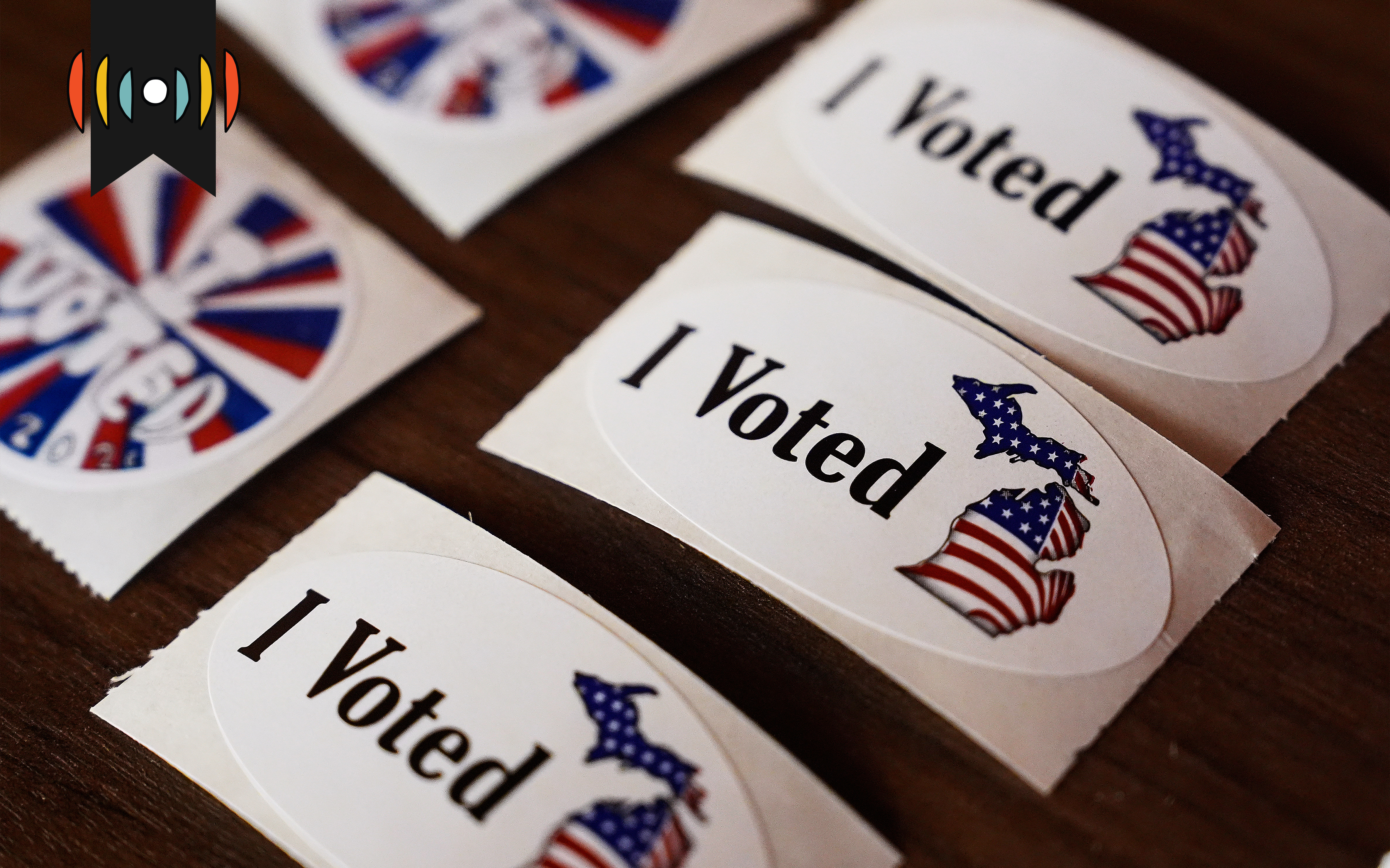
Stickers on primary election day in Birmingham, Mich., Aug. 4 Associated Press / Photo by Paul Sancya
Editor's note: The following text is a transcript of a podcast story. To listen to the story, click on the arrow beneath the headline above.
NICK EICHER, HOST: It’s Wednesday, September 30.
This is The World and Everything in It from World Radio, celebrating 15 years.
Good morning. I’m Nick Eicher.
LINDSAY MAST, HOST: And I’m Lindsay Mast.
Time now for Washington Wednesday. Back with us is political scientist and senior fellow at the First Liberty Institute, Hunter Baker.
Hunter, good morning.
HUNTER BAKER: Good morning.
EICHER: Well, issue one, Hunter. Five races to watch. Five weeks now before Election Day. Let’s dig into the congressional map. Our old friend Henry Olson of the Ethics and Public Policy Center writes in the Washington Post. He’s picked five races that he thinks can tell us what kind of election we’re having. So, two Senate races, three House races. In the Senate, it’s Michigan and Alaska. In the House, it’s Ohio’s ninth congressional district, Colorado’s eighth, and Michigan’s fourth.
MAST: Yeah, and these aren’t necessarily the five closest races. Olson picked them because each test something different about the electorate. But he says one question runs through all five of these: Can Democrats persuade white voters who supported Donald Trump in 2024 to switch sides? Hunter, does that strike you as the right question for understanding these midterms?
BAKER: Well, that’s certainly one of the big questions. Do you retain that strong constituency that you have with white men, but also with white women. But the other question that I would ask is whether or not this thing is setting up as a wave election. So, for example, in 2010, you had had Obama elected in 2008 by a convincing margin, and then in 2009, you have the Virginia governor’s race and the New Jersey governor’s race go strongly for the other side, and then you had a wave election against the Democrats in 2010. And I’m looking at this upcoming midterm, and I you know it feels a little bit similar. You had big wins in Virginia and New Jersey for the Democrats, and I just wonder if that kind of forecast that you’re going to have a wave this time. But the problem is, is that we just can’t trust the polling the way that we once did. You know, we have covered several races on the podcast this year, and the polling has been completely unreliable.
EICHER: Hunter, there is some evidence, though, of strain inside the Republican coalition. Republican candidates in tough races have put some distance between themselves and the president, and that’s not polling. That’s actual conduct. Vice President Vance, he’s been trying to reassure skeptical conservatives. Now, the Wall Street Journal is reporting dissatisfaction among farmers over tariffs, lost export markets, immigration, and higher input costs for necessities to run their farms. So, do you see this as a test of whether the Trump coalition is able to hold together when the going gets tough, and the going’s going tough.
BAKER: Well, there’s dissatisfaction, and then there’s the question as to whether the other side could alleviate things. I’m sure that people are alienated from Trump, and so one way that it can affect the race is that people just stay home. It’s a bigger deal to actually switch teams and vote for the other side. I think that’s a little bit less likely, but it doesn’t take a lot of people staying home to affect things. Now, with regard to Vice President Vance, one thing I think is really interesting is that usually the Vice President is kind of the attack dog who allows the president to soar above it all. President Trump does not need an attack dog. He’s he is his own attack dog, and so you’ve got Vance kind of trying to smooth things over. It’s a little bit of a different dynamic.
MAST: Hey Hunter, I want to go back to the Henry Olson five. Each of the races test very different things. So in Michigan’s Senate race, whether an unusually progressive Democrat can win swing voters in Alaska whether a Democrat with a record of outperforming her party can win in Trump territory, and then in Michigan’s fourth district whether Democrats can seriously threaten a fairly conventional Republican incumbent in historically Republican territory. So, if one of those races moves dramatically between now and Election Day, which kind of movement would tell you the most about what’s happening nationally?
BAKER: If things really began to go Mike Rogers’ way in Michigan, that would really say something. I mean, Michigan is kind of a bellwether state, and also you talk about that Michigan congressional district. If it looked like that Republican in a comfortable district was in trouble, that to me would signal a wave going against the Republicans.
MAST: Well, moving on to issue two, Iran’s weakening leverage. Something important has changed since we talked about this last week. Negotiators are again pressing Iran for concession.
EICHER: At the same time, Iran appears to be losing some of its leverage over the Strait of Hormuz. Gulf oil exports have been recovered to about 80% of pre-war levels, as producers seem to be finding ways around this disruption. So, Hunter, if Washington has weakened Iran’s strongest bargaining chip. What do you think the United States should be trying to get in return now?
BAKER: At this point, I completely reject the idea of bargaining. I think that it has become clear that Iran is going to continue to string the president out with failed deal after failed deal, and if I were leading this negotiation, I would be working toward complete capitulation. I just have no confidence that anything is going to ultimately work out other than that. I think that Iran is trying to take advantage of the president’s political distress, and he’s tried to blunt that by saying that even after the midterms, you’re going to have to deal with me. But I just see crawfish after crawfish on any deal that is made, and I think that they have to go all the way to something like victory.
EICHER: Crawfish after crawfish, like what? Just backing off.
BAKER: Walking back.
EICHER: This is a southern thing?
BAKER: Yeah.
MAST: Well, issue three: Who controls the money? Talking now about a constitutional fight over federal spending, the Trump administration says it will cancel another $810 million that Congress has already appropriated. It’s using what’s called a pocket rescission, sending the request so close to the end of the fiscal year that the money can expire before Congress completes the normal process. Hunter, Congress appropriated the money. The president says he doesn’t want to spend it constitutionally. Who gets the last word here?
BAKER: I don’t want to pretend like this is just an easy question because we live in a world where the Constitution has been stretched and pulled like taffy, but I’m a simple guy. I like the text of the Constitution, the real Constitution, not the FDR Constitution, not the living Constitution, not the breathing Constitution, the organic Constitution, and the Constitution does not indicate that the president gets to make this kind of decision. So, from my perspective, this is the incorrect interpretation, and Trump should allow Congress to make this decision.
EICHER: Well, obviously, presidents have to have some discretion in administering federal programs. I mean, I remember when the shoe was on the other foot, and there was this thing called prosecutorial discretion. I know you’ll know this term. It formed the basis for pretty controversial immigration policies that were totally decided by the executive. Where is the line between ordinary executive discretion and effectively giving the president a veto over the power of the purse Congress supposedly has?
BAKER: The president is a manager and is supposed to carry out the laws made by Congress. If we have an indication that money is being spent incorrectly, fraudulently, futilely, whatever, the president could make different decisions about how to administer the program that would that would not include not spending the money. I can see delaying spending the money, but not refusing to spend it altogether, or trying to create that effect through some sort of maneuver.
MAST: All right, time for the lightning round. And first up, former special counsel Jack Smith. Smith appeared before the Senate Judiciary Committee yesterday to defend his investigations of President Trump, Republicans accused him of politically motivated abuses of investigative power. Smith defended his work as lawful and nonpartisan. So, Hunter, it seems if control of Congress changes, hearings like this change with it. So, how much should voters think about congressional oversight power, not just legislation. When they decide who controls Congress,
BAKER: They should think about it. It has a definite effect on how the president operates. To be constantly investigated and pressed by the other party in Congress, it’s unfortunate that it has come to that. Sometimes I watch these congressional hearings, and I mean whether Republican or Democrat, I feel embarrassed watching it. They, you know, insist yes or no, yes or no. You know, no explanation, no nuance. I just think it has become incredibly partisan and sort of a way of posturing for the cameras. And yes, think about it, because you can vote for the other team, but if you want the president to enact his program, if you like that program, then you should support the president in Congress to avoid this kind of constant investigation and superpartisan oversight.
EICHER: Well, next, America’s missile supply. The Wall Street Journal is reporting that defense contracts. Are racing to increase production after heavy missile use in the Iran War, but new factories and production lines-they take years to produce significantly more weapons. Are we finding out here that American military strategy assumes an industrial capacity that we no longer have?
BAKER: What I think has happened is sort of a a perfect storm, where we have supplied a lot of armaments to Ukraine, maybe also to Taiwan, and now have had to use a lot of our armaments in this conflict with Iran, and not to use the armaments to great effect sometimes in Iran because early on in the war, there was all this concern about using one in $2 million missiles to shoot down 20 or $30,000 drones. So I think that what has happened is that our our capacity has been stretched by things that we did not anticipate: geopolitical developments and the changing nature of warfare. I think that we should be able to adjust. I think that we have maintained a lot of this manufacturing capacity. They just need to scale up.
MAST: All right. Finally, voter rolls. The Supreme Court has allowed the administration, for now, to use an expanded federal immigration database to help state and local election officials check voter citizenship. Supporters call it an election integrity tool. Critics warn about inaccurate records and eligible voters being removed, and the underlying litigation continues. Hunter, how far should federal power reach into elections that the Constitution largely leaves to the states?
BAKER: The Constitution does leave the issue of elections to the states, however, it does also say that Congress can regulate, and the things that I have heard have been working from Social Security records, that Social Security database. To me, that would be a great way to do it because people who have Social Security numbers are definitely going to be voters if they are of the appropriate age. So, from my perspective, anything that can be done to tighten things up, I think that’s great. And I think that in the current technological age, it makes a lot of sense to do a lot of that work at the federal level.
EICHER: Hunter Baker is a senior fellow at the First Liberty Institute and our regular Washington Wednesday analyst. Hunter, thank you. We’ll see you next week.
MAST: Thanks, Hunter.
BAKER: Thank you.
WORLD Radio transcripts are created on a rush deadline. This text may not be in its final form and may be updated or revised in the future. Accuracy and availability may vary. The authoritative record of WORLD Radio programming is the audio record.
Please wait while we load the latest comments...
Comments
Please register, subscribe, or log in to comment on this article.