
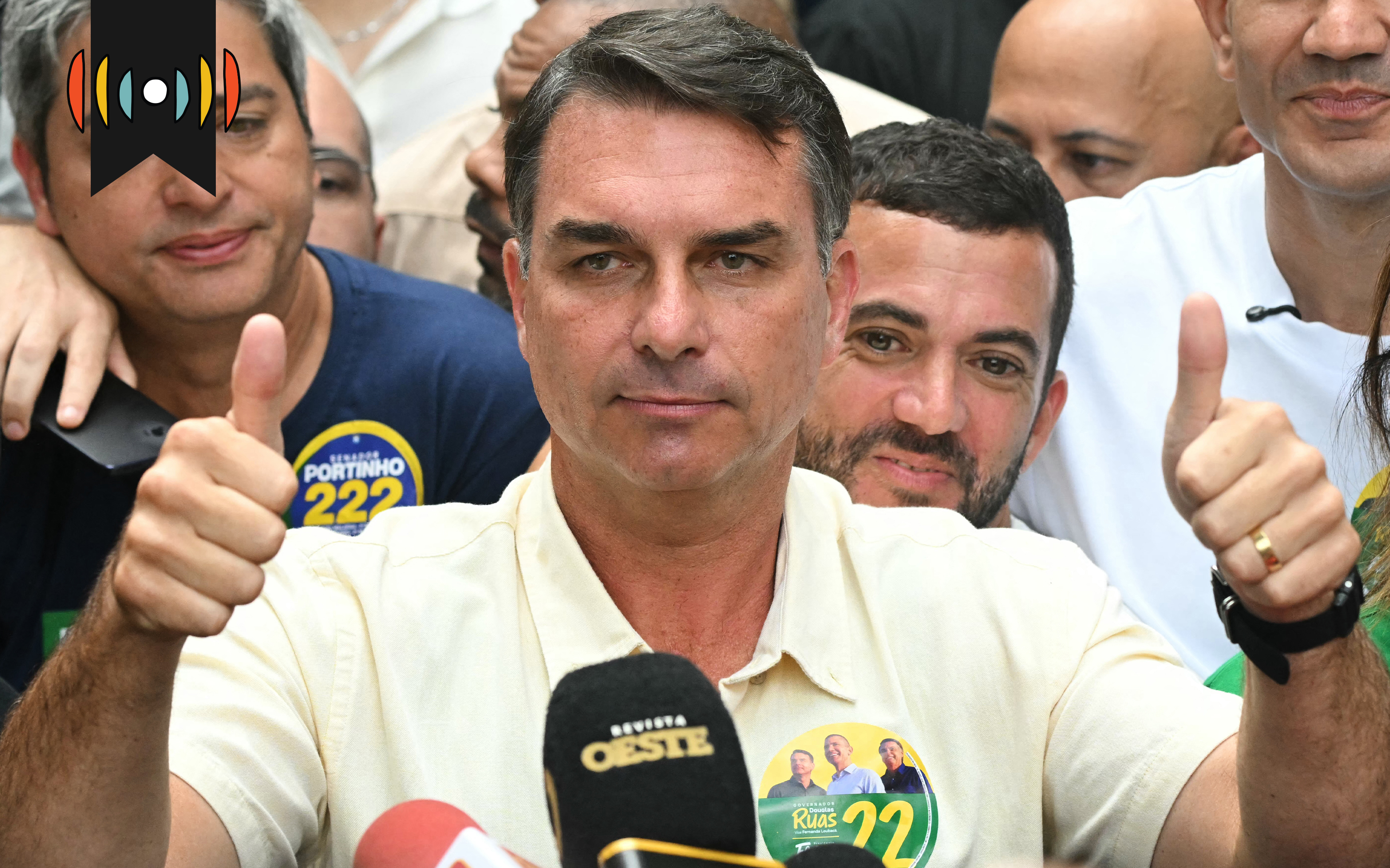
Flávio Bolsonaro gives thumbs up. Getty Images / Photo by Mauro Pimentel / AFP
Editor's note: The following text is a transcript of a podcast story. To listen to the story, click on the arrow beneath the headline above.
NICK EICHER, HOST: Coming up next on The World and Everything in It: a surprise in Brazil’s presidential election.
Conservative Senator Flávio Bolsonaro finished two points ahead of leftist President Luiz Inácio Lula da Silva on Sunday. Neither won a majority, so the two meet again in an October 25th runoff.
The presidential race wasn’t the only shift to the right. Conservative candidates also made major gains in Brazil’s Congress and Senate.
LINDSAY MAST: Joining us now to talk about it is Gil Guerra. He's a fellow at the Hudson Institute with a focus on Latin America. Gil, good morning.
GIL GUERRA: Good morning, Lindsay.
MAST: I want to start just with some national context. Just briefly, what do you see as the main issue at play for voters in Brazil this election?
GUERRA: What we see time and time again in various polls, it is security, crime, and violence. If it's anywhere from twenty-nine to thirty percent of Brazilian voters say that that is their top issue. Corruption is usually a little bit behind, and then the economy comes in third. but for most Brazilian voters, even if some crime statistics have improved in the past years, ninety-four percent say that they have felt insecurity when they leave their homes in the past year.
So for them it is overwhelmingly an issue that is important to them and also an issue that they trust the candidate Flavio Bolsonaro more with than the candidate Lula de Silva.
MAST: You know, neither candidate here is a political newcomer. Flavio Bolsonaro's father is a former president. And incumbent president Lula, of course, is seeking a historic fourth term. Can you go through just a few of the main differences between the candidates and their platforms?
GUERRA: They represent sort of the two poles of the Brazilian electorates and of Brazilian politics. And it is perhaps because they are such fixtures that we have seen an estimated twenty-one percent abstention rates in the first round. And for context, that is the highest abstention rate that we have had in Brazil since 1998.
It seems that what Brazilian voters want is something new and something different. And that may be why Flavio, who is not the incumbent, has the advantage. But they represent, broadly speaking, very different approaches towards the United States. Flavio is far more aligned with the United States. Lula has spent his career trying to build more of a third world approach based on alliances through a block known as BRICS, which is an alliance with other middle powers such as Russia, India, China, and South Africa.
But really, one of the main differences is on crime, where Flavio is promising much more of a Bukele, El Salvador style approach to crime. Whereas Lula, even though we can see 61% of his voters actually approve of trying minors as adults. So his voters themselves are actually also fairly hard on crime. For various ideological reasons, that just has not been one of his main priorities, in part because he's the incumbent and so he doesn't want it to seem like crime is actually that big of a problem. So that's part of the trap that he has there.
MAST: Let's talk a little bit about U.S.-Brazil relations. President Trump has become something of a factor in the race. Lula has accused Washington of interfering in Brazilian politics. Do you think Trump's involvement helps Bolsonaro or could it provoke some nationalist backlash?
GUERRA: I think that one of the excuses if Flavio wins is going to be what we've seen in other elections, which is that U.S. interference led to the ultimate victory of the candidate of the right or the candidate who is more aligned with the United States. But I actually think that the opposite is true. I think that this administration obviously really wants Flavio to win because relations with the United States would be much better than they are now. But you can look through the polling and virtually every step that the administration has taken that could influence the election has actually backfired and has actually hurt Flavio.
If you look at the tariffs that we've placed on Brazil recently, the majority of Brazilian voters say that it has actually made them less likely to support Flavio for it. So I think it is overall more accurate to say that if Flavio wins, it will actually be despite some of the actions the administration has taken to try to weigh on the election and not because of them.
MAST: So watching the returns coming in on Sunday night, you could see some of the congressional elections inside Brazil. This is more than a presidential race—I mean if Lula were to win the runoff, do you think that the political center of gravity in Brazil has already moved to the right just with what's happened in their legislature?
GUERRA: I would say so, and I think that we've already seen this happen in Brazilian politics where there has already been the rejection of an appointment of Supreme Court Justice. That's the first time that has happened since the late eighteen hundreds in Brazil. It already seems like whoever comes in, obviously Lula will be very constrained. But from what we've also been able to see, the Partido Liberal, the party that Bolsonaro is tied to, they have a majority, but do not have such an absolute majority that they can just pass things without having to work with some of the more center right parties, some of the center parties for some of their really major reforms. But obviously if Lula does make even a stunning comeback in the next few weeks, he is going to be especially backlogged and blocked by this Congress.
MAST: Gil, I wanna ask about the math behind the runoff. Bolsonaro finished with 47% to Lula's 45. There are millions of voters who backed other right of center candidates. Is there a realistic path for Lula here to make up the difference in the runoff? And where would those votes come from?
GUERRA: His votes would have to come from the twenty-one percent of voters who abstained in this round. So he would have to motivate people who did not show up in the first round by basically convincing them that the stakes are so high that they have to come out and do this. I think that is especially challenging for him for a number of reasons. It is far easier to get voters from other aligned candidates. And from what we've been able to see, with one exception, the majority of the candidates who were in the low single digits.
Most of their voters say that they are probably going to go to Flavio instead. So he's already facing also some momentum from Flavio. And another factor in all of this is that Lula's age, Lula is fairly old. He's 80. He is very much associated with again, if you are already the incumbent and if voters already think, I don't like how things are going, we think you've been around too long, we want change, it's very hard to convince people to give you even more time when you are so visibly aged. We've seen that here in the United States but it is something that is obviously taking form in Brazil as well.
MAST: Gil Guerra is a fellow at the Hudson Institute. Gil, thank you so much.
GUERRA: Thank you, Lindsay.
WORLD Radio transcripts are created on a rush deadline. This text may not be in its final form and may be updated or revised in the future. Accuracy and availability may vary. The authoritative record of WORLD Radio programming is the audio record.
Please wait while we load the latest comments...
Comments
Please register, subscribe, or log in to comment on this article.