
The threats kept coming
After a man posing as a college girl blackmailed 17-year-old Gavin Guffey over explicit images, Gavin took his life—and the demands reached his family before they could bury him. WORLD’s Harrison Watters reports on Gavin’s Law and how parents can spot the trap early.
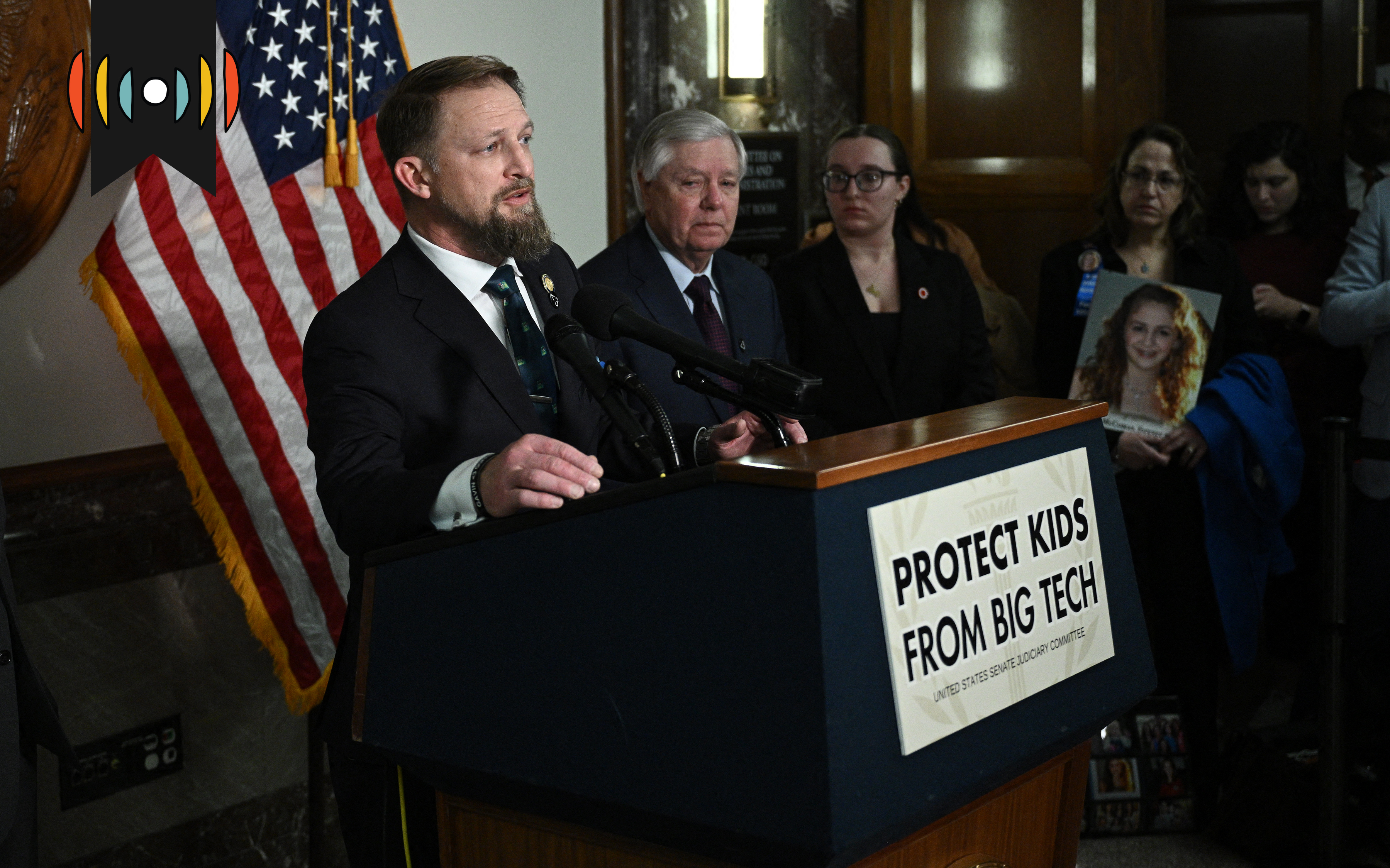
South Carolina State Representative Brandon Guffey speaks at a press conference after the US Senate Judiciary Committee hearing in Washington, D.C., January 31, 2024. Getty Images / Photo by Brendan Smialowski / AFP
Editor's note: The following text is a transcript of a podcast story. To listen to the story, click on the arrow beneath the headline above.
NICK EICHER, HOST: Up next: protecting children from online predators.
Last year, authorities received nearly a million and a half reports of online enticement involving children. Some of those encounters end in blackmail. A few have ended in tragedy.
WORLD’s Harrison Watters has the story.
HARRISON WATTERS: After Brandon Guffey heard a gunshot from a bedroom in his house, he made a horrifying discovery: his seventeen-year-old son had taken his own life. Figuring out why took longer.
BRANDON GUFFEY: Gavin had just come back from a Young Life camp. He had his last Instagram post was about him being saved.
Guffey is a member of the South Carolina legislature. At a recent conference in Washington, he said he discovered messages on Gavin’s phone from a man pretending to be a girl in college. The stranger sent explicit photos and asked Gavin for images of himself, then demanded money to not post those photos online.
GUFFEY: The crime was called sextortion and it was someone that is just pretending to be someone else just for money, it’s financial sextortion.
The crime has become more common. The National Center for Missing and Exploited Children received 80,000 reports of sextortion last year and many more may go unreported. The child safety nonprofit group Thorn reports one in five minors are too embarrassed to tell anyone about online sexual interactions. Many victims are young men. The stakes have changed, too. Predators used to ask for images and favors. Now they are more often demanding money. The Nigerian scammer who exploited Gavin soon reached out to other family members.
GUFFEY: In their mind, politicians are rich. I was the cash cow for them, so they continued to try to extort my family, even before we could even bury my son.
Guffey contemplated quitting politics. Instead, he wrote a bill raising penalties for extortionists. “Gavin’s Law,” enacted in 2023, made sextortion a felony, with up to 20 years in prison per offense. He told WORLD it also requires schools to train teachers and students how to report sextortion to law enforcement and parents.
GUFFEY: So that way, they are aware of the crime. They know what to look out for, how to have the conversations.
Artificial intelligence has made the conversation more complicated. In August, Thorn found that perpetrators are altering young people’s social media photos to create fake sexually explicit images and then blackmailing their victims.
ALEXANDRA BAILEY: You are never able to move anywhere to hold any job where you are now not Googleable in a way that permanently alters your life.
Alexandra Bailey is Senior Policy Strategist at the National Center on Sexual Exploitation and a survivor of this kind of abuse. She says policies like Gavin’s Law help but wants other ways to prevent incidents.
BAILEY: Parents need to be able to not have to play whack-a-mole with 50 different applications, but we need to have safety by design at the app level.
Last year, the federal Take It Down Act gave victims and their families a way to remove images or videos on the internet, and this year, the Justice Department seized internet domains for two AI-pornography websites.
But other proposals to verify users’ ages and hold tech companies accountable for sexual exploitation on their platforms have stalled in Congress.
Delaying children’s access to phones and social networking apps may be a good start:
BAILEY: But I think the first and most obvious thing is to actually talk to your children about sexual exploitation, sextortion, and human trafficking, and how it happens.
The National Center for Missing and Exploited Children, NCMEC, has age-appropriate resources for talking about these issues.
State rep. Guffey says he talks to a lot of young men who’ve made the same mistakes Gavin made and he tells them there is hope even if they do fall for a sextortion scheme.
GUFFEY: We're all going to fall short. And whenever you do, it's just best you strive to be a better man tomorrow than you are today
The Nigerian man charged with extorting Gavin was extradited to South Carolina last year. The U.S. government wants to put him on trial in December with life in prison on the table.
Reporting for WORLD, I’m Harrison Watters.
WORLD Radio transcripts are created on a rush deadline. This text may not be in its final form and may be updated or revised in the future. Accuracy and availability may vary. The authoritative record of WORLD Radio programming is the audio record.
Please wait while we load the latest comments...
Comments
Please register, subscribe, or log in to comment on this article.