
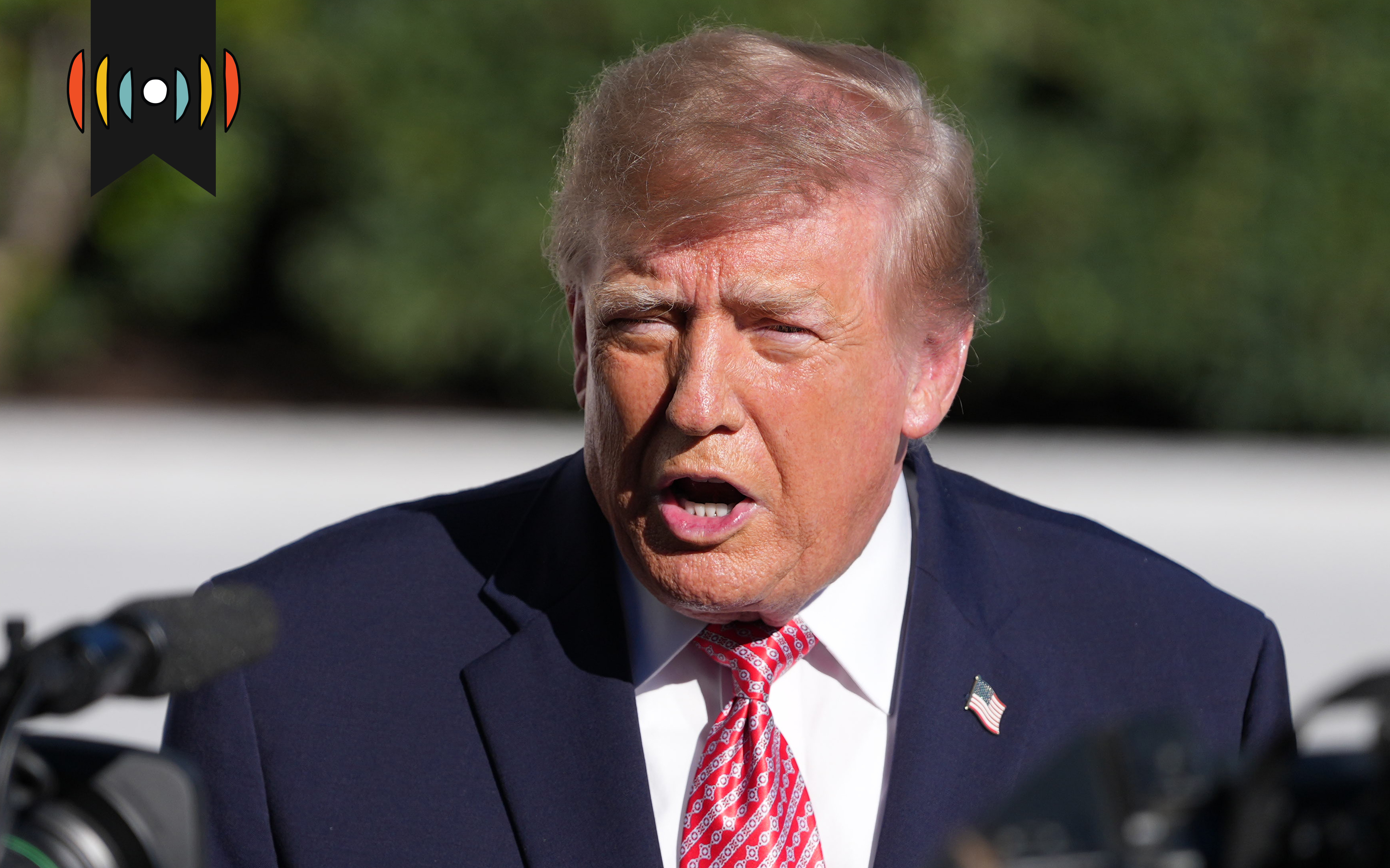
President Donald Trump speaks to the media on the South Lawn of the White House, Monday. Associated Press / Photo by Mark Schiefelbein
Editor's note: The following text is a transcript of a podcast story. To listen to the story, click on the arrow beneath the headline above.
NICK EICHER, HOST: It’s The World and Everything in It from WORLD Radio, celebrating 15 years. Today is October 20th.
Thanks for making us part of your morning routine. Good morning. I’m Nick Eicher.
LINDSAY MAST, HOST: And I’m Lindsay Mast.
First up on The World and Everything in It: Russia sanctions on hold.
President Trump has delayed new sanctions on Russia, even as Moscow continues attacking Ukraine’s energy infrastructure.
EICHER: Critics complain the move gives leverage back to Russian President Vladimir Putin.
The administration says the pause is temporary.
Treasury Secretary Scott Bessent told Meet the Press on Sunday the sanctions aren’t gone for good.
BESSENT: There is a 60 day period so we can examine what’s going on. The only thing that has been lifted is the diesel embargo.
MAST: Joining us now to talk about it is Max Meizlish, he once worked at Treasury, in the office of foreign assets control. He’s now a research fellow at the Foundation for Defense of Democracies.
Max, good morning.
MAX MEIZLISH: Good morning.
MAST: Let’s start with the sanctions law…President Trump in September signed the bill, named after the late Senator Lindsey Graham, and it was supposed to kick in on Sunday…tell me what portions of it President Trump’s order waived.
MEIZLISH: In fact, the, the waivers apply to all of the substantial portions of the bill that President Trump signed into law relating to tariffs and sanctions involving Russia and purchasers of Russia's oil supply. At the end of the day, right, this is really a waiver that has no time limit, so it can go on until the end of the term by President Trump, and then frankly, it can also extend even further, for the full five-year duration of the the law and however long it's it's in effect.
MAST: Okay, so just, just to be clear, what sanctions on Russia then are still in effect today?
MEIZLISH: Right. So every sanction that the U.S. had in place towards Russia and those supporting it remain in effect. Essentially, what the president waived was the requirement that he make certain determinations with respect to individuals and entities that were buying Russian oil, the ships that were transporting Russian LNG and Russian oil, and essentially just deferring any future action. This is a big deal because there was a lot that President Trump could have done with this legislation. He could have imposed significant tariffs on supporters of Russia buying its oil. It could have gone after several hundred shadow fleet tankers that had yet to be sanctioned by the United States. But at the present day, there's no additional sanctions or tariffs that a lot of people were expecting.
MAST: What can you tell us about how much sanctions have affected Russia's war budget so far, and then how much money then would this change, or does this change put back in the Kremlin's pocket?
MEIZLISH: Yeah, I, I wouldn't think of this as putting anything back into the Kremlin's pocket per se. It's really just about the degree to which the U.S. is giving up additional leverage to further constrain Moscow. What we know is that sanctions are never going to just on their own stop a bad actor from circumventing sanctions. Right? There's always going to be a black market. There's always going to be pathways for evasion. But with more rigorous enforcement, the United States is able to constrain an adversary's ability to develop war financing.
And so what we've seen over the duration of President Trump's second term is relatively lax enforcement of Russia sanctions. There have been some significant actions against some Russian oil and gas producers; those are notable. But compared to previous application of U.S. sanctions under the Biden administration, we really haven't seen a lot of new designations. From where I sit, I think that if the the leading factor for prices going up is that the war is going on, and the best way for the United States to ensure that the war comes to a speedy end is for us to be applying more pressure, not less.
MAST: I think sometimes news like this, people's eyes tend to glaze over. So, could you briefly, why should this matter in the ongoing dispute, in the ongoing war between Russia and Ukraine? What, why should the average American care about this most recent action?
MEIZLISH: At the end of the day, Americans need to be giving more consideration to sanctions as a tool of foreign policy, not just because it's a way in which the U.S. can be seen as doing something, but because it creates a broader space for us to operate between a problem arising and then having to resort to war or appeasing our enemies. And so when we remove the leverage that sanctions provides, it either is going to force us in a position of having to appease our enemy, which will be a bad thing in this case, appeasing to Russia, or furthering a war. So both of those outcomes are not good for the American consumer. They're not good for Ukrainians. They're not good for our allies, and it's not necessarily the case that sanctions will just on their face solve for all these challenges. But what it does do is it gives the United States more optionality and could help avert potential for additional war and appeasing the enemy.
MAST: Max, is there anything Congress can do about the waiver, or is this the president's decision alone?
MEIZLISH: Sure. So there are questions about whether the waiver itself is actually fully legal and compliant with other statutes. In 2017, there was a law called the Combating America's Adversaries Through Sanctions Act, which requires that Congress be notified and provide an opportunity to object to any policy that significantly alters the U.S. approach towards Russia. And so, whether the the diesel export general license from last week could be considered as significantly altering that policy, if Congress wasn't given its notice—which it wasn't—there might be a case that Congress could object in court and challenge the the move by the Trump administration to authorize the import of Russian diesel outright.
But beyond that, there are pathways for Congress to shore up some of the gaps in the legislation. Right, one of the big sticking points to the Lindsey Graham law when it was under consideration in Congress was the extent to which it gave the president broad waiver authority for matters of national security interest. So Congress could seek to tighten the scope on that activity.
I don't know if it's necessarily likely that we'll see this happen before the, the midterm comes in the United States, but we have seen growing pressure from a bipartisan cohort in Congress in both the House and the Senate opposing the, the president's recent policies towards Russia and Ukraine.
HOST: Alright. Max Meizlish is Deputy Director of the Center on Economic and Financial Power at the Foundation for Defense of Democracies. Max, thank you so much!
MEIZLISH: Thank you.
WORLD Radio transcripts are created on a rush deadline. This text may not be in its final form and may be updated or revised in the future. Accuracy and availability may vary. The authoritative record of WORLD Radio programming is the audio record.
Please wait while we load the latest comments...
Comments