
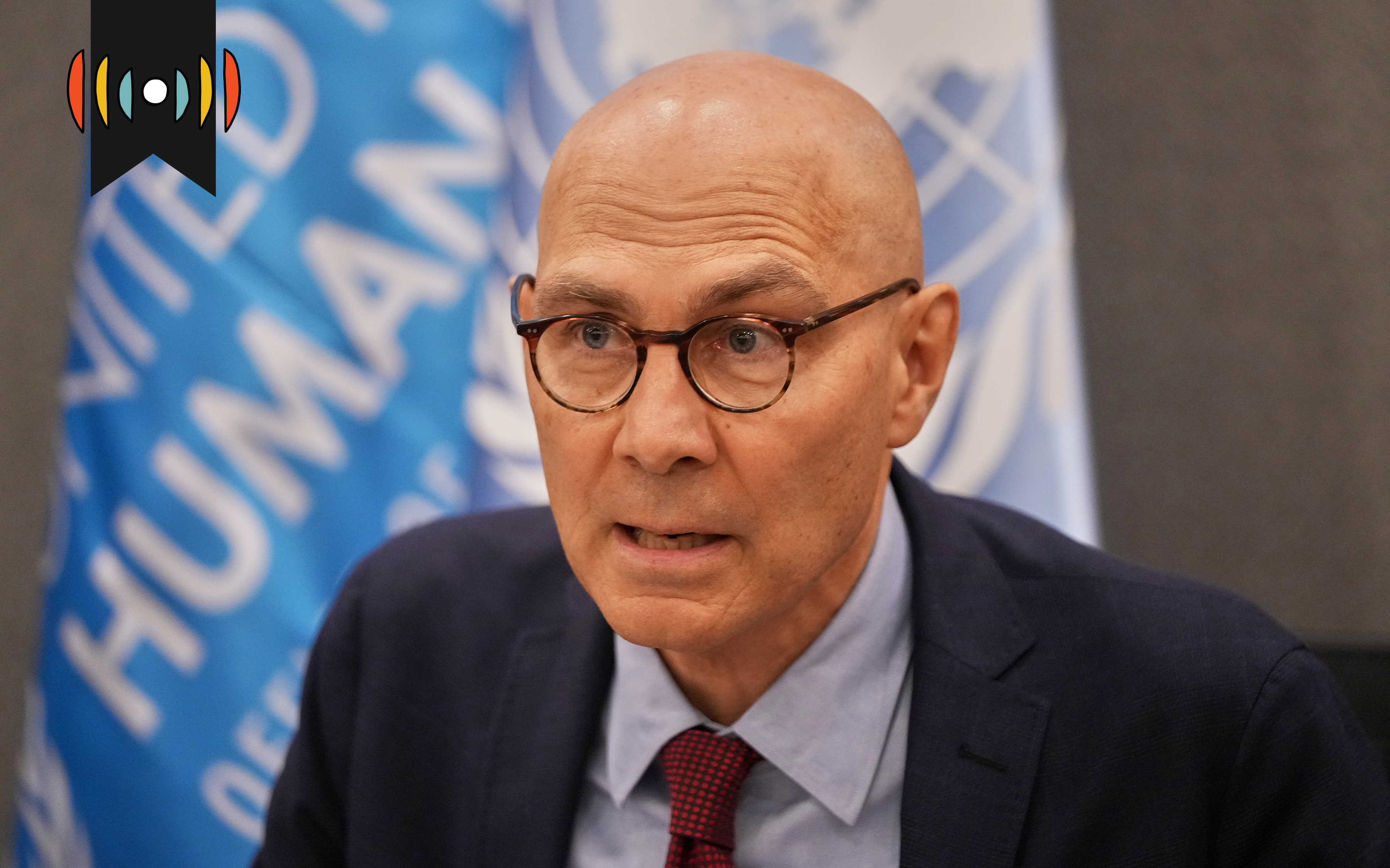
U.N. High Commissioner for Human Rights Volker Türk speaks to the media in Beirut, Lebanon. Associated Press / Photo by Hassan Ammar
Editor's note: The following text is a transcript of a podcast story. To listen to the story, click on the arrow beneath the headline above.
MYRNA BROWN, HOST: Good morning! This is The World and Everything in It from listener-supported WORLD Radio. I’m Myrna Brown.
MARY REICHARD, HOST: And I’m Mary Reichard.
The United Nations has a new concern about the future of humanity. And it comes with a familiar proposal. Here’s WORLD commentator Daniel Suhr.
DANIEL SUHR: The UN’s top human rights official picked the third anniversary of the October 7th Hamas attacks on Israel to issue a warning about threats to humanity.
Regrettably, the warning was not about Hamas.
His warning was about artificial intelligence.
Volker Türk is an Austrian lawyer who serves as the UN High Commissioner for Human Rights.
Have a listen to what he had to say at an AI summit in Oxford:
TÜRK: The ruthless race for AI and the competition that we see have brought us into uncharted waters, with mounting concerns about human agency, our safety, and even our continued existence as a species. . . . The clock on AI regulation is ticking. If we fail to move quickly, we risk unforeseeable consequences—for ourselves and future generations.
Yikes. He’s echoing a warning from an Anthropic AI researcher. Last month, the researcher made headlines for putting the odds of AI killing us all within the next decade at greater than ten percent.
That’s just the sort of warning a would-be global regulator loves. And Türk’s proposed solutions are predictable.
Mandatory safeguards. Government oversight. International cooperation. New rules governing the companies developing the most advanced AI systems.
Now, to be fair, Türk does get one thing right.
Human beings have rights. Robots don’t. Technology should serve humanity, not the other way around.
But beyond that, his argument has a faint echo of another UN initiative.
Türk praised a new UN body with a name that’s a mouthful: the Independent International Scientific Panel on Artificial Intelligence.
The High Commissioner says no one country should dominate the AI future. And the European Union and 29 mostly European countries are on board with this model.
Not on board: the Chinese Communist Party.
Just look at another UN project: the Paris Agreement on climate change. China and other emerging powers, including India, haven’t made it the priority Western governments have.
So I don’t expect Beijing to suddenly handcuff itself with UN-dictated AI safeguards.
Though the Chinese would no doubt be more than happy to see the U.S. do exactly that.
In the end, the High Commissioner’s speech just adds to the noise surrounding AI. He’s using the UN’s remaining credibility to attract attention. And some pretty dramatic warnings are helping him get it.
Meanwhile, there’s a race on, and Europe isn’t in it. This is between Silicon Valley and whatever China can muster.
However much the High Commissioner wishes the UN to call the shots, one country will dominate.
The question is whether it will be the United States, supported by our Western allies—or China.
I do agree with the High Commissioner about the dire threat and the ticking clock.
But the real danger, in my view, is China winning.
For WORLD, I’m Daniel Suhr.
WORLD Radio transcripts are created on a rush deadline. This text may not be in its final form and may be updated or revised in the future. Accuracy and availability may vary. The authoritative record of WORLD Radio programming is the audio record.
Please wait while we load the latest comments...
Comments
Please register, subscribe, or log in to comment on this article.