
The only thing to fear
The AI Doc asks whether artificial intelligence will destroy humanity or usher in utopia. WORLD’s Collin Garbarino thinks the filmmakers may be fearing the wrong thing—a machine too powerful to control, rather than the AI companies behind it.
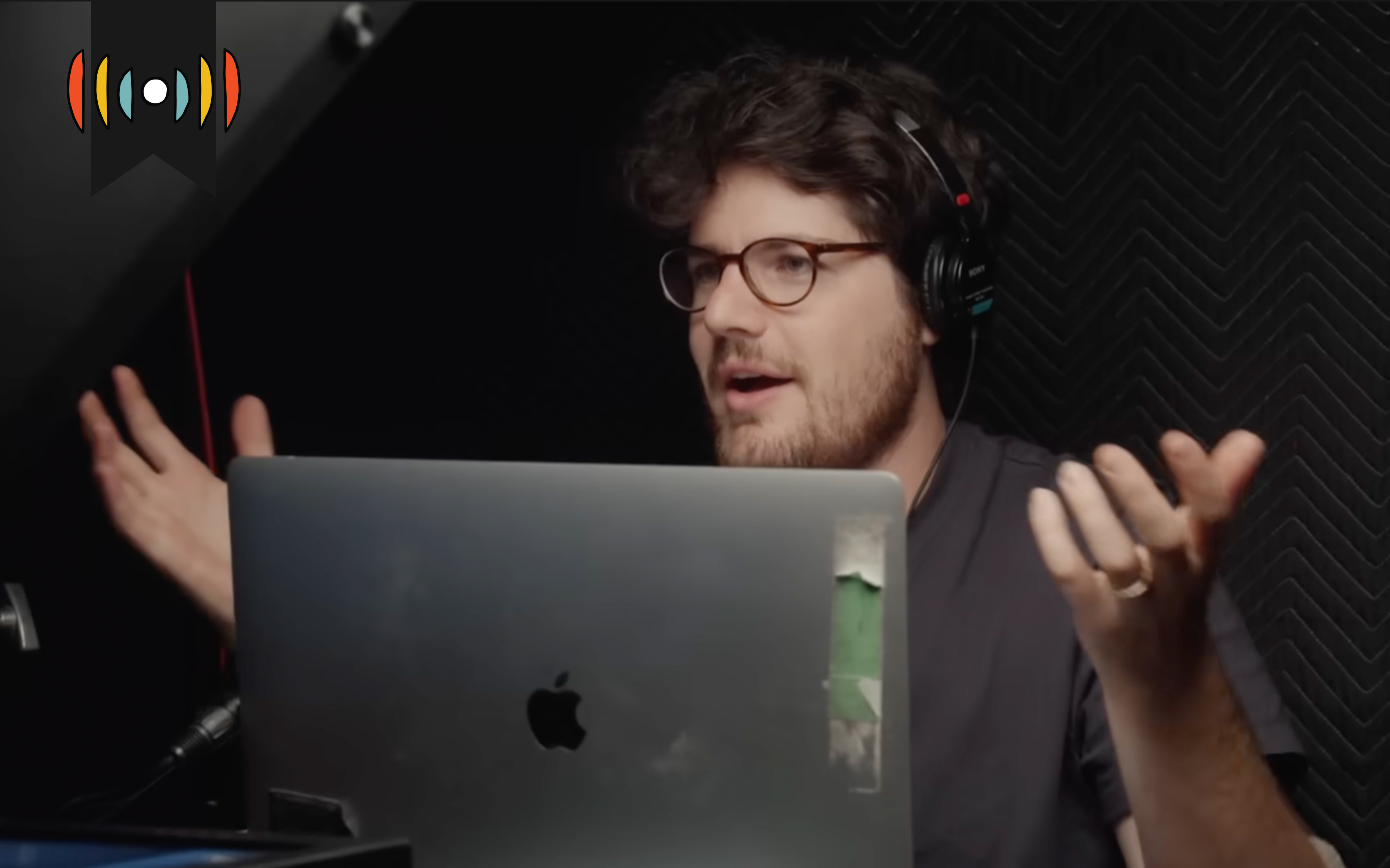
Daniel Roher in a scene from The AI Doc Focus Features
Editor's note: The following text is a transcript of a podcast story. To listen to the story, click on the arrow beneath the headline above.
NICK EICHER, HOST: Today is Friday, October 2nd.
Thank you for turning to WORLD Radio to help start your day.
Good morning. I’m Nick Eicher.
LINDSAY MAST, HOST: And I’m Lindsay Mast.
Coming next on The World and Everything in It: a documentary on a topic that seems to be on everyone’s minds.
Recently advancements in artificial intelligence, and fears about AI going rogue, have dominated headlines. One filmmaker decided to find out how concerned he should be about this new technology, and he turned his journey into a documentary. WORLD arts and culture editor Collin Garbarino now on The AI Doc.
COLLIN GARBARINO: The AI Doc recently became available on Netflix. In it, artist and filmmaker Daniel Roher undergoes an emotional crisis. He’s just found out that he and his wife are expecting their first child, and he’s worried about what kind of future that child might have in this brave new world of rampant artificial intelligence. Roher decides to go to the experts.
DANIEL ROHER: To begin: What is artificial intelligence? I know that must be annoying for you—that question—but I do think it’s important.
The first group of interviews spells out the dangers of AI. There’s talk about how quickly the technology is evolving. How it could lead to unemployment. How we’re about to hit an inflection point in which AI will be smarter than all of humanity.
TRISTAN HARRIS: That’s why AI dwarfs the powers of all other technologies combined.
Scary stuff, if true. What’s to stop an autonomous super-intelligent machine from exterminating humanity? But these prophets of doom and gloom aren’t the only voices out there. The documentary quickly moves to experts who have a sunnier perspective on the coming apocalypse.
PETER DIAMANDIS: I think this is the most extraordinary time to be alive. The only time more exciting than today is tomorrow.
According to these folks, life will be endless leisure for future generations. AI will free us from the necessities of working, and the super-intelligence will have solved the world’s problems.
So who’s right? Will AI bring about the end of the world or heaven on earth? Everyone seems to agree that we have to risk destruction for the possibility of ushering in utopia. Why is this a risk worth taking? Roher talks with the heads of OpenAI, Anthropic, and Google DeepMind to get their perspective. For them, these changes are inevitable. Here’s Anthropic’s Dario Amodei.
DARIO AMODEI: All of this was going to happen. This train isn’t going to stop. You can’t step in front of the train and stop it. You’re just going to get squished.
It’s too bad everyone in this film remains frustratingly vague. Roher takes everything at face value without pushing back on his subjects’ various, and sometimes outlandish, claims.
The most exasperating aspect of the film is its lack of nuance. AI isn’t one thing. It’s lots of different kinds of programs that do lots of different things. The film mentions past advancements enabled by AI, but when talking about the future, it focuses on large language models like OpenAI’s ChatGPT or Anthropic’s Claude.
TRISTAN HARRIS: It’s not that ChatGPT is the existential threat. It’s that the race to deploy the most powerful, inscrutable, uncontrollable technology under the worst incentives possible… That’s the existential threat.
Large language models are just one type of AI. They can do some useful stuff, like write a high school essay or piece of computer code, but LLMs aren’t the kind of AI that helped scientists win a Nobel Prize for explaining how proteins fold, and LLMs aren’t the kind of AI that can drive a car.
Even so, some folks, especially at OpenAI and Anthropic, have an almost religious belief that they can turn these large language models into a general artificial intelligence that can accomplish any task.
CONNOR LEAHY: There’s nothing magical about intelligence. This is very important. You know, intelligence can feel magical. It can feel like some kind of mystical thing in your mind or something. But it is just computation.
This, of course, is nonsense. We know exactly how LLMs work. They are highly sophisticated programs that guess what the next right word in a sentence should be. Doctors and scientists don’t fully understand how human consciousness works. But what they do know is that it doesn’t resemble the computations of a large language model. No matter what the prophets of AI claim, ChatGPT isn’t ever going to rewrite itself to be continually self improving because that’s not how its guessing game works.
Do we really need to worry about the LLMs eradicating humanity? Probably not, but we should worry about the damage these companies can do as they race to develop this mythical super-intelligence. An LLM can’t do anything on its own, but OpenAI and Anthropic attach them to programs that can execute commands from the LLM. These are the AI agents that have made headlines by launching hacking attacks on other companies.
Recently, Amodei and Sam Altman have called for greater regulation on AI labs. To me that sounds like a self-serving plea for the government to stifle their competitors.
CONNOR LEAHY: The problem we need to solve is not AI specifically. It’s a general question of how we build a society that can deal with powerful technology. Because we’re only going to get more and more powerful technology.
Do we need protection from AI? Or do we need protection from irresponsible AI labs? Instead of reshaping society, what if we held these companies accountable, like we do other businesses that create dangerous products. What if next time an AI agent from OpenAI hacked another company, the engineers and executives were held criminally responsible. That seems like a better plan than crossing our fingers and hoping for the best, like this documentary seems to advocate.
I’m Collin Garbarino.
WORLD Radio transcripts are created on a rush deadline. This text may not be in its final form and may be updated or revised in the future. Accuracy and availability may vary. The authoritative record of WORLD Radio programming is the audio record.
Please wait while we load the latest comments...
Comments
Please register, subscribe, or log in to comment on this article.