
The margin of doubt
Lula lost Brazil’s first round, then won the presidency. A last-minute court order stirred controversy, but the extra votes “would not have made a difference,” says one election expert. WORLD’s Emma Freire reports on Lula’s comeback—and the conservative Congress that won’t make his fourth term easy.
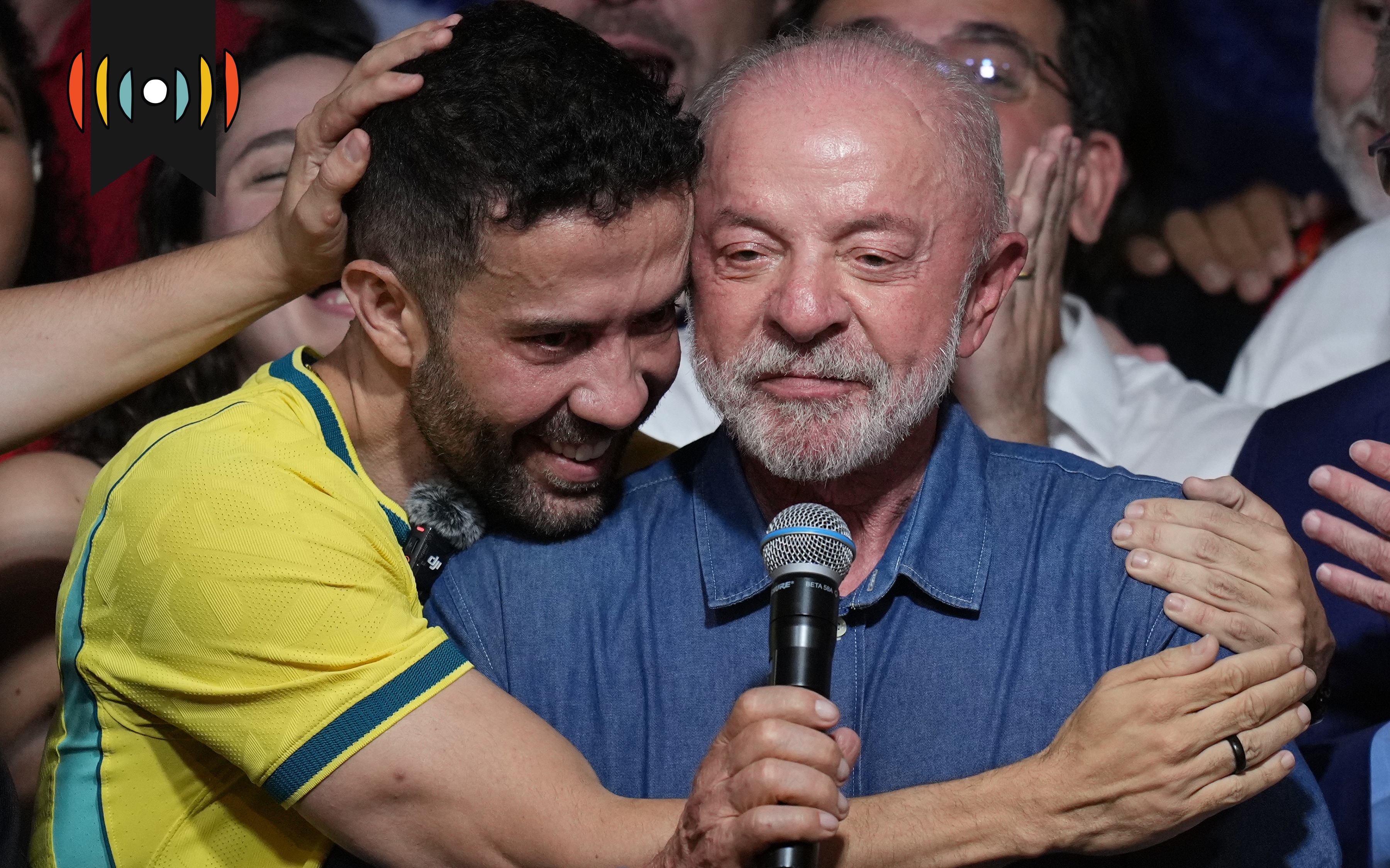
Brazilian lawmaker Andre Janones embraces President Luiz Inacio Lula da Silva as he delivers a victory speech in the presidential runoff in Brazil, Sunday. Associated Press / Photo by Andre Penner
Editor's note: The following text is a transcript of a podcast story. To listen to the story, click on the arrow beneath the headline above.
NICK EICHER, HOST: Coming up next on The World and Everything in It:
A disputed presidential election in Brazil.
Brazilian equity markets took a tumble yesterday after leftist incumbent President Lula pulled off a surprise re-election.
LINDSAY MAST, HOST: Investors had bet heavily on conservative Flavio Bolsonaro winning. Bolsonaro is challenging the result, pointing to a highly unusual court order that extended voting hours and triggered last-minute chaos.
But did it affect the outcome?
WORLD’s Emma Freire reports.
GUARDIAN NEWS, LUIZ INÁCIO LULA DA SILVA: (Portuguese) But I wanted to thank the Brazilian people for their generosity they have shown me for a long time.
EMMA FREIRE: Luiz Inácio Lula da Silva, usually known as simply Lula, thanked his supporters after Sunday’s victory gave him a fourth term as president.
MEIDASTOUCH: STREET CELEBRATIONS
He defeated Flavio Bolsonaro, the son of Brazil’s former president Jair Bolsonaro. His father is serving a 27-year sentence under house arrest after Brazil’s Supreme Court convicted him of plotting a coup after his election defeat in 2022.
Lula’s victory was unusual. Brazil has a 2-round election system. Bolsonaro won the first round on October 4. Since Brazil returned to democracy in the 1980s, no presidential candidate had lost the first round and then won the second.
Bolsonaro is challenging the result. Because just as polls were closing, a Supreme Court justice ordered voting extended nationwide by two hours, from 5 to 7 pm.
Gabriel de Arruda Castro teaches international relations at Cedarville University.
CASTRO: Brazil does have an electoral court, so that's usually where those issues have to be addressed.
Both campaigns asked the electoral court for more time in some areas. Lula’s campaign cited problems with public transportation. Bolsonaro’s pointed to heavy rain. But Lula’s campaign also went to Brazil’s Supreme Court.
CASTRO: And there the case was in a lottery system distributed to Lula's former personal lawyer, who is now a Supreme Court justice.
The order applied nationwide, but some polling stations had already closed.
CASTRO: Many parts of the country they were not able to actually extend the voting hours until 7 p.m. because they were already closed by the time they got the decision.
Castro says those extra 2 hours didn’t change the outcome.
CASTRO: Everything is electronic in elections in Brazil, it's not a paper ballot. We know exactly how many votes came after 5 p.m. So it was not a lot, so it was it would not have made a difference. Lula had a major victory.
Analyses by Folha and BBC News counted fewer than 35,000 votes coming in after 5pm–not enough to threaten Lula’s winning margin of more than 4 million. Whether the justices had the authority to extend voting is a separate question.
Lula’s campaign rolled out a familiar playbook, relvying on votes from Brazil’s more impoverished Northeast region. His previous administrations directed welfare subsidies to that area.
CASTRO: He targeted those low income voters more aggressively with new promises of expansion of those welfare programs.
Castro says Lula also warned voters about what a Bolsonaro presidency could mean for those benefits.
CASTRO: And Lula also did a good job, telling voters in general that his opponent would privatize the public healthcare system, would reduce welfare benefits, which is not something Flavio Bolsonaro was actually talking about.
Guilherme Casaroes, an associate professor at Florida International University, says Lula also made a clever change in campaign tactics after the first round.
CASAROES: After trailing the first round to Flavio Bolsonaro, his campaign took a U-turn. He and his supporters embarked in a social media blitz. Hundreds of 1000s of people took to the streets, and Lula successfully conveyed a message to undecided voters that his rival was a dangerous option for Brazil's future.
Castro says domestically, Lula will keep doubling down on welfare programs. And on foreign policy:
CASTRO: The Brazil Lula has in mind is more aligned with the BRICS, with China, and even Russia than with the U.S., especially now with Trump in the White House.
Casaroes thinks Lula has an uphill battle. He must face Bolsonaro’s election challenge and then there’s his legislative agenda. Right-wing candidates won control of Brazil’s Congress on October 4th.
CASAROES: Upon taking office, another major challenge for Lula will be to work with a conservative majority Congress, which is already given signals that it will not make Lula's life easy in the fourth term.
Reporting for WORLD, I’m Emma Freire.
WORLD Radio transcripts are created on a rush deadline. This text may not be in its final form and may be updated or revised in the future. Accuracy and availability may vary. The authoritative record of WORLD Radio programming is the audio record.
Please wait while we load the latest comments...
Comments
Please register, subscribe, or log in to comment on this article.