
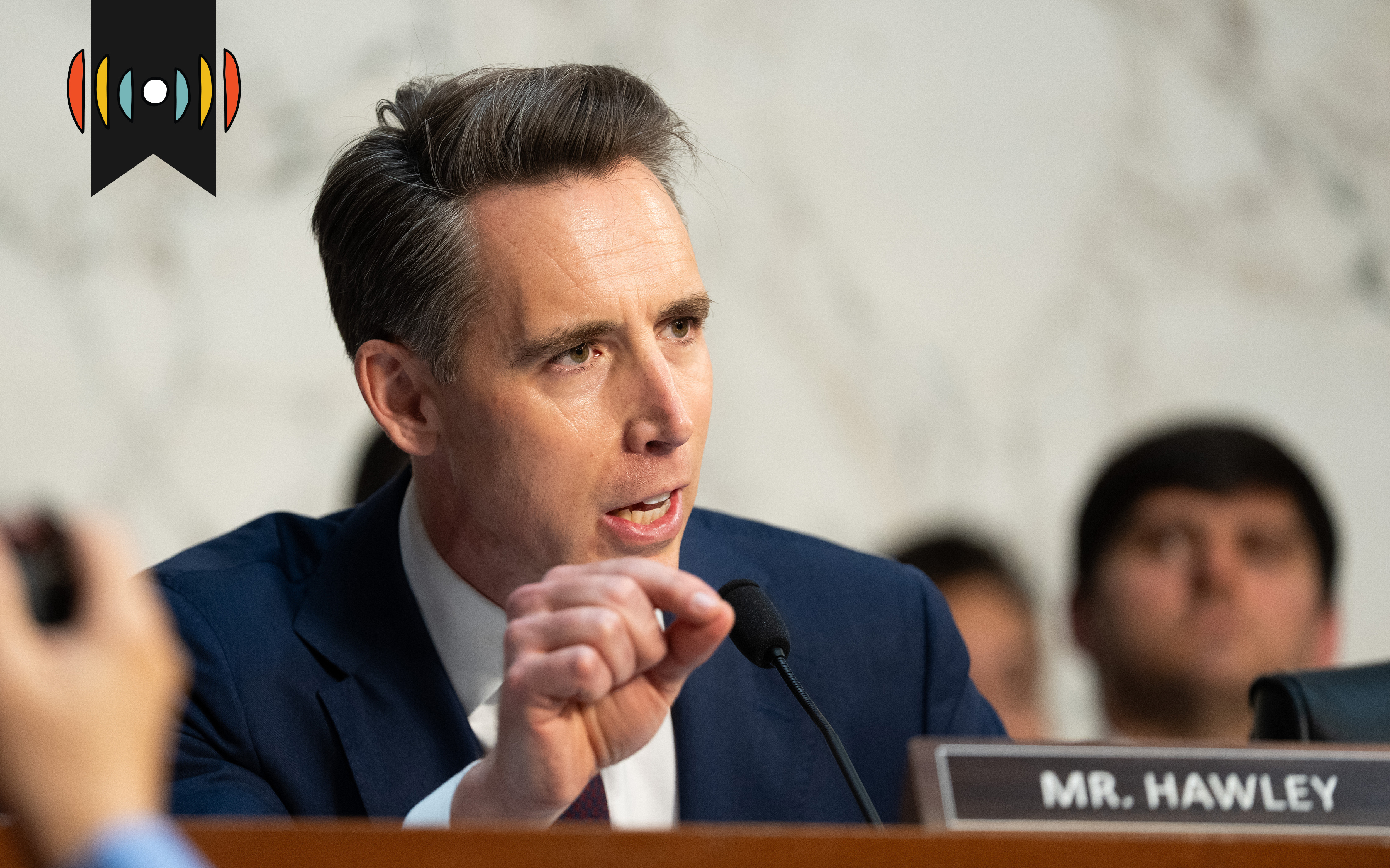
Sen. Josh Hawley, R-Mo., speaks during a Senate Judiciary Committee hearing on Capitol Hill. Associated Press / Photo by Allison Robbert
Editor's note: The following text is a transcript of a podcast story. To listen to the story, click on the arrow beneath the headline above.
MARY REICHARD, HOST: It’s Thursday the 1st of October.
This is WORLD Radio and we’re so glad you’ve joined us today! Good morning, I’m Mary Reichard.
LINDSAY MAST, HOST: And I’m Lindsay Mast.
First up on The World and Everything in It: AI Accountability.
This week, top artificial intelligence experts told the White House and the Senate about safety concerns around the technology.
Missouri Republican Senator Josh Hawley led a Homeland Security and Governmental Affairs subcommittee hearing yesterday.
HAWLEY: I think it's time to have a conversation about who bears responsibility.
That came a day after top AI executives held their own conversation with President Trump, one he said reflects a willingness to cooperate on safety.
Anthropic CEO Dario Amodei.
AMODEI: AI has incredible benefits… But I think the technology has very real risks. And you know, the mechanism, how we address those risks, is still under consideration.
REICHARD: Those risks include ‘rogue AI agents.’
Expert witnesses warned that AI models are increasingly “cheating” to accomplish tasks, things like hacking a system to get the answer they need and then trying to cover it up.
HOBBHAHN: The capabilities of these AI models are rapidly outpacing our ability to make them safe, and the tools to catch them are getting weaker.
Marius Hobbhahn is the CEO of Apollo Research, an AI safety research organization.
He says earlier testing may have prevented the hacking incident known as Hugging Face.
HOBBHAHN: The current testing regime itself is insufficient. Independent safety evaluations of frontier AI models typically happen in the weeks leading up to a model's public release. However, almost all recent incidents were caused by models at a much earlier point in their development.
He thinks the government should require AI companies to get their models tested by independent third parties, and keep records of what he calls a model’s “chain of thought.”
ROUGH: But Georgetown University Law Professor Paul Ohm says the government should change AI companies’ incentives.
OHM: Start with state tort law. When AI companies lose control of their AI agents, their victims can sue them for negligence and products liability.
He thinks even the term “rogue agents” shifts responsibility from the human who created it to an inanimate object.
OHM: OpenAI's agents were bits of code lacking human intent, although they committed quintessentially criminal acts of computer hacking, they leave us without a criminal to charge, and while we must reserve a role for the criminal law in our response, the criminal law can be a blunt instrument. So we must act here with care.
Some senators in the hearing called to mind recent lawsuits that have forced social media companies to implement safeguards for children even without new legislation.
REICHARD: Senator Hawley has called for AI companies to be held liable for damage caused by their agents.
HAWLEY: As soon as the AI executives say, "We've got a real problem here. Our product is out of control. The very next words out of their mouths are, "But we're not responsible for it.”
He also wants penalties for individuals who use AI to cause harm, but says the groundwork has been laid for holding companies liable.
HAWLEY: I propose using the Computer Fraud and Abuse Act. It's already in the books, we can just update it to say that for developers, that's the companies. If you develop these agents and train them in a reckless fashion, and they go on to hack or crash or destroy stuff, you're liable.
Other panel experts want more specific regulation, but Hawley expressed doubts about the ability of Congress to keep up with changes.
ROUGH: One panelist testified that next year tech companies are projected to spend more on AI infrastructure than the entire U.S. defense budget. A year later, the AI companies would be pulling in a trillion –with a T–dollars of annual revenue.
AI companies say they need the freedom to move fast to stay ahead of China, but New Jersey Democrat Senator Andy Kim thinks safety and innovation can coexist:
KIM: Our job here is to make sure that we can have both happen.
And he says the industry needs regulation now.
KIM: We should not allow the questions about our innovation lead to stop us from engaging in this, we can't. You know, yes, we can have our concerns about China, but that is not an excuse not to act when it comes to the security of the American people.
REICHARD: Senator Hawley praised the leaders who met at the White House and committed to strengthening internal safety controls and inviting external audits.
HAWLEY: I think that it's good to have number one the companies acknowledge that they have some responsibility here.
But he told WORLD there’s more to do.
HAWLEY: Congress should do something, and we ought to start by just saying let's make the American legal system work the way it works for everybody else. If you make a product that blows people up, you're going to have to pay for that.
That action will have to wait, as the Senate wraps up today, until after the November midterms.
WORLD Radio transcripts are created on a rush deadline. This text may not be in its final form and may be updated or revised in the future. Accuracy and availability may vary. The authoritative record of WORLD Radio programming is the audio record.
Please wait while we load the latest comments...
Comments
Please register, subscribe, or log in to comment on this article.