
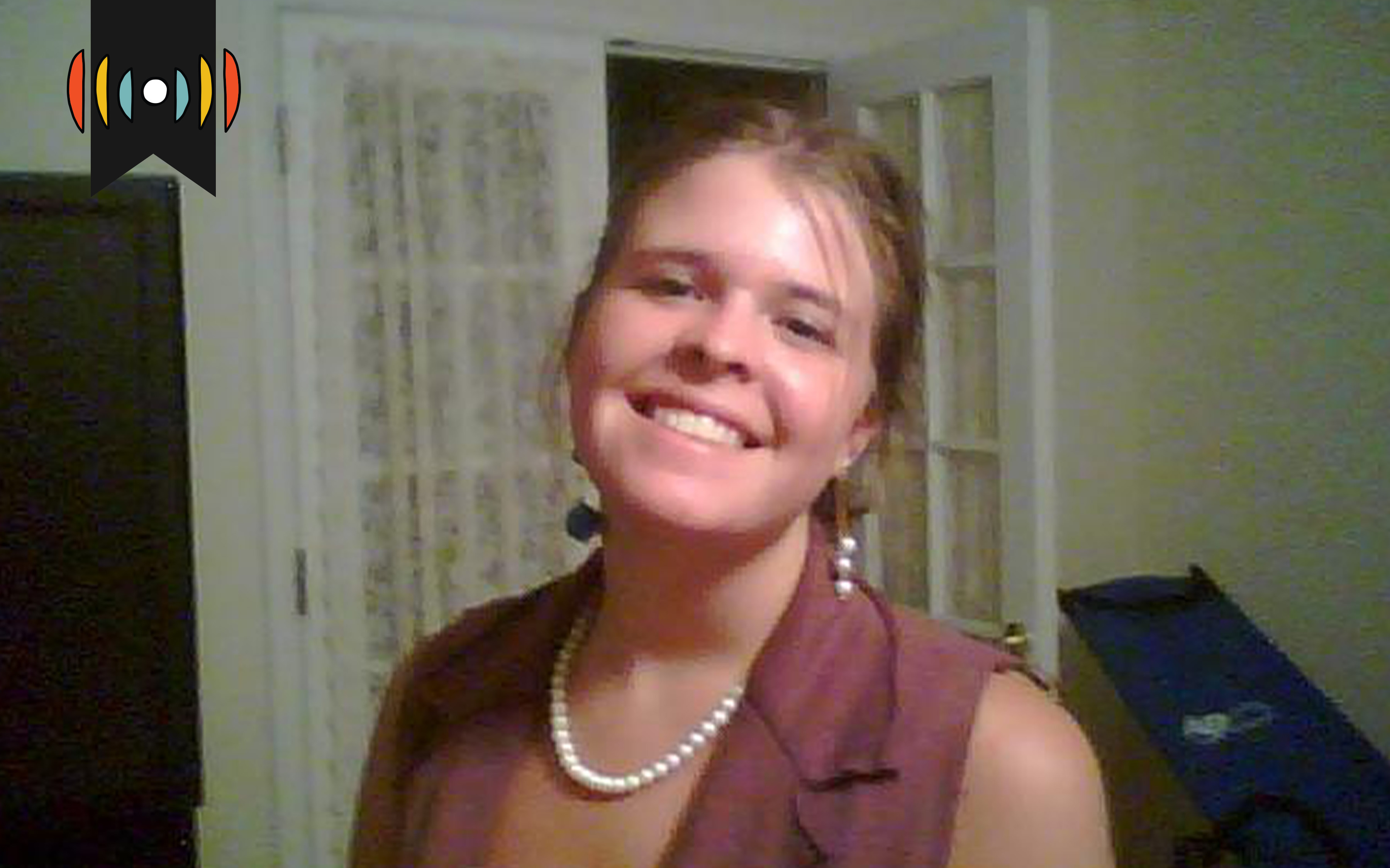
Kayla Mueller Photo courtesy of Marsha and Carl Mueller
LES SILLARS: From WORLD Radio, this is Doubletake. I’m Les Sillars.
This is the final episode in our three-part series: The kidnapping of Kayla Mueller. Kayla was a humanitarian aid worker who was kidnapped in Syria on August 4th, 2013. A group of ISIS terrorists known as the Beatles held her captive.
August 4th, 2014, marked one year since Kayla’s abduction. The ISIS Beatles were getting restless. They had threatened to kill Kayla unless her parents paid a ransom of 5 million euros, about 6.2 million dollars at the time. A deal that was never done. The execution deadline came and went. But Carl and Marsha Mueller knew their daughter was still alive. There was still a chance to negotiate.
In October of 2014, they learned the ISIS Beatles had handed her over to a senior leader in the organization who reported directly to Abu Bakr al-Baghdadi, the self-proclaimed caliph of ISIS. Baghdadi promptly claimed Kayla as his wife. As the year drew to a close, the FBI, the U.S. military, and others continued to try to locate Kayla. Meanwhile, prosecutor Dennis Fitzpatrick of the U.S. Department of Justice sought to bring Kayla’s original captors, the ISIS Beatles, to justice.
DENNIS FITZPATRICK: One primary motivation, rationale, foundation of the U.S. justice system is to achieve justice for victims of crime. And there’s really no more compelling case than this one.
But first, the government had to find them. The Beatles had gone into hiding. WORLD correspondent Jenny Rough picks up the story from here.
JENNY ROUGH: The sound of the owls always reminded Marsha and Carl Mueller of their daughter, Kayla. She loved owls.
The Muellers’ home in Arizona backs up to the Prescott National Forest. The owls fly into the trees in their backyard, or hang out on top of the garage where Carl keeps his camper.
Back in 2014, whenever Marsha heard the owls, she wondered what was going on with Kayla in Syria. For the first year of her abduction, Kayla had been held hostage by a group of three men known as the ISIS Beatles: John, Ringo, and George. Here’s prosecutor Dennis Fitzpatrick:
FITZPATRICK: Called the Beatles, and in part called the Beatles because the released hostages had nicknamed them the Beatles because they all had British accents.
The Beatles had origins in Africa or the Middle East. Their families had relocated to London and attended the same mosque. That’s where the Beatles met … and united.
FITZPATRICK: They all shared an affinity with what they were hearing on the internet. And they all decided to travel to Northern Syria and … originally joined al-Nusra Front, which is another faction of this sort of religious, political terrorist group. … And they traveled there in … late 2011 and 2012 to join the cause.
Eventually, the Beatles split from al-Nusra Front to join ISIS. And the Beatles oversaw the international hostage cell. They had taken dozens of Westerners hostage, mostly Europeans. But also four Americans: three men and Kayla. They kept Kayla for a little over a year. Then, on August 19th, 2014, the Beatles beheaded one of the American men and posted the killing on social media.
FITZPATRICK: A horrible video is released by the Islamic State. A message to America. And it is Jim Foley on his knees, orange jumpsuit. … and then you see the knife go to Jim Foley’s neck. … And the video is meant to terrorize the west. … A week later, Steven Sotloff is killed. And then … Peter Kassig was killed in October of 2014.
The Muellers had been in contact with the Beatles through email. But after the Beatles began their killing spree, the emails stopped. Here’s Marsha:
MARSHA MUELLER: You know we kept reaching out. They didn’t respond. Kept sending messages … sending emails, emails. They weren’t responding. … And we don’t know what happened to Kayla. Whether she lived or died.
In October 2014, the Muellers learned the Beatles had turned Kayla over to someone else in ISIS and disappeared.
The militants who now held Kayla were Abu and Umm Sayyaf. A married couple. They locked Kayla inside their house and kept her on behalf of their leader, the founder of ISIS. His name: Abu Bakr al-Baghdadi.
Prosecutor Fitzpatrick again:
FITZPATRICK: And Abu Sayyaf was a lead lieutenant of Abu Bakr al-Baghdadi. And she was transferred to his custody so she could be Abu Bakr al-Baghdadi’s slave. … I mean, there’s nothing more horrific than the beheading of U.S. citizens, and then the rape and sexual abuse of an American woman at the hands of the leaders of the terrorists organization.
The Sayyafs kept other slaves in their house too. Including a small group of Yazidi women. But two of the Yazidis escaped through a window. One of them talked to BBC News about what Kayla went through as Baghdadi’s “wife.” One of them:
YAZIDI GIRL: Kayla would be taken to another room for Baghdadi. When she came back, sometimes she just lay down without saying a word. Sometimes she would cry under a blanket. She tried to hide that from us. She didn’t want to upset us. She wanted to seem strong. She did everything Baghdadi wanted. … He told Kayla if you refuse, I will behead you. … I asked Kayla to run away with me and she said, no. They will behead me. Kayla was like a sister or a mother to us. When we wept, she tried to make us feel safe. She would always tell us, you will get home to your parents one day. I will never forget her and what she did to us.
Throughout all of this, Marsha held fast to her faith. She trusted that God had not abandoned Kayla in her suffering.
MARSHA: I think Jesus was with Kayla, and I think He was crying, too.
But Carl’s doubts grew. Nobody seemed trustworthy. Not God. Certainly not ISIS. And not the U.S. government.
The Muellers were still trying to keep Kayla’s name quiet and out of the media. But after the ISIS Beatles posted its beheading videos, word was out that the Beatles had more hostages. So Carl and Marsha knew it wasn’t if Kayla’s name got out to the public. It was when. The “when” came on January 25th, 2015. Denis McDonough, Obama’s White House Chief of Staff, went on a talk show. Audio from ABC News:
DENIS MCDONOUGH: … and as it relates to our hostages, we are obviously continuing to work those matters very, very aggressively. We are sparing no expense and sparing no effort both in trying to make sure we know where they are and make sure that we’re prepared to do anything we must to try to get them home. But Kayla’s family knows how strongly the president feels about this and we will continue to work this.
Right away, the Muellers received a call from Obama’s counterterrorism advisor.
MARSHA: … saying, “That was a mistake.” He didn’t mean to do it. Well, my thought at that point was, you know, I was almost glad. Because maybe we could get some help now. But I guess it wasn’t a good thing.
Then Obama made threats to ISIS. The leak and the threats gave ISIS a heads up that the United States was on their tail. The U.S. military continued to follow leads to try to locate the house where the Sayyafs held Kayla. Or rather, houses. The Sayyafs moved her around.
But everything changed again a week after the media leak, in February 2015. A series of simultaneous world events unraveled quickly … within days. The Syrian civil war was still going on. And the U.S. and Jordan were allies. Fitzpatrick again:
FITZPATRICK: The first event was that the Islamic State had captured a Jordanian pilot who had fallen. His plane somehow was hit. He parachuted to the ground and was abducted, excuse me, in Syria, and held by the Islamic State. And this was an opportunity for the Islamic State to promote their viciousness.
ISIS placed the Jordanian pilot in a cage. On February 3rd, ISIS released a video.
FITZPATRICK: They doused the cage with gasoline and set it aflame and they burned the Jordanian pilot to death.
The next day, Jordan retaliated. It took a female ISIS terrorist who had been convicted in Jordan of war crimes and executed her.
Two days after that, February 6th, ISIS posted a message on Twitter.
FITZPATRICK: The Islamic State releases … an announcement on their social media network that Kayla Mueller had been killed in Jordanian airstrikes.
A reporter called the Muellers to tell them the news: ISIS has claimed Kayla was dead. And ISIS blamed her death on Jordan’s wrongdoing. Jordan’s missiles killed her, as if ISIS had nothing to do with it. But Fitzpatrick says Kayla was not killed in the manner ISIS claimed.
FITZPATRICK: There was just abundant evidence there were no Jordanian airstrikes and she was not killed in any type of military action.
The Muellers did not know what to believe.
“Really?!!” Marsha wrote in her notebook. “I am starting to wonder if this is true. Was Kayla killed … by ISIS? Was she brutally murdered because Baghdadi was done with her? Did she try to escape? … I need and want to know everything.”
FBI negotiator Zorka Martinovich traveled from Washington, D.C. to Prescott, Arizona, to be at their side. As far as anyone knew, the Beatles’ email address was still active. The Muellers had not received an email from the Beatles in months. But the Muellers decided to send another. Here’s Zorka:
ZORKA MARTINOVICH: When they claim that Kayla is dead, I talked to Carl and Marsha, we decided … let’s just put out a statement. And the statement was, essentially, we need proof. You know, we hear what you’re saying. And it’s a hard decision point.
Hard because what if Kayla was not dead? What if she was still living with the Sayyefs? Would the Muellers’ demand for a proof of death photo cause ISIS to kill her? They thought it through as best they could.
MARTINOVICH: They’re in an impossible situation. It’s impossible. And every option is full of risk, and dire risk to Kayla.
They decided to ask.
MARTINOVICH: We’re like, we need to know conclusively because it’s this limbo that’s so difficult.
MARSHA: And so we reached out to ISIS and said, you know, we need to know. … We needed proof.
Within 24 hours, ISIS sent three pictures of Kayla. Prosecutor Fitzpatrick again.
FITZPATRICK: They produced photographs of her. They had dressed her in sort of traditional Islamic burial garb. … You only see one side of her face. She looks injured.
But ISIS had a reputation of sending staged photos. ISIS sometimes made its hostages fake their death. Did they force Kayla to do that? FBI negotiator Zorka:
MARTINOVICH: We weren’t certain. And so, you know, again, until we’re certain of this we should continue to work as if she’s alive. … Let’s get these pictures to our doctor at our headquarters for them to review from a physician’s perspective, what’s your assessment on this?
The results: inconclusive. Zorka continued to advise the Muellers to act as if Kayla was still alive until they knew for sure she was not. Still, the state of Arizona flew flags at half mast. And grieving members of the Prescott community gathered at the plaza in front of the courthouse. They placed cards, flowers, and candles at a memorial.
Days after her reported death, the Mueller family appeared on NBC’s Today show.
MARSHA: I’m still in denial. I still expect Kayla to come through the door.
Here’s Kayla’s brother, Eric, talking about whether to even believe ISIS’ claims of his sister’s death.
ERIC: That’s all that group does is lie. They lie, and it’s a propaganda thing, and they’re trying to push their agenda, so it was—we definitely had big doubts.
The Muellers sent follow up emails to the Beatles, but heard nothing.
Three months after Kayla’s reported death, the United States finally began to make significant progress in defeating ISIS. U.S. special operations forces stormed the home of Abu and Umm Sayyaf, the couple who had enslaved Kayla and held her for Baghdadi. Fitzpatrick:
FITZPATRICK: In May of 2015, there was a raid on the Sayyef compound … and it’s there Umm Sayyaf is captured. Abu Sayyef is killed along with many other Islamic state fighters.
Umm Sayyaf, the wife, was turned over to the Iraqi government to be prosecuted. To this day, she reportedly remains imprisoned there. But she has never been held accountable specifically for her crimes against Kayla.
In November 2015, the U.S. government killed the ISIS Beatle Jihadi John in a targeted drone strike. Jihadi John, real name Mohammad Emwazi, was the Beatle who had beheaded the American men.
The two other Beatles remained at large: Ringo and George. Real names: El Shafee Elsheikh and Alexanda Kotey. Baghdadi, their leader, was also in hiding.
And the Muellers had so many unanswered questions.
But those questions boiled down to three things. One: They wanted responsible parties held accountable. Two: They wanted to know the full truth of what happened to Kayla. Three: If Kayla was dead, they wanted to recover her remains.
As far as accountability, that included ISIS, of course. But they also wanted others to acknowledge their part. An unexpected opportunity to confront one of those parties popped up the year following Kayla’s death.
The Muellers had traveled to New York City to speak at a United Nations event. They learned that the Belgium director of Doctors without Borders, a lady, was also in the city. She had traveled to the States because she was upset the U.S. government had bombed an area where her people worked.
The Muellers could hardly believe it. This Belgium director had negotiated the release of three women held in the same hostage cell as Kayla. But she had refused to negotiate Kayla’s release. Even though Kayla had been in a Doctors without Borders vehicle when she was kidnapped. And even though Carl and Marsha had begged the organization to include Kayla in the deal and were willing to pay.
Neither the Muellers nor the lady director had any idea the other would be in New York City at the same time. It was a fluke. But once the Muellers learned, they walked over to the Doctors without Borders headquarters. They explained who they were, why they were there, and said they wanted to meet with the Belgium director. The guy they talked to looked shocked. He checked with another guy—
MARSHA: We wanted to meet with her. And he says, “Oh, I don’t think.” We want to meet with her. Well, she finally did have us come back and meet with her.
CARL: I just asked her who made the decision not to help Kayla, to just leave her there? And she didn’t answer. And I just kept asking. I didn’t quit. Who made the decision? Who made the damn decision to leave my daughter over there?
Carl continued to drill down.
CARL: And I don’t know how many times I did it. And that’s when she broke down and she said, “I did.”
MARSHA: She broke down in tears. We just, I mean, I felt so bad for that lady, I had to hug her, I just felt … my heart broke. She has to live with that the rest of her life. … She could’ve saved Kayla so easily.
Marsha couldn’t help but see the irony. The whole point of the Doctors without Borders organization is to save lives.
MARSHA: Your organization is to save lives and you allowed this when you could’ve easily worked to get her out.
On January 20th, 2017, Donald Trump became president of the United States. One year passed with little updates on the remaining Beatles, Elshiekh and Kotey. The government had no real leads. The case had essentially gone dormant. In fact, U.S. officials began to wonder if Elsheikh and Kotey had been killed among all the fighting in Syria. But in January of 2018, the news changed.
Prosecutor Fitzpatrick again:
FITZPATRICK: I can remember the day, the phone starts ringing, and emails were coming in, and we get notice that Alexanda Kotey and El Shafee Elsheikh had been detained … by the Syrian Democratic Forces. … They were trying to escape northern Syria in the back of a pickup truck to get into Turkey to get back into Europe. … So then all the sudden, that sort of injected life into it. … So in 2018, it was sort of all hands on deck. Let’s put together a charge and let’s figure out what to do to these guys and to bring them to justice.
The Syrian Democratic Forces initially held Elsheikh and Kotey. The United States wanted custody. It wanted to put the Beatles on trial in America. But legal hurdles blocked the way.
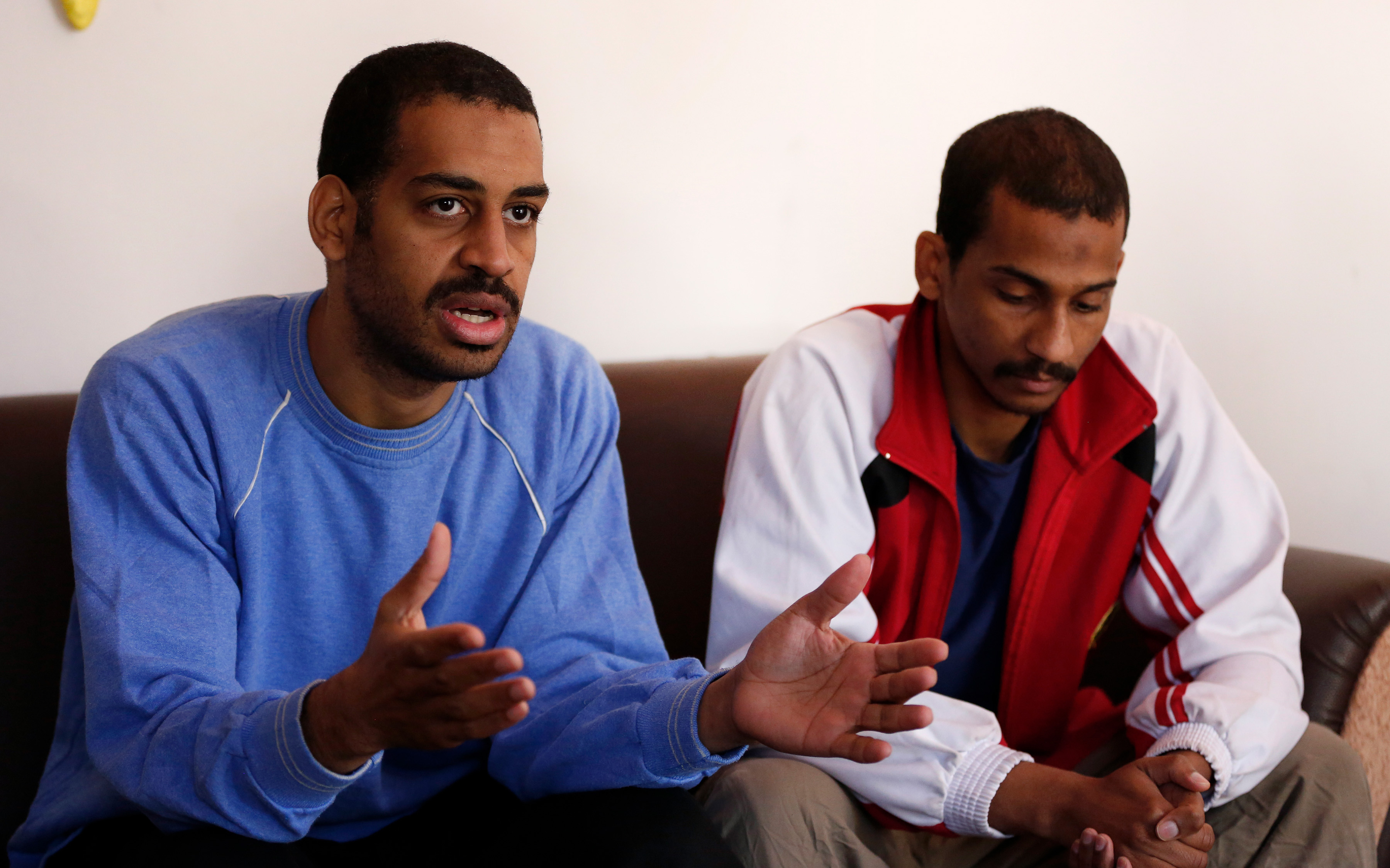
Alexanda Amon Kotey, left, and El Shafee Elsheikh, who were allegedly among four British jihadis dubbed "The Beatles," speak with the Associated Press at a security center in Kobani, Syria, March 30, 2019. Associated Press / Photo by Hussein Malla, File
As the Beatles sat in detention in Syria, another significant event occurred. The U.S. government locked down Baghdadi’s location in northwest Syria. Under President Trump’s approval, U.S. Army Delta Forces raided his compound. The invasion took place in the fall of 2019, but the assault force named the raid after a completely different date, a summer one. Here’s Kayla’s dad, Carl:
CARL: We knew this date, 8-14. That’s Kayla’s birthday.
Task Force 8-14 carried out Operation Kayla Mueller. In a Pentagon briefing, the operational commander for the mission, General Kenneth McKenzie, explained how the assault force closed in on the compound.
GEN. KENNETH MCKENZIE: With the assault force surrounding the compound, we repeatedly urged those inside to come out peacefully.
Some did, including 11 children. Five ISIS members refused to surrender. To gain access inside, the assault force breached a wall. Carl has learned more details from conversations with the government and military officials.
CARL: You don’t want to go through the doors because it’s alarmed and booby-trapped and everything else. So they just set a charge on the wall, blew a hole in the wall, and in they go. Surprise, surprise.
A military working dog entered first.
CARL: A group of military guys in Special Forces going in the wall with a dog in front … The dog went in, and they went in right after him. … There’s helicopters in the background and ropes hanging down. … They took over the compound, and Baghdadi ended up going into a tunnel that wasn’t finished. It was a dead end. It would have been, eventually, an escape tunnel. And he blew himself up and two kids with him.
Baghdadi had detonated a suicide vest. One of the kids was his own son.
CARL: Yeah … those people are nuts.
General McKenzie again:
GEN. MCKENZIE: After Baghdadi’s murder-suicide, our assault force cleared significant debris from the tunnel and secured Baghdadi’s remains through DNA identity confirmation. … Baghdadi’s remains were buried at sea.
But what about Kayla’s remains? The Muellers still could not say for sure she was dead. Another hostage who had been released claimed to have seen Kayla in a prison in Iraq after her reported death. The information created uncertainty and provided hope. A trusted friend of the Muellers had a vivid dream that Kayla was alive and would soon return home. Again, unlikely. But still.
MARSHA: It’s not over yet. That’s what’s so hard. The other families, pretty much, you know, they know what happened, at least to a certain point. But we truly do not, we’re getting there, but we truly do not know what happened.
At least by then, in their quest for the truth, they could talk freely about their daughter. At the 2020 Republican National Convention, they shared part of their story.
CARL: When Kayla was a hostage, I’d go outside at night and look at the moon. I’d look at the moon, and I’d promise her I’d do everything I could to get her home. Now when I see the moon, I’m reminded of my promise to her I couldn’t keep.
MARSHA: We are still working to find her. And God willing, we will bring her home. Kayla was born a miracle. We were told we would never have a second child. But God gave us Kayla, and she gave herself to the world.
Baghdadi was now dead. And the last two Beatles were finally in U.S. custody. A time-consuming process with legal technicalities followed. But it eventually led to the transfer of the Beatles to the United States.
FITZPATRICK: I felt strongly the evidence was there that we could prove the case and that this crime needed a public airing. … We proceeded to present our indictment to the grand jury. And that was in October 2020.
A grand jury voted to indict the Beatles. The Muellers hoped the criminal trial would bring more answers.
On March 29th, 2022, the government presented its opening statement in the United States of America versus El Shafee Elsheikh. The trial took place at the United States District Court for the Eastern District of Virginia. A court known as the “rocket docket” for moving cases through the system quickly and efficiently. Often high profile ones like this.
Kotey took a plea deal. So the case proceeded only against Elsheikh. Eight counts ranging from conspiracy to provide material support to terrorists to hostage taking resulting in death—not only for Kayla, but also Americans James Foley, Steven Sotloff, and Peter Kassig.
The prosecution’s first witness presented evidence about the history of ISIS. Bruce Hoffman, a Georgetown professor.
BRUCE HOFFMAN: And I’m also the senior fellow for counter-terrorism and homeland security at the Council on Foreign Relations. I’ve been studying terrorism now for 50 years.
He talked about how social media played a role in recruiting young men who felt culturally adrift.
HOFFMAN: You know, what’s social media? It’s all concentric circles of networks. Friends. People who like you, people who follow you. They just reach out to a wider and wider group, and that’s why ISIS became the first truly international terrorist organization with 53,000 foreign fighters from at least 80 countries.
On the stand, Hoffman faced Elsheikh. The rest of the courtroom only saw the back of his head.
HOFFMAN: El Sheikh, he just looked straight ahead. Never engaged. Never said anything. Never did anything. Completely unrepentant. … To me it was interesting because the defense cut his hair, trimmed his beard. And had him dressed, you know he looked very preppy. He was wearing khakis and a button down shirt and a blue crew neck sweater. He looked more like a student than a terrorist. But his demeanor.
Another witness testified to Elsheikh’s criminal activity in London. Like an arrest outside the U.S. Embassy for a demonstration in support of September 11th.
The prosecution called other hostages to the stand. Like Patricia Chavez, one of the women held in the same room as Kayla for six weeks.
Also, Nicolas Henin. One of four French men ISIS let go in 2014 after the French government reportedly negotiated for their release. Before ISIS set them free, the Beatle known as Jihadi John brought Kayla before the four French men. The Beatles wanted the men to see Kayla with their own eyes. That way, the men could report that Kayla was still alive and perhaps move along the negotiations for ransom. Although he did not tell the full story at the trial, here’s Nicolas explaining what happened in an interview with Democracy Now!
NICOLAS HENIN: She was looking extremely brave.… She obviously had been through some tough moments, but she managed very well to overcome them. I was just impressed. She was looking beautiful.
So strong that—
HENIN: I mean, to the point that Jihadi John believed that she converted to Islam. And she said, oh, I just want to correct you. I did not convert. I mean no one would dare to contradict him. But she did. Very calm, but very decided.
During the trial, Carl and Marsha sat right behind the prosecution team. The jury box was to their side. Carl listened to as much witness testimony as he could. But hearing directly from other hostages proved difficult. Adding to the difficulty: the Muellers were staying in the same hotel with the other hostages. Those who had been released and reunited with their families. Who had gone on to marry and have children.
CARL: I got up and left one time. One of the men was held in the same area as Kayla. He starts telling the story about Kayla crying for feminine products. … I couldn’t. I got up, and I had to leave. … My brother-in-law was there, and we went and had a few beers. I had an anxiety-dehydration attack, and the FBI took me to the hospital, and I spent the night at the hospital. Back at the courthouse the next day.
Prosecutors also called the parents of hostages to the stand. Steven Sotloff’s dad testified. So did James Foley’s. And then it was Marsha’s turn.
CARL: Marsha testified for, I think, almost an hour.
To prepare, a female prosecutor practiced with Marsha beforehand.
MARSHA: I was just an emotional wreck. Normally, I’m able to talk, but I had a hard time. I think because, finally, they are going to do something. I was relieved, which made me more emotional. … There were certain questions I did not want her to ask me because I told her I would break down, and I wouldn’t be able to continue. So you need to avoid certain triggers for me, and she did. She really did. She focused mostly on … our emails. And then she just had me read certain things.
Mainly, the email exchanges between the Muellers and the Beatles. But Marsha also had to convey who Kayla was.
FITZPATRICK: How do you explain … the beauty and the lovingness of your daughter to complete strangers? … She was truly remarkable.
Fitzpatrick had been a prosecutor for 20 years. So he’s seen a lot. He notes that trials in the United States are open to the public, so they get busy with constant ambient noise. The courtroom door opens and closes. The clerk runs back to chambers to retrieve something, or other distractions. But…
FITZPATRICK: When Marsha was testifying, you could hear a pin drop. I mean, it was just her voice. … The jury, the audience, was just enraptured by it.
For his defense, Elsheikh argued mistaken identity. When dealing with the hostages, the Beatles had kept themselves masked. When the Beatles entered a cell, they demanded the hostages turn around, kneel, and face the wall.
FITZPATRICK: Were these the guys who had committed these crimes back in 2012, 2013, and 2014? Part of the way we proved that was through the voice analysis that the Brits had done.
Also, a former ISIS member took the stand to testify against Elsheikh. Plus, after Syrian Democratic Forces first captured Elsheikh and Kotey, the two had given media interviews. Here’s Elsheikh with ITV News downplaying his role:
ELSHEIKH: My role in it has not much to do with the execution … my role was just logistics. Getting the email from this guy, getting the email from that guy. … I was not standing over them with a weapon.
And here is Elsheikh with a CNN reporter talking about Jihadi John:
ELSHEIKH: He was a friend of mine.
REPORTER: For what reasons?
ELSHEIKH: For what reasons was he my friend? Do you need to have a reason to be a friend of somebody?
REPORTER: I’m just asking to describe him as a person.
ELSHEIKH: Oh to describe him as a person. … He was one of the most loyal friends I’ve had. Trustworthy. Honest. Upstanding.
REPORTER: Were you surprised when you saw videos of him cutting off people’s heads?
ELSHEIKH: Surprising, yeah.
REPORTER: You didn’t approve?
ELSHEIKH: Did I approve of the act or did I approve of the video?
REPORTER: Did you approve of the act by your friend?
ELSHEIKH: I’d rather not answer.
Fitzpatrick described one of the most condemning interviews introduced into evidence at trial as this:
FITZPATRICK: The interviewer leans over to El Sheffe Elsheikh and shows him a newspaper that had Jim Foley's photograph ... and El Shafee Elsheikh says, yeah, that's the guy we held.
In all, 35 witnesses testified. The trial lasted about three weeks. The deliberations, about three hours. The jury returned the verdict: Guilty.
At the sentencing phase of the trial, the families presented victim impact statements. The opportunity allowed them to directly address both Beatles: Elsheikh and Kotey, the one who had taken the plea.
Marsha gave her statement before Carl. “We miss our beautiful daughter,” Marsha began. I go to bed every night thinking of her. I wake up several times a night thinking of her and … what … she endured.” Marsha recounted some of that terror: her head shaved, solitary confinement, … being screamed at for all the wrong things ISIS believed America had done.
The Muellers had learned that ISIS had pulled out the fingernails of another woman hostage. They hoped that did not happen to Kayla. Marsha thought Kayla had lovely hands. Not only because of the way she used them to serve … but literally, physically lovely.
In high school, Kayla taught herself to play the guitar. She wrote her own music.
MARSHA: I always remember her playing the guitar and how pretty her hands were.
As Marsha continued to read her victim impact statement, she said: I look at my own hands and think of this often. Marsha also spoke of how she thinks of the young Yazidi girls held with Kayla. “Repeatedly raped, brutally beaten, enslaved, and terrorized. … No human being should be subject the treatment, torture, and terror that ISIS inflicted.”
Those in the courtroom listening held tissues to their eyes to dab their tears.
Carl spoke next. He had tried to type out a statement. But in the end, he abandoned the printed pages and spoke from the heart.
Carl first turned to the defendant, Elsheikh.
CARL: I just looked at that savage. They were both there. … I looked at both of them. And I said who puts a young woman who just came to help in a dog crate and holds her in solitary confinement, and all those things that I had learned about what they did? I said, I’ll tell you who does it. Cowards do that.
He next addressed the judge.
CARL: I addressed the judge first. And I said, Your Honor, you know, throughout this whole ordeal, I’d lost my faith in my government, and I lost my faith in God. And I said, but because of this trial, some of my faith in my government has been restored. … I said, watching the diligence of the jury, and Your Honor presiding over this affair, watching the prosecution, the hours and the weekends and the travel, and all the things they put together to make this trial.
At this, even the judge’s voice broke. Carl even thanked the defense team because without them, America’s system of due process would fail.
Carl and Marsha next had the opportunity to meet directly with Alexanda Kotey. It was one of the conditions of his plea deal.
MARSHA: I remember we were sitting around this great big, huge table. And Mr. Fitzpatrick said, he’s wanting to do a plea. And one of the stipulations would be that he would have to speak to the family. I was the first one that said, I want to talk to him because he knows where Kayla is.
Marsha felt ready to face him.
MARSHA: I asked him all my questions.
Like: What happened to Kayla? Where is she now? She tried her best to get Kotey to show her the trail of where her daughter went.
MARSHA: I’d just sit there and stare at him until he had to answer me something.
Kotey told Marsha that Jihadi John did not like Kayla.
MARSHA: Kotey told me … that they felt Kayla was a witch … because of her personality, you know … something about brought us bad luck. ,… I was so dumbfounded when he said that, that I didn’t follow through on that comment. I wish I would’ve.
On August 19th, 2022, the judge sentenced Elsheikh to life. Kotey’s punishment also resulted in life, but as part of his plea deal, he can petition to be transferred to the U.K. after 15 years. For now, Elsheikh and Kotey have become the ones trapped alone in a cell. They’re at a supermax federal prison in Colorado.
Four years have passed since the trial. Thirteen since Kayla was taken. The Muellers now know Kayla is not alive. Although Marsha says they had a hard time letting go of that dream.
In a trunk in Kayla’s room at their home, the Muellers keep a collection of her poems, cards, and writings.
One of those writings: Kayla’s high school paper about the Beslan hostage crisis. In her conclusion, Kayla wrote of a pain worse than death—the pain of families left behind. Parents who have searched and searched for answers and remains. “These families have no closure,” Kayla wrote, “no end to the torture of the question, where?”
Today, the Muellers are focused on that “where” question. Here’s Carl.
CARL: We don’t have a grave. We don’t have a marker. We don’t have any place to go to grieve for Kayla.
The Muellers are working with the Soufan Group to locate Kayla. The Soufan Group is an intelligence security company, and it has already made a half a dozen trips to Syria in the hopes of finding the hostages’ bodies as it uncovers burial sites there. To perhaps one day confirm identity, Marsha has a CD of Kayla’s dental scans.
Marsha says Carl reminds her so much of Kayla. Carl says the exact same of Marsha. But they deal with their pain in different ways. For example, Carl’s faith walk has had more pronounced ups and downs while Marsha’s has been more steady.
MARSHA: Carl’s had such a hard time with Kayla.
CARL: I haven’t prayed in 10 years.
MARSHA: And I pray constantly.
And they’re constantly wondering another where question: Where is God’s hand in all this? At times, the Bible describes God’s hand as heavy. He will not let the guilty go unpunished. At other times, God’s hand is described as merciful. He will forgive wrongdoing. Looking at Carl and Marsha, I see a glimpse of both. Carl who seeks justice. Driving for a reason. Marsha who sees how everybody hurts, and extends compassion. So Carl presses; Marsha hugs. She reads the Bible constantly too, no matter how difficult.
MARSHA: It’s been hard to read. I just finished Job. Yeah, that was a tough one. It was a good one, but it really made me think of Kayla.
Job deals with the question of why God allows suffering, and how God’s wisdom and ways remain a mystery.
Just recently, Carl joined a men’s Bible study.
CARL: In my long and slow struggle back to God, I keep thinking, when I stand before him there will be one question. Why? Why Kayla?
It’s a legitimate question. The Muellers found that they could negotiate with ISIS and at least get an answer they could understand, money or a prisoner exchange. But like Job, the Muellers found that when you demand answers from God, God might answer. But He might not provide the answer you’re looking for, and He never explains himself.
And so the “why” lingers. For now.
SILLARS: Jenny Rough reported and wrote this episode, and this completes our series. I’m Les Sillars, the editor and producer. Please don’t forget to rate and review us on your favorite podcast app. It helps us get the word out and do more stories like this. Thanks for listening. We’ll see you next time.
WORLD Radio transcripts are created on a rush deadline. This text may not be in its final form and may be updated or revised in the future. Accuracy and availability may vary. The authoritative record of WORLD Radio programming is the audio record.
Please wait while we load the latest comments...
Comments
Please register, subscribe, or log in to comment on this article.