
The house that teaches
At Shepherd’s Way, young adults with intellectual disabilities practice independent living alongside college-age mentors who often find themselves changed by the experience, too. WORLD’s Lauren Dunn reports on a household where growth runs both ways.
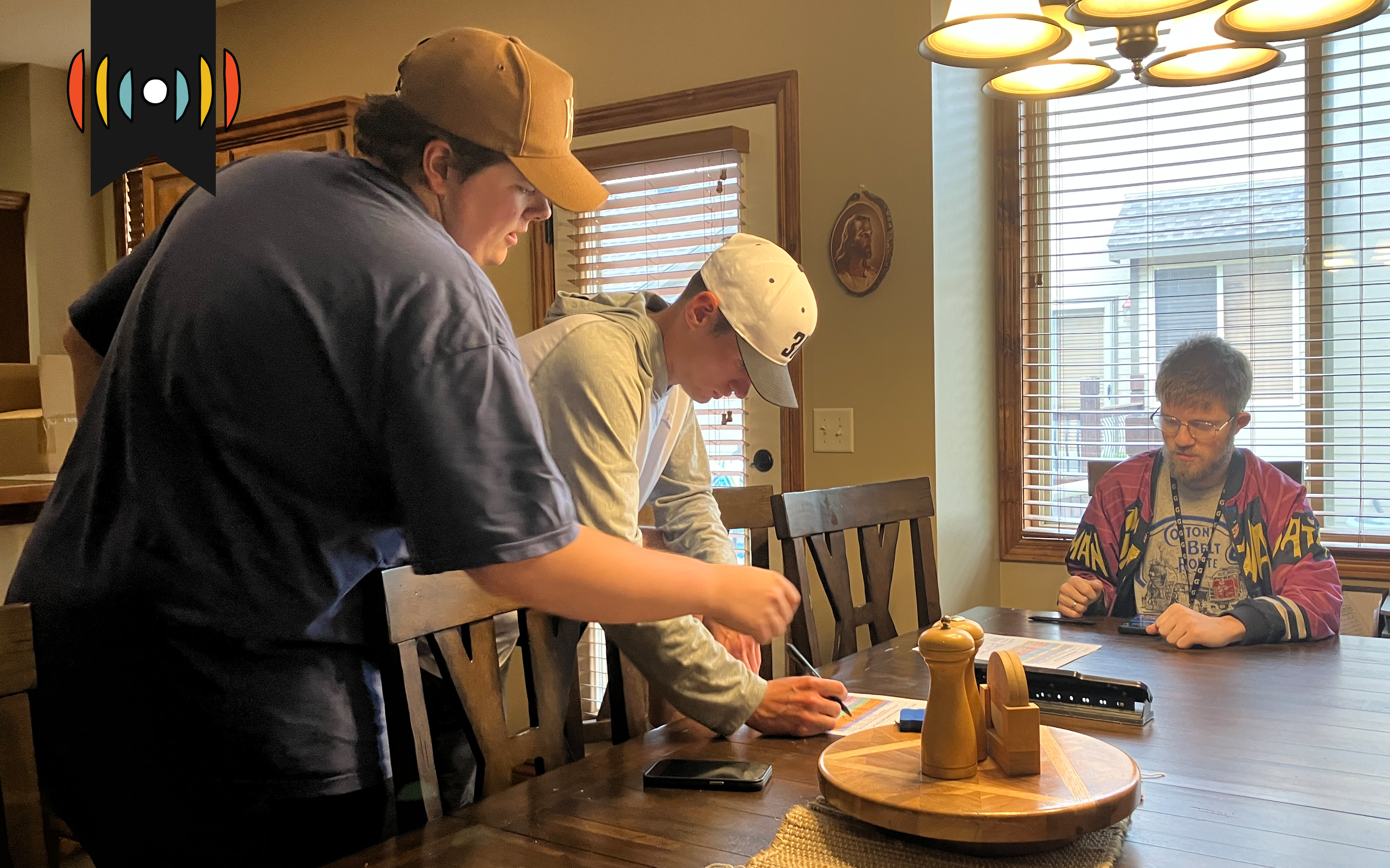
Mentors Aidan Johnson and Hudson Cryer talk with participant Ashton Chesser. Photo by Lauren Dunn
Editor's note: The following text is a transcript of a podcast story. To listen to the story, click on the arrow beneath the headline above.
LINDSAY MAST, HOST: Today is Tuesday, September 29th.
Thank you for turning to WORLD Radio to help start your day.
Good morning. I’m Lindsay Mast.
NICK EICHER, HOST: And I’m Nick Eicher.
Coming next on The World and Everything in It: Room to grow.
In the U.S., about 6-and-a-half-million people have an intellectual disability. For their families, adulthood brings decisions about work, housing, and independence. For some, living on their own may not be possible
MAST: For others, it can be—with the right support.
WORLD’s Lauren Dunn has the story.
LAUREN DUNN: This morning, grad student Hudson Cryer is coaching his roommate on how to get laundry detergent out of the carpet.
CRYER: Hopefully, we can wash out the detergent. You [don’t] have to squeeze too much because you're still kind of getting the brush… There you go. There you go.
Cryer has lived in this duplex for more than three years. He works as a mentor, guiding young men with intellectual disabilities through the first step in a program built to help people get used to independent living.
CRYER: I've gotten to be the person that's been around all the new guys that join our program, and I'm really thankful for that.
Cryer took on the job with the Shepherd’s Way program at 19, as a college freshman.
But when he started, Cryer had no experience working with people with disabilities. And no plans to.
CRYER: I was gonna do corporate sales for a sports organization. Yeah, that was my, my dream job at the time.
A friend invited Cryer to try it out, and that’s when Cryer saw an opportunity to put his energies toward something outside of himself.
CRYER: My yes was something that could be giving back to somebody besides going to college, thinking about what I'm going to do, what I want to pursue, how much money I'm hoping to make, what friends I want to make, you know, what kind of experience I want to have.
The Shepherd’s Way enrollment process starts with career development guidance for the person with intellectual disabilities. Once the individual has a job, he or she can move into the first guys’ house or girls’ house in the three-step program.
That’s where mentors come in. In the first tier, two mentors, usually college or graduate students, live with two friends with special needs. Next, one mentor lives with two participants. After that, three or four participants live in a program house in the same neighborhood as the others but without any live-in mentors.
The program’s founder, Ben French, says the program wants to develop the mentors just as much as the young adults with disabilities.
FRENCH: I always describe it in short this way: the mentorship experience is tax-free housing and utilities, a stipend to live on, and the growth opportunity of a lifetime.
French says some mentors are surprised by how much they grow through their time as roommates, and they often find their own replacements when they leave for their next career move.
FRENCH: Oftentimes, what I hear is, this is an experience that I grew more than I ever thought I would in, but I had no idea what I was getting into until I really got into it.
Mentors take on a wide variety of tasks. They’ll talk through schedules with their roommates. Take them grocery shopping. And offer reminders while cooking or cleaning.
And cleaning requires a lot. Shepherd’s Way prints out photos illustrating what the clean surfaces should look like. Cryer offers help by prodding roommates to keep the place looking like those photos. And everyone in the house takes turns sweeping, dusting, vacuuming, and tidying.
The living room in this house is spotless.
CRYER: My mom's never been like, man, but she's come over a couple—Yeah, you guys do a great job for a bunch of bachelors and guys living [in] this house. So I guess that's, I guess that's most all the approval I need when it comes to keeping the house clean.
Cryer started college—and this program—with an achievement mindset. But he’s learned that his heart attitude matters more.
CRYER: Jesus never turned his eyes from the unnormal or the special, and he cared, and it meant a lot, and he valued them, and they were a big part of his ministry, and were a big part of the miracles that he performed.
He says his roommates have also taught him a lot. He’s learned from something as simple as how they do their jobs.
CRYER: Their checkout line is twice as long as any other line because people want to see our friends and get to have their day brightened by a smile and also their name remembered or whatever that may be. … They just live a great life. Like they live it to the full. They don't go halfway.
In January, Cryer will move out of this house and close the chapter on his mentoring days. He’ll be wrapping up his master’s degree in business administration and starting a full-time staff role at Shepherd’s Way. Then, he’ll start recruiting and preparing new mentors to learn from this experience just as he has.
Reporting for WORLD, I’m Lauren Dunn in Wichita, Kansas.
WORLD Radio transcripts are created on a rush deadline. This text may not be in its final form and may be updated or revised in the future. Accuracy and availability may vary. The authoritative record of WORLD Radio programming is the audio record.
Please wait while we load the latest comments...
Comments
Please register, subscribe, or log in to comment on this article.