
The hollow icon
WORLD History Book: A French gift celebrating American liberty became a symbol of welcome to immigrants. Historian Ed Berenson calls the Statue of Liberty a “blank canvas” for generations of Americans. WORLD’s Emma Eicher reports on Lady Liberty at 140.
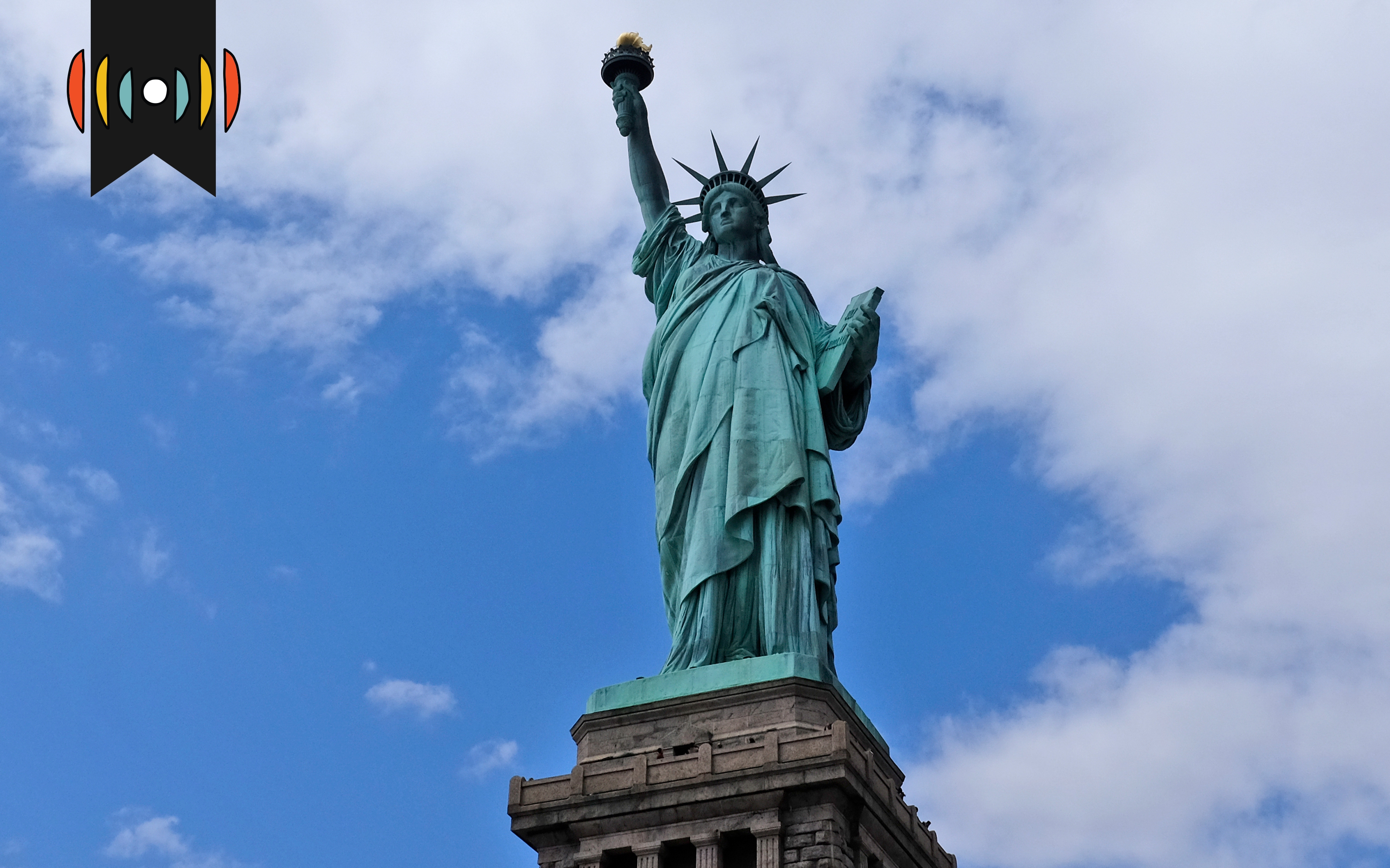
The Statue of Liberty on Liberty Island in New York Associated Press / Photo by Charles Dharapak
Editor's note: The following text is a transcript of a podcast story. To listen to the story, click on the arrow beneath the headline above.
NICK EICHER, HOST: Good morning! This is The World and Everything in It from listener-supported WORLD Radio. I’m Nick Eicher.
MARY REICHARD, HOST: And I’m Mary Reichard. Up next, the meaning of one of America’s most historic landmarks.
America has been a republic for 250 years, and Lady Liberty has been part of that story for more than half that time.
The statue was dedicated 140 years ago. But what she symbolizes is up for debate.
WORLD’s Emma Eicher has this week’s WORLD History Book.
EMMA EICHER: Over her 140 years, the Statue of Liberty has stood for two causes. First, it was abolition. Now, it’s an icon for immigration.
But how did it change?
ED BERENSON: There's an art historian named Albert Boime who called the Statue of Liberty a hollow icon,
Ed Berenson is professor of history and chair of the history department at New York University.
BERENSON: What he meant by that was that because it was this kind of classical Greco-Roman goddess of liberty, it it didn't really stand in particular for for anything. It was a blank canvas onto which people could project their ideas and their understandings.
Berenson says the statue started as a project for the people, or rather, two peoples: the French and the Americans.
BERENSON: The original deal was the French would pay for the statue, and the Americans would pay for the pedestal.
Two Frenchmen dreamt up plans to build the giant statue: law professor Edouard de Laboulaye and sculptor Frederic Bartholdi. Bartholdi wanted it to signify freedom:
BERENSON: He put the goddesses of liberty together with the colossi from the ancient world to come up with the idea of building a gigantic statue.
In the 1870s and 80s, France and the U.S. were improving their already friendly relationship. De Laboulaye and Bartholdi were abolitionists and idealized the American Republic.
BERENSON: They were really hoping that the, that France could return to a regime that looked much more like the American one. That is, that had the freedoms that were associated with the Declaration of Independence and and American liberty.
1876 was the centennial of the U.S. Declaration of Independence, the perfect time for a gift. And a political statement.
BERENSON: By creating a monument that praised the United States and, by implication, criticized their own lack of liberty, they thought they could achieve a number of political objectives.
The French people generally supported the idea, and crowdfunded the materials for the statue, which was completed in 1886. Her official name: Liberty Enlightening the World.
From base to torch, Lady Liberty stands a little over 151 feet tall, around 14 stories. At her feet are broken shackles and chains—symbolizing the end of oppression. The torch represents enlightenment. Her left hand holds a tablet referencing the Declaration of Independence. And her form is draped with thin sheets of copper.
BERENSON: Hammered to just two pennies in thickness.
At the time, builders didn’t realize that copper would eventually oxidize and turn green.
BERENSON: Bartholdi died in 1904, and that transformation was, hadn't all the way taken place, and so he actually didn't live to see its final color.
But the color became iconic, especially to New Yorkers:
BERENSON: The Statue of Liberty was massively restored in the 1980s because it was actually falling apart, and there was never any thought to, to changing the color.
In 1883, Americans held a fundraiser for construction of the pedestal. Emma Lazarus, a poet and author, wrote the poem “A New Colossus” as part of the fundraising efforts.
Twenty years later, it appeared alongside Lady Liberty:
BERENSON: Her poem was engraved on a plaque, and that a plaque was attached to the Statue of Liberty.
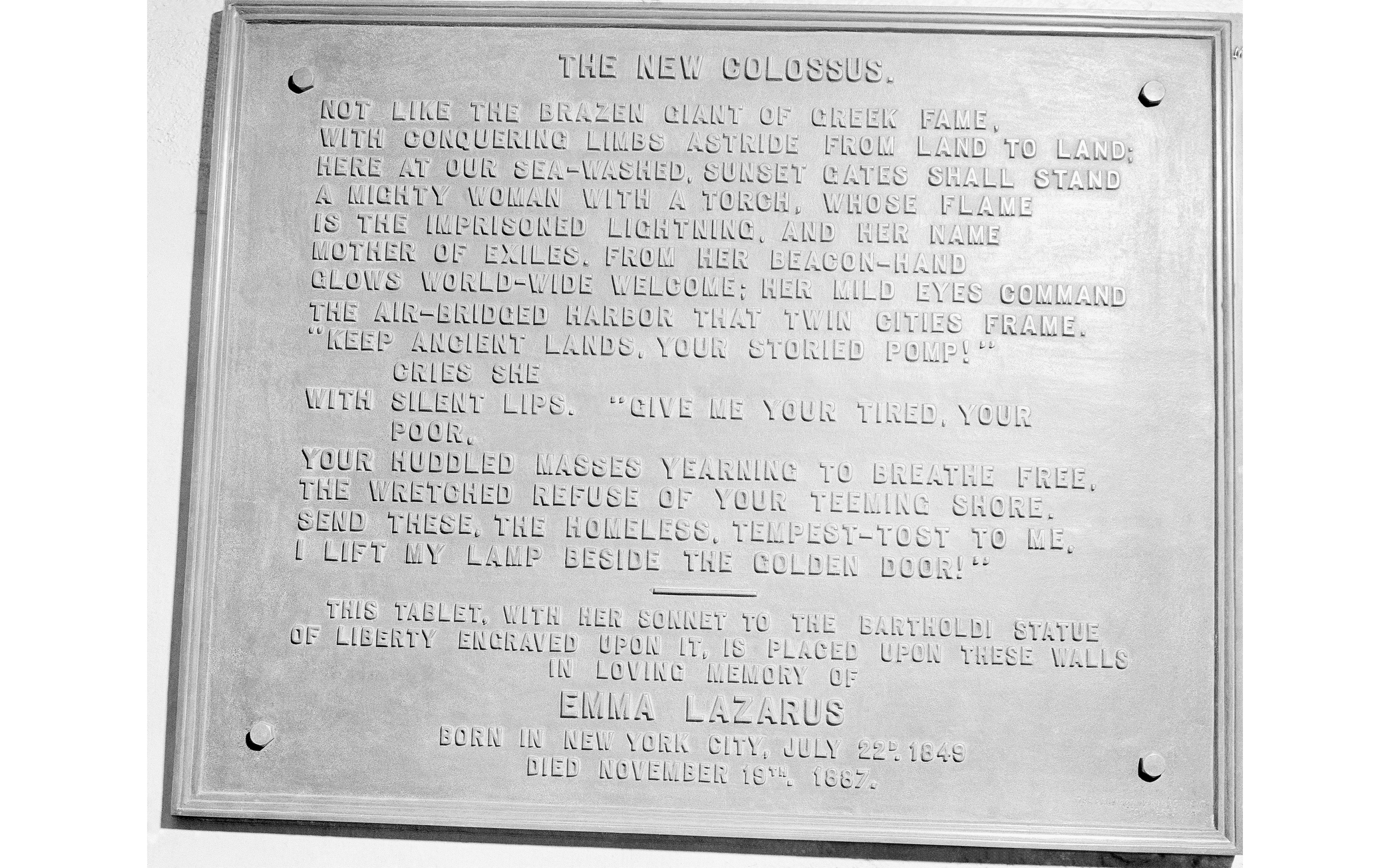
This circa 1950 photo shows a bronze plaque of the poem by Emma Lazurus on the Statue of Liberty in New York. Associated Press / Photo by File
People began to connect the themes of Lazarus’s poem with the statue:
BERENSON: That's what most Americans think when they think of the Statue of Liberty. They think, okay, give me your tired, your poor, your huddled masses yearning to be free … and it's really not until well into the 20th century that the Statue of Liberty comes to stand for a welcome to immigration.
The shift away from the statue’s association with abolition coincided with an influx of immigrants through Ellis Island.
BERENSON: That's when there's just a gigantic wave of immigrants who start to come from Europe to the United States, and because so many people came in a space of a really short period of time, 20-25 years or so, immigration was incredibly controversial.
Not all Americans welcomed the change:
BERENSON: There's one really famous political cartoon where the Statue of Liberty is holding her nose and hiking up her skirts as the garbage from Europe is being dumped at her feet.
Berenson says immigration has always been a controversial topic in America, and even though the Statue is now recognized as a symbol of immigration, it wasn’t always that way.
Still, that could be the magic of it.
BERENSON: It was the generic neoclassical form that allowed this abstract symbol to be open to all kinds of different interpretations.
Berenson says many New Yorkers who can trace their European ancestry back through immigration admire what the Statue stands for. Their families yearned to breathe free, and made their home in the land of liberty.
That’s this week’s WORLD History Book. I’m Emma Eicher.
WORLD Radio transcripts are created on a rush deadline. This text may not be in its final form and may be updated or revised in the future. Accuracy and availability may vary. The authoritative record of WORLD Radio programming is the audio record.
Please wait while we load the latest comments...
Comments
Please register, subscribe, or log in to comment on this article.