
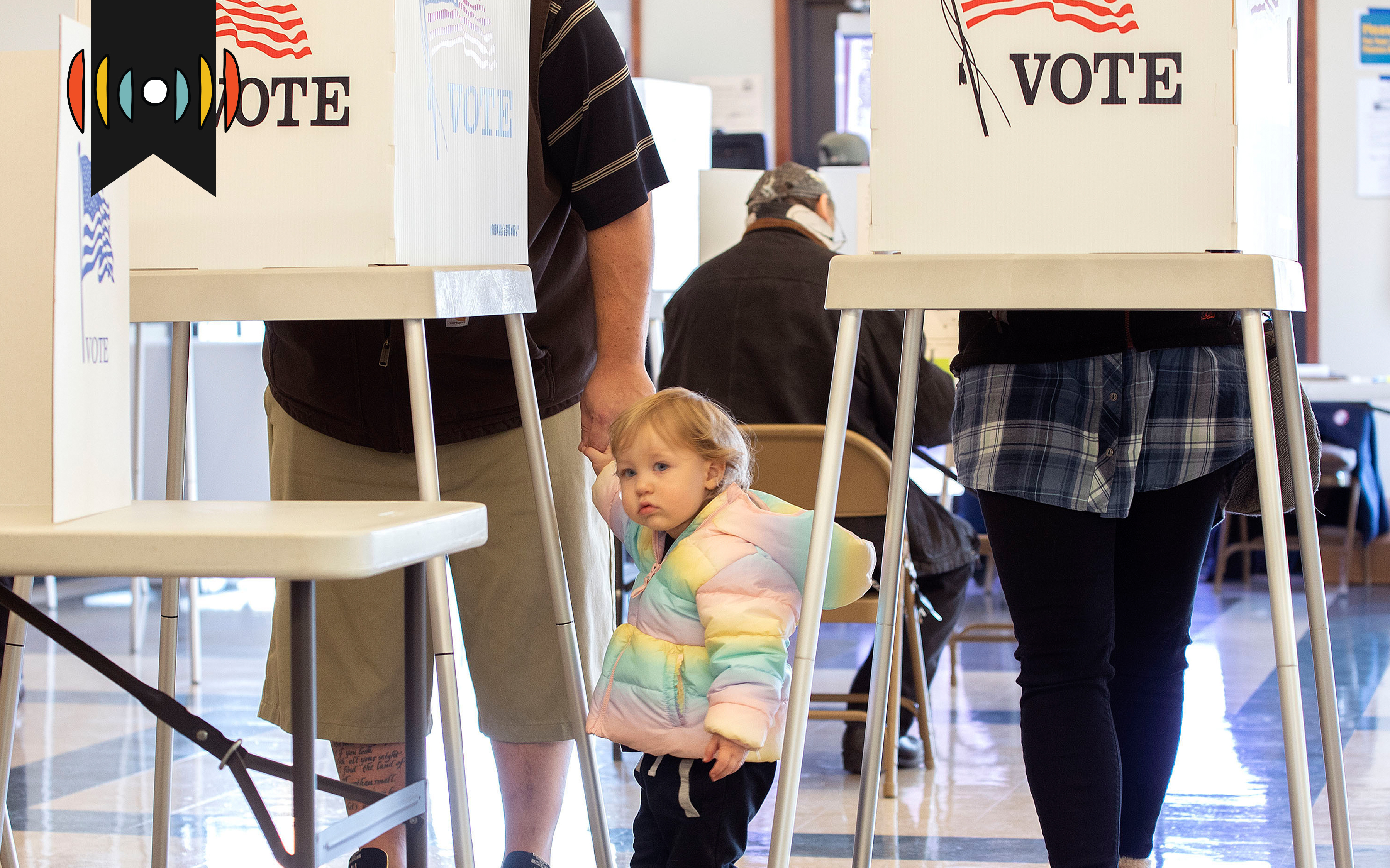
A two year old waits while her father marks his ballot in a voting booth in Moscow, Idaho. Associated Press / Geoff Crimmins / The Moscow-Pullman Daily News
Editor's note: The following text is a transcript of a podcast story. To listen to the story, click on the arrow beneath the headline above.
MARY REICHARD, HOST: Good morning! This is The World and Everything in It from listener-supported WORLD Radio. I’m Mary Reichard.
LINDSAY MAST, HOST: And I’m Lindsay Mast.
Below the surface of a crucial midterm election are abortion-related measures on ballots in four states. The outcome could reshape state policy for years to come. WORLD Opinions contributor David Closson read the fine print.
DAVID CLOSSON: The overturning of Roe versus Wade in the Supreme Court’s Dobbs decision returned abortion policy largely to the states—and since then voters in at least a dozen states have approved pro-abortion measures.
This fall, four more consequential votes will take place in Idaho, Missouri, Nevada, and Virginia.
In Idaho, Proposition 1 would make abortion until fetal viability a state-protected right. Current law generally prohibits abortion, with an exception to save the life of the mother, and first-trimester exceptions exist for reported rape or incest.
But Proposition 1 would dramatically change the legal landscape. Current Idaho law protects a child who can potentially survive outside the womb, even with medical help. Prop. 1 would apply a different test entirely using a two-tiered standard: Protection would be given only to those unborn children with, one, a significant likelihood of sustained survival and, two, without extraordinary medical measures.
Those words matter. They could determine which unborn child receive legal protection—and which does not.
The proposition also says its provisions take precedence over conflicting sections of Idaho law. Pro-abortion supporters dispute this, but pro-life attorneys argue that Prop. 1 could put existing safeguards at risk—including parental-consent and physician-only requirements.
Missouri is different.
Two years ago, voters narrowly approved a constitutional right to reproductive freedom, including abortion through fetal viability. This November, voters will decide whether to repeal it. The new amendment would generally prohibit abortion, with exceptions for medical emergencies, fetal anomalies, rape, and incest. It would also require parental consent for minors.
In other words, Missouri voters are being asked whether to keep the abortion right they added to their constitution just two years ago—or reverse course and go in a more pro-life direction.
Voters in Nevada face Question 6 for a second time. The state requires constitutional amendments proposed by initiative to pass in two consecutive general elections. If approved, Question 6 would create an abortion right up to viability. But the meaning of viability is determined by the treating health-care practitioner. After viability, abortion would remain protected in cases where the life or health of the pregnant mother is deemed at risk. That largely squares with current law.
But unlike ordinary legislation, this would place abortion rights in Nevada’s constitution, making future changes significantly more difficult.
Finally, Virginia voters will decide whether to add a fundamental right to reproductive freedom to the state constitution.
The amendment would permit regulation in the third trimester, but that comes with a crucial asterisk. If one physician judges an abortion medically needed to protect the woman’s life or physical or mental health, that judgment prevails.
Current Virginia law is much more specific: the physician and two consulting physicians must certify that continuing the pregnancy is likely to result in death or “substantially and irremediably” impair the woman’s mental or physical health.
The difference is significant: The proposed amendment would replace that three-physician standard with the judgment of a single physician—and enshrine the underlying right in Virginia’s constitution.
By no means did the Supreme Court in Dobbs end the abortion debate. It relocated it—to the states.
And increasingly, the battle is not simply over individual abortion laws. It is over whether abortion rights will be written into state constitutions, where they can shape—or override—future legislation for years to come.
That is why words like “viability,” “health,” “fundamental right,” and “fetal anomalies” matter. They may sound technical. They aren’t. They determine when the law protects an unborn child—and when it does not.
Behind the legal language are questions of life and death. And this November, voters in four states will answer them.
For WORLD, I’m David Closson.
WORLD Radio transcripts are created on a rush deadline. This text may not be in its final form and may be updated or revised in the future. Accuracy and availability may vary. The authoritative record of WORLD Radio programming is the audio record.
Please wait while we load the latest comments...
Comments
Please register, subscribe, or log in to comment on this article.