
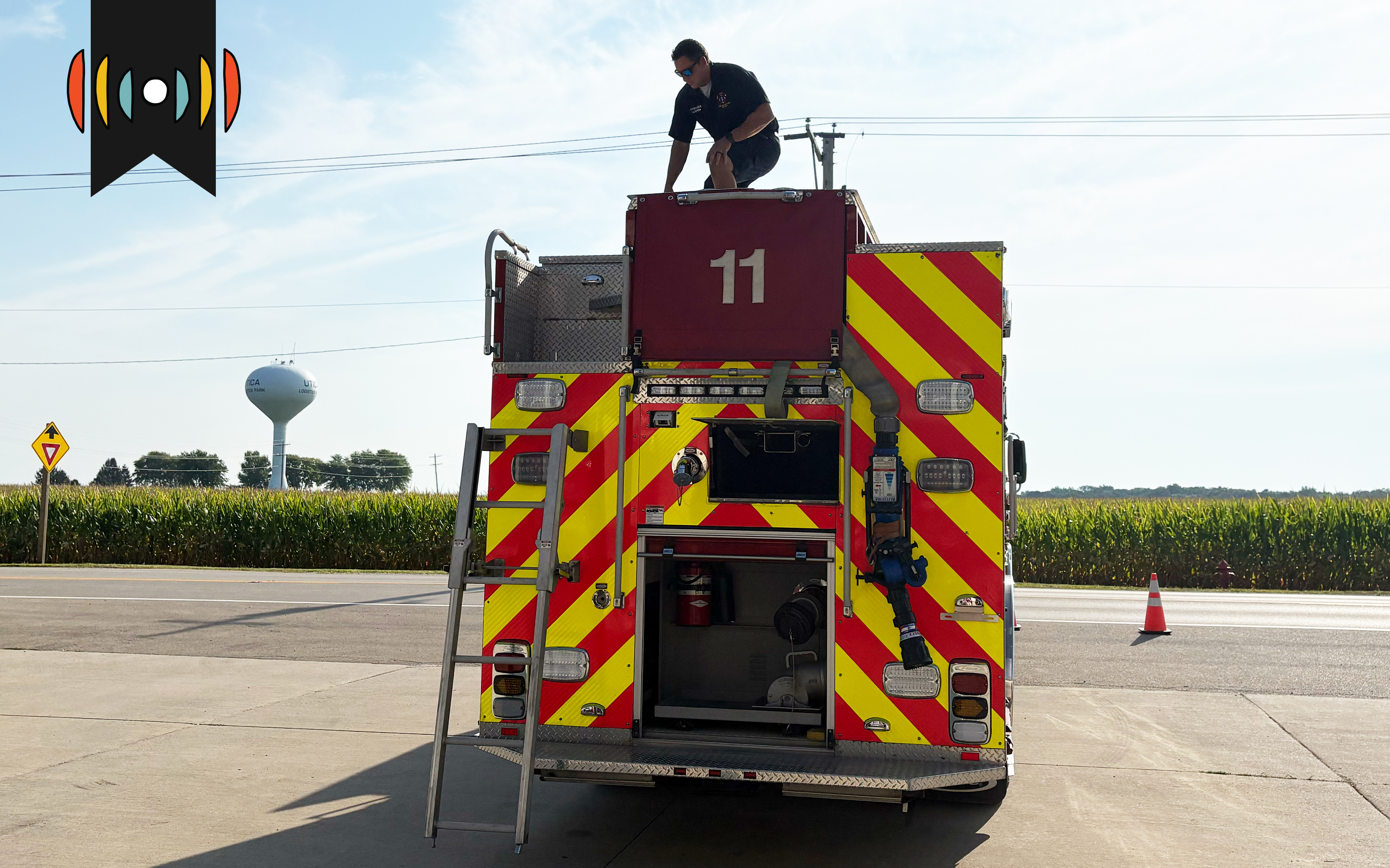
Ben Brown works on a fire truck at the Utica, Illinois fire station. Photo by Lauren Smyth
Editor's note: The following text is a transcript of a podcast story. To listen to the story, click on the arrow beneath the headline above.
NICK EICHER, HOST: Today is Wednesday, October 14th.
Thank you for turning to WORLD Radio to help start your day.
Good morning. I’m Nick Eicher.
MYRNA BROWN, HOST: And I’m Myrna Brown
Coming next on The World and Everything in It: The struggle to keep rural ambulance services on the road.
Emergency calls are expensive. Equipment costs are climbing. And across rural America, ambulance services are shutting down, leaving residents with longer waits for emergency care.
But in the small village of Utica, Illinois, about an hour and a half southwest of Chicago, one fire and ambulance service has found reasons—and resources—to stick with a difficult job.
WORLD’s Lauren Smyth has the story.
LAUREN SMYTH: Ben Brown was just sixteen when a tornado struck the fire station where he worked. He crouched on the floor, covering his head, as the storm tore off the roof.
BROWN: It was just so fast. It only lasted like 90 seconds, or a minute and a half, or two minutes. It was just loud. We had foam ceiling tiles at the time in the bay that were flying all over the place.
He remembers the exact date: April 20, 2004. Brown was a fire cadet, and that day, he got his training on the job.
BROWN: And that changed my job outlook, and I love my job. Every day, it’s something different.
SOUND: [Fire alarm]
That’s the fire alarm on a 1934 Chevrolet fire truck. The tornado pushed Utica Fire and EMS to modernize their trucks and equipment. But they still kept some of their old tools and even refurbished the Chevy.
BROWN: It’ll go out for the Veterans’ Day parade and Memorial Day and any other major event in town…. You can see it still shines a little bit, but they’ll just run the buffer over it and clean it up real sharp.
They’re still upgrading things. Wait times for new equipment have gotten even longer since COVID. The station still hasn’t received the new ambulance and firetruck they ordered almost three years ago.
BROWN: Wait times on an ambulance used to be seven, eight months.
Brown says locals are usually willing to accept small tax increases to help the station pay for equipment. But prices are rising faster than inflation, and Brown says it’s squeezing an already tight budget.
BROWN: We get about $600,000 a year in tax money. The rig costs 1.2. That doesn't take in any of our other expenses. It's hard.
DISPATCHER: Requesting transport to the hospital for evaluation.
About half the station’s calls come from nearby Starved Rock State Park, which hosts over 2.5 million visitors per year. On average, each call costs the ambulance station about $1200.
BROWN: Then you’ve also got to remember, we’ve got to pay for the lights and the power, or the lights, water, gas, heat, fuel.
The mostly rural area has only about 2,600 residents to carry that tax burden. Non-residents are charged a fee, but Brown says it usually goes unpaid. On average, ambulance services lose about $1,000 on every call.
That explains why money is tight—and why first responders often seem to be underpaid for the risks they take on. For example, EMTs, or emergency medical technicians, take home on average just $43,000 per year. That’s nearly $30,000 less than the national average wage.
BROWN: All of us have multiple jobs.
Britain Siegmann is a firefighter-paramedic with two jobs. She does it for…
BRITAIN SIEGMANN: Pay and boredom. This is kind of like my fun-money job, and then I have my full-time job that pays my bills. Most of us, it’s 24 on, 48 off.
Long shifts can keep first responders away from their families for days at a time. So at the Utica station, kids often come to work with their parents. Today, Brown brought his toddler. Everyone at the station helps look after her.
SIEGMANN: Girl, what’s on your face? What were you eating?
BEN BROWN: Cupcake!
SIEGMANN: Cupcake?
There are other ways the station keeps morale up. The profession is known for its above-average risk of divorce, suicide, and other mental health crises, but Brown likes to focus on the community he serves.
SOUND: [Box sliding]
FIREFIGHTER: We’d better inspect it for damage, because that box looks like it’s been through it.
BROWN: It’s all the coloring books and stuff for fire prevention. We do need to check it though because we’ve got to figure out what the old man ordered.
In the station lobby, glass cases display old firefighting and medical memorabilia. The walls are decorated with photos, plaques, and patches.
BROWN: So it’s like, well, hey, we have all this stuff. Let's start showing it off. Let's show our pride. This is some pictures of the tornado. That's actually me right there.
It’s Brown as a sixteen-year-old, working emergency response for the first time and driving his truck through the walls of a ruined building. Now, he’s the station chief, and he takes pride in passing on what he’s learned to new first responders.
BROWN: We have this nice meeting room, holds 40, 50 people, and we hold all of our trainings and meetings in here. We also host a lot of stuff for the Illinois Fire Service Institute here.
The room is a storm shelter, reinforced with rebar and concrete.
BROWN: So it should take a two-by-four at like 300 miles an hour, and still not come through it. But we don’t ever want to test it again!
For WORLD, I’m Lauren Smyth in Utica, Illinois.
WORLD Radio transcripts are created on a rush deadline. This text may not be in its final form and may be updated or revised in the future. Accuracy and availability may vary. The authoritative record of WORLD Radio programming is the audio record.
Please wait while we load the latest comments...
Comments
Please register, subscribe, or log in to comment on this article.